The relationship between ADHD and addiction is one of the relationships psychiatrists observe most in their clinics: teenagers and adults with an untreated disorder are more likely than others to smoke early and try hash, alcohol and stimulants, and more likely for experimentation to turn into dependence. Some find that hash “calms their brain”, and some find in Captagon a focus they have never known before, so they treat themselves with a substance that increases the problem. In this article we explain why the risk rises, what is known about the effect of treating the disorder in reducing it, and how the two conditions are treated together. Only a psychiatrist makes the diagnosis after a comprehensive assessment.
How closely is ADHD linked to addiction?
Studies indicate that the proportion of people with ADHD among those being treated for addiction is much higher than in the general population, and that those affected start using at a younger age on average, sometimes moving between more than one substance. The figures differ between studies by country and method of measurement, so we don’t give a specific number, but the direction is clear and repeated. This doesn’t mean everyone with ADHD will become addicted; most don’t, especially those who received an early diagnosis and good family support.
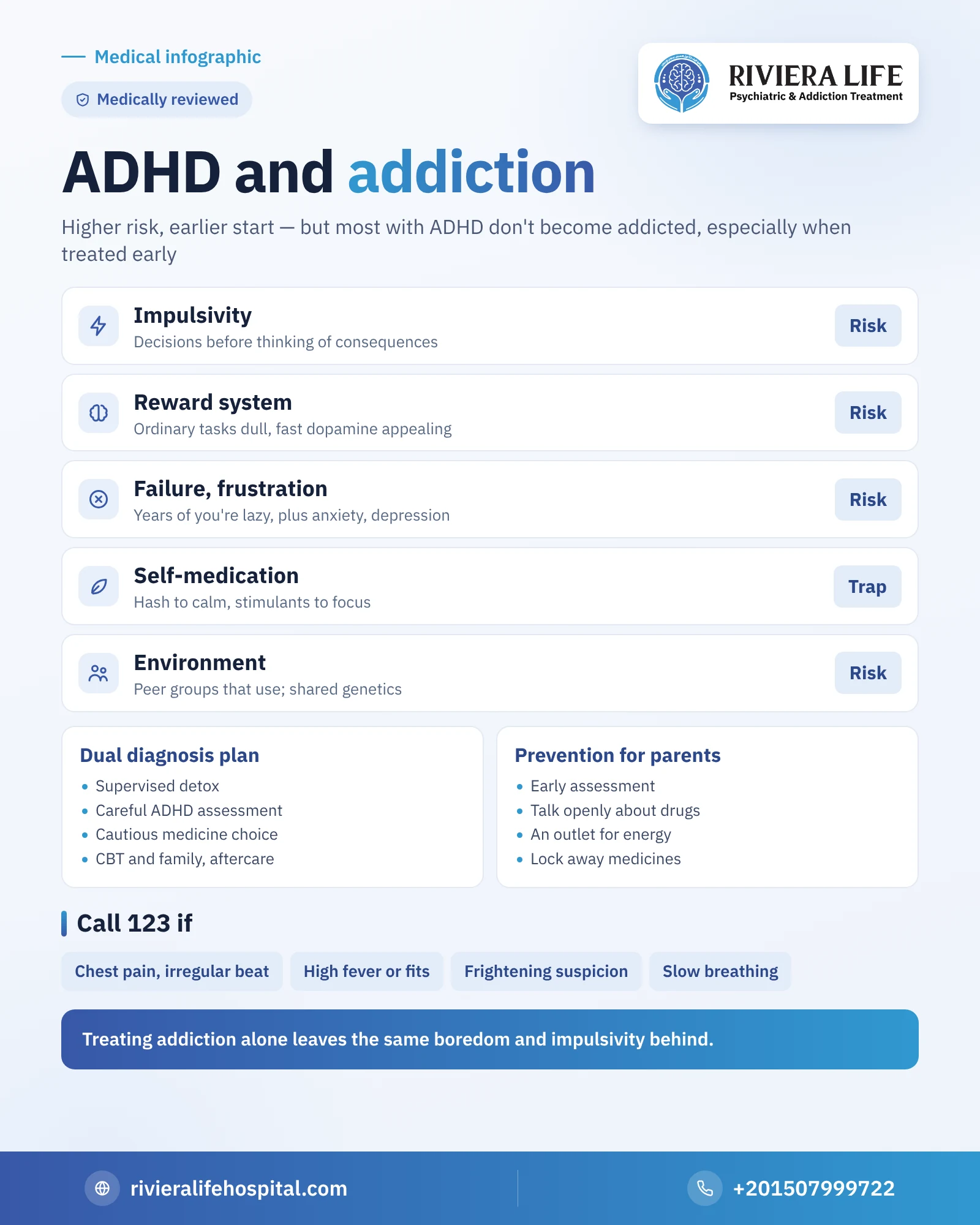
ADHD and addiction: why does the risk rise?
Impulsivity and thrill-seeking
Impulsivity means the decision is made before thinking about its consequences. An offer of a hash cigarette at a party, or a pill that “keeps you awake”, is accepted quickly because the reward is immediate and the consequence distant.
The brain’s reward system
The disorder is linked to differences in how the dopamine circuits responsible for motivation and reward work, so ordinary tasks seem very boring, and substances that raise dopamine quickly seem very attractive. We explained these circuits in the article on dopamine and addiction.
Accumulated failure and frustration
Years of “you’re lazy” and “you’re a failure”, failing at school and being fired from work leave a mark on self-esteem. With the anxiety and depression that often accompany the disorder, the drug becomes a means of escape.
Environment and friends
A teenager rejected by disciplined classmates may find quick acceptance in a group that uses. The disorder is also largely hereditary, and one parent may have the disorder or an addiction without a diagnosis.
Self-medication: when the drug becomes the wrong “medicine”
Many patients we meet didn’t start using in search of a high, but in search of a solution.
- Hash and bango: the young person feels it calms racing thoughts and helps them sleep. But regular use weakens memory, motivation and attention itself, meaning it deepens what they were trying to treat, and it may trigger anxiety and psychosis in some people. Its details are in the hash guide.
- Stimulants: Captagon, amphetamines and ice give a feeling of focus and energy at first, so the person thinks they have found their treatment. But their content is unknown and doses random, and they lead quickly to dependence, insomnia, suspicion and collapse.
- Nicotine: cigarettes and vapes are among the most widespread substances among people with ADHD, and many describe them as “helping focus”.
- Alcohol and sedatives: to ease tension and insomnia, with the risk of dependence and interaction with medicines.
Does treating ADHD reduce the risk of addiction?
This is a question every parent who hesitates to give their child a stimulant asks. The balanced answer: available research doesn’t show that treating the disorder with medicines prescribed under supervision increases the risk of later addiction, and a number of large studies link treatment with a decrease in substance problems. But most of these studies are observational, meaning they note the association and don’t prove causation conclusively, and part of the effect may be due to the fact that families who stick to treatment provide more support in the first place.
What we can say with confidence: early, integrated treatment improves study, relationships and self-esteem, all of which are factors that protect against substance use. The plan for this treatment by age is explained in the article on ADHD treatment.
The difficulty of diagnosis during substance use
Substance use itself may cause distraction, poor concentration and impulsivity, and stimulant withdrawal causes sluggishness and weak attention. So the doctor doesn’t rush to diagnose ADHD in a patient who uses regularly. What helps is the history: were the symptoms present in childhood before any use? What do old school reports and the family say? The picture usually becomes clearer after a period of abstinence.
Treating dual diagnosis: both together
Treating the addiction alone while ignoring ADHD leaves the patient facing the same boredom, impulsivity and failure that pushed them to use, so the chances of relapse rise. And treating ADHD alone while use continues is neither safe nor effective. That is why the dual diagnosis program is based on one plan run by one team:
- Supervised detox when the substance calls for it.
- Careful assessment of ADHD and the depression or anxiety that accompanies it.
- Cautious medication choice: the doctor may prefer non-stimulant medicines, or extended-release forms that are hard to misuse, with controlled dispensing and follow-up. The decision is entirely medical.
- Cognitive behavioral therapy combining organization skills with skills for relapse prevention and dealing with urgent craving.
- Involving the family in understanding the disorder, and in keeping and monitoring the medicines.
- Long aftercare, because impulsivity doesn’t disappear when admission ends.
Prescribed stimulants for a patient with a history of substance use
Here parents worry: how do we give a stimulant to someone who has been addicted to stimulants? The answer is that the decision is made case by case. The doctor may start with a non-stimulant option, or may judge that an extended-release stimulant under strict control is better than leaving the disorder untreated. In all cases, amounts are dispensed carefully, a family member keeps them if necessary, and signs of misuse are monitored. To learn more about methylphenidate specifically, see the article on Ritalin.
ADHD in the recovering adult
Some patients are only diagnosed with ADHD after recovering from addiction. A month or two passes without using, and the patient and their family discover that the disorganization, forgetfulness, procrastination and boredom haven’t disappeared, and that they were there since school. This discovery may be a relief, because it explains years of failure in a way other than “you’re weak-willed”. But it is also a point of danger: boredom and frustration are among the strongest triggers of relapse. So every person in recovery who has these symptoms deserves an ADHD assessment within the aftercare plan, rather than being left to fight alone.
Preventive advice for parents
- Ask for an early assessment if you notice signs of the disorder, and don’t wait for them to “grow up and settle down”.
- Talk to your teenage son frankly about drugs, and mention that impulsivity makes him more vulnerable.
- Look for an activity that releases his energy and gives him success: sport, a manual skill, or work.
- Keep his medicines in a locked place, and monitor their count.
- Watch for signs of use: a change of friends, missing money, and shifts in sleep and mood.
Seek urgent help immediately if you see
Call an ambulance on 123 or go to the nearest emergency department if, after using stimulants or mixing them with other substances, there is:
- Chest pain or severe, irregular palpitations
- A very high temperature or seizures
- Hallucinations, frightening suspicion or agitation that threatens safety
- Deep drowsiness or slow breathing after mixing sedatives or alcohol
- Talk of ending life or self-harm; you can also call the mental health hotline on 16328
How can Riviera Life help you?
At Riviera Life in Sheikh Zayed, consultants in psychiatry and addiction work together on cases where ADHD and substance use come together, with round-the-clock medical supervision, a family program and aftercare. The first consultation is free and confidential, and you can get in touch at any time on +201507999722.
More from the ADHD guide
- ADHD: the complete guide
- ADHD treatment
- The dual diagnosis program for addiction treatment
- Adderall and modafinil: the difference and the risks
- Strattera (atomoxetine): treating ADHD without stimulants
- ASRS adult ADHD test
Questions many people ask
No. The risk is higher than average, but most people with ADHD don't become addicted, especially with early diagnosis, treatment and family support.
No. The person may feel temporary calm, but regular use weakens attention, memory and motivation and increases anxiety, so it deepens the problem.
Available research doesn't show that prescribed use under supervision raises the risk of addiction, and some links it to a decrease. What matters is sticking to the prescription and keeping the medicine safe.
Diagnosis is harder because use resembles its symptoms. The doctor relies on childhood history and information from the family, and may wait for a period of abstinence for the picture to become clear.
In a place that offers a dual diagnosis program treating both conditions with one plan, such as Riviera Life in Sheikh Zayed, with family involvement and aftercare.