Ritalin is the best-known brand name for methylphenidate, a central nervous system stimulant that is one of the most widely used ADHD medicines in the world, and is also used to treat narcolepsy. The medicine improves attention and impulse control in many patients within a short time, but at the same time it is a controlled medicine because it can be misused, especially among students who take it to stay up and study. In this article we explain how Ritalin works, its effects on the heart and appetite, and why using it with a prescription differs from taking it without one. There are no doses here; starting, adjusting and stopping are for the treating doctor alone.
What is Ritalin?
Methylphenidate is a stimulant that has been used for many decades, and is available in short-acting forms that work for a few hours, and extended-release forms under different brand names designed to cover the school or work day. The difference between the forms lies in the speed of release and the length of the effect, not in the substance itself. It is one of two main options in the stimulant class, the other being the amphetamine family, which we cover in our article on Adderall and modafinil.
Uses of Ritalin
ADHD
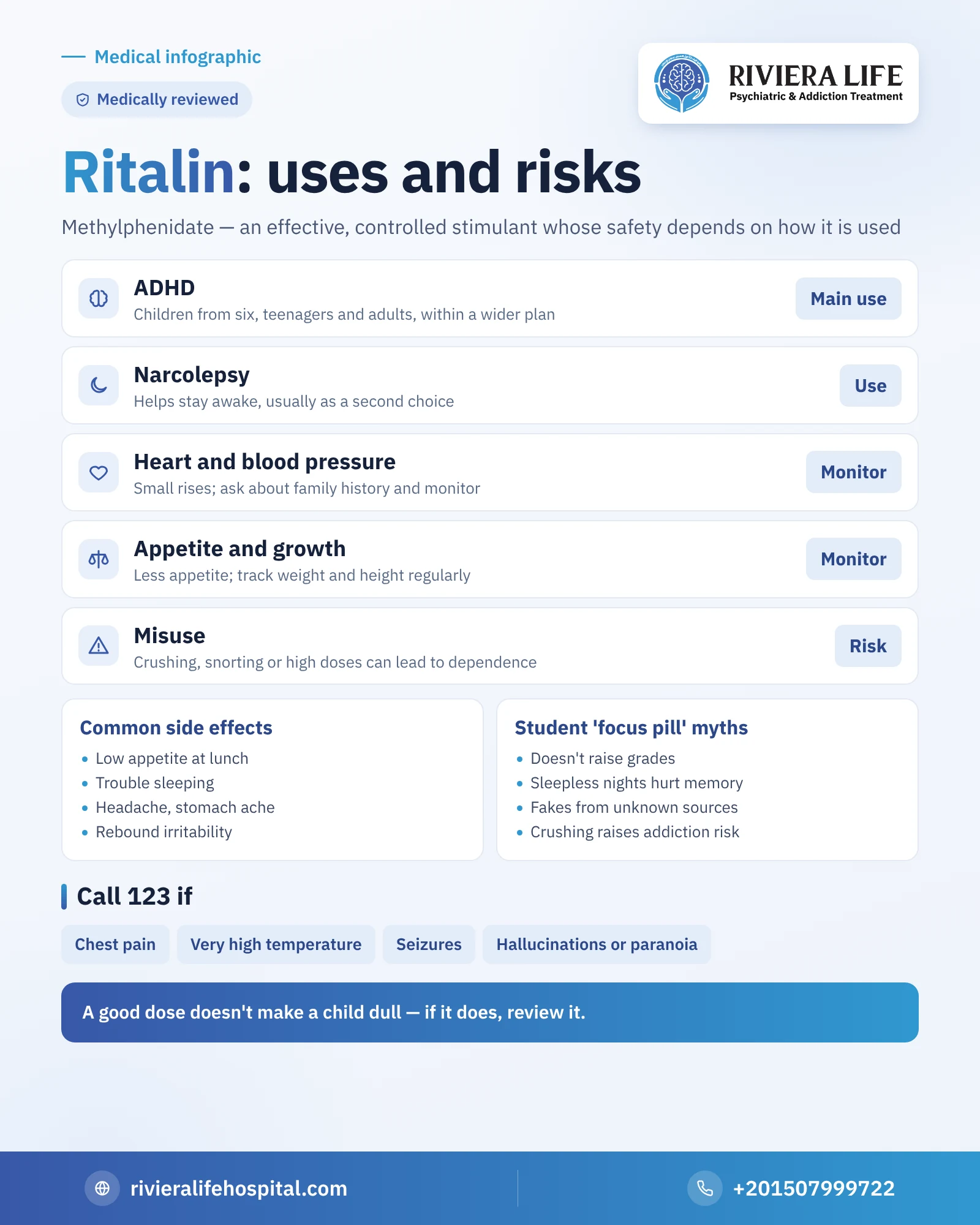
The main use is for children from age six, teenagers and adults, within a plan that includes behavioral and school interventions. The full picture of this plan, and when a stimulant is chosen and when something else, is in our article on ADHD treatment.
Narcolepsy
A rare disorder in which sleepiness overcomes the patient at inappropriate times. Methylphenidate may be used to help them stay awake, usually as a second choice after other medicines.
How does Ritalin work in the brain?
Methylphenidate blocks the reuptake of dopamine and noradrenaline into nerve cells, so they stay longer in the space between cells, especially in the frontal lobe responsible for planning, attention and inhibition. In someone with ADHD this translates into a better ability to stay on task and delay an impulsive response. The paradox that puzzles parents is that a stimulant makes the child “calmer”; the reason is that what parents see as excess movement is partly the brain’s attempt to stay alert, so when attention improves, the need for it decreases.
And dopamine itself is the reward messenger, which explains the potential for misuse when large amounts are taken or non-medical routes are used, as we explain in our article on dopamine and addiction.
What does the family notice when the medicine suits the child?
When the medicine and timing are right, the first observations usually come from school: “he’s now finishing his work in class”, “he gets up from his seat less”. At home, daily study time shortens and arguments about it decrease. But a good medicine doesn’t make the child silent, sad or “switched off”; if you notice your child has become flat, withdrawn from play or lost their cheerfulness, this is a sign that the dose or medicine needs reviewing, not that this is the price to pay. Record your observations and the teacher’s, and bring them to the follow-up appointment.
Common side effects
- Reduced appetite, especially at lunchtime, one of the most common complaints.
- Difficulty sleeping if the medicine’s effect extends into the evening.
- Headache and stomach ache, which usually ease after the first weeks.
- Irritability, moodiness or crying as the medicine wears off at the end of the day.
- Dizziness and dry mouth.
- Tics appearing or increasing in some children.
Many of these effects are solved by adjusting the timing or formulation, which is the doctor’s work. Tell them about it instead of stopping or skipping days.
Ritalin, the heart and blood pressure
Stimulants raise the pulse and blood pressure slightly in most users, which isn’t usually worrying in a healthy person. But the risk differs in someone with a congenital heart defect, a rhythm disorder, or a family history of sudden death at a young age. So the doctor asks about this history before starting, measures pulse and blood pressure at follow-up, and may request an ECG or an assessment by a cardiologist. And if the patient feels chest pain, palpitations or fainting during exertion, they should stop the exertion and contact the doctor immediately.
Appetite and growth in children
Reduced appetite may be reflected in weight, and in the long term may slightly slow growth in height in some children. This isn’t a reason to refuse treatment, but a reason for follow-up: measuring height and weight regularly and recording them on a growth chart, giving a good breakfast before the medicine, and a nutritious evening meal when the appetite returns. The doctor may discuss breaks during the holidays with the family if they see fit.
Students misusing Ritalin for studying
Before exams, talk spreads among students about the “focus pill” that lets you study all night. Some take a tablet from a classmate who has a prescription, or buy it from an unknown source. What actually happens?
- Research doesn’t show that taking stimulants without medical need noticeably improves grades; what usually increases is the feeling of alertness and confidence, not the learning itself.
- Continuous sleeplessness harms memory, because sleep is when information is consolidated.
- Palpitations, anxiety, insomnia and loss of appetite appear quickly, and panic attacks may occur.
- Tablets from unofficial sources may not be Ritalin at all, but street stimulants.
- Some students crush the tablets or snort them, routes that greatly increase the risk of addiction and poisoning.
And for a student whose use has gone beyond this to repeated use, the addiction treatment program for students and adolescents provides assessment and treatment suited to this age.
Is Ritalin addictive?
The medicine’s own leaflet warns that it may cause dependence. But there is a big difference between two situations. A patient who takes it on prescription and as prescribed rarely becomes addicted, and research indicates that treating ADHD may be linked to a lower risk of drug use later, which we discuss in our article on ADHD and addiction. Large amounts, crushing and snorting, or use in search of a high, however, strongly activate the reward circuits and may lead to real dependence, with intense craving, increasing amounts, and a collapse in mood and energy on stopping.
The legal status in general
Methylphenidate is classified in many countries as a strictly controlled medicine because of its potential for misuse; in the United States, for example, it is in Schedule II. In Egypt, as is known, it is subject to restricted dispensing rules with a special prescription. Possessing the medicine or giving it to others without a prescription may expose you to legal accountability, as well as health risks. Keep your child’s medicine in a locked place, count the tablets, and don’t share it with anyone.
Call an ambulance on 123 immediately if you see
After taking a large amount of Ritalin, crushing and snorting it, or mixing it with other stimulants:
- Chest pain or severe, irregular palpitations
- A very high temperature with sweating
- Seizures or loss of consciousness
- Severe agitation, hallucinations or frightening suspicion of others
- Very fast breathing with tremor that won’t stop
Common mistakes with Ritalin
- Giving a tablet to a brother or friend “so he can study”.
- Increasing the amount on your own during exam days.
- Taking it with lots of energy drinks and coffee.
- Stopping it without telling the doctor because of low appetite, instead of looking for a solution.
- Hiding a family history of heart problems from the doctor.
How can Riviera Life help you?
Whether you are a parent worried about your child’s medicine, an adult wanting an accurate assessment, or a family that has discovered their son is using Ritalin without a prescription, Riviera Life’s consultant psychiatrists offer a confidential assessment and a clear plan, and the first consultation is free.
More from our ADHD guide
- ADHD: the complete guide
- ADHD treatment
- Adderall and modafinil: the difference and the risks
- Amphetamines: the complete guide
- Strattera (atomoxetine): treating ADHD without stimulants
Questions many people ask
No. It improves attention in someone with ADHD, but it doesn't raise intelligence, and research doesn't show it clearly improves the grades of healthy people.
Stimulants usually work within a short time of being taken, and the length of the effect varies with the formulation. The doctor sets the timing to suit the school or work day.
Yes, if the doctor diagnoses ADHD in an adult and judges it suitable, after asking about the heart, blood pressure and substance use.
No. Using it without a prescription exposes the student to palpitations, anxiety, insomnia and possible dependence, and may expose whoever gives it to legal accountability.
Give them a good breakfast before the medicine and a nutritious evening meal, and tell the doctor so they can assess weight and height and may adjust the timing or formulation.