The short answer
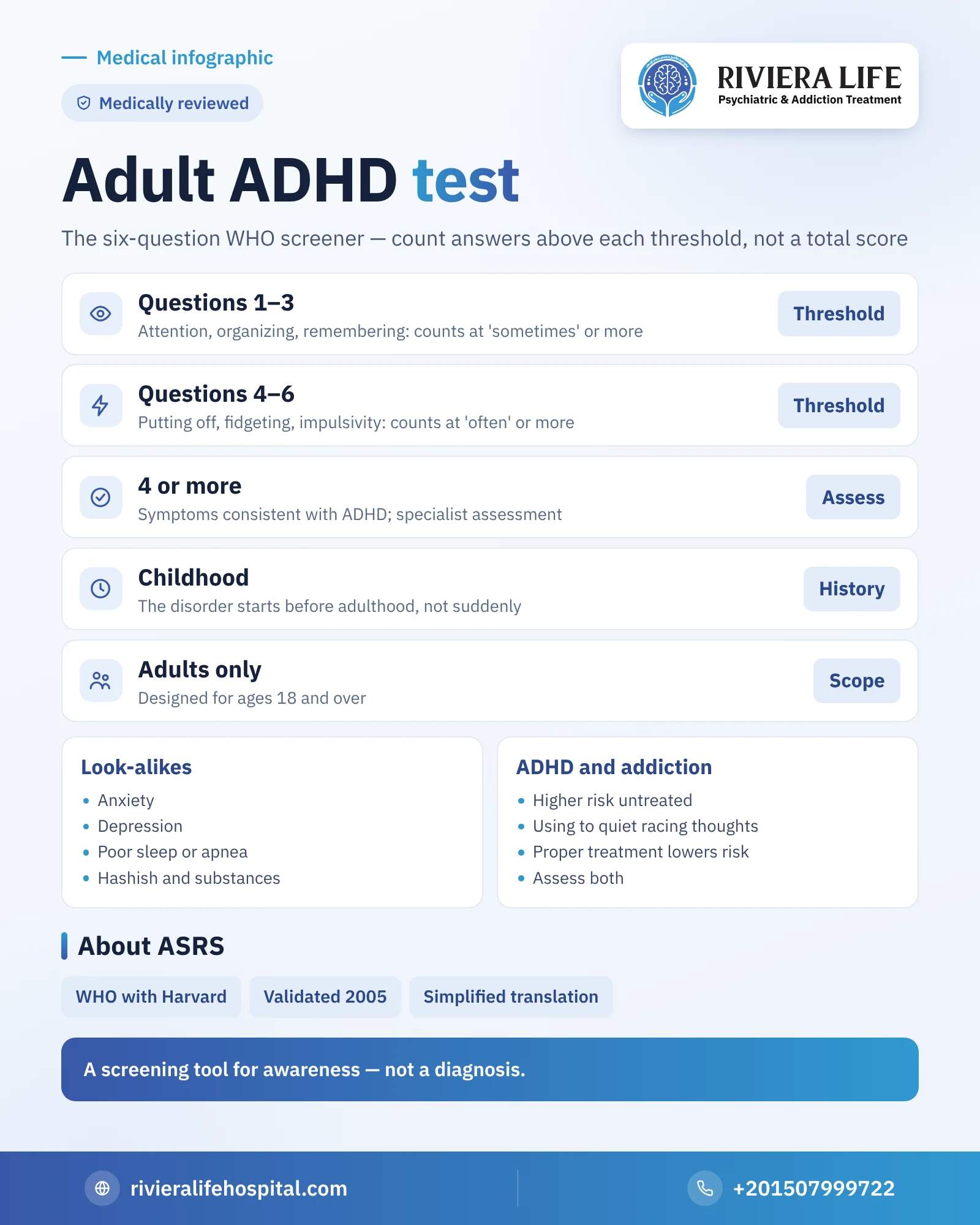
The adult ADHD test (ASRS) is the first part of the World Health Organization’s scale for this disorder, and consists of six questions about the past six months. Each question has a specific threshold: in the first three questions the answer counts if it is “sometimes” or more, and in the last three if it is “often” or more. If four or more answers exceed this threshold, the symptoms are consistent with attention deficit hyperactivity disorder and deserve a specialist assessment. This test isn’t suitable for children.
- GroupAdults aged 18 and over
- Questions6 questions about the last 6 months
- 4 or more above the thresholdDeserves a specialist assessment
Attention deficit hyperactivity disorder wasn’t known in the childhood of many adults today, so they grew up hearing that they were “careless”, “disorganized” or “lazy”. Then come the job, the home and commitments, and forgotten appointments and unfinished tasks pile up. This short test is a first step to finding out whether what you are going through deserves an assessment for this disorder.
Start the ADHD test
Adult ADHD test (ASRS)
Over the past six months, how often has the following happened to you?
To discuss your result with a psychiatrist in confidence, the first consultation is free on +201507999722.
This is an initial screening test for awareness, not a diagnosis. Your answers are not saved or sent to anyone; the calculation happens on your device only.
How is the result counted?
The scores aren’t added up here; instead, the number of answers that exceed the threshold set for each question is counted:
| Questions | The answer counts if it is |
|---|---|
| 1, 2 and 3 (attention, organizing and remembering) | Sometimes, often or very often |
| 4, 5 and 6 (putting off, fidgeting and impulsivity) | Often or very often |
Four or more answers above the threshold mean the symptoms are consistent with the disorder, and need an assessment to confirm.
What may resemble ADHD?
A high result doesn’t necessarily mean the disorder is present, because several conditions give a similar picture:
- Anxiety, which occupies the mind and weakens concentration.
- Depression, which slows thinking and weakens motivation.
- Lack of sleep or sleep disorders, such as sleep apnea.
- Using hashish or other substances, which weakens memory and attention.
- Some physical causes, such as thyroid disorders.
That is why the doctor also asks about childhood, because the disorder begins before adulthood and doesn’t appear suddenly later in life. The different causes of poor concentration are explained in causes of poor concentration.
ADHD and addiction
Adults with this disorder who aren’t treated are more prone to substance use, and sometimes using is an attempt to quiet racing thoughts or restlessness. Proper treatment of the disorder reduces this risk. Read ADHD and addiction.
About the ASRS
It was developed by the World Health Organization in collaboration with researchers from Harvard University, and the validation study of the short part was published in 2005, finding that the first six questions are the most predictive of the disorder. The version here is a simplified translation for awareness.
How can Riviera Life help you?
The psychiatrist at Riviera Life assesses the symptoms in a detailed interview including childhood history, rules out similar conditions, and then sets a treatment plan suited to your age and circumstances. The first consultation is free and confidential on +201507999722.
Read also
Questions many people ask
No, the scale was designed for adults aged 18 and over, and assessing children relies on scales filled in by parents and teachers and a specialist interview.
Not necessarily, as anxiety, depression, lack of sleep and substance use may give a similar picture, and confirmation needs an assessment that includes childhood history.