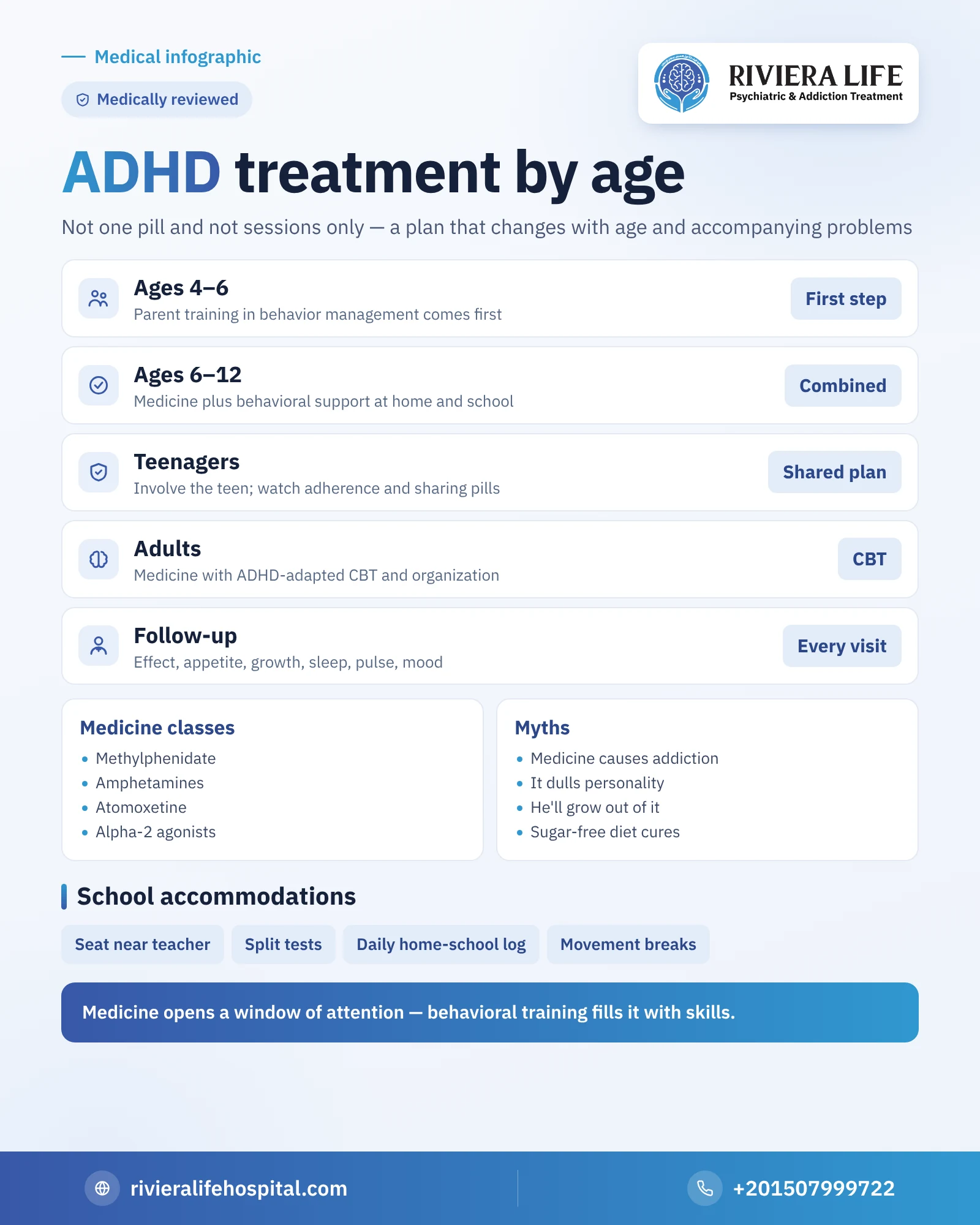
ADHD treatment doesn’t mean a single medicine or sessions only, but a plan that changes according to the patient’s age, the severity of symptoms and the problems that accompany them. For a preschool child, treatment usually starts with parent training; from school age it often combines behavioral and school support with medicine, while for the teenager and the adult cognitive behavioral therapy and tools for organizing daily life are added.
In this article we detail the plan stage by stage, explain the medicine classes in general, what is monitored, and the myths that keep many families from treatment. If you want to learn about the disorder itself, its types and causes, start from our ADHD guide.
What is the goal of ADHD treatment?
The goal isn’t a “calm child” who sits without moving, nor an employee who never forgets anything. The goal is for the symptoms to decrease to a degree that allows the person to learn, work and build relationships without paying a daily price of failure and blame. That is why a good doctor starts by asking the family: what disrupts your life the most right now? It may be homework, anger outbursts, road accidents for a young man, or repeated dismissal from work. These specific goals are what improvement is later measured against.
Before the plan: a careful assessment and what accompanies the disorder
A large proportion of those affected have another problem with it: learning difficulties, anxiety, depression, oppositional defiant disorder, sleep disorders, or substance use in teenagers and adults. A plan that ignores these problems usually fails. That is why treatment is preceded by an assessment that gathers information from the family and the school or partner, rules out other causes such as poor hearing or sleep deprivation, and may include a heart examination or questions about the family’s heart history before some medicines.
The plan by age
From about age four to six
Here international guidelines agree that training parents in behavior management is the first step, because at this age it gives results close to medicine, while young children are more sensitive to side effects. Medicine isn’t usually considered unless severe symptoms persist despite good training, and it is decided by a doctor specialized in child psychiatry.
School age: from six to twelve
Treatment usually combines medicine with behavioral interventions at home and school. Medicine improves attention and impulse control, and behavioral training teaches the child and parents skills no pill teaches: how to finish a task, how to wait your turn, and how to calm down after anger.
Adolescence
Priorities change: driving, relationships, academic pressure, and the possibility of experimenting and substance use. The teenager himself takes part in the plan instead of having it imposed on him, and adherence to the medicine is followed because many leave it at this age. The possibility of giving the medicine to classmates is watched, which is common around exams.
Adults
The adult is usually treated with medicine along with cognitive behavioral therapy adapted for ADHD, which focuses on procrastination, time management and the thinking that justifies abandoning tasks. Organization coaching may help, as may couples therapy if the relationship has been affected.
Parent training: what do parents learn?
It isn’t a lecture about “patience”, but a practical program of several sessions in which parents are trained to:
- Give one short instruction after eye contact, instead of five instructions while in the kitchen.
- Praise good behavior immediately and specifically.
- Use a points or stars chart exchanged for small agreed rewards.
- Use calm, predictable consequences, such as a short time-out, instead of shouting and hitting.
- Ignore minor annoying behaviors that attention feeds.
Many mothers say after weeks that the home has become calmer, not because the child changed on his own, but because the vicious circle of defiance and punishment was broken.
School support and academic accommodations
The school is an essential partner. Accommodations that can be requested in agreement with the administration include:
- A seat near the teacher, away from the window and door.
- Splitting a long test or assignment into parts, with extra time or a quiet room if possible.
- A daily home-school log with three clear goals.
- Allowing short movement breaks instead of punishing movement.
- Writing homework on the board and in a message to the parents, not relying on the child’s memory.
Cognitive behavioral therapy for teenagers and adults
In its sessions the patient learns applicable tools: breaking a task into a very small first step, using alarms and a calendar instead of relying on memory, setting a short work period followed by a break, and reviewing thoughts such as “I’ll start when I’m in the right mood”. It also deals with the frustration and low self-esteem accumulated over years of blame, which explains why many untreated adults develop anxiety and depression.
Medicine classes in general
| Class | Examples | When the doctor usually chooses it |
|---|---|---|
| Stimulants of the methylphenidate family | Ritalin and its extended-release forms | A common first choice for children and adults |
| Stimulants of the amphetamine family | Amphetamine salts and others | A first choice in some countries, and availability varies from country to country |
| Non-stimulants acting on noradrenaline | Atomoxetine | When there is no response or tolerance, or with anxiety or a risk of misuse |
| Alpha-2 agonists | Guanfacine and clonidine | With tics, insomnia or severe impulsivity, or added to a stimulant |
Stimulants work within hours of being taken, while non-stimulant medicines need weeks. The doctor determines the medicine, dose and timing after assessment, and may try more than one medicine until reaching the most suitable. No medicine should be started, changed or stopped except with the treating doctor.
Follow-up: what does the doctor monitor?
- Effect: short scales filled in by the parents and teacher before and after the medicine.
- Appetite, weight and height: especially in children on stimulants.
- Sleep: difficulty sleeping is among the most common complaints, and is often solved by adjusting the timing.
- Pulse and blood pressure: at almost every visit.
- Mood: irritability, sadness or the appearance of tics.
- The use itself: are the pills running out faster than expected?
Myths about ADHD medicines
- “The medicine makes the child an addict”: prescribed use under supervision doesn’t raise the risk of addiction; research even indicates it may be linked to lowering it, which we cover in our article on ADHD and addiction.
- “It will change his personality and make him dull”: this feeling is a sign that the dose or medicine isn’t suitable, and it is adjusted.
- “He’ll grow up and get better on his own”: the hyperactivity may calm down, but inattention and impulsivity persist in many, and years of academic failure don’t come back.
- “Medicine alone is enough”: it improves attention, but it doesn’t teach skills or repair the relationship between the child and his parents.
- “A sugar-free diet cures it”: a healthy diet is useful for everyone, but it isn’t a treatment for the disorder.
Combining treatments: why does it work better?
Medicine opens a “window” in which the child can pay attention, and behavioral training fills this window with skills. A family that learns new methods sometimes needs a lower dose. In adults, medicine makes cognitive therapy sessions more effective because the patient can apply what he learns. That is why guidelines agree that multi-faceted treatment is best for most patients.
The right place for ADHD treatment: how to choose
The right place for ADHD treatment is the one that offers what your patient specifically needs: a careful assessment of what accompanies the disorder, a plan combining medicine with behavioral therapy, and regular follow-up. Ask before you choose:
- Is the assessment done by a consultant psychiatrist, gathering information from the family and the school or partner?
- Are anxiety, depression, learning difficulties and substance use assessed at the same time?
- Are there parent training sessions and cognitive behavioral therapy, not just a prescription?
- Does the doctor explain side effects and set follow-up appointments for pulse, weight and sleep?
- Can a case where the disorder comes together with stimulant or hashish use be handled?
- Does the place respect the confidentiality of the patient and his family?
Beware of any party that promises you a “final cure” in weeks or a magic treatment without follow-up.
How Riviera Life meets these standards
These criteria are what Riviera Life offers, in detail:
- Psychiatry and addiction consultants: a comprehensive assessment that distinguishes the disorder from what resembles it and what accompanies it.
- Fourteen years of experience: and thousands of cases that have recovered.
- Ministry of Health license: regulated medical work according to official standards.
- A family program: because parents and partners are part of the treatment.
- Dual diagnosis treatment: when the disorder comes together with stimulant or other substance use.
- Round-the-clock medical supervision: when the case needs a stay or careful adjustment of medicines.
- Complete confidentiality: for every patient and his family.
- Aftercare: continuous follow-up after the condition stabilizes.
The first consultation is free, and you can get in touch around the clock on +201507999722, and our premises are in Sheikh Zayed, Giza.
For neurofeedback specifically, and what recent reviews have shown about its benefit in ADHD, read Neurofeedback: how it works and what the evidence says.
More from our ADHD guide
- ADHD: the complete guide
- Ritalin (methylphenidate)
- ADHD and addiction
- Addiction treatment program for students and teenagers
- Strattera (atomoxetine): ADHD treatment without stimulants
- Causes of poor concentration: sleep, anxiety, depression, ADHD and physical causes
- The difference between Asperger’s and autism: why the name disappeared and what it means today
- Adult ADHD test (ASRS)
Questions many people ask
In young children treatment starts with parent training and may be enough. At older ages and in moderate and severe cases, combining medicine with behavioral therapy is usually more effective.
It varies from person to person, and many need treatment for years with periodic review. The doctor assesses the need to continue from time to time instead of stopping at random.
Some doctors discuss this according to appetite, growth and the nature of the day. The decision is made with the doctor, not by the family alone.
Yes, it focuses more on cognitive behavioral therapy and organizing work and relationships, with assessment of anxiety, depression and substance use. Suitable medicines may also differ.
Look for an assessment by a consultant psychiatrist that also covers anxiety, depression, learning difficulties and substance use, a plan combining medicine with behavioral therapy and parent training, and regular follow-up. Riviera Life in Sheikh Zayed meets these criteria, with a family program and dual diagnosis treatment.