How long crack stays in the body depends on the type of sample: it stays in the blood for only a few hours, but the substance a urine test looks for usually shows for two to four days after the last use, and may extend to a week or more in someone who smokes it heavily and for a long time.
A hair test may detect it for around three months. These figures are approximate and vary from person to person. In this article we explain why they vary, how the body deals with crack, whether a test distinguishes it from powder cocaine, when a result is open to doubt, and what no test can tell you.
What happens to crack inside the body?
Crack is cocaine itself in a smokable form, so the active substance is the same. The difference is the route: when smoked it reaches the lungs and from there the brain within seconds, so it peaks quickly and its effect fades within minutes. Then the liver and blood enzymes start breaking it down very quickly, so cocaine itself in the blood falls by half within about an hour.
The most important product of this breakdown is a substance called benzoylecgonine. This substance doesn’t cause a high, but it stays in the body much longer than cocaine, which is why it is what most tests look for.
Does a test distinguish crack from powder cocaine?
A routine test doesn’t distinguish them, as both produce the same by-product, and the result is written as “cocaine” in both cases. But when cocaine is smoked, an additional substance forms because of the heat, which some specialized laboratories can detect with precise equipment as a marker pointing specifically to smoking. This test isn’t part of the usual tests, and is only requested in special circumstances. For the general picture of detecting cocaine in all its forms, see our article on how long cocaine stays in your system.
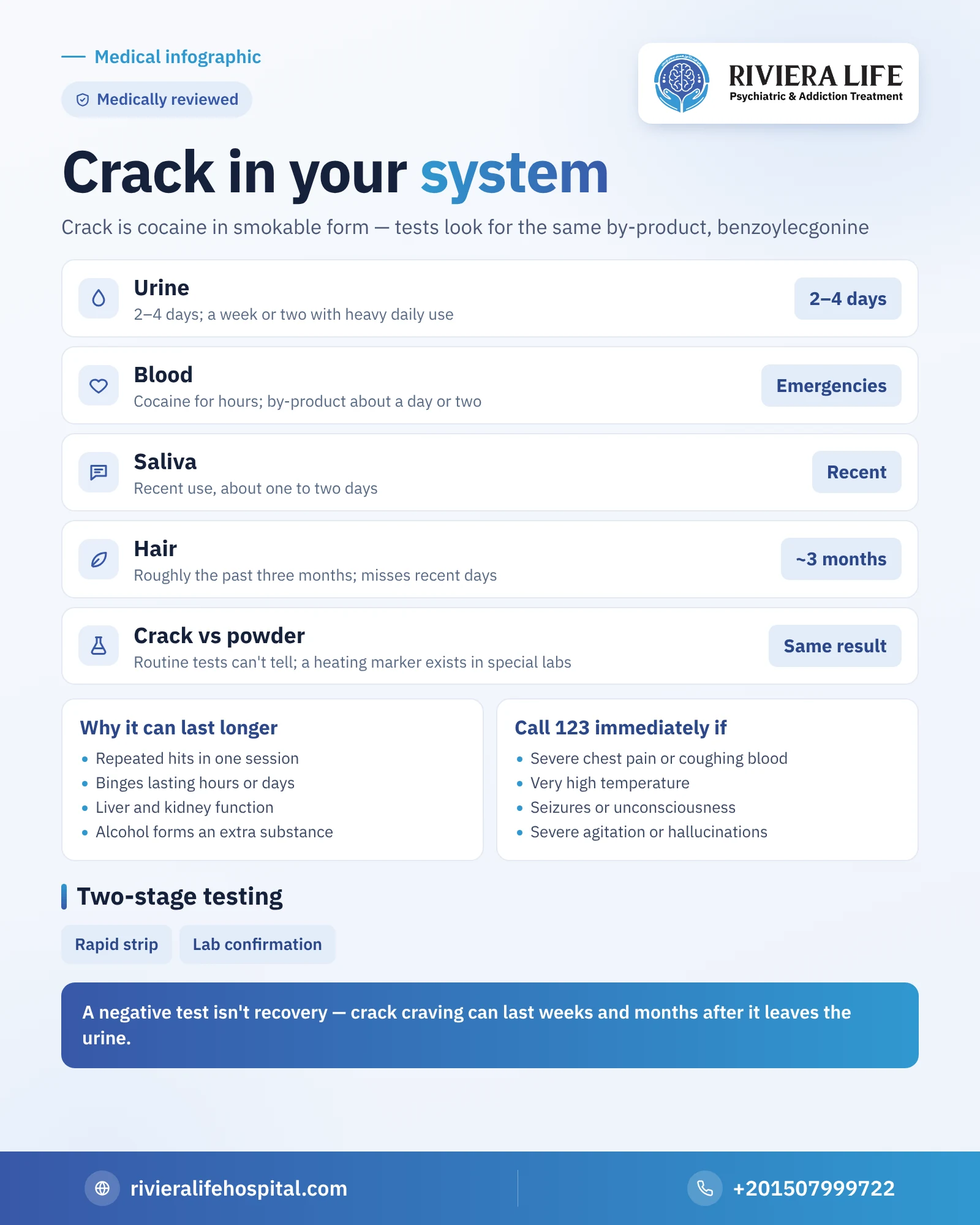
How long crack shows in each type of test
The urine test
The most widely used. The by-product usually shows in it for two to four days after the last use in someone who smokes occasionally. With heavy daily use over long periods, the window may extend to roughly a week or two, because the substance builds up faster than the body clears it.
The blood test
Cocaine itself disappears from the blood within hours, while the by-product may show for roughly a day or two. That is why a blood test is mostly used in emergencies to assess someone with symptoms of poisoning, rather than to detect past use.
The saliva test
Detects recent use, within roughly a day or two. With crack specifically, the result in the first hours may be affected by residue in the mouth from the smoke itself.
The hair test
The hair test covers the longest period of all tests; the part closest to the scalp carries the trace of crack for around the past three months. But it can’t detect use in the last few days, since that hair hasn’t yet emerged from the skin, so it is used to track the pattern of use over a long period.
When does crack leave the blood and urine?
This is the question in the title of many searches. The short answer:
- From the blood: cocaine itself within a few hours, and the by-product within roughly a day or two.
- From the urine: in most people who use it intermittently within about four days, and with heavy use it may take a week or more.
“Leaving” here means the concentration has fallen below the level the test detects, not that the body is completely clear, nor that the substance’s effects on the brain have ended.
Why does it sometimes last longer with crack?
The way crack is used itself lengthens the detection window. Because the effect fades within minutes, the user tends to smoke again and again in a single session, and a session may last hours or days. Other factors also have an effect:
- The number and length of sessions and the total amount.
- The duration of use: weeks or years.
- Liver and kidney efficiency and general health.
- Age and body mass.
- Drinking alcohol with it, since an extra substance forms that stays in the body longer.
- The sensitivity of the test and the detection limit the laboratory uses.
The screening test and the confirmatory test
Rapid strips and cassettes give a preliminary result within minutes; they are useful for initial screening but aren’t final proof. If positive, part of the sample is sent to a laboratory that uses more precise confirmatory equipment, which identifies the substance by name and concentration. Each laboratory has a minimum concentration at which it considers the result positive, which explains how one sample can give two different results in two different places. So always ask about the type and method of the test before basing any judgment on it. And for important decisions, such as work, family disputes or starting treatment, the strip alone isn’t relied on.
Can the result be wrong?
A positive cocaine result is relatively accurate compared with other substances, because the by-product the test detects is specific to cocaine. It helps to know the following:
- The usual local dental anesthetic doesn’t give a cocaine result, because it is a chemically different substance.
- Some drinks made from coca leaves, which aren’t common in Egypt, may give a positive result.
- Exposure to crack smoke in a closed room may leave a tiny trace, but it rarely exceeds the accepted detection limit.
If there are doubts about the result, the solution is a confirmatory test and discussing medicines and circumstances with the doctor.
Can crack be cleared from the body faster?
There is no safe way to clear crack from the body faster than the liver and kidneys do. Drinking huge amounts of water or taking “cleansing” products doesn’t change that, and may upset the blood’s salts, and laboratories easily detect diluted samples. The more important question isn’t how to get past a test, but why the test has become a worry in the first place.
What can’t the test tell you?
A test says the substance was used within a certain period, but it doesn’t say whether the person is addicted or used once, doesn’t measure the severity of dependence, and doesn’t predict relapse. A negative result doesn’t mean the brain has recovered; the craving for crack may continue for weeks and months after the substance leaves the urine. Our article on crack addiction explains why attachment to it forms so quickly.
How are tests used during treatment?
In treatment programs, regular tests are used as a tool for follow-up and encouragement, not punishment. Successive negative results give the patient and family tangible evidence of progress, and gradually rebuild trust. If a positive result appears, it is a signal to review the plan with the treatment team. You’ll find the full stages of the plan in our article on cocaine addiction treatment.
Danger signs that don’t wait for a test result
If someone shows signs of poisoning after smoking crack, there is no time to wait for any test:
Call an ambulance on 123 immediately if you see
Stay with them, keep them away from heat, and tell the paramedics what they took and any other substances with it.
- Severe chest pain, sudden shortness of breath or coughing up blood
- A very high temperature with sweating, or hot, dry skin
- Seizures or loss of consciousness
- Severe agitation, hallucinations or unusually violent behavior
And if the worry about a test concerns someone close to you, the Riviera Life team offers a free, confidential first consultation, and helps the family turn a test result from a confrontation into the start of treatment. Contact us around the clock: +201507999722.
More from our cocaine guide
- Cocaine: the complete guide
- Cocaine withdrawal symptoms
- How to recognize someone addicted to cocaine
- The physical and psychological harms of cocaine
Questions many people ask
Usually two to four days after the last use, and it may extend to a week or more with heavy daily use.
Cocaine itself disappears from the blood within a few hours, while its by-product may show in the blood for roughly a day or two.
A routine test doesn't distinguish them because both produce the same substance; specialized laboratory tests can detect a marker specific to smoking, but they aren't usually done.
Yes. A hair test can reflect use over roughly the previous three months, but it doesn't detect the last few days.
No. It only means the substance is no longer at a concentration the test detects, while craving and changes in the brain may continue for weeks and months.