When talking about how long alcohol stays in the body, we need to distinguish between alcohol and its breakdown products. Alcohol itself stays in the blood and breath for a few hours — usually up to about half a day after heavy drinking — because the liver clears it at a roughly constant rate equal to one standard drink per hour.
But modern tests don’t look for alcohol alone; they look for its breakdown products, which stay much longer: they may appear in urine for about three to five days, in blood for weeks, and in hair for months. This article explains the detection window in each type of test, what lengthens or shortens it, when a result can be misleading, and what a test can’t tell you.
How does the body get rid of alcohol?
After drinking, alcohol is absorbed quickly from the stomach and small intestine, and its concentration in the blood reaches its highest level within about half an hour to two hours, depending on whether the stomach is full or empty. Then the liver begins to break it down in two stages: first it is converted into a toxic substance called acetaldehyde, then into acetic acid, which is finally turned into water and carbon dioxide.
A very small part of alcohol leaves unchanged in the breath, urine and sweat, and this part is what a breath tester detects. Tiny amounts of by-products are also formed that stay in the body for days and weeks, and long-term tests rely on them.
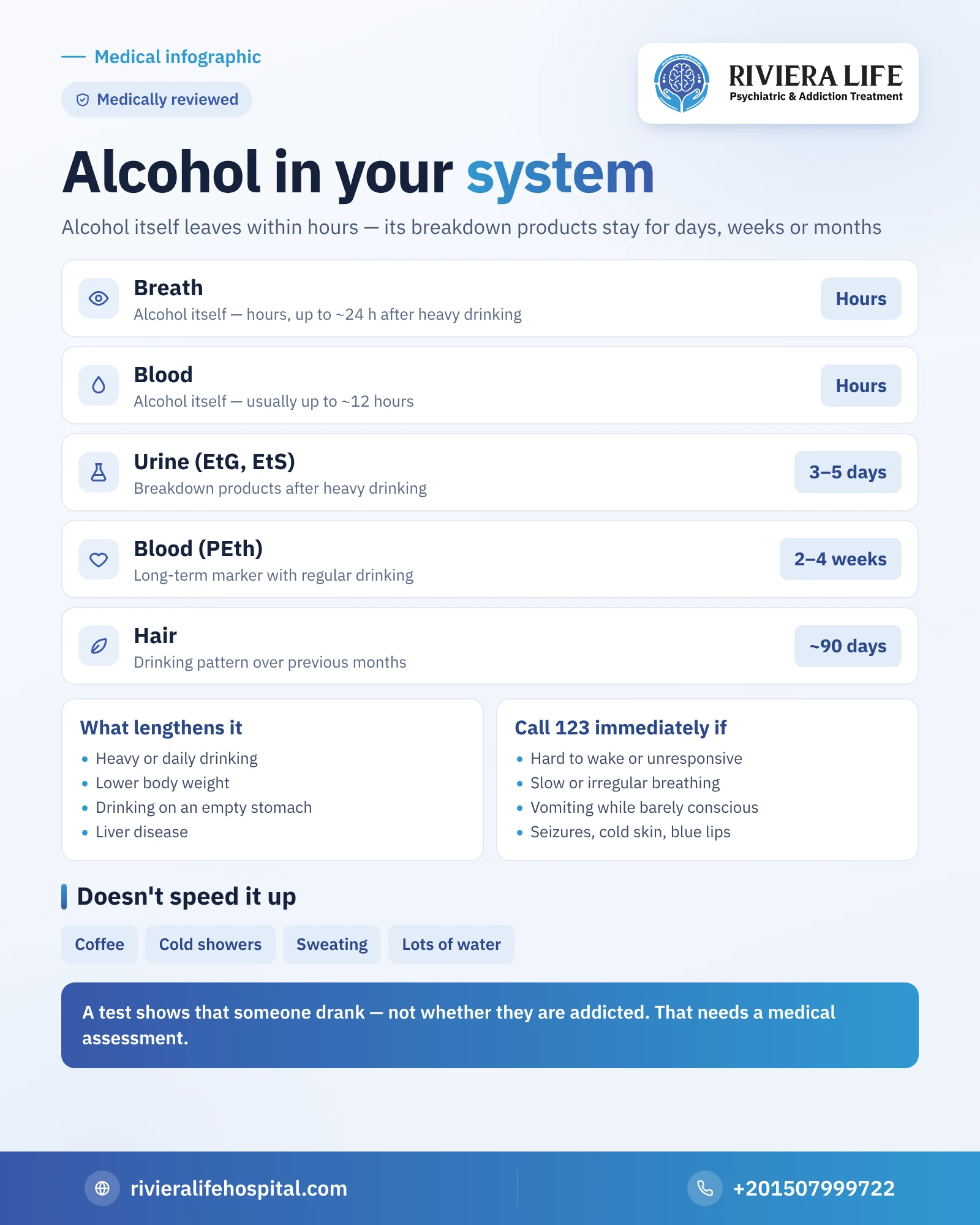
How long alcohol shows up in each type of test
The following figures are approximate, and differ with the amount, the drinking pattern and the sensitivity of the test:
| Type of test | What it detects | Approximate detection window |
|---|---|---|
| Breath | Alcohol itself | From hours up to about 24 hours after heavy drinking |
| Blood | Alcohol itself | Usually up to about 12 hours |
| Saliva | Alcohol itself | Up to about 12–24 hours |
| Urine | Alcohol itself | Up to about 12–24 hours |
| Urine | Breakdown products (EtG and EtS) | Up to about 3–5 days after heavy drinking |
| Blood | The PEth marker | Up to about two to four weeks with regular drinking |
| Hair | Breakdown products | Up to about 90 days |
The breath test
This is the best known on the roads and in police stations. It measures alcohol in exhaled air and roughly reflects its concentration in the blood at that moment. It doesn’t detect drinking whose effect has ended, but it may detect drinking from the previous night if the amount was large.
The blood test
Used in emergencies and legal cases because it is the most accurate way of measuring the current alcohol level. It isn’t useful for detecting drinking that happened more than a day before unless a special long-term marker is requested.
The urine test: how long does alcohol stay in urine?
It detects alcohol itself for hours, while testing for breakdown products extends the window to days, which is why it is widely used in treatment programs and in monitoring abstinence.
The hair test
It sketches drinking habits over the previous months, but it doesn’t point to a specific night, and it doesn’t capture the last few days because hair needs time to emerge above the skin.
How long does alcohol stay in the blood and urine of someone who drank once?
The calculation for someone who drank on a single occasion differs from that for a regular drinker, because here the body clears a single amount and that is the end of it, with no accumulated store from previous days.
- In blood and breath: the liver clears alcohol at a roughly constant rate that doesn’t speed up with drinking water or coffee. So the trace of one or two glasses usually disappears from the blood within a few hours, while a large amount in a single night may need most of the next day.
- In urine: alcohol itself shows up for a few hours after it has disappeared from the blood. But tests that look for its by-products, such as ethyl glucuronide (EtG), may stay positive for about a day or two after a small amount, and may extend to about three days after a large amount.
- In hair: a hair test doesn’t usually detect a single passing episode of drinking, because it is designed to capture a repeated drinking pattern over weeks or months.
These are approximate ranges, not guarantees: weight, food, liver health and the type of test all change the result. And if you have used a product containing alcohol, such as mouthwash, some cough medicines or hand sanitizer, tell the laboratory before the sample is taken, because the confirmatory test is what distinguishes drinking from incidental exposure.
What does blood alcohol concentration mean?
Blood alcohol concentration is the amount of alcohol in a specific volume of blood, usually written in grams per liter or as a percentage. It rises with every glass and falls at a slow, steady rate, which is why a person may still be above the legal driving limit the next morning even though they slept for hours. Egyptian traffic law penalizes driving under the influence of alcohol, and the simplest safety rule is that someone who has been drinking doesn’t drive — not that they calculate how much alcohol is left in their blood.
Factors that lengthen or shorten the time
- The amount and the drinking pattern: heavy drinking in a single session or daily drinking lengthens all the detection windows.
- Body weight and its water content: alcohol is distributed in the body’s water, so its concentration rises more in lighter people.
- Sex: alcohol concentration in women usually reaches a higher level than in men after the same amount.
- Food: drinking on a full stomach slows absorption and lowers the peak.
- Liver health: liver disease may slow the clearance of alcohol.
- Age and some medicines: they may change the speed of breakdown or increase alcohol’s effect.
Can alcohol be cleared from the body faster?
No. Coffee makes a person more alert but doesn’t lower blood alcohol, and cold showers, sweating and drinking a lot of water don’t change the rate at which the liver works. Only time lowers the level. And the feeling of being sober after coffee can be more dangerous than obvious drunkenness, because it fools the person into thinking they are able to drive.
When is a positive result inaccurate?
Urine tests for breakdown products are very sensitive, and may pick up small amounts of alcohol from sources other than drinking, such as mouthwash containing alcohol, heavy use of hand sanitizers, or some liquid medicines. That is why laboratories rely on specific cut-off levels, and a low result alone isn’t interpreted as proof of drinking. Conversely, a negative result may appear despite drinking if enough time has passed or the amount was small.
The screening test and the confirmatory test
Strips and portable breath testers give a quick result, but they can be wrong. If important decisions will be based on the result — at work, before a legal authority or in a treatment program — a confirmatory test is requested in an accredited laboratory with more precise equipment. This is a general rule in all substance testing, and alcohol is no exception.
What can’t a test tell you?
A test says that a person drank at some point, but it doesn’t say they are addicted, doesn’t measure how much control they have over drinking, and doesn’t reveal their mental state. And a negative result doesn’t mean the problem doesn’t exist: the person may have stopped for just two days before the test. That is why a medical assessment and everyday behavior remain more important than the test report. To learn the signs that really reveal addiction, read our article on alcohol addiction symptoms.
Advice for the family before home testing
A family may consider buying a breath tester or home strips to detect drinking by one of its members. These tools may give a temporary answer, but they often turn into an arena of conflict, surveillance and denial, moving the conversation from “we are worried about you” to “we caught you”. If you have strong suspicions, it is more useful to ask for a medical consultation that helps you open the conversation the right way, and to leave testing to the treatment team.
How are tests used during treatment?
In treatment programs, tests are used as a support tool, not a punishment. Urine tests for breakdown products and long-term blood markers help the doctor follow abstinence, and give the patient themselves tangible evidence of their progress to share with their family. Liver tests also help follow the organs’ recovery after stopping. Our article on alcohol addiction treatment explains where this follow-up fits in the complete plan.
Alcohol leaving the body doesn’t mean its effect is over
After the last drop of alcohol has disappeared from the blood, the brain of a regular drinker remains in an adapted state that may show as tremor, anxiety and insomnia, and may reach seizures, as our article on alcohol withdrawal symptoms explains. And if blood alcohol rises to a high level in a single session, poisoning can happen:
Call an ambulance immediately on 123 if you see
Blood alcohol can keep rising after drinking stops, so don't leave the person to sleep alone.
- Difficulty waking them, or no response when called
- Slow or irregular breathing
- Vomiting while barely conscious
- Seizures
- Cold skin and blue lips
When does a drinker sober up?
Sobering up doesn’t mean alcohol has gone from the blood. A person feels they have sobered up when the alcohol concentration falls to a level at which concentration and balance improve, but the liver usually needs many hours to clear what was drunk. The time varies with the amount, the type of drink, the person’s weight and sex, what they ate, and the health of their liver.
And there is a difference between the dizziness easing and driving or working becoming safe. A person may seem composed while their judgment and reaction speed are still affected. That is why personal feeling isn’t a valid measure.
And nothing speeds up this process: coffee, cold water, a shower and a short nap change the feeling of drowsiness but not the speed at which the liver works. Only time lowers the concentration.
But if the person shows signs such as repeated vomiting, slow breathing, blue lips or difficulty waking, these are signs of alcohol poisoning, not ordinary drunkenness, and an ambulance must be called on 123 immediately. You will find the stages in detail in our article on the symptoms and stages of drunkenness, up to alcohol poisoning.
More from our alcohol guide
- Alcohol: the complete guide
- The harmful effects of alcohol on the body and mind
- Alcohol withdrawal symptoms and danger signs
- Alcohol addiction treatment: stages and medicines
Questions many people ask
Usually several hours, and it can reach around 12 hours or more after heavy drinking, because the liver clears it at a rate of roughly one standard drink per hour.
Alcohol itself doesn't, but its breakdown products such as EtG can appear for about three to five days after heavy drinking, and less after a small amount.
Mouthwash containing alcohol, or heavy use of hand sanitizers, can cause low results in highly sensitive tests, which is why laboratories rely on cut-off levels and confirmatory tests.
No. Coffee may increase alertness, but it doesn't speed up the liver's work. Only time lowers blood alcohol.
Usually not, because hair needs days to grow above the surface of the skin, so it reflects the drinking pattern over the previous months, not the last few days.