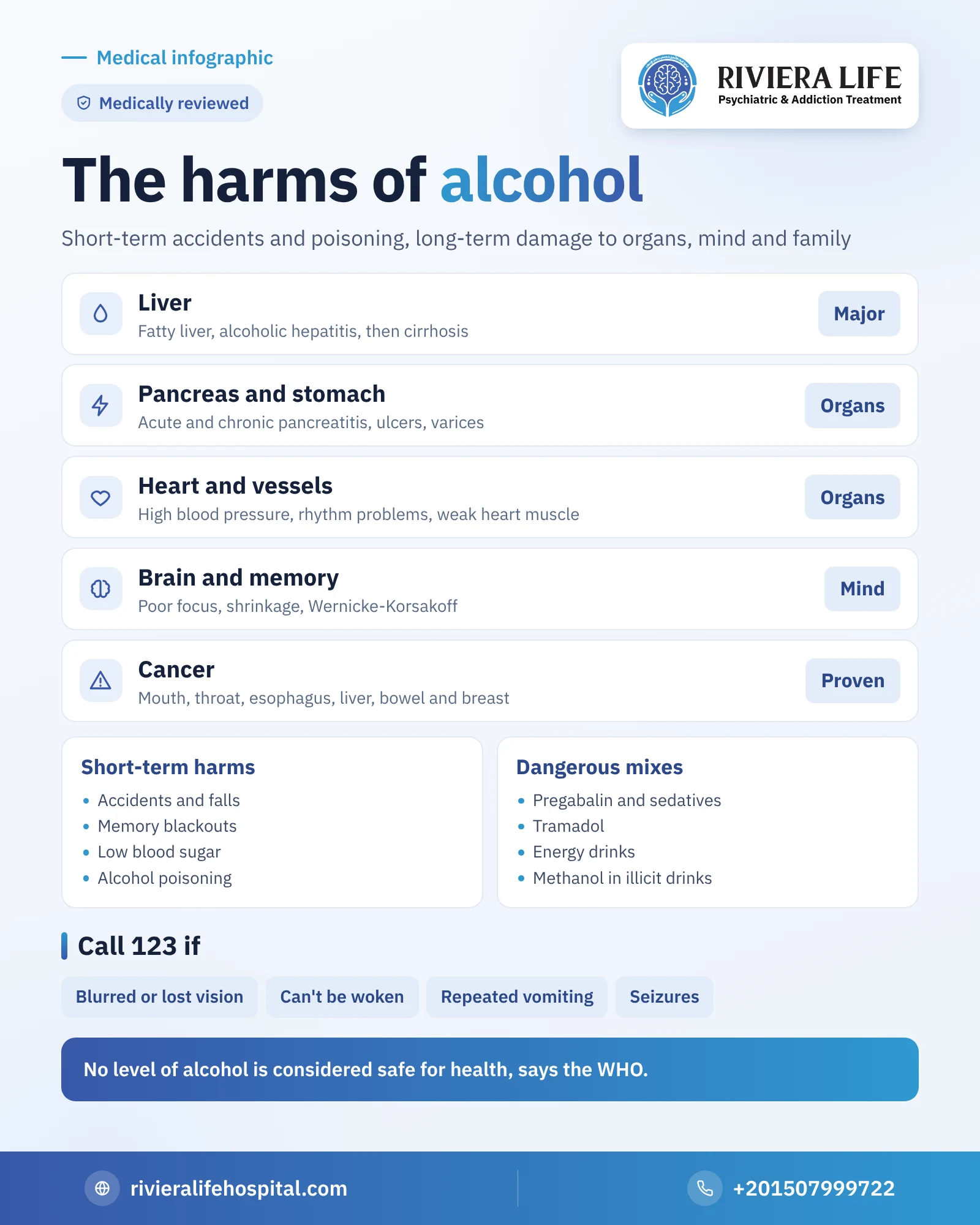
The harms of alcohol begin from the first night, in the form of accidents, wrong decisions and possible poisoning, then accumulate silently over the years to affect the liver, pancreas, heart, nerves and brain, and raise the risk of several types of cancer. And its effect doesn’t stop at the body; it touches mood, sleep and memory, the family, work and money. This article sets out the short- and long-term harms organ by organ, the dangers of mixing and adulterated drinks, its effect on pregnancy and teenagers, and what can improve after stopping.
Short-term harms of alcohol
Even someone who doesn’t drink regularly may pay a heavy price in a single night. Alcohol slows reactions and weakens judgment, making the person more prone to road accidents, falls, burns and drowning, and more inclined to fights and impulsive behavior they regret. Its short-term harms also include:
- Memory loss for periods of the night, a sign that the amount affected the brain’s memory-storage centers.
- Vomiting, stomach acidity and acute gastritis.
- Heart rhythm disturbance after heavy drinking, even in healthy people.
- Low blood sugar, especially in diabetics or those who drink without food.
- Alcohol poisoning, which may suppress breathing and lead to coma.
- Next-day effects: headache, dehydration, fatigue and poor concentration.
Long-term harms of alcohol on the body
The liver
The liver is the organ that bears the greatest burden. Damage begins with fat building up in it, a stage that is usually silent and can reverse with stopping. With continued drinking, alcoholic hepatitis may occur, then cirrhosis, which replaces healthy liver tissue with scars that don’t come back. There may be no symptoms until advanced stages, when yellowing, a swollen abdomen, swollen feet and bleeding appear.
The pancreas
Heavy drinking is one of the best-known causes of acute pancreatitis, a severe pain in the upper abdomen extending to the back that needs hospital admission. With repetition it may turn into chronic inflammation that weakens digestion and leads to diabetes.
The stomach and esophagus
Alcohol irritates the stomach lining and causes acidity and ulcers, and liver cirrhosis may lead to varices in the esophagus that can bleed suddenly.
The heart and blood vessels
Alcohol raises blood pressure with continued use, is linked to heart rhythm disturbances, may weaken the heart muscle itself after years of heavy drinking, and raises the risk of stroke.
Nerves and muscles
Long-term drinking causes damage to the peripheral nerves, appearing as numbness and burning in the feet and weak balance, as well as muscle weakness.
Alcohol and cancer
The International Agency for Research on Cancer, part of the World Health Organization, classifies alcohol as a confirmed human carcinogen. It is linked to cancers of the mouth, throat, larynx, esophagus, liver, colon, rectum and breast. The risk increases with the amount, and roughly doubles with smoking for mouth and throat cancers. The type of drink doesn’t change this fact, as the causative substance is alcohol itself and its breakdown product, acetaldehyde. That is why quitting smoking deserves equal attention, and the ways to do it are explained in our guide to quitting nicotine addiction.
Harms of alcohol on the brain and memory
With years of heavy drinking, the brain is affected in several ways: concentration, planning and problem-solving weaken, and scans sometimes show shrinkage in brain size. Among the most serious complications is a deficiency of the vitamin thiamine, which may cause Wernicke’s encephalopathy, then Korsakoff syndrome, in which the patient loses the ability to form new memories and fills the gaps with untrue stories without meaning to lie. The reassuring part is that some mental functions improve clearly within months of stopping.
Harms of alcohol on mental health
Many drink to calm down or sleep, but alcohol gives short relief and then takes more than it gave. It disrupts the stages of deep sleep so the drinker wakes up tired, increases anxiety the next day, and long-term use is linked to depression. It also raises impulsivity and weakens restraint, which is why it is linked to an increased risk of self-harm in those with depression. Any talk of ending life calls for immediate contact with a doctor or an ambulance.
The harms of mixing alcohol with other substances
Sometimes the most dangerous thing about alcohol is what is drunk with it. It is a depressant of the nervous system, and when combined with another depressant, the effect on breathing and consciousness multiplies:
- With pregabalin, sedatives and sleeping pills: severe drowsiness and suppression of breathing that may be fatal; the details are in our article on pregabalin and alcohol.
- With tramadol: double suppression and a risk of seizures.
- With stimulants and energy drinks: they hide the feeling of drunkenness, so the person drinks more without noticing.
- With some ordinary medicines such as large amounts of paracetamol painkillers: an extra burden on the liver.
Adulterated alcohol and the danger of methanol
Drinks made at home or sold cheaply outside licensed places may contain methanol, an industrial alcohol that turns in the body into substances that attack the optic nerve and the brain. Its symptoms appear hours after drinking, and sometimes a day later, as headache, vomiting, abdominal pain and blurred vision that may end in blindness or death. Any disturbance of vision after a drink of unknown origin calls for going to the emergency department immediately.
Call an ambulance on 123 immediately if you see
After heavy drinking or after a drink of unknown origin, even if the person seemed fine at first.
- Blurred or hazy vision, or loss of sight
- Difficulty waking them, or slow and irregular breathing
- Repeated vomiting with severe abdominal pain
- Seizures
- Severe confusion or loss of consciousness
Harms of alcohol in pregnancy and on the fetus
Alcohol crosses the placenta to the fetus, and the fetus’s liver can’t get rid of it. There is no amount known to be safe during pregnancy. Drinking during pregnancy may cause a group of disorders called fetal alcohol spectrum disorders, including poor growth, distinctive facial features, and problems with learning, attention and behavior that last a lifetime, as well as an increased risk of miscarriage and premature birth.
Harms of alcohol on teenagers
The brain continues developing until about the mid-twenties, and the areas responsible for controlling impulsivity and planning are the last to mature. Drinking at this stage may affect learning and memory, and is linked to a higher risk of addiction later the younger the starting age. Teenagers also tend to drink heavily in a single session, a pattern that raises the risk of poisoning and accidents, and our article on the causes of alcohol addiction discusses the role of the starting age in detail.
Family and social harms
In many homes the harm doesn’t show in a medical report but in the details of daily life: children learning to read their father’s mood from the sound of the door, a wife making excuses to her family, money disappearing, and a job lost after repeated warnings. Alcohol is also linked to domestic violence and road accidents, and children may live with the effects of these years long after the parent has stopped drinking.
The benefits of alcohol: what remains of the old idea?
For years the idea that a small glass a day protects the heart was widespread. It appeared in observational studies that compared moderate drinkers with non-drinkers, but later reviews revealed a flaw in the comparison: the “non-drinkers” group included patients who had quit because of their illnesses and people who were worse off in other ways, so the drinkers seemed healthier than they really were.
To this day there is no strong evidence that starting to drink improves health, and the World Health Organization says no level of alcohol consumption can be considered safe for health. As for the antioxidants attributed to wine, their source is the grapes themselves, and they can be obtained without alcohol.
- No one should start drinking on the pretext of protecting the heart.
- For someone who already drinks, less is better, and there is no figure that guarantees safety for everyone.
- Someone who has lost control of the amount needs an assessment, not moderation tips, because the idea of the “beneficial glass” doesn’t apply to them at all.
If you notice you drink more than you intend or can’t stop, read quitting alcohol from withdrawal to recovery and the steps of alcohol addiction treatment.
Do the harms of alcohol go away after stopping?
Many of them improve, and some don’t come back. Fatty liver may reverse within weeks to months, blood pressure falls, sleep improves, and concentration and memory regain a large part of their capacity within months. Advanced liver cirrhosis, some nerve damage and Korsakoff syndrome may remain, but stopping prevents them from worsening and prolongs life. So stopping at any stage is a real gain, provided it is done safely, as our guide to quitting alcohol explains.
How can Riviera Life help you?
Treatment at Riviera Life isn’t limited to stopping drinking, but begins by examining what alcohol has left in the liver, nerves and mood, on which safe withdrawal, a psychotherapy plan and follow-up are built, as our article on alcohol addiction treatment explains.
More from our alcohol guide
- Alcohol: the complete guide
- Alcohol and sex: desire, erection and fertility
- Alcohol addiction symptoms
- How long alcohol stays in the body
- The difference between ethyl and methyl alcohol: methanol poisoning and medical alcohol
Questions many people ask
Not everyone who drinks develops cirrhosis, but the risk rises greatly with heavy drinking for years. The damage usually begins with fatty liver, which may reverse if the person stops early.
This idea is no longer supported as it once was; alcohol raises blood pressure and the risk of some cancers even in small amounts, and doctors don't recommend drinking to protect the heart.
Headache, vomiting and abdominal pain, then blurred vision or loss of sight, which may be delayed by hours after drinking. It is an emergency that needs immediate transfer to hospital.
Many concentration and memory functions improve within months of stopping, but some severe damage such as Korsakoff syndrome may partly remain.
The harmful substance is the same in both: ethanol. The difference is only in concentration, and someone who drinks a large amount of beer is exposed to the same harms.