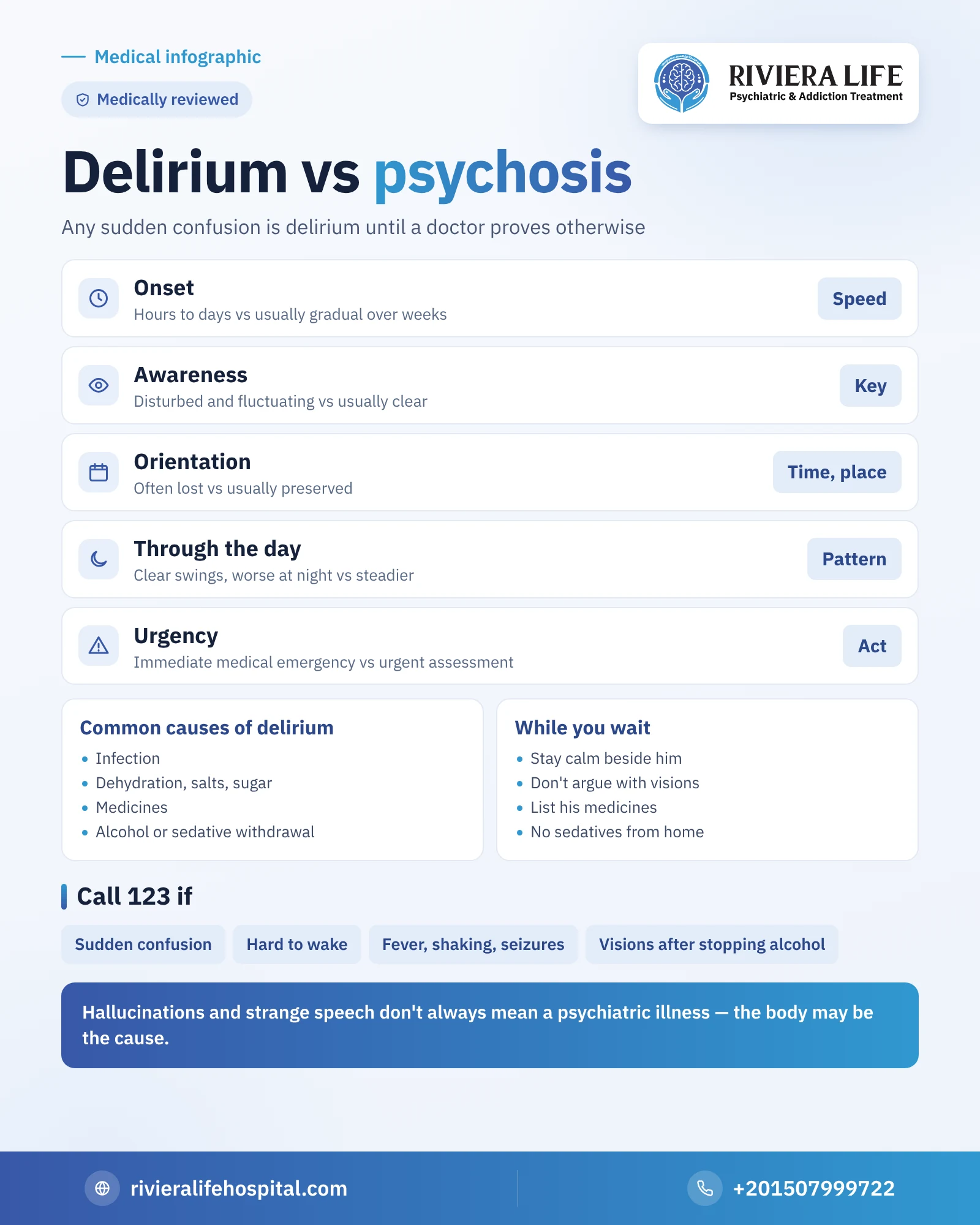
The difference between delirium and psychosis starts with awareness and speed of onset. Delirium is an emergency medical condition in which awareness and attention change suddenly, so the person becomes confused and doesn’t know the time and place, and his state fluctuates during the day. Psychosis, on the other hand, is a disorder of perception and thinking in which awareness usually stays clear. Delirium begins within hours or days, its cause is usually a physical illness, a medicine or alcohol withdrawal, and it needs a hospital immediately. Here we explain how to tell them apart, why assessment must not be delayed, and what to do while waiting.
Call an ambulance on 123 immediately if you see
Delirium is a medical emergency; don't wait for it to pass on its own if a person shows:
- Sudden confusion or not recognizing the place and people
- Severe drowsiness, hard to wake from, or a clear fluctuation in awareness
- Fever, severe shaking, heavy sweating or seizures
- Hallucinations with confusion after stopping alcohol or sedatives
What is delirium?
Delirium isn’t an illness in itself, but a syndrome indicating that the brain is suffering because of a physical problem. Attention and awareness are both disturbed in it. The person may seem absent, staring at nothing, or agitated, trying to get up and pulling out tubes, and may alternate between the two states. His condition changes between morning and evening, and usually worsens at night. It is common among older people and hospital patients, but it may affect any age.
And what is psychosis?
Psychosis means a partial loss of contact with reality: hallucinations, delusions and disorganized thinking, with awareness and attention usually intact. The person is alert and knows who and where he is, but interprets the world in a disturbed way. Its causes are psychiatric, drugs or organic diseases, and its onset is usually slower. Details of the causes are in our article on causes of psychosis.
The difference between delirium and psychosis in a table
| Point of comparison | Delirium | Psychosis |
|---|---|---|
| Onset | Sudden, within hours or days | Usually gradual, over weeks |
| Awareness and attention | Disturbed and fluctuating | Usually clear |
| Orientation to time and place | Often lost | Usually preserved |
| Hallucinations | Mostly visual and unstable | Mostly auditory and more organized |
| Change through the day | Clear, worse at night | Less fluctuating |
| Usual cause | Infection, dehydration, a medicine, alcohol withdrawal, severe illness | A psychiatric disorder, drugs or a brain disease |
| Degree of urgency | An immediate medical emergency | Urgent assessment, and an emergency if there is danger |
The picture may sometimes look similar, which is why guessing isn’t appropriate. The safe rule: any sudden confusion is considered delirium until the doctor proves otherwise.
What are the causes of delirium?
Delirium is usually a direct result of a physical disorder, and its best-known causes are:
- Infection, especially urinary and lung infections in older people, and brain infections.
- Dehydration and salt imbalances such as sodium, and low or high blood sugar.
- Medicines and some of their interactions, including sedatives, strong painkillers and medicines that affect the brain.
- Sudden withdrawal from alcohol or sedative-hypnotics, which is among the most dangerous causes. We explained the first in our article on alcohol withdrawal symptoms.
- Drug poisoning or overdoses.
- Head injuries, stroke, and liver or kidney failure.
- Surgery, anesthesia, a stay in intensive care and lack of sleep.
Delirium tremens: a severe and special picture
It appears in some who stop alcohol suddenly after chronic use, usually two to four days after stopping. Shaking, sweating, a racing heart, confusion and hallucinations come together in it, seizures may occur, and it may be life-threatening. A patient like this isn’t left at home, and alcohol isn’t stopped suddenly without medical supervision if the use has been heavy and chronic. Treatment is in hospital under supervision.
Why do people mistake it?
Because hallucinations and strange speech suggest psychiatric madness, so the family takes him to “psychiatric treatment” or a “sheikh” and delays the doctor. The truth is that delaying treatment of the organic cause may cost the patient his life. Among the signs that point towards delirium: a physical illness or recent infection, a change in medicine, older age, a clear fluctuation between clarity and confusion, reversed sleep, and excessive drowsiness or agitation.
How is delirium treated?
The basis is treating the cause: an antibiotic for infection, replacing fluids, correcting sugar and salts, reviewing medicines, and medical supervision in withdrawal. Support includes a quiet room, lit by day and dark at night, a familiar presence beside the patient, a clock and calendar that remind him of the time, his glasses or hearing aid if he uses them, and avoiding physical restraints as far as possible. The doctor may use a sedating medicine for a short period for severe agitation, and that is his decision alone. After the delirium passes, weak concentration may remain for days or weeks.
When is psychosis the closer explanation?
If the person is fully alert, his symptoms began gradually, he knows the place and time, and his hallucinations revolve around voices or organized suspicions, it is more likely to be psychosis, and he still needs an urgent medical assessment. The treatment of psychosis is the subject of our article on psychosis treatment. The two may occur together, as a patient with psychosis may develop delirium if he becomes physically ill.
What does the family do while waiting?
- Stay beside him calmly, and speak in short sentences and a low voice.
- Don’t argue with his hallucinations or mock them, and gently remind him of where he is and the time.
- Remove anything that might harm him and don’t leave him alone.
- Prepare the names of the medicines he takes and any recent illness, injury, substance use or stopping of a substance, to tell the doctor.
- Don’t give him sedatives or sleeping pills on your own.
Who is most at risk of delirium?
Older people are at the top of those at risk, especially those with weak memory or multiple chronic illnesses. They are followed by those admitted to hospital or undergoing surgery, those taking several medicines that affect the brain, those with poor sight or hearing, those suffering dehydration or malnutrition, and those who drink heavily and then stop. It may occur in children with high fever. Knowing these factors is useful because it makes the family more alert to the first sign of sudden confusion, so they call the doctor early.
Does a person return to normal after delirium?
In many cases delirium goes away after the cause is treated within days or weeks. But in some older people the confusion may remain longer, delirium may reveal a cognitive weakness that was hidden, and it increases the risk of later memory decline. That is why doctors recommend following memory and concentration after recovery. Many people remember the experience with fear, so calm talk afterwards and reassuring the patient that it was an effect of the illness, not “madness”, helps him get past it.
Questions families often ask
Is delirium dementia? No. Dementia is a slow, continuous decline in memory and thinking, while delirium is a sudden, fluctuating change that can go away, but dementia increases the likelihood of delirium. Is it enough for the patient to sleep and calm down? He may calm down and then it returns, as the physical cause hasn’t been treated yet. Can it be treated at home? If the confusion is sudden, no, because the doctor needs tests and treatment of the cause, and behind it may be an infection, a bleed or a dangerous withdrawal. Are the patient’s hands tied? Doctors try to avoid restraints as far as possible because they increase agitation, and it is preferable for a familiar relative to be beside him.
How can Riviera Life help you?
Acute delirium is treated first in a general hospital’s emergency department. If the cause is withdrawal from alcohol or sedatives, or drug-induced psychosis lies behind the symptoms, the team at Riviera Life in Sheikh Zayed, licensed by the Ministry of Health, can provide specialist round-the-clock medical supervision, psychological and family therapy and aftercare in complete confidentiality. The first consultation is free on +201507999722.
More from our psychosis guide
- Psychosis: the complete guide
- Drug-induced psychosis
- Hallucination symptoms
- Alcohol withdrawal symptoms
Questions many people ask
Yes, it is a sign of a physical problem that may be severe, such as infection, a salt imbalance or alcohol withdrawal, and it needs urgent medical assessment.
Confusion and disturbed attention and awareness that are sudden and fluctuate during the day, while awareness usually stays clear in psychosis.
Delirium tremens may occur after sudden stopping in some long-term drinkers, and it is an emergency requiring medical supervision.
Yes, a patient with psychosis may develop delirium if he gets a physical illness, which is why any sudden confusion is assessed medically.
It may go away by treating the cause within days or weeks, but leaving it untreated exposes the person to serious complications.