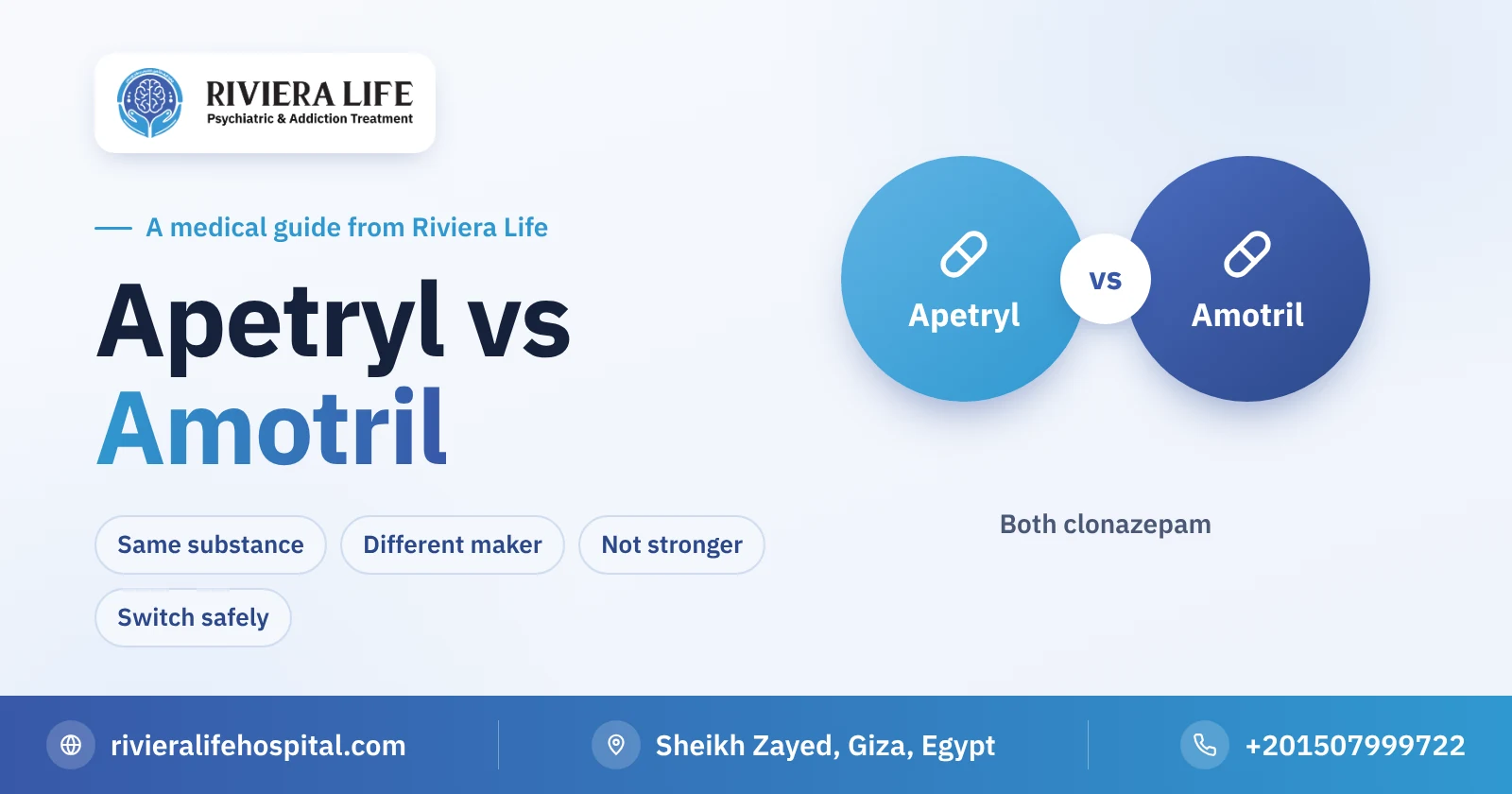
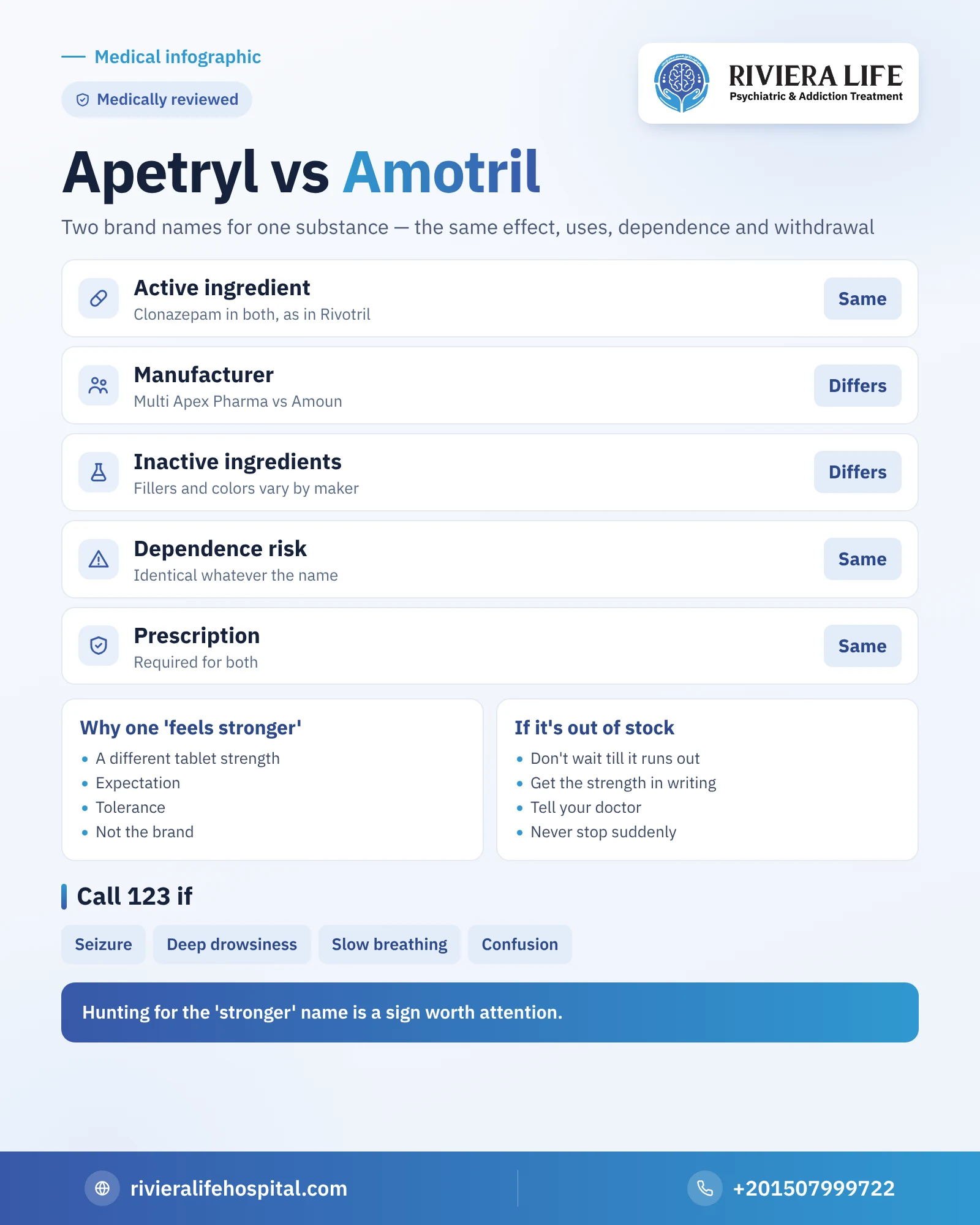
The difference between Apetryl and Amotril is much smaller than many think: both are brand names on the Egyptian market for one substance, clonazepam, the same substance found in Rivotril. What differs between them is the manufacturer, the inactive ingredients such as fillers and colors, the shape of the tablet and pack, the price and availability. The calming effect, uses and risk of dependence and withdrawal are the same. In this article we explain what unites and separates them, correct the rumor that one of them is “stronger”, and explain why switching between them happens only with the doctor’s knowledge.
What are Apetryl and Amotril?
According to the medicine guides in circulation in Egypt, Amotril is clonazepam tablets made by Amoun Pharmaceutical, and Apetryl, sometimes written “Apetril”, is clonazepam tablets made by Multi Apex Pharma. The original medicine with which the substance was first launched is Rivotril. Other names for the same substance may appear on the market over time, and the availability of each changes from one period to another.
Clonazepam belongs to the benzodiazepine family, and in Egypt it is subject to controls on medicines affecting mental state, so none of these names is dispensed without a prescription.
The active ingredient is one: clonazepam
Clonazepam strengthens the action of the inhibitory transmitter “GABA” in the brain, calming excess nervous activity. It is used medically in some types of epilepsy, in panic disorder, and in other neurological conditions the doctor determines. Because it is long-acting, it builds up with daily use, and stays in the body for a while after stopping.
All these characteristics relate to the active ingredient, not to the name written on the box. So everything said about Rivotril in terms of effect and risks applies equally to Apetryl and Amotril.
What is the real difference between them?
| Aspect | Apetryl | Amotril |
|---|---|---|
| Active ingredient | Clonazepam | Clonazepam |
| Manufacturer | Multi Apex Pharma | Amoun Pharmaceutical |
| Inactive ingredients | Vary according to the company’s formulation | Vary according to the company’s formulation |
| Tablet shape, color and pack | Specific to the company | Specific to the company |
| Price and availability | Change with the market | Change with the market |
| Risk of dependence and withdrawal | The same | The same |
| Need for a prescription | Yes | Yes |
What role do inactive ingredients play?
Every tablet contains, besides the active ingredient, substances that help shape it, preserve it and dissolve it in the stomach, such as lactose, starch, colorings and binders. These ingredients differ from one company to another, and don’t change the drug’s effect under normal circumstances. But they matter in specific cases: someone with an allergy to a particular coloring, severe lactose intolerance, or following a special diet. In these cases the doctor or pharmacist reviews the leaflet of each product before switching.
Medicines carrying the same substance are subject to requirements proving they produce similar levels of the active ingredient in the body, which is what makes switching possible in principle.
Is one of them stronger than the other?
This is one of the most frequently repeated questions, and the answer is: there is no basis for considering one stronger than the other when the amount of active ingredient in the tablet is the same. The difference some people feel usually comes from one of three reasons:
- A different tablet strength: each name may be available in more than one strength, and taking a different strength from usual without noticing really does change the effect.
- Expectation: someone who believes the new name is weaker notices their anxiety more, and someone who believes it is stronger feels more drowsy.
- Tolerance: someone who has used clonazepam for a long time may feel its effect weakening, and blame the brand name when the cause is the brain adapting.
And hunting for the “stronger” name is a sign worth attention, because it may mean the person is looking for the effect, not the treatment.
The risk of dependence is the same whatever the name
Dependence on clonazepam isn’t linked to the manufacturer. Daily use over a long period may cause tolerance and then physical dependence, even when sticking to the prescription. Addiction appears when the medicine is taken for something other than what it was prescribed for, when its amount increases without the doctor’s knowledge, or when it is gathered from more than one pharmacy under different names. Switching names between Apetryl, Amotril and Rivotril may sometimes be a way of hiding the real amount from the doctor or family.
How this dependence forms, its signs and its harms are explained in the article on Rivotril addiction, which applies to all three names.
Why does switching between names happen only with the doctor?
Changing the brand name may seem simple when one of them is short in pharmacies, but there are reasons that make consulting the doctor necessary:
- Confirming the strength: so that the actual amount doesn’t change unintentionally because of a different tablet strength or shape.
- The epilepsy patient: some neurologists prefer a constant product for epilepsy patients and monitor any change, because the return of seizures has big consequences.
- Preventing duplication: someone who takes Apetryl from one pharmacy and Amotril from another may take the same substance twice without noticing.
- Allergy: to review the inactive ingredients if the patient has a known allergy.
- Documenting the plan: so the doctor knows exactly what the patient is taking, especially if there is a reduction plan.
And the most important rule: no change in the amount and no stopping the medicine, whatever its name, except with a plan set by the treating doctor.
What do you do if you can’t find the usual name at the pharmacy?
A shortage of a particular clonazepam brand in pharmacies happens from time to time, and it confuses patients, especially those with epilepsy or panic. The safe steps are simple:
- Don’t wait until the medicine runs out completely; start looking or contact the doctor days before that.
- Ask the pharmacist to write down the substitute name and tablet strength for you, and compare it with what you were taking.
- Tell your doctor about the switch so they confirm it, write it on the prescription, and follow any change in symptoms.
- Don’t turn to unofficial sources or tablets without a box, as they may be counterfeit or of unknown strength.
- Don’t stop the medicine suddenly because you couldn’t find it; sudden stopping is more dangerous than a delay in getting the substitute with the doctor’s knowledge.
Withdrawal doesn’t differ between Apetryl and Amotril
Stopping suddenly after regular use of either may cause rebound anxiety, insomnia and tremor, and may reach seizures, especially in an epilepsy patient. Because clonazepam is long-acting, symptoms usually appear days after stopping, so some wrongly think they have passed the stage. The timing and stages of these symptoms are explained in the article on Rivotril withdrawal symptoms.
Call an ambulance on 123 immediately if you see
After suddenly stopping Apetryl, Amotril or Rivotril, or when any of them is mixed with alcohol, tramadol or pregabalin.
- A seizure, or a long or repeated epileptic fit
- Deep drowsiness from which the person doesn’t wake
- Very slow or irregular breathing
- Severe confusion or hallucinations
When does it need treatment?
If the person moves between Apetryl, Amotril and Rivotril looking for a stronger effect, takes more than the doctor prescribed, or can’t stop, the problem is no longer the choice of name but the dependence itself. Treatment starts with an assessment, then a slow, gradual withdrawal, then treating panic or anxiety or controlling epilepsy in safe ways, as explained in the article on Rivotril addiction treatment.
At Riviera Life our consultants in psychiatry and addiction treatment assess cases of dependence on clonazepam under its different names in complete confidentiality, and we coordinate with the neurologist when needed. The first consultation is free on +201507999722.
More from the benzodiazepines guide
- Benzodiazepines: the complete guide
- Rivotril (clonazepam) addiction
- Rivotril withdrawal symptoms
- Rivotril addiction treatment
Questions many people ask
The active ingredient in them is the same, clonazepam; the difference is in the manufacturer, inactive ingredients, tablet shape and price.
There is no basis for that when the concentration of the active ingredient in the tablet is the same; the difference some feel usually comes from a different strength, expectation or tolerance.
No, that means taking the same substance twice, and may increase the risk of severe drowsiness and slow breathing.
Yes, because the substance is the same, so the risk of tolerance, dependence and withdrawal doesn't differ with the brand name.
Contact your doctor to confirm the substitute and its strength and write it on the prescription, and don't stop the medicine suddenly because it is out of stock.