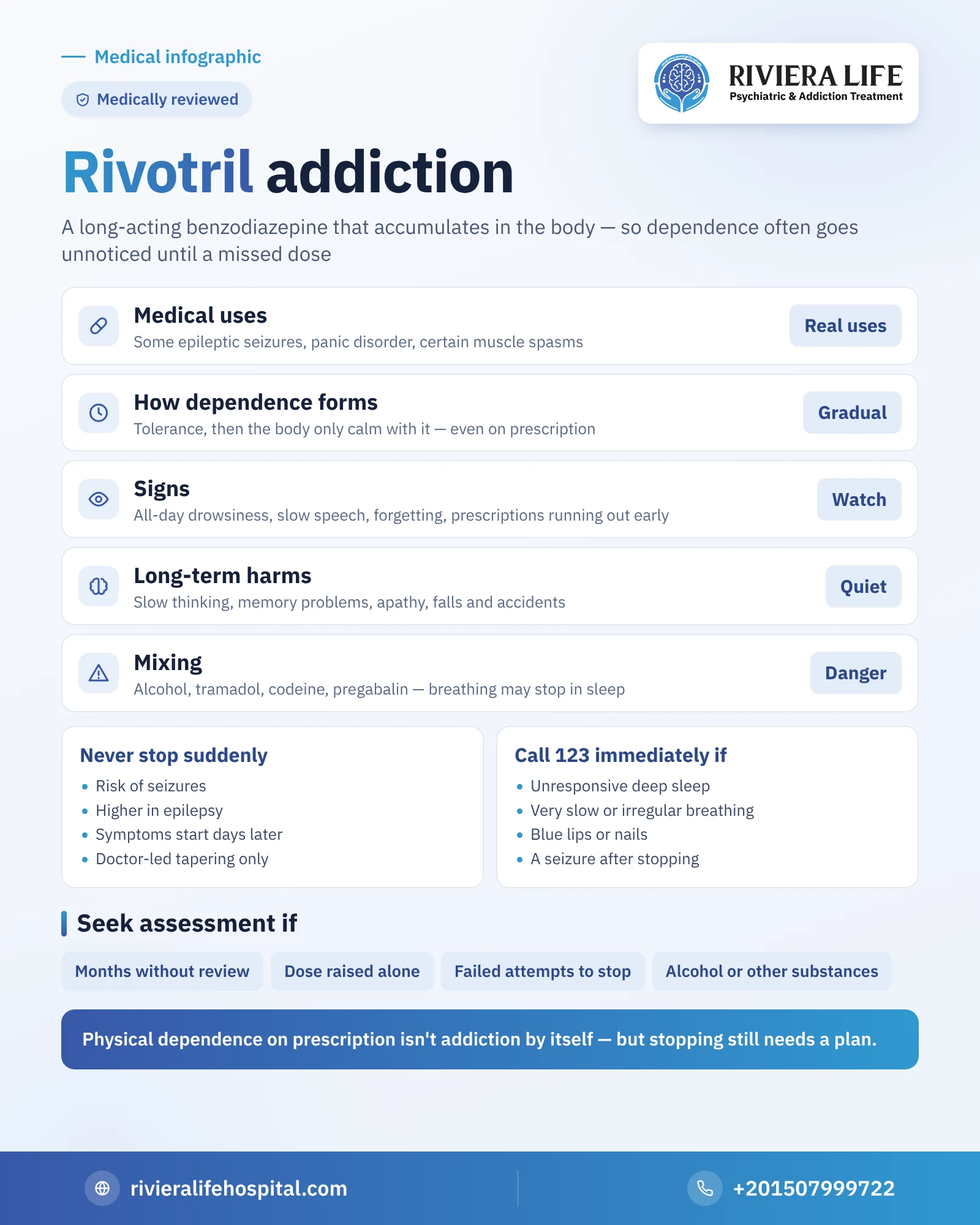
Rivotril addiction is physical and psychological dependence on clonazepam, a medicine from the benzodiazepine family that neurologists prescribe for epileptic seizures and psychiatrists prescribe for panic disorder. For many it starts with a completely correct prescription, then use extends for months or years without review, or turns into a tablet taken for sleep and escaping stress without a doctor.
This article is about dependence on the medicine and how it forms. If you are looking for Rivotril itself, what it is used for, when it starts working and its side effects, you will find that in our guide to Rivotril.
Clonazepam is sold in Egypt under brand names, best known as “Rivotril” and “Clozepam”, and everything we explain here applies to either because the active substance is the same.
The most dangerous thing is that its long action hides dependence, so the person doesn’t feel their need for it until they are days late with a dose. In this article we explain what clonazepam is, why dependence on it forms, its signs and harms, how it differs from Xanax addiction, and when to seek help.
What is Rivotril (clonazepam)?
Clonazepam is a medicinal substance that calms the nervous system by strengthening the action of an inhibitory neurotransmitter called GABA. In Egypt it circulates under brand names, best known as Rivotril and Amotril, and some people know it by its scientific name, clonazepam. It is a long-acting benzodiazepine, with a half-life in adults estimated at about a day and a half on average, with wide differences between people. This means the substance accumulates in the body with daily use, and leaves it only slowly after stopping.
Rivotril is subject in Egypt to the control of psychoactive medicines, so it is dispensed only on prescription, and trading it outside this framework is a legal violation. It belongs to the same benzodiazepine family that includes alprazolam and diazepam, but it has a different character, as we will see.
Why do doctors prescribe clonazepam?
Clonazepam has real medical uses, and understanding them helps the family not treat everyone who takes it as an addict:
- Epilepsy: used for some types of epileptic seizures, sometimes with other medicines, as set by the neurologist’s plan.
- Panic disorder: it reduces the frequency and severity of panic attacks, and is supposed to be part of a plan that includes psychotherapy and medicines that don’t cause dependence.
- Other neurological conditions: such as some types of muscle spasm and restless legs syndrome, as the doctor judges.
The problem doesn’t start with the prescription itself, but with the absence of follow-up: a medicine prescribed for weeks continues for years, or a dose changes without the doctor’s knowledge.
How does dependence on Rivotril form?
A brain receiving clonazepam daily gradually readjusts itself, reducing its sensitivity to the substance’s effect. After weeks, the same effect needs a larger dose; this is tolerance, and it is clearest in the sleep-inducing effect. Then the body reaches a stage where it only works calmly when the medicine is present, and physical dependence appears. This dependence may happen with full adherence to the prescription, and on its own doesn’t mean addiction, but it does mean stopping must be gradual.
Addiction goes beyond the body to behavior: taking the medicine for reasons other than those it was prescribed for, increasing the dose without the doctor’s knowledge, looking for more than one source, and continuing despite harm.
The prescription path and the misuse path
When it starts with a prescription
Imagine a woman in her forties prescribed Rivotril after repeated panic attacks. She improved within days, so she stayed on the same prescription for years, and whenever she tried to stop, stronger attacks returned after a few days, so she became convinced she couldn’t live without it. This is a common case of therapeutic dependence, and it often goes untreated because the person doesn’t see herself as addicted.
When it is used without a doctor
On the other side, some young people use clonazepam to get relaxation or to “calm” the effect of stimulants, or add it to tramadol, pregabalin or hashish to strengthen the sensation. Here the danger is doubled: unknown doses, unreliable sources, and mixing that depresses breathing. You will find the risk factors that make one person more vulnerable than another in our article on the causes of benzodiazepine addiction.
Signs of Rivotril addiction
Some signs are specific to clonazepam because of its long action:
- Constant drowsiness and heaviness throughout the day, not linked to when the tablet is taken.
- Slow speech and movement, and weak balance and coordination.
- Forgetting recent events and whole conversations.
- The prescription running out before it should, or moving between more than one doctor and pharmacy.
- Irritability, insomnia and anxiety appearing two or three days after forgetting the medicine, not hours.
- Emotional flatness and withdrawal from activities they used to love.
The full list of signs families notice across this whole family of medicines is in our article on benzodiazepine addiction symptoms.
The harms of long-term clonazepam use
Because the substance accumulates, its harms usually come quietly and gradually. Long-term users complain of slow thinking and weak concentration and memory, and of depression or apathy. The risk of falls and fractures rises, especially in older people, as does the risk of road accidents for those who drive under its influence. Anxiety and insomnia themselves may increase over time instead of improving, because the brain has come to rely on the medicine for calming. The full details of this family’s effect on body and mind are in our article on the harms of benzodiazepines.
Mixing with alcohol, opioids and pregabalin
Clonazepam alone rarely stops breathing in a healthy person, but the picture changes completely with mixing. Alcohol and opioids, including tramadol, heroin and cough medicines containing codeine, and pregabalin, are all substances that depress the nervous system. When they combine with Rivotril, their effect on the breathing center multiplies, so breathing slows and may stop during sleep. Clonazepam’s long action means the danger doesn’t end after a few hours, but may continue if another substance is taken the next day.
How does Rivotril addiction differ from Xanax addiction?
Both are from the same family, but the difference in timing changes the whole experience:
| Comparison | Rivotril (clonazepam) | Xanax (alprazolam) |
|---|---|---|
| Time in the body | Long, and it accumulates with daily use | Relatively short |
| Feeling between doses | Usually steady, so dependence is discovered late | A dip and anxiety before the next dose |
| Start of withdrawal after stopping | After about days | Within hours to a day |
| Length of withdrawal | Usually longer and slower | Shorter but sharper |
| Main medical use | Epilepsy and panic disorder | Generalized anxiety and panic |
The bottom line is that Xanax reveals dependence quickly, while Rivotril hides it. Those who want to go deeper into the other case will find it explained in our article on Xanax addiction.
Why must Rivotril not be stopped suddenly?
After regular use, stopping suddenly may lead to seizures, and this risk is higher in someone with epilepsy, whose seizures may return strongly or come in succession. The long action deceives the patient: they stop and feel fine for a day or two, then the symptoms begin when they have moved away from any follow-up. That is why adjusting the dose or stopping remains a decision made by the treating doctor alone, with a gradual reduction plan. The expected timing and stages of symptoms are explained in our article on Rivotril withdrawal symptoms.
When should you seek help?
Ask for a specialist assessment if use has continued for months without review, the dose has increased without the doctor’s knowledge, attempts to stop have failed, or alcohol or another substance has come into the picture. The aim of the assessment isn’t to judge the person, but to set a safe plan that treats the dependence and the original cause together, as our article on Rivotril addiction treatment explains.
Call an ambulance on 123 immediately if you see
Especially if Rivotril has been mixed with alcohol, tramadol, pregabalin or any opioid painkiller.
- Deep sleepiness with no response to calling or shaking
- Very slow or irregular breathing, or unusual snoring
- Blue lips or nails
- A seizure after stopping the medicine
- Severe confusion or hallucinations
At Riviera Life, dealing with clonazepam cases starts with a confidential assessment that distinguishes therapeutic dependence from addiction, coordinating with the neurologist when the patient has epilepsy.
More from our benzodiazepine guide
- Benzodiazepines: the complete guide
- Rivotril withdrawal symptoms
- Rivotril addiction treatment
- Xanax (alprazolam) addiction
- Apetryl vs Amotril: one substance, clonazepam — so what differs?
- Valium vs Rivotril: use, duration, dependence and withdrawal
Questions many people ask
Both are brand names for the same substance, clonazepam, so they share the same characteristics and risks in terms of dependence and withdrawal.
Physical dependence may form with long regular use even when sticking to the prescription; it differs from behavioral addiction, but it means stopping must be gradual under the doctor's supervision.
Not necessarily more dangerous, but different: it stays in the body longer so dependence on it is discovered later, and its withdrawal starts after days and lasts longer.
No. Stopping without a plan may bring seizures back strongly. Any adjustment is decided by the treating neurologist, in coordination with the psychiatrist if there is dependence.
All are substances that depress the nervous system, and combining them doubles the risk of slowed breathing and coma, especially during sleep or with alcohol.