The withdrawal symptoms of Rivotril don’t usually appear on the first day after stopping; they are typically delayed by about two days to a week, because clonazepam stays in the body for a long time and leaves it slowly. After this deceptive calm, anxiety and insomnia return strongly, tremor, tension and sensitivity to sound and light appear, and severe cases may reach seizures or delirium. The acute phase usually lasts weeks, and milder symptoms may remain for months in those who used the medicine for a long time. That is why Rivotril is only stopped with a gradual tapering plan set and monitored by the treating doctor.
These symptoms and their timing also apply to withdrawal from “Clozepam”, another brand name for the same clonazepam.
Why is Rivotril withdrawal delayed?
Clonazepam’s half-life is long, estimated in most adults at roughly one to two days. With daily use the substance builds up in the body, so when a person stops, its level doesn’t drop all at once but declines slowly over days. During these days everything seems normal, and the patient may think they got through it easily. Then the level reaches a point that isn’t enough to calm a nervous system that has been used to the medicine for months, and the symptoms begin.
This delay is a double-edged sword. It makes withdrawal less intense at the start than with short-acting medicines, but it deceives the patient and the family: the person stops on Friday, goes back to work, then has a severe episode in the middle of the following week, having thought the danger had passed. The general picture of withdrawal for the whole family is in our article on benzodiazepine withdrawal symptoms; here we focus on what is specific to clonazepam.
The timeline of Rivotril withdrawal
The following timings are approximate, and vary with the dose, length of use, age and speed of stopping.
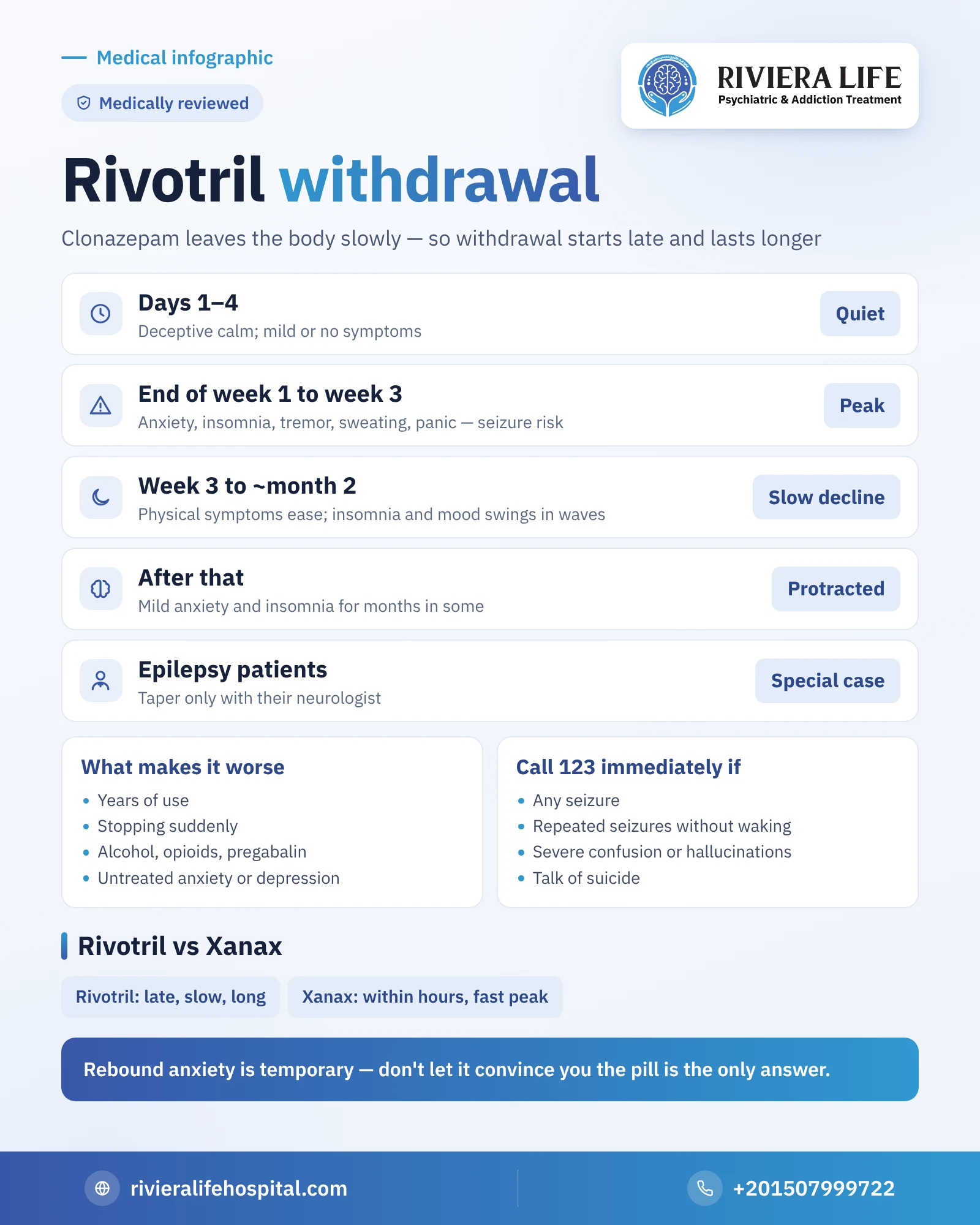
The first days: a deceptive calm
Roughly two to four days may pass with mild symptoms or none. The patient may notice slight difficulty sleeping or passing tension, and not link it to stopping.
From the end of the first week to the third week: the peak
In this period symptoms intensify in most patients: high anxiety, severe insomnia, tremor, sweating, palpitations, muscle tension and panic attacks. This is when the risk of seizures is highest for those who stopped suddenly after long use or high doses.
From the third week to roughly the end of the second month: slow decline
Physical symptoms gradually settle, while insomnia, poor concentration and mood swings remain. Symptoms often come in waves, with good days followed by a difficult one.
After that: protracted symptoms
In some patients mild anxiety, insomnia and sensitivity to stress continue for months, with steady but slow improvement.
Physical and psychological symptoms
- Physical: hand tremor, sweating, palpitations, headache, muscle aches and cramps, nausea, dizziness, ringing in the ears, and tingling in the limbs.
- Psychological: severe anxiety, panic attacks, irritability and quick temper, depression, and a feeling of being detached from oneself or reality.
- Sensory: exaggerated discomfort from light, sounds and touch, and sometimes disturbed perception.
- Cognitive: poor concentration and difficulty following reading or long conversations.
Rebound anxiety and insomnia
What the patient suffers most in clonazepam withdrawal is the return of anxiety and insomnia more severely than they were before the medicine. Doctors call this rebound, because a nervous system that was held back surges in the opposite direction when the medicine is lifted. The most dangerous thing about rebound is that it convinces the patient that their original illness has returned and that the only treatment is the pill. The important difference is that rebound is temporary and eases over weeks, while the return of the original disorder comes with the same pattern of old symptoms and persists. Telling them apart is a psychiatrist’s job, and it changes the plan: the first needs patience and support, the second needs treatment that doesn’t cause dependence.
The risk of seizures: epilepsy patients are a special case
Benzodiazepine withdrawal is one of the few situations where withdrawal itself can be life-threatening. A seizure can happen in someone who has never had epilepsy, especially after long use and sudden stopping, or with alcohol mixed in. For someone taking clonazepam to treat epilepsy, stopping it without a plan can bring their seizures back severely or cause repeated seizures without regaining consciousness in between, which is an emergency. That is why the medicine is only reduced for an epilepsy patient in coordination with the neurologist who follows them.
Call an ambulance on 123 immediately if you see
Danger signs may be delayed for days after the last Rivotril tablet — don't be reassured because the first days passed quietly.
- A seizure or epileptic fit, even once
- Repeated seizures without the patient waking in between
- Severe confusion or not recognizing places and people
- Visual or auditory hallucinations
- Violent tremor with a very fast pulse and heavy sweating
- Talk of suicide or self-harm
Protracted symptoms after withdrawal
After the acute phase ends, some patients go through a period of mild, fluctuating symptoms: anxiety that appears for no clear reason, broken sleep, poor concentration, and intermittent tingling or muscle tension. These symptoms don’t mean the brain has been permanently damaged, but that it is still readjusting. Knowing this in advance protects the patient from giving up and going back to the medicine in the second or third month, a common time for relapse.
What makes withdrawal more severe or longer?
- A long period of use; someone who used the medicine for years differs from someone who used it for weeks.
- Stopping suddenly instead of tapering gradually.
- Mixing with alcohol, opioids or pregabalin.
- Epilepsy or previous seizures.
- An untreated anxiety disorder or depression.
- Older age or weaker liver function.
Why is tapering done under supervision?
The goal isn’t for the patient to stop as quickly as possible, but to stop safely. The doctor assesses the actual dose, the accompanying substances and the history of seizures, then sets a plan to reduce in stages, leaving enough time between each step. Clonazepam’s long action makes tapering relatively smoother than with short-acting medicines, but it also means the effect of each step only shows days later, so it takes patience and monitoring so the steps don’t pile up too quickly.
The plan is adjusted if symptoms intensify. We don’t publish tapering schedules or doses here, because any change in dose or stopping must be done with the doctor who prescribed the medicine. The full stages of treatment after withdrawal are explained in our article on Rivotril addiction treatment.
Do symptoms appear during tapering itself?
Yes, and this is expected. Gradual tapering doesn’t eliminate withdrawal; it makes it bearable and less dangerous. After each step the patient may have days of insomnia or tension, then settle before the next step. And because the effect of a reduction is delayed with clonazepam, symptoms may come days after the step rather than on the day, so the patient may wrongly think something else caused them. The solution is to tell the doctor rather than going back to the previous dose on your own.
How does it differ from Xanax withdrawal?
Xanax withdrawal begins within hours and peaks quickly, while Rivotril withdrawal is delayed and lasts longer at a slower pace. For this same reason, doctors sometimes switch a Xanax patient to a long-acting medicine before tapering. Anyone wanting to compare the timings will find the details of the other case in our article on Xanax withdrawal symptoms.
How can the family support the patient?
Don’t be reassured by the calm of the first days, and keep watching over the following two weeks. Record the symptoms and their timing to show the doctor, reduce noise at home, and don’t give him any sleeping pill or sedative from the home medicine cabinet however much he insists. To understand how the dependence formed in the first place, see our article on Rivotril addiction. At Riviera Life, withdrawal can be done with an inpatient stay under round-the-clock medical supervision when the dose is high or there is epilepsy or mixing with other substances.
More from our benzodiazepines guide
- Benzodiazepines: the complete guide
- Rivotril (clonazepam) addiction
- Rivotril addiction treatment
- Benzodiazepine withdrawal symptoms
Questions many people ask
Usually about two days to a week after the last dose, because clonazepam leaves the body slowly; the timing varies with the dose and length of use.
The acute phase usually lasts several weeks, and milder symptoms such as anxiety and insomnia may remain for months in those who used the medicine for a long time, with gradual improvement.
It can after stopping suddenly, especially with long use, epilepsy or mixing with alcohol, which is why tapering must be gradual and medically supervised.
Not always. It is often temporary rebound anxiety that eases over the weeks, and a psychiatrist is the one who distinguishes it from the original disorder returning.
Don't adjust the dose yourself; tell your doctor, who may slow the plan. Random adjustments prolong withdrawal and confuse follow-up.