Rivotril addiction treatment rests on four connected steps: an assessment that establishes why the patient started clonazepam and how he uses it now, then a slow gradual taper under medical supervision, then treatment of the original problem, whether panic, anxiety or epilepsy, then follow-up that prevents relapse.
For those who want to understand the medicine before starting the plan, our Rivotril medicine guide explains its medical uses, effects and interactions.
The same plan suits those used to clonazepam under the name “Clozepam” or any brand name other than Rivotril.
The medicine’s long action makes the taper calmer in rhythm but longer in duration, and it may extend for months for someone who used it for years. The fixed rule is that any reduction or stopping happens with the treating doctor, not at home by individual decision. In this article we explain each stage, how treatment differs if the patient has epilepsy, and how to choose the right hospital.
What makes clonazepam treatment different from others?
A Rivotril patient usually comes by one of two routes: a prescription for panic or epilepsy that stretched over years, or use without a doctor mixed with other substances. The two routes need different plans. The first may not see himself as addicted, and fears his illness will return if he stops, and he may be partly right if he has epilepsy. The second needs treatment for several substances together. On top of that, clonazepam leaves the body slowly, so the effect of each step in the taper only appears after days, which requires a patient doctor who doesn’t rush the steps. For the general picture of treating this family, see our article on benzodiazepine addiction treatment.
Stages of Rivotril addiction treatment
- Comprehensive assessment: the reason for the original prescription, the actual dose, accompanying substances, and history of seizures.
- Medical coordination: with the neurologist if the patient has epilepsy.
- Slow gradual taper: reduction in stages with enough waiting time between steps.
- Treating the cause: panic, anxiety or insomnia with methods that don’t cause dependence.
- Preventing relapse: a written plan, follow-up after discharge and a clear role for the family.
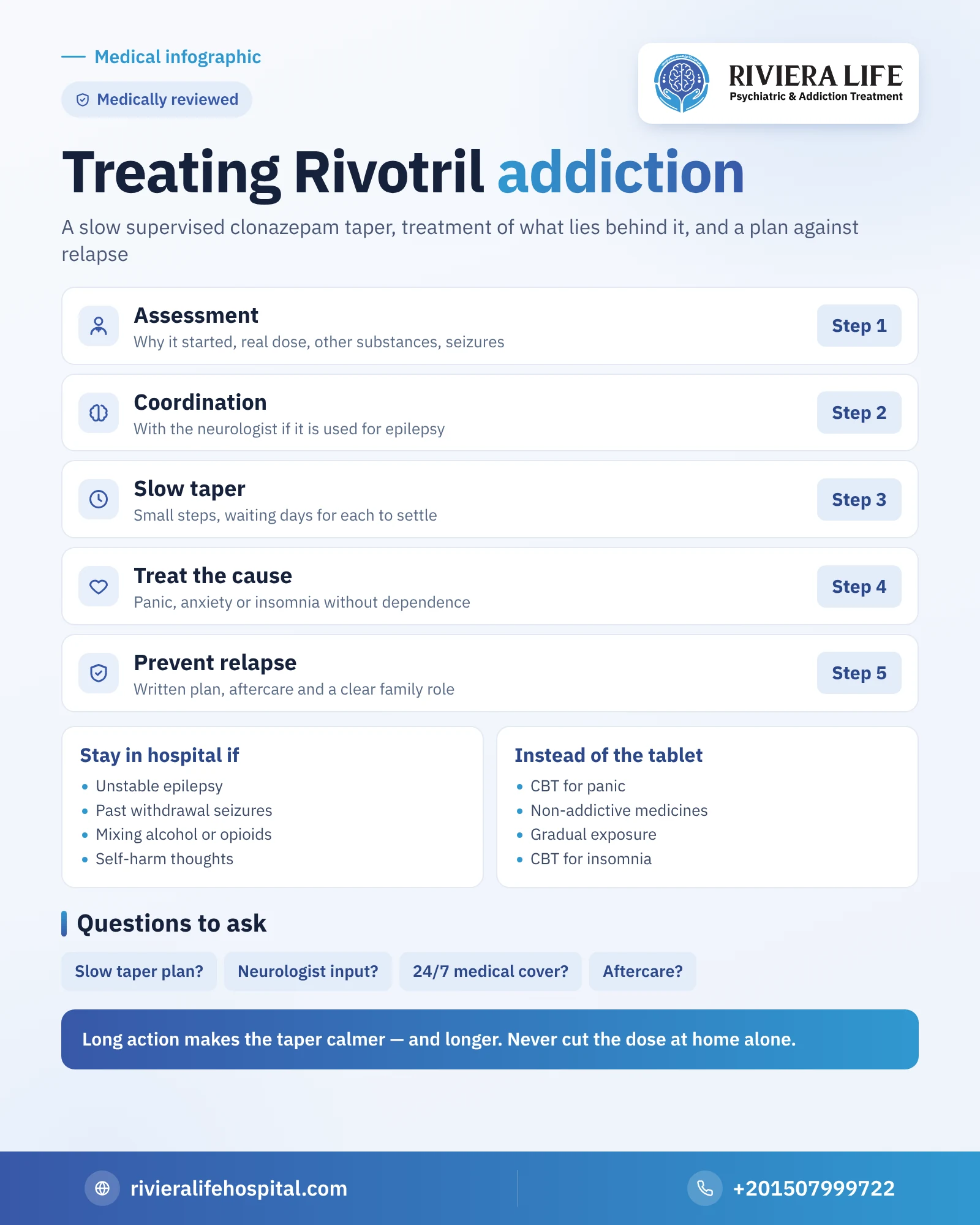
Assessment: why did the medicine start, and where has it got to?
The first question the doctor asks isn’t how many tablets you take, but why you started. The plan for a woman with panic differs from the plan for a young man mixing clonazepam with tramadol, and differs from the plan for an epilepsy patient. Then come the rest of the questions: since when? Has the dose increased without the doctor’s knowledge? Is there alcohol, pregabalin or opioids? Have there been seizures before? Are there thoughts of self-harm? This is completed with a medical examination and the necessary tests. Honesty here protects the patient, because a plan built on untrue numbers may end in a seizure.
The slow gradual taper
Clonazepam’s long action is an advantage in tapering: its level in the blood falls calmly, so it usually doesn’t need switching to another medicine as sometimes happens with short-acting medicines. But the same advantage imposes slowness, because the effect of each reduction is delayed by days. That is why the plan is divided into small steps, and after each step there is a wait until the patient settles before the next step.
The process may take weeks in short cases, and months for someone who used the medicine for years. The pace follows the patient’s response, not a fixed schedule, which is why we don’t publish reduction schedules. What the patient can expect in terms of symptoms during this period is explained in our article on Rivotril withdrawal symptoms.
The epilepsy patient: treatment in coordination with the neurologist
If clonazepam is part of epilepsy treatment, the question isn’t only how to stop it, but what will protect the patient from seizures afterward. Here the psychiatrist and neurologist work together: the neurologist decides whether the patient needs another epilepsy medicine or an adjustment to his current medicines before the reduction, and the psychiatrist follows the dependence and withdrawal symptoms. In some cases the team may decide that the patient really needs the medicine, so the goal becomes controlling use and preventing increases, not stopping completely. In all cases, the medicine isn’t reduced for an epilepsy patient without his doctor’s agreement.
Treating panic and anxiety without sedatives
Many who depend on Rivotril started it to treat panic attacks, and successful treatment means the patient learns to face the attack without the tablet. Among the most important approaches:
- Cognitive behavioral therapy for panic: it explains to the patient that the physical symptoms of an attack are distressing but not dangerous, and trains him not to flee from them.
- Medicines that don’t cause dependence: some antidepressants are used for anxiety and panic disorders, and the doctor chooses them according to the case.
- Gradual exposure: returning step by step to the places and situations the patient avoids for fear of an attack.
To learn more about this treatment approach, see our article on cognitive behavioral therapy, and for anxiety treatment options in general, our article on anxiety treatment.
Cognitive behavioral therapy for insomnia
Insomnia is the complaint that takes many back to Rivotril in the second or third month. The solution isn’t a new sleeping pill that repeats the problem, but an organized behavioral program: fixed times for sleeping and waking, not staying in bed awake for long periods, avoiding screens and stimulants in the evening, and learning to deal with thoughts that prevent sleep. Improvement comes gradually, and knowing this in advance prevents frustration.
Hospital stay or outpatient follow-up?
Some cases are managed with outpatient follow-up, especially if the prescription is regular, the dose isn’t high and there is no mixing. A hospital stay is usually safer when there is unstable epilepsy, previous seizures with withdrawal, mixing with alcohol, opioids or pregabalin, failure of previous attempts, or depression with thoughts of self-harm.
Preventing relapse and the family’s role
Relapse with clonazepam usually comes at a moment of anxiety or a sleepless night, or through a new prescription from a doctor who doesn’t know the history. That is why the preventive plan includes informing every doctor who treats the patient of his history with sedatives, setting out what he does at the first panic attack after stopping, and whom he calls. The family’s role is to support without suffocating monitoring: noticing the return of drowsiness or forgetfulness, encouraging attendance at sessions, and not keeping sedatives at home. If a relapse happens, it isn’t the end of the road, and we have dedicated our relapse treatment program to it. To understand the condition from its beginning, see our article on Rivotril addiction.
The right hospital for Rivotril addiction treatment: how to choose
The right hospital for Rivotril addiction treatment is a place able to taper a long-acting medicine slowly and safely, while treating the panic or anxiety, or coordinating the treatment of the epilepsy, that lies behind it. Ask before you decide:
- Does a psychiatrist specialized in addiction set a slow taper plan that takes into account the delayed effect of each step?
- Does the team coordinate with a neurologist if the patient takes the medicine for epilepsy?
- Is there round-the-clock medical supervision to deal with seizures if they happen?
- Is mixing with alcohol, pregabalin or opioids treated within the same plan?
- Does it offer cognitive behavioral therapy for panic and insomnia, not just stopping the tablet?
- Does follow-up continue after discharge throughout the period of protracted symptoms?
Beware of any place that promises you a guaranteed recovery rate or an end to Rivotril dependence within days.
How Riviera Life meets these standards
Here is how these criteria are met at Riviera Life:
- Official license: a hospital licensed by the Ministry of Health for psychiatry and addiction treatment.
- Specialist consultants: consultants in psychiatry and addiction treatment set a slow taper plan and adjust it at every step.
- 24-hour medical supervision: continuous monitoring in the weeks when the risk of seizures is higher.
- Treatment for panic and insomnia: a psychological program that treats the reason that led to clonazepam.
- Fourteen years of experience: thousands of recovered cases, including cases of mixing sedatives with other substances.
- A family program: sessions that explain to the family the nature of delayed withdrawal and how to support without pressure.
- Aftercare: follow-up after discharge covering the period of protracted symptoms.
- Complete confidentiality: the patient’s data and condition aren’t shared with any party.
The first consultation is free, and the family can start with it before the patient agrees. Contact us around the clock on +201507999722, or visit us in Sheikh Zayed, Giza.
More from our benzodiazepines guide
- Benzodiazepines: the complete guide
- Rivotril (clonazepam) addiction
- Rivotril withdrawal symptoms
- Valium addiction treatment
Questions many people ask
The taper alone may extend from weeks to months depending on the duration of use, because the effect of each step is delayed by days, and psychological follow-up then continues for longer.
Usually not, because clonazepam is long-acting and can be reduced directly, but the doctor may add helping medicines for anxiety or sleep depending on the case.
Yes, but with a plan in which the neurologist takes part to decide what protects against seizures, and sometimes the goal may be controlling use rather than stopping completely.
Cognitive behavioral therapy is one of the most effective approaches for panic, and alongside it the doctor may prescribe medicines that don't cause dependence, such as some antidepressants.
Look for slow supervised tapering, round-the-clock medical cover, coordination with a neurologist for epilepsy, treatment for panic and insomnia, and aftercare. Riviera Life in Sheikh Zayed meets these criteria, is licensed by the Ministry of Health, and offers a free first consultation.