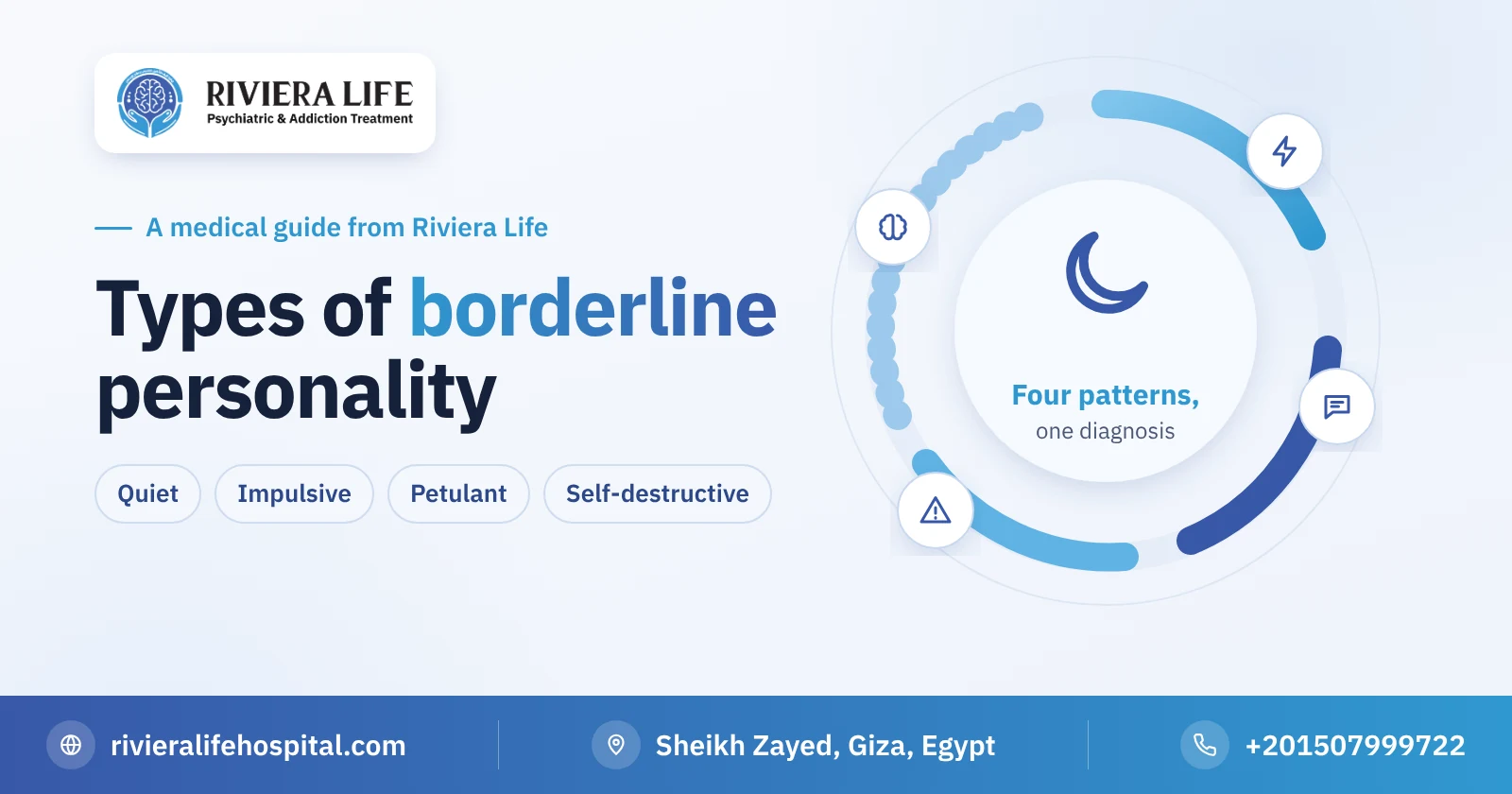
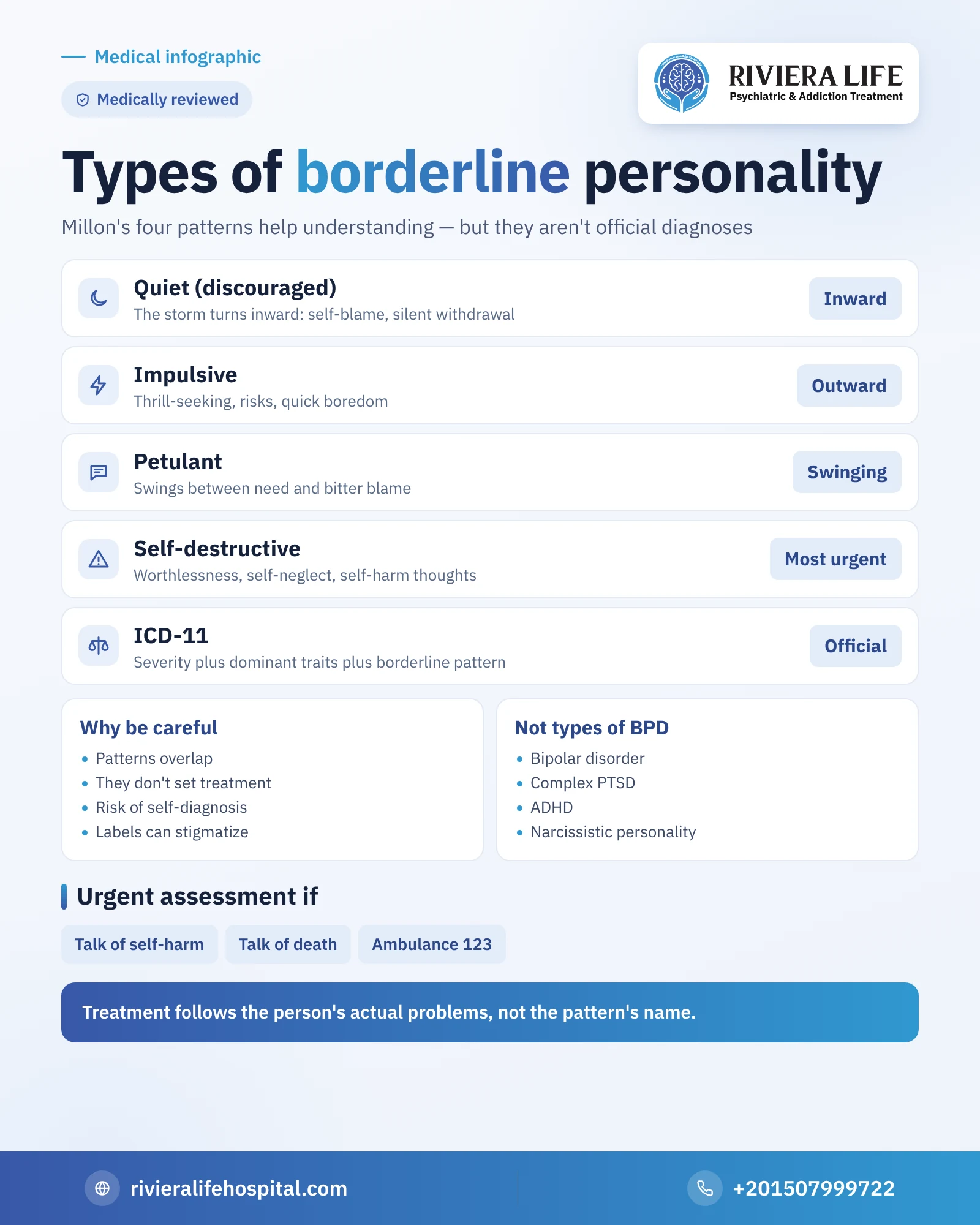
The widespread talk about the four types of borderline personality, the quiet, impulsive, petulant and self-destructive, is based on subtypes described by the psychologist Theodore Millon, which websites then simplified and renamed. These patterns aren’t official diagnoses; the American diagnostic manual in its fifth edition treats borderline personality as a single diagnosis without types, and the International Classification of Diseases in its eleventh edition describes the severity of personality disorder and its dominant traits instead of types.
Even so, the four patterns are useful in understanding that the disorder looks different from one person to another. In this article we explain each pattern and the differences between them, then clarify what the official classification says, and what resembles borderline personality without being a type of it.
Does borderline personality have official types?
No. When a doctor diagnoses borderline personality according to the American manual, they write a single diagnosis without adding “quiet type” or “impulsive type”. The manual places this disorder within a cluster of personality disorders united by intense emotion and instability, which also includes antisocial, histrionic and narcissistic personality disorders. The differences between those affected are described by the doctor in their report according to each person’s most prominent signs, not by naming a subtype.
Where did the four patterns come from?
Theodore Millon, one of the most prominent researchers in personality disorders, proposed that people with borderline personality tend towards four patterns depending on the other traits that blend with the disorder: the discouraged, the impulsive, the petulant and the self-destructive. This was a theoretical description to help therapists understand cases, not an approved diagnostic classification. As it spread online, the “discouraged” pattern often came to be called “quiet”, and the patterns turned in many minds into official “types”, which is inaccurate.
The quiet (discouraged) pattern
Here the storm turns inward. The person seems calm and cooperative, and may please everyone at their own expense, but inside they live with an intense fear of rejection, harsh self-blame, and recurring sadness and shame. They suppress their anger instead of showing it, and may withdraw silently when hurt. Because the family sees no outbursts, this pattern often goes undiagnosed, or is diagnosed as depression or anxiety only. Picture a woman who smiles in front of guests, then spends the night replaying every word she said and convincing herself that they hate her.
The impulsive pattern
It is dominated by seeking excitement, movement and attention. The person is attractive and full of energy at first, but quickly bored, jumps between relationships and projects, and takes risks in driving, spending, relationships or substance use without counting the consequences. Under this impulsiveness there is often a fear of loneliness and emptiness. This pattern is more prone to substance problems, so its assessment needs a frank question about substances such as cannabis and sedative pills.
The petulant pattern
The name is taken from the popular description, and means the moody, discontented one. The person swings between an intense need for others and a bitter feeling that they let them down, so they get angry, blame and complain, then cling again. They seem to object a lot and to be hard to please, and inside they feel unappreciated whatever they do. This pattern shows clearly in marriage and work, where disputes repeat with almost the same script.
The self-destructive pattern
In it, anger and frustration are turned strongly against the self. The person is dominated by a feeling of worthlessness, may neglect their health and get into situations that harm them, and has more thoughts of self-harm. This pattern in particular needs the greatest attention and seriousness: any talk of self-harm or death isn’t treated as exaggeration, but calls for urgent assessment, and calling an ambulance on 123 or going to the nearest emergency department when there is immediate danger.
The warning signs are detailed in borderline personality disorder symptoms. Some people call this tendency to harm oneself “masochism”, but the difference between them is clear in our guide to masochism in its psychological and medical sense.
A quick comparison of the four patterns
| Pattern | Direction of emotion | What others see | What people misread |
|---|---|---|---|
| Quiet | Inward | Calm and pleasing others | Read as shyness or depression only |
| Impulsive | Outward through risk-taking | Energy, charm and adventure | Read as recklessness or addiction only |
| Petulant | Swinging between need and blame | Complaints and anger, then clinging | Read as a bad temper |
| Self-destructive | Strongly against the self | Self-neglect and harmful situations | Read as indifference |
In reality most people carry features of more than one pattern, and the same person may move from one picture to another depending on their circumstances and age.
Why be careful with these classifications?
- The overlap is large: a single pattern rarely fits a person completely.
- They don’t determine treatment: the doctor chooses the plan according to the actual problems, such as self-harm, substance use or accompanying depression, not according to the pattern’s name.
- The risk of self-diagnosis: reading a description of the “quiet pattern” may make someone worry needlessly, or wrongly reassure them because they don’t explode.
- Stigma: labels such as “petulant” may turn into an insult at home instead of being a tool for understanding.
How does the international classification describe personality disorder today?
The eleventh edition of the International Classification of Diseases changed the way all personality disorders are viewed. The doctor now first determines whether there is a personality disorder, then its degree: mild, moderate or severe. After that they describe the dominant traits across five domains: negative affectivity, detachment, dissociality, disinhibition and anankastia. And because borderline personality is a well-established concept in practice, the classification added a separate specifier called the “borderline pattern”. The American manual itself has an alternative model for research that moves in a similar direction.
What resembles borderline personality without being a type of it
- Bipolar disorder: mood episodes that last days or weeks with a clear beginning and end, while mood in borderline personality swings within hours. The details are in our guide to bipolar disorder.
- Complex post-traumatic stress disorder: shares with it difficulty regulating emotion, but is linked to repeated trauma with intrusive memories and avoidance, and the two may occur together.
- Attention-deficit/hyperactivity disorder: impulsiveness and distraction since childhood without the central fear of abandonment.
- Other personality disorders: such as narcissism, which is dominated by a sense of being special, not fear of loss.
How does the family deal with each picture?
The patterns aren’t a diagnosis, but they may help the family not to misread what it sees:
- With the quiet picture: don’t take silence as a sign of contentment. Ask gently what they feel, give them time to answer, and praise their honesty when they express their distress.
- With the impulsive picture: set clear limits on money, the car and late nights before the crisis, not during it, and watch early for any sign of substance use.
- With the discontented picture: don’t enter a race of blame. Acknowledge the feeling in a short sentence, then postpone the discussion until both sides have calmed down.
- With the self-destructive picture: take any sign of self-harm completely seriously, keep surplus medicines out of reach, and don’t postpone assessment.
In all cases, remember that steady limits and calm reassure more than big promises or threats.
Does the pattern change the way of treatment?
Not fundamentally. Proven programs, such as dialectical behavior therapy and mentalization-based therapy, were designed for the disorder itself, and the therapist adapts them according to what dominates in each person: the quiet pattern may need more training in expressing needs, and the impulsive pattern a focus on control and substance use. The details of the plan are in borderline personality disorder treatment. At Riviera Life, naming the pattern isn’t enough; consultant psychiatrists carry out a full assessment that determines what the person really needs, and the first consultation is free.
More from our borderline personality guide
- Borderline personality disorder: the complete guide
- Borderline personality disorder symptoms
- The causes of borderline personality disorder
- Borderline personality disorder treatment
Questions many people ask
No. "Quiet" is a popular description taken from a pattern proposed by Theodore Millon, and doesn't appear in the American manual or the international classification. The doctor writes only a diagnosis of borderline personality disorder and describes the most prominent symptoms.
No type is more dangerous in itself; the danger is determined by the actual signs, most importantly thoughts of self-harm and substance use. Any talk of self-harm calls for urgent assessment whatever the pattern.
Yes, most people carry features of more than one pattern, and the dominant picture may change with age, circumstances and treatment.
It sets the severity of personality disorder from mild to severe, describes the dominant traits, and adds the borderline pattern specifier when it applies, instead of dividing the disorder into types.
No. The American manual places them in one cluster because they share intense emotion, but the core of borderline personality is fear of abandonment and an unstable self, not a sense of being special.