Borderline personality and addiction come together in many cases, and the reason is usually that severe emotional pain and impulsivity, the heart of the disorder, push toward seeking quick relief in alcohol, drugs or pills. Then use comes and increases swings, impulsivity and conflicts, so the cycle turns. This article explains why the two are linked, how each changes the other, what makes treatment harder and more possible than people think, and how a program that treats both conditions together works. Diagnosis is made by a psychiatrist after a careful assessment, because the effect of substances itself may resemble the symptoms of the disorder.
Borderline personality and addiction: how much do the two conditions overlap?
Studies indicate that substance use disorder is among the most common conditions accompanying borderline personality, and that a large proportion of those affected go through a substance problem in their lives, clearly higher than the general population. On the other hand, borderline disorder is discovered in a considerable group of those seeking addiction treatment. The numbers differ by country and method of measurement, so we don’t rely on a specific percentage, but the direction is constant: whoever suffers from one is checked for the other.
Why does borderline lead to use?
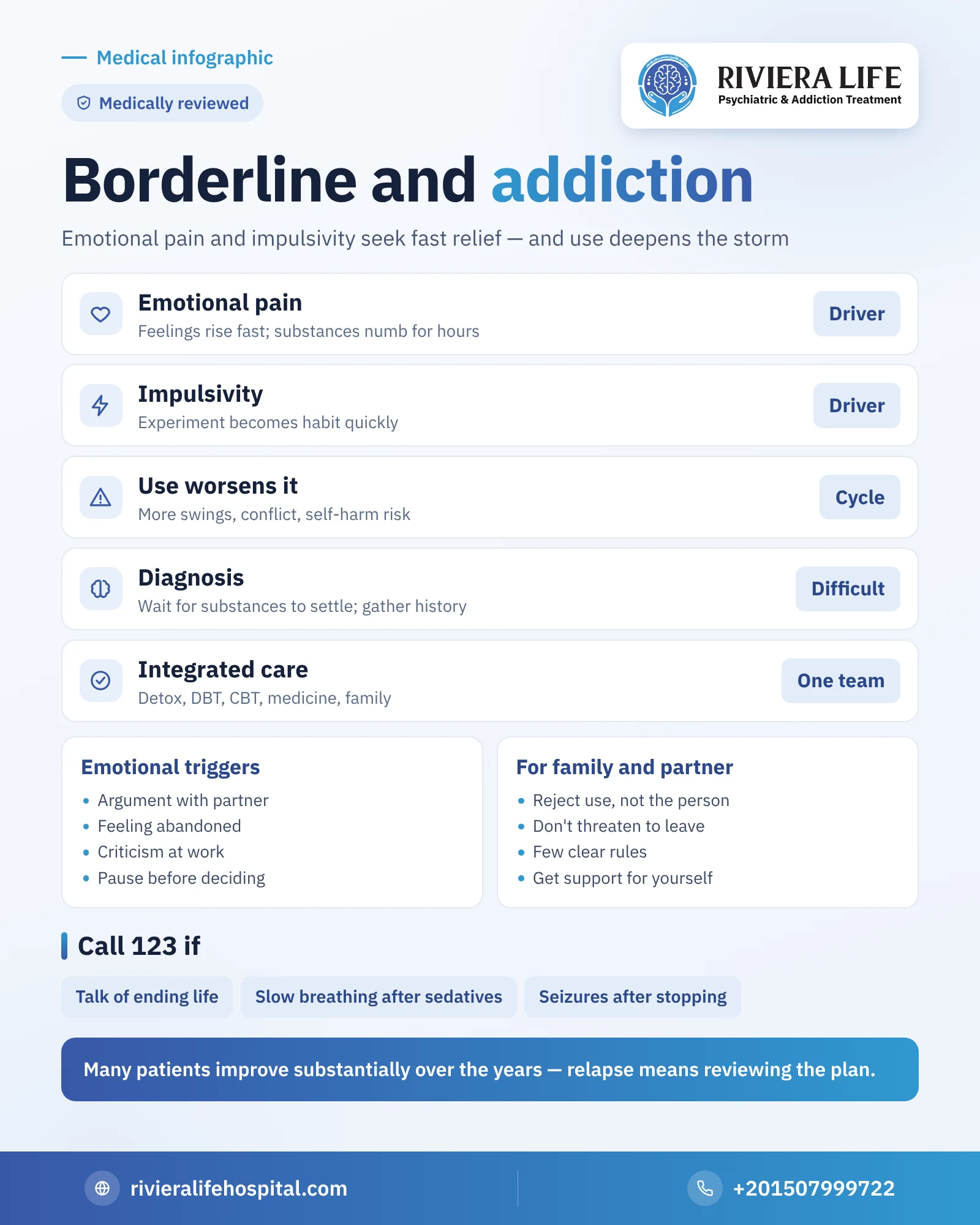
- Acute emotional pain: feelings that rise quickly and stay heavy, and drugs or alcohol are the fastest “anesthetic” for them, even if for hours.
- Impulsivity: difficulty stopping before acting, so the experiment quickly turns into a habit.
- Chronic emptiness: a feeling of inner hollowness that the substance or excitement tries to fill.
- Fear of abandonment: the person may enter into use to stay with a partner or group who use.
- A painful past: many with both conditions went through trauma or neglect in childhood, a shared ground for both. For detail see the causes of borderline personality.
And how does use make borderline worse?
Substances don’t calm the storm, but delay it and then increase it. Alcohol weakens emotional control and judgment, so conflicts and impulsivity increase. Sedatives and sleeping pills give temporary clarity then a rebound of anxiety when they wear off. Stimulants ignite tension and suspicion. And the withdrawal periods themselves cause disturbance in mood and sleep, so the borderline symptoms seem more severe. Most dangerously, use raises the risk of self-harm and reckless actions, because the barrier between feeling and action weakens.
That is why doctors see that the two conditions aren’t two separate problems each treated in its own circumstance, but one tangled problem. To learn the basic signs of borderline personality see borderline personality symptoms.
Diagnostic difficulty: what do doctors mix up?
Use and withdrawal cause mood swings, anger, anxiety and dark thoughts, so it is hard to know whether these symptoms are a personality disorder or the effect of substances. That is why the diagnosis isn’t usually settled in the first weeks after stopping. The doctor waits until the effect of substances calms, and gathers the history from the patient and family: did these patterns exist before use? And did they appear during periods of abstinence? What matters is that treatment isn’t postponed until the diagnosis is complete.
Patterns of use in people with borderline personality
Not everyone uses the same substance in the same way. Some use in bursts at moments of emotional explosion after a dispute or feeling of rejection, and some use daily to suppress emptiness and tension. Some mix different substances or add pills to alcohol, which is among the most dangerous patterns because mixing sedatives multiplies the danger to breathing. Some also turn to other addictive behaviors such as compulsive eating, spending or reckless relationships, and one may replace another if one is treated and the others left. Knowing the person’s pattern helps the team choose the most suitable coping skills.
When is improvement realistic?
Experience shows that many patients who committed to specialized psychotherapy for years had their symptoms ease, and that some of them no longer met the criteria of the disorder over time. In cases accompanied by addiction the road is longer but not closed. What raises the chances of improvement: the patient staying in treatment despite relapses, a good relationship with the therapist, a less tense home environment, and a clear plan for emotional crises that sets who to call and what to do before turning to the substance.
Integrated treatment: what works?
Good treatment rests on one team that treats both conditions at the same time, according to these general pillars:
- Safe detox: under medical supervision, especially in cases of alcohol and sedatives because withdrawal from them may be dangerous.
- Dialectical behavior therapy: the most studied type of therapy for borderline personality, it teaches skills of distress tolerance and emotion regulation, and there are versions of it designed for substance use too. The full definition is in dialectical behavior therapy.
- Cognitive behavioral therapy and relapse prevention: recognizing triggers and building alternatives for dealing with them.
- Medicine when needed: the doctor may prescribe medicines for certain symptoms such as depression, anxiety or insomnia, and others that help with abstinence, without mentioning doses here. Doctors take great caution with sedatives because their addictive potential is high.
- The family: teaching the patient’s family how to set clear limits without abandonment or harshness.
You will find a description of this model in the dual diagnosis program.
The role of emotional triggers
Most episodes of returning to use in people with both conditions don’t come out of nowhere, but after an emotional event: a dispute with the partner, a feeling that a friend abandoned them, or criticism at work. In these moments the pain accelerates faster than the person can calm it. That is why good treatment focuses on training the patient in “before the substance”: noticing the rise of emotion early, having short means to calm the body such as changing place, moving or calling an agreed person, and waiting minutes before any decision, because the peak of craving usually falls if it isn’t fed.
Relapse doesn’t mean failure
A return to use midway is common in people with both conditions. What matters is how it is understood: it is a signal that a skill hasn’t settled yet or that a new trigger has appeared, not evidence that treatment is useless. And there is a big difference in outcome between a team that punishes relapse so the patient drops out, and a team that reviews the plan with them and returns. Improvement in borderline personality may also be noticeable over time, as many patients’ symptoms ease considerably over years.
Tips for the family and partner
- Separate the person from the behavior: reject the use, not the human being.
- Don’t threaten to leave when you are angry; it is the biggest trigger of pain and impulsivity.
- Set a few clear rules and apply them calmly, and don’t multiply promises and threats.
- Don’t carry the responsibility for their decisions about use or recovery.
- Seek support for yourself, as accompanying someone with this condition is exhausting. For more see borderline personality and marriage.
Call an ambulance on 123 immediately if there appear
Don't leave the person alone, and go to the nearest emergency department.
- Talk of ending life or an attempt at self-harm
- Severe drowsiness, slow breathing or loss of consciousness after sedatives or alcohol
- Tremor, seizures or hallucinations after suddenly stopping alcohol or sedatives
You can also call the hotline of the General Secretariat of Mental Health on 16328.
How does Riviera Life help you?
At Riviera Life in Sheikh Zayed the psychiatry and addiction consultants work together on cases in which borderline personality disorder comes together with substance use, with round-the-clock medical supervision and complete confidentiality, and a program for the family and aftercare after discharge. The first consultation is free: +201507999722.
More from the borderline personality guide
- Borderline personality: the complete guide
- Borderline personality treatment
- Depression and addiction
- Self-harm
Questions many people ask
Usually to escape acute emotional pain or chronic emptiness, and impulsivity increases the speed at which the experiment turns into a habit.
Yes, because use and withdrawal cause swings, anger and anxiety that resemble the symptoms of the disorder, so the doctor waits until the effect of substances calms and gathers the history.
Integrated treatment by one team including supervised detox, dialectical behavior therapy or cognitive behavioral therapy, medicine when needed, and family support.
No, it is common and indicates that a skill hasn't settled yet or a new trigger has appeared, and the team reviews the plan with the patient.
Yes, psychiatry and addiction consultants work in one team in Sheikh Zayed within the dual diagnosis program.