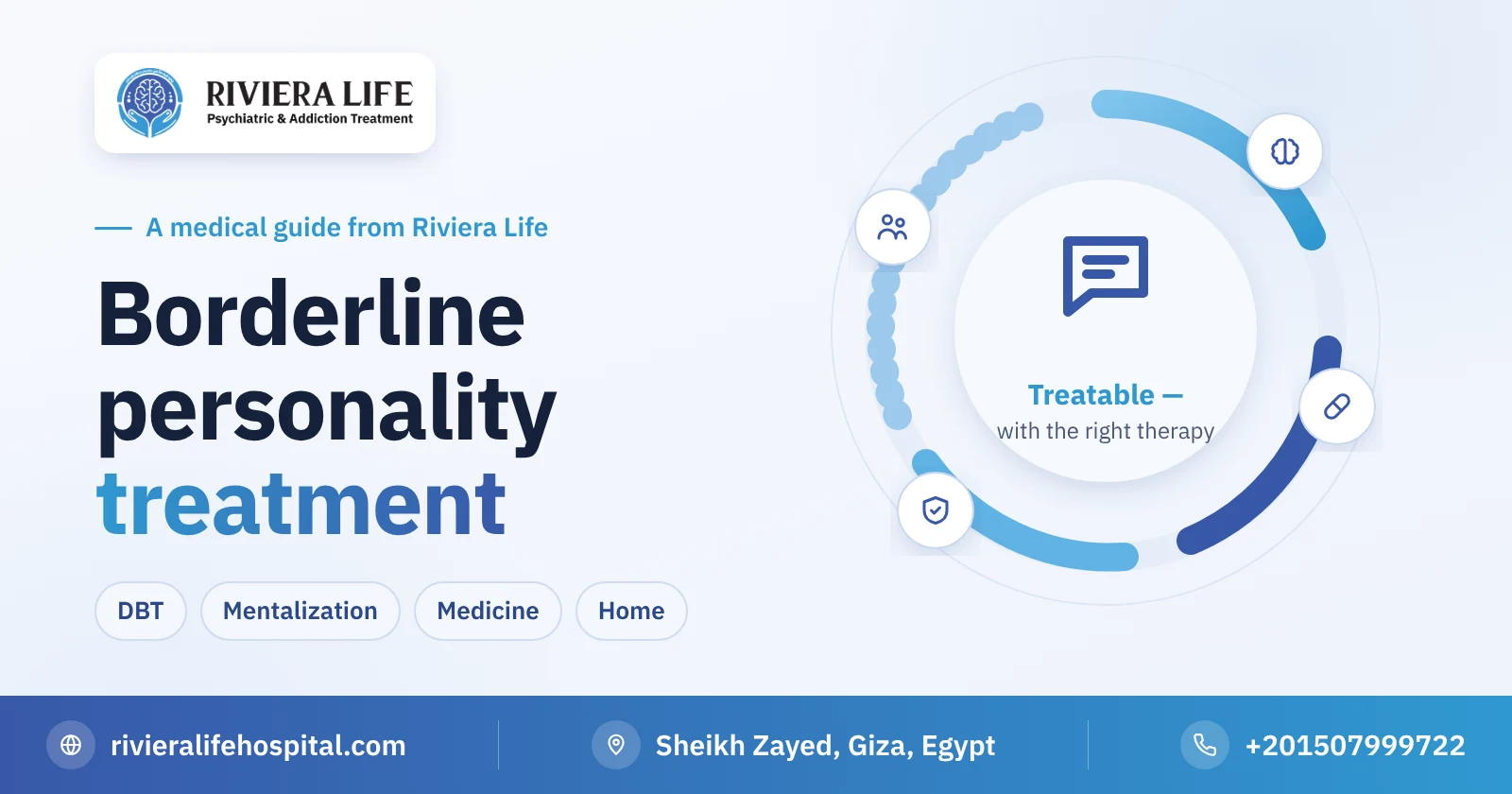
Borderline personality disorder treatment is possible, and its results are much better than the old image of the disorder suggests. Its foundation is specialized psychotherapy, the most studied being dialectical behavior therapy, mentalization-based treatment and schema therapy. As for medicines, none is approved to treat the disorder itself, and their role is limited to accompanying symptoms or periods of crisis.
Many ask about treatment at home: there are daily skills and habits that really help, but they support specialized treatment and don’t replace it. In this article we set out the steps of recovery, each therapeutic method, the limits of medicine, when hospital is needed, and what can honestly be done at home, then the criteria for choosing the right place.
Is borderline personality really treatable?
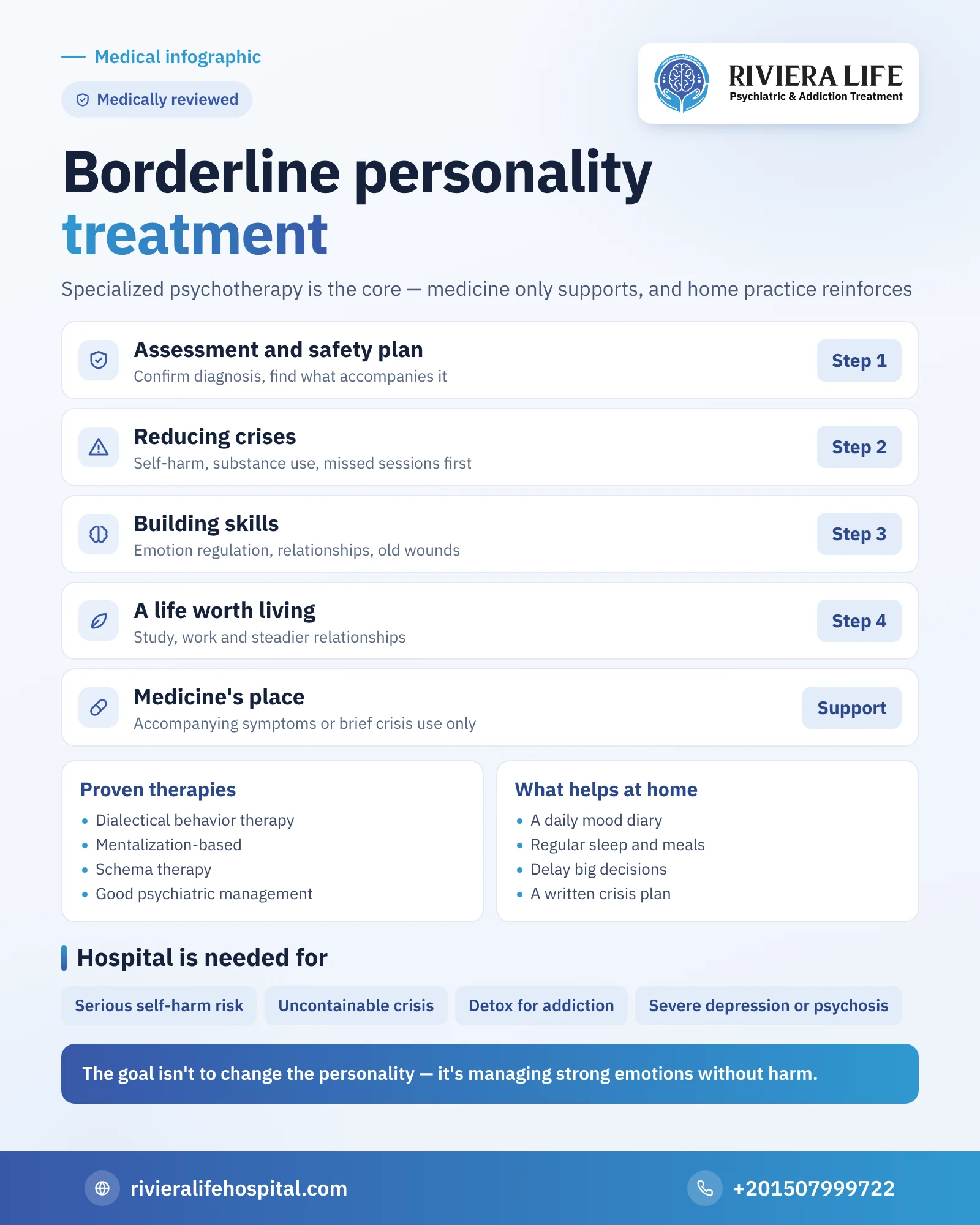
Yes. For many years this disorder was described as “hard to treat”, until programs designed specifically for it appeared and studies proved their effectiveness. With these programs crises, self-harm and emergency visits decrease, and work and relationships improve. Long-term follow-up studies show that many no longer meet the diagnostic criteria after years. The goal isn’t to change the personality, but to learn to manage strong emotions in ways that don’t harm the person or those around him.
The steps of recovery and its duration
Assessment and a safety plan
Treatment begins with an assessment that confirms the diagnosis and reveals what accompanies it: depression, anxiety, substance use or trauma. A brief safety plan is written with the patient immediately: what ignites a crisis, what calms it, and whom to call. Among the most important things this assessment settles is distinguishing the swings of borderline personality from mood episodes, which we explain in our comparison of borderline personality and bipolar disorder.
Reducing crises
The priority in the first months is behaviors that threaten life or the treatment, such as self-harm, substance use and dropping out of sessions.
Building skills
After stabilization the focus shifts to emotion-regulation and relationship skills, then to old wounds and self-image.
Building a life worth living
Study or work and more stable relationships. Specialized programs usually last a year to a year and a half, and may be longer depending on the case.
Dialectical behavior therapy
It was designed by psychologist Marsha Linehan for people who repeatedly harm themselves, and has become the most widespread treatment for borderline personality. The word “dialectical” refers to combining two things that seem contradictory: accepting the person as he is now, and working with him on change. The full program consists of a weekly individual session, a group for learning skills, brief contact between sessions at times of crisis, and meetings of the treatment team. The patient learns four sets of skills:
- Mindfulness: noticing feelings and thoughts without being swept away by them.
- Distress tolerance: getting through a moment of acute emotion without an action that makes it worse.
- Emotion regulation: understanding feelings and reducing vulnerability to exploding.
- Interpersonal effectiveness: asking for what he needs and refusing while keeping the relationship and self-respect.
Mentalization-based treatment
Mentalization is the ability to understand what goes on in your mind and in the minds of others: why did I feel this? And what did my friend really mean? This ability weakens severely in someone with borderline personality at moments of emotion, so he jumps to a conclusion such as “he ignored me because he hates me”. This treatment rebuilds that ability through individual and group sessions, and usually lasts about a year and a half. Its effect is clear in reducing self-harm and hospital admissions.
Schema therapy and other methods
Schema therapy assumes that basic needs in childhood, such as safety and acceptance, weren’t met, so entrenched “schemas” formed, such as “I’ll always be left” or “I’m defective”. The therapist works on these schemas with cognitive and experiential techniques, and with a warm therapeutic relationship that partly compensates for what was missing. Other proven methods include transference-focused psychotherapy and good psychiatric management, a simpler approach suited to places where intensive programs aren’t available. The choice of method depends on the case, the patient’s preference and what is available, and what matters most is persistence.
The role of medicines: what they do and what they don’t
There is no approved medicine that treats borderline personality itself, and international guidelines advise against relying on medicine as its main treatment. But medicines have a specific place:
- Treating other disorders that accompany it, such as depression, anxiety or sleep difficulties.
- Short-term calming in an acute crisis, then quickly reviewing the need for it.
- Sometimes mood stabilizers or antipsychotics at low doses for specific symptoms, by medical decision and with follow-up.
Doctors usually avoid dependence-causing sedatives for long periods, because they may increase impulsivity and open the door to addiction. No medicine is changed or stopped without consulting the doctor.
When is hospital admission needed?
- A serious risk of self-harm or suicidal thoughts with clear intent.
- An acute crisis that can’t be contained at home or in the clinic.
- An accompanying addiction that needs supervised detox.
- A severe accompanying disorder such as acute depression or psychotic symptoms.
The stay is usually short with a specific goal: getting past the danger and then returning to outpatient treatment, because long, unplanned stays may delay building skills in real life.
Treating borderline personality with addiction
The disorder coming together with substance use is common, and each feeds the other. That is why the patient needs one team that treats both together: safe detox when needed, then emotion-regulation skills as an alternative to the substance. You will find details of substances common in these cases on our pregabalin and alcohol pages.
Can borderline personality be treated at home?
The honest answer: the specialist can’t be done without, but home is a very important place to practice what is learned in sessions.
What really helps at home
- A daily mood diary recording the emotion, what preceded it and what helped.
- Regular sleep, regular meals and physical activity, as exhaustion raises vulnerability to exploding.
- Quick calming skills the therapist teaches, such as slow breathing or washing the face with cold water at the moment of emotion.
- Postponing big decisions and angry messages until the emotion calms down.
- Staying away from alcohol and non-prescribed sedatives.
- A written crisis plan and clear numbers known to the household.
What home can’t replace
Books, videos and apps don’t make up for a regular treatment program, and the family’s will alone isn’t enough, especially when there is self-harm or substance use. Whoever promises you complete treatment at home without a specialist is promising what he doesn’t have.
The role of the family in treatment
In programs dedicated to them, families learn to validate the feeling before discussing the behavior, to set firm limits without threats, and to avoid unintentionally rewarding crises with attention only at those times. Family members themselves need support, as living with intense emotions is exhausting. Understanding the early signs described in borderline personality symptoms helps them step in before a crisis.
The right hospital for borderline personality treatment: how to choose
The right hospital for borderline personality treatment is the one that offers what this disorder specifically needs: long-term specialized psychotherapy, safety in crises, and attention to accompanying substance use or depression. Ask before choosing:
- Is the place licensed, and is treatment led by consultant psychiatrists?
- Does it offer psychotherapy based on proven methods such as dialectical behavior therapy, not medicine alone?
- Is there a medical team present at every moment to contain a self-harm crisis without danger to the patient?
- Can it treat accompanying addiction within the same plan?
- Is there a family program that involves the family and teaches them how to help?
- Is there clear follow-up after discharge that prevents a return to crises?
Beware of any party that promises a guaranteed cure or a change of personality in days.
How Riviera Life meets these standards
These are the details of what Riviera Life offers in this area:
- Official license: a hospital licensed by the Ministry of Health.
- Fourteen years of experience: in psychiatry and addiction treatment.
- A plan set by a consultant: psychiatry and addiction consultants tailor treatment to each patient’s circumstances.
- Safety in crises: round-the-clock medical supervision.
- Dual diagnosis: treating the disorder and accompanying substance use together.
- The family as a partner: a family program and follow-up after discharge.
- Complete confidentiality: full privacy for the patient and his family.
- Extended experience: thousands of recovered cases.
Book your first consultation free of charge by calling +201507999722 at any hour of the day, and you will find us in Sheikh Zayed City, Giza.
More from our borderline personality guide
- Borderline personality: the complete guide
- Borderline personality symptoms
- Causes of borderline personality
- Types of borderline personality
- Borderline personality and marriage: fear of abandonment, the conflict cycle and the road to improvement
- Dialectical behavior therapy (DBT): its four skills, who it suits and how it works
- Borderline personality and addiction: the loop between them and how they are treated together
- Borderline personality test: instant result
Questions many people ask
Specialized psychotherapy is the basis, and its most studied methods are dialectical behavior therapy and mentalization-based treatment. The most suitable is decided according to the case and what accompanies it.
Daily habits and skills help a lot, but they don't replace a treatment program with a specialist, especially when there is self-harm or substance use.
Specialized programs usually last a year to a year and a half, and many feel an improvement in crises before that, while work on self-image and relationships needs longer.
There is no medicine approved to treat the disorder itself. Medicines may be used for accompanying depression or anxiety or for a short period in crises, under medical supervision.
Look for a licensed hospital that combines specialized psychotherapy, round-the-clock supervision, treatment of accompanying addiction and a family program. Riviera Life in Sheikh Zayed meets these criteria, with a free first consultation and complete confidentiality.