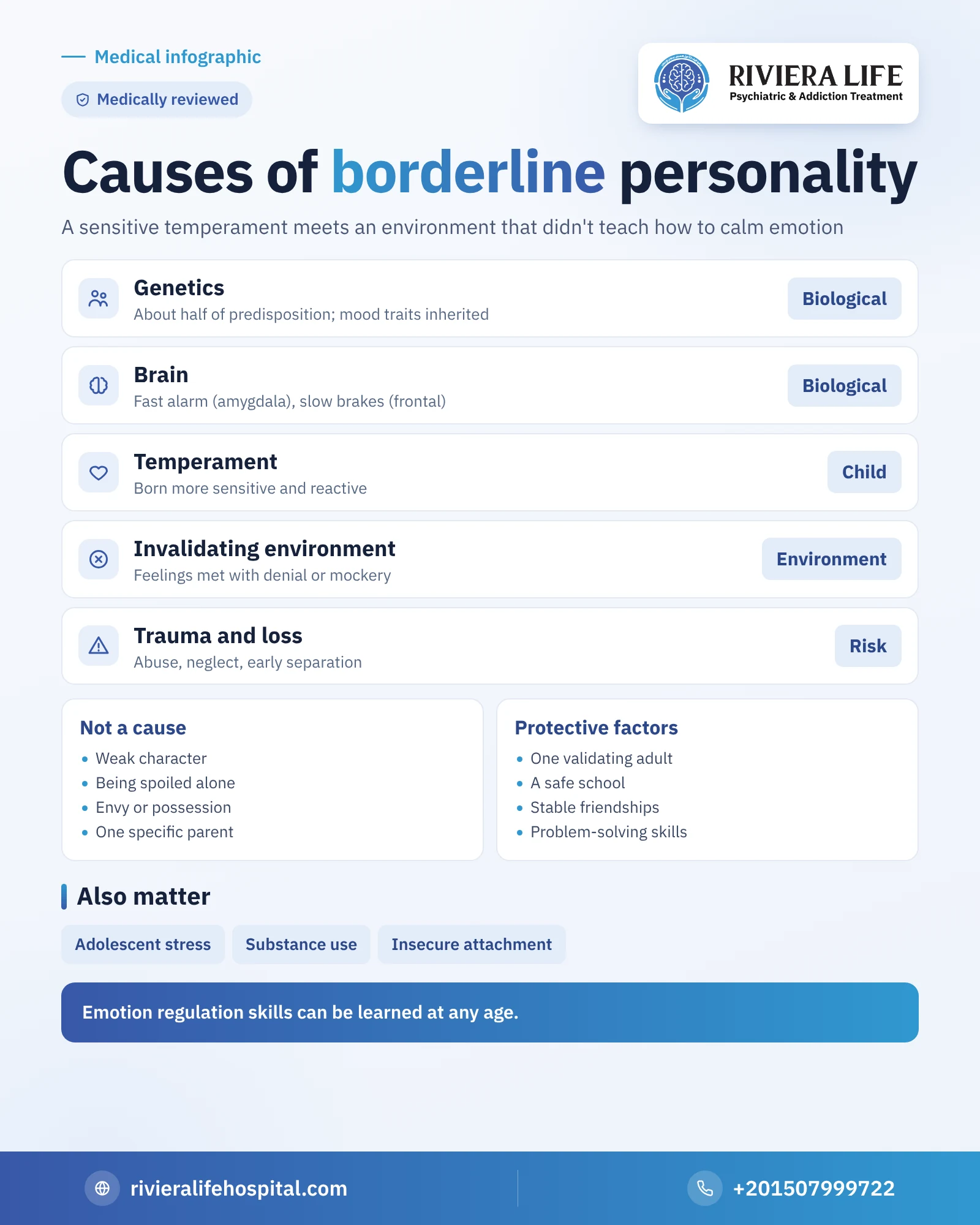
The causes of borderline personality disorder don’t come down to a single factor, but to a meeting of factors that begin before birth and continue into youth. The clearest explanation science offers today is that a child is born with a sensitive emotional temperament, a considerable part of which is shaped by genetics, then grows up in circumstances that didn’t teach them how to understand and calm their emotions, and perhaps goes through trauma, loss or neglect. Over the years, painful ways of dealing with emotion take shape. In this article we weigh each factor in proportion: genetics, the brain, temperament, the family environment, childhood trauma and substance use, and we clarify what isn’t a cause and what protects against the disorder.
Why is there no single cause?
If borderline personality had a single cause, we would find it in everyone affected and absent in others, and this doesn’t happen. Two brothers in the same home may be exposed to the same circumstances, and one develops it while the other doesn’t. The biosocial model developed by psychologist Marsha Linehan explains this as the result of a continuous interaction: an emotional predisposition in the child is met by a reaction from the environment, and the reaction increases the predisposition, and so on in a cycle repeating for years. No one in this cycle is necessarily evil; it is a loop that can be understood and broken.
Genetics: what is passed on in families?
Twin studies indicate that genetic factors explain roughly half of the variation in the likelihood of developing it, and that the disorder is more common among first-degree relatives of those affected. But what is inherited is usually not the ready-made disorder, but mood traits such as intensity of emotion, impulsiveness and sensitivity to rejection. And there is no single responsible gene; many genes each contribute a small effect. So having an affected relative raises the likelihood, but doesn’t condemn anyone to developing it.
The brain and the chemistry of emotion
Imaging studies have recorded differences in the activity of brain areas in many of those affected, most importantly the amygdala, which sets off the alarm of danger and emotion and appears more reactive in them, and the frontal cortex, which inhibits impulsiveness and weighs consequences and whose connection with the emotion centers appears weaker. The result is an understandable picture: an alarm that rings quickly and loudly, and brakes that work slowly. Disturbances in the regulation of neurotransmitters such as serotonin, linked to mood and impulse control, are also mentioned.
These differences aren’t permanent “damage”, and aren’t used as a diagnostic tool. Most importantly, the brain is flexible; psychotherapy that trains emotion regulation leaves a measurable effect on how it works.
Emotional temperament from early on
Some children are born more sensitive than others: they cry quickly, are deeply affected, and need longer to calm down. This sensitivity isn’t an illness, and may be a source of empathy and creativity. But it makes the child more in need of someone to help them name and calm their emotions. If this help is absent, the child grows up feeling that their emotions are bigger than them and not knowing what to do with them.
An environment that doesn’t validate feelings
By an invalidating environment, specialists mean a home or school where the child’s feelings are met with denial, mockery or punishment. A child cries because he was scared and hears: “You’re a man, there’s nothing to be scared of.” A girl talks about her distress and is told: “You’re blowing things out of proportion.” These messages repeat until the child learns that what they feel is wrong, and that their emotion won’t be heard unless it becomes very intense. This may happen in loving families that don’t mean harm, but that never learned in turn how to deal with emotion.
Childhood trauma and neglect
Many of those affected report a history of physical, emotional or sexual abuse or severe neglect in childhood, at a higher rate than the general population. Even so, not everyone exposed to trauma develops it, nor has everyone affected been through trauma. Trauma is a strong risk factor, not a condition. Borderline personality intersects here with post-traumatic stress disorder, especially its complex form resulting from repeated trauma, which is why the doctor assesses both together. You will find details of trauma and its effects in our guide to post-traumatic stress disorder.
Loss and early attachment
Losing a parent through death, divorce or long travel, or an inconsistent upbringing in which the parent comes close and moves away without explanation, may leave the child with an anxious attachment style. They grow up expecting that those they love will leave, so they cling to them tightly, and read any small sign as the beginning of departure. This partly explains why fear of abandonment occupies a central place in the disorder, as we explained in borderline personality disorder symptoms.
Adolescence and later stresses
Adolescence is an age in which emotions naturally escalate, and relationships with peers become the center of life. Bullying, a harmful romantic relationship, severe academic pressure or ongoing family conflict may all be the spark that reveals an old predisposition. These stresses don’t create the disorder alone, but they uncover it and increase its severity in those carrying the other factors.
Substance use: cause or consequence?
The relationship runs both ways. Many turn to sedatives, hashish or alcohol to extinguish an emotion they can’t bear, so use becomes a consequence of the disorder. Conversely, use increases impulsiveness and mood swings and weakens self-control, escalating symptoms and complicating diagnosis. Pills such as tramadol and benzodiazepines are widespread in Egypt among those seeking quick calm, and they create new dependence on top of the original problem.
What doesn’t cause borderline personality?
- Weak character or willpower: the disorder isn’t a choice or laziness about self-control.
- Being spoiled alone: indulgence doesn’t create a disorder this deep.
- Envy or possession: the family may turn to spiritual support, but linking the disorder to non-medical explanations delays proven treatment.
- A particular mother or father: blaming one party overlooks genetics, temperament and circumstances, and hurts a family that needs to be a partner in treatment.
Factors that protect and reduce risk
Just as there are risk factors, there are protective factors. Having at least one adult who validates the child and calms them, a safe school, stable friendships and problem-solving skills all reduce the likelihood that predisposition will turn into a disorder. Even after symptoms appear, these factors remain a foundation on which treatment is built.
How do the factors interact? An example from life
Imagine a girl born with high sensitivity; she is bothered by noises, cries for a long time and clings tightly to her mother. She grows up in a home crowded with responsibilities, her father away most of the year, and her mother exhausted with no time to listen to her. Whenever she cries she is told she is “too sensitive”, so she learns to hold it in, then explodes when the holding in overflows. In adolescence she enters a strong friendship that ends suddenly, so she feels the ground has been pulled from under her, and discovers that long late nights or a sedative pill dulls the pain a little.
No single one of these factors created the disorder alone: temperament, absence, repeated messages, loss and the wrong way of calming all accumulated in one direction. And this is exactly what makes treatment possible; every link in this chain can be worked on, from learning to name emotion to building safer relationships.
What does understanding the causes mean for the family today?
The purpose of knowing the causes isn’t to look for someone to blame, but to understand what needs treatment. If the problem lies in emotion regulation skills, these are skills that can be learned at any age, and this is exactly what the programs explained in borderline personality disorder treatment do. At Riviera Life the assessment covers childhood, family and substance use history, then the family program involves the parents in understanding what happened and how they can help without carrying guilt they don’t deserve.
More from our borderline personality guide
- Borderline personality disorder: the complete guide
- Borderline personality disorder symptoms: the nine signs
- Types of borderline personality
- Borderline personality disorder treatment
- Attachment disorder: the difference between a child’s disorder and adult attachment styles
- Personality disorders and depression: why they occur together and how they are treated together
Questions many people ask
Genetics has a considerable share, as twin studies indicate it explains about half of the predisposition. But what is inherited is mood traits, not the disorder itself, and the environment determines much of what happens after that.
No. Trauma is a strong risk factor, but most who go through it don't develop the disorder, and some of those affected have been through no clear trauma.
Responsibility can't be placed on one party. The disorder is the result of an interaction between inherited temperament, environment and circumstances, and the family is an important partner in recovery, not a defendant.
Substance use isn't a known original cause, but it increases impulsiveness and mood swings and escalates symptoms, and it often begins as an attempt to calm intense emotion.
There is no guaranteed prevention, but a supportive environment that hears the child's feelings and helps them calm down, and early intervention when signs appear, reduce the risk and improve the course.