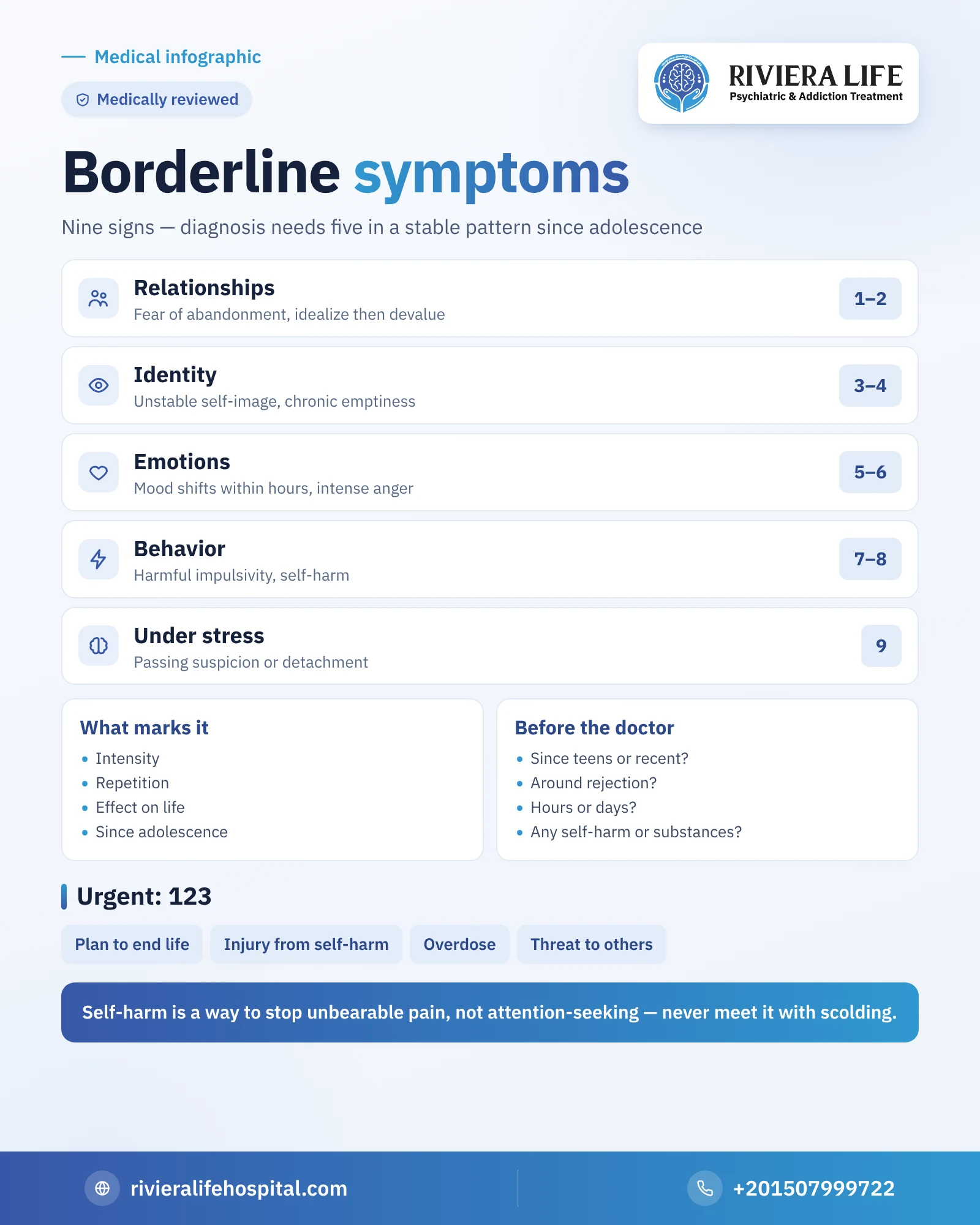
Borderline personality symptoms are nine signs set out in the American diagnostic manual, revolving around fear of abandonment, unstable relationships and mood, a shaky self-image, impulsivity, intense anger, a chronic feeling of emptiness, thoughts or behaviors of self-harm, and passing suspicion or detachment under stress. Having one or two signs isn’t enough; diagnosis needs at least five signs in a stable pattern extending from adolescence or early adulthood and appearing in many situations.
In this article we explain each sign in simple language with an everyday example, then clarify when assessment is necessary and when the situation is an emergency. Remember that the goal is to understand what you see, not to make a diagnosis; that is the work of the doctor or psychologist.
When do strong emotions become a disorder?
We all get angry, worry and get attached to those we love. Three things distinguish borderline personality: intensity, as the emotion is much stronger than the situation; repetition, as it is a pattern, not an incident; and effect, as it destroys relationships, disrupts study or work and causes the person great suffering. A young man who gets angry once with his fiancée isn’t like a young man whose relationships have all flipped in the same way for ten years, and who after every outburst feels shame and self-hatred.
The nine signs at a glance
- Frantic efforts to avoid abandonment, whether real or imagined.
- Intense, unstable relationships swinging between idealization and contempt.
- Identity disturbance and a shifting self-image.
- Impulsivity in at least two areas that could harm the person.
- Recurrent thoughts, threats or behaviors of self-harm.
- Sharp mood swings, usually lasting hours.
- A chronic feeling of emptiness.
- Intense, inappropriate anger or difficulty controlling it.
- Passing stress-related suspicion or detachment from reality.
Relationship signs
1. Fear of abandonment
Not passing worry about separation, but real terror that drives behavior. A husband being half an hour late may be read as proof that he will leave, so calls and messages follow one after another, and it may reach pleading, threatening or ending the relationship first “before he leaves me”. And when this attachment becomes the center of all of life, it overlaps with what therapists describe as love and relationship addiction.
2. Relationships that swing between peak and trough
A new friend becomes “the only one who understands me” within weeks, then after a small disagreement turns into “selfish and undeserving”. Specialists call this swing between idealization and disappointment splitting: seeing people in black or white with no shades in between.
Identity and self signs
3. A self-image that doesn’t settle
The person changes their goals, studies, opinions and sometimes their appearance and friends suddenly and repeatedly. Some say: “I feel I change color depending on who I’m with, and I don’t know who I am when I’m alone”.
4. Chronic emptiness
Not sadness or boredom, but a feeling that the inside is hollow. The person tries to fill it with a new relationship, late nights and shopping, or substance use, and it doesn’t stay full for long.
Emotional signs
5. Sharp mood swings
Mood moves from calm to intense sadness, tension or distress within hours, usually because of something in relationships: a tone of voice, a comment, or an unanswered message. A single mood rarely lasts for days on end, which distinguishes it from episodes of bipolar disorder. For a detailed comparison between the two conditions, read bipolar disorder vs borderline personality disorder.
6. Anger that is hard to control
Strong bouts of anger that may include shouting, cutting sarcasm or breaking things, usually followed by regret and deep shame. Many families describe this as “nerves” or “a hot temper”, so seeking help is delayed for years.
Behavioral signs
7. Harmful impulsivity
Impulsivity that recurs in at least two areas that could harm the person: spending beyond one’s means, reckless driving, binge eating, unsafe relationships, or substance use. Some turn to sedatives or hash to calm down, starting another road we explain on the pregabalin page and other addiction pages.
8. Self-harm and thoughts of death
Repeated thoughts of death, threats of self-harm at times of crisis, or actual self-harming behaviors may appear. Many describe them as an attempt to stop unbearable emotional pain, not a wish to attract attention. This sign in particular isn’t discussed with scolding or ignored even if it recurs, but calls for a specialist assessment, and sometimes urgent help, as we explain below. And this behavior has no connection to masochism disorder; the pain here is a means to calm an unbearable emotion, not a source of arousal.
The sign of thinking under stress
9. Passing suspicion or detachment
In moments of severe stress the person may feel people are conspiring against them, or that they are detached from their body or that what surrounds them isn’t real, as if watching a film. These experiences usually pass within minutes or hours as the stress fades, which distinguishes them from continuous psychosis.
What do the symptoms look like at home?
Families rarely come talking about “nine signs”. They come with stories: a daughter who spends a happy week then shuts her bedroom door for two days because her friend didn’t invite her to an occasion. A son changing his faculty for the third time. A wife who calls her husband twenty times if he is late, then apologizes bitterly. This is often explained as “being spoiled” or “bad upbringing”, while the inner suffering is much greater than what shows.
The difference between borderline personality and ordinary emotion
A teenager who gets angry and moody during puberty isn’t necessarily affected, and someone going through an emotional trauma may behave in a way resembling the symptoms for a while and then recover. The deciding factor is persistence across years and different situations, and the severity of the effect. Some disorders resemble borderline personality on the surface; we explain the differences between it and what resembles it in the article on types of borderline personality.
Do the symptoms differ between men and women?
The nine signs are the same, but how they show may differ. In some men they appear as anger, impulsivity, substance use and fighting, so they are read as a behavioral problem or addiction only. In some women they appear as sadness, anxiety and self-harm, so they are sometimes read as depression alone. That is why assessment needs a comprehensive look at the person’s whole history, not at the loudest symptom.
Questions to help you before seeing the doctor
These questions aren’t a diagnostic test, but they organize your observations to present to the specialist:
- Have intense emotions recurred since adolescence, or did they start recently after a particular event?
- Do most of them revolve around fear of rejection or loss in relationships?
- Does mood change within hours, or does it last for days on end?
- Have thoughts or behaviors of self-harm appeared, even once?
- Is there use of substances or medicines without a prescription?
- Has what is happening affected study, work or marriage?
Signs that call for urgent help
Seek urgent help immediately if you see
Don't wait for the clinic appointment: call the ambulance on 123 or go to the nearest emergency department, and don't leave the person alone.
- Direct talk of wanting to die or a plan to end life
- Self-harm that caused an injury needing treatment
- Taking a large amount of a medicine or substance
- Uncontrollable emotion with a threat to oneself or others
For further guidance, the hotline of the General Secretariat of Mental Health and Addiction Treatment is available on 16328.
When should you seek a psychological assessment?
If a large part of the above applies as an ongoing pattern, assessment is a step worth taking now, not after the next crisis. Early diagnosis opens the door to proven treatments that we explain in the article on borderline personality treatment. At Riviera Life our consultant psychiatrists carry out a calm, confidential assessment that listens to the person and the family, and the first consultation is free on +201507999722.
More from the borderline personality guide
- Borderline personality: the complete guide
- The causes of borderline personality
- Borderline personality treatment and the steps of recovery
- Types of borderline personality and the differences between them
- Personality disorders: the complete guide
- Personality disorders and depression: why they coexist and how they are treated together
- Borderline personality and addiction: the cycle between them and how they are treated together
- Borderline personality test: instant result
Questions many people ask
At least five of nine, provided they are a stable pattern extending from adolescence or early adulthood and appearing in different situations, which a specialist determines after a direct assessment.
No. Popular tests may draw your attention to observations worth discussing, but they don't distinguish borderline personality from similar disorders, and diagnosis needs an interview with a specialist.
No. Self-harm may accompany depression, other disorders or severe stress. But in all cases it is a sign that deserves serious assessment and care, not blame.
Its features usually become clear in adolescence or early adulthood. Some parents notice high emotional sensitivity from a young age, but that alone isn't a diagnosis.
Impulsive symptoms and crisis behaviors often ease over time, especially with treatment, while chronic feelings such as emptiness may need longer therapeutic work.