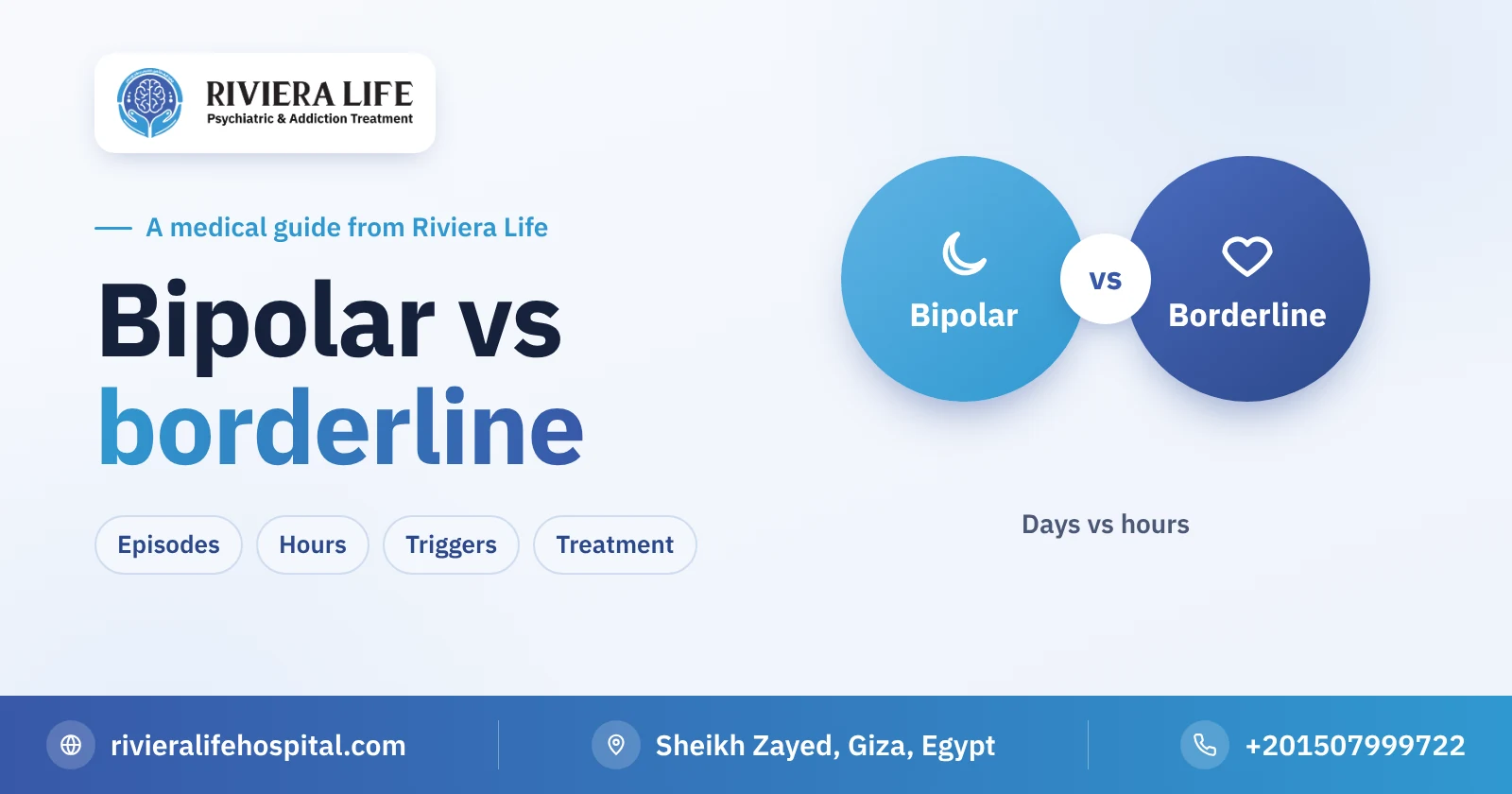
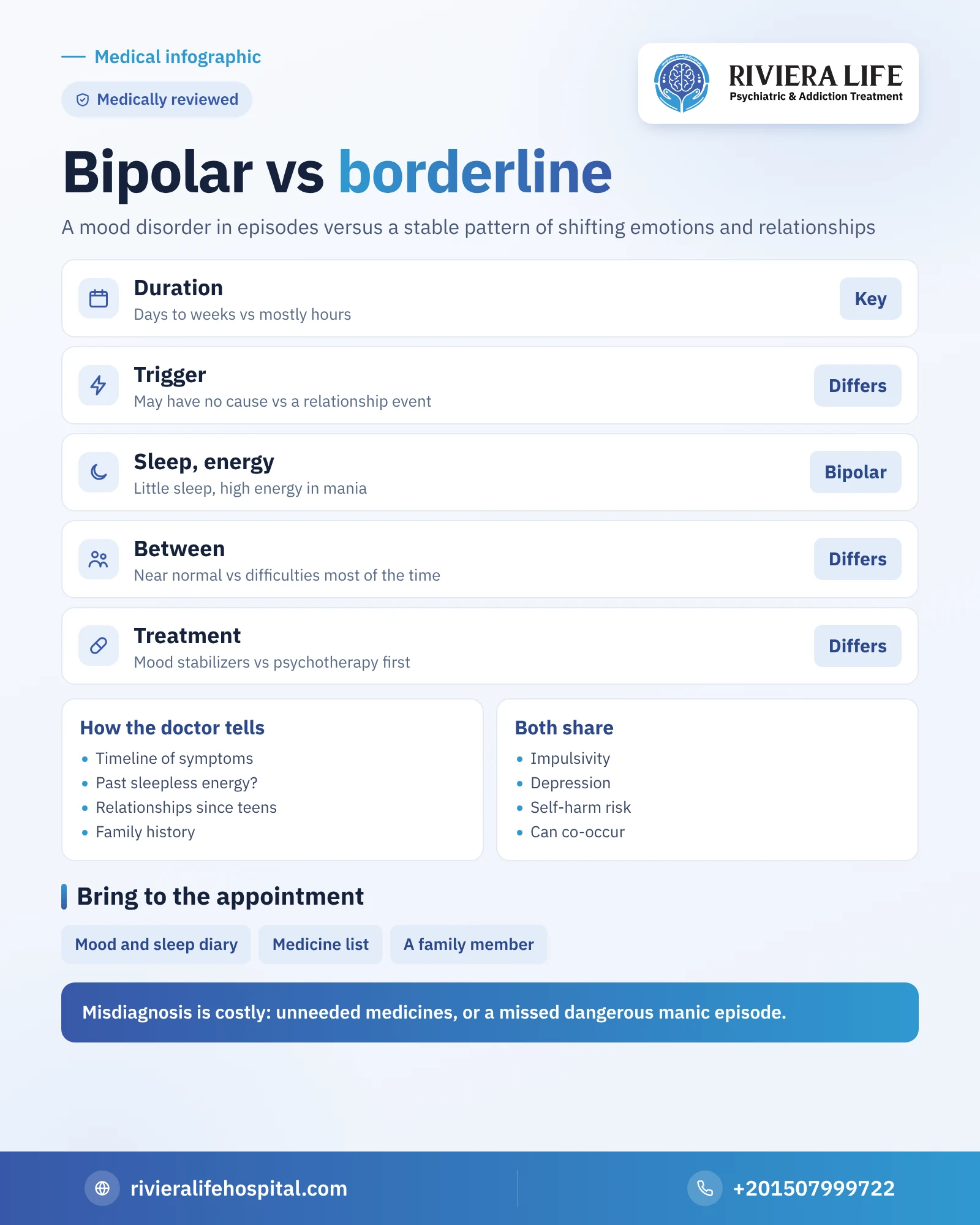
The difference between bipolar disorder and borderline personality at its core is that the first is a mood disorder that comes in clear episodes of mania or depression lasting days and weeks, with the person usually returning to their usual state between them, while the second is a stable pattern of emotional instability and disturbance in relationships and self-image, in which emotions shift within hours in response to situations with others. The two disorders resemble each other in instability and impulsivity, which is why they are often confused, but their treatment is different. In this article there is a point-by-point comparison, illustrative examples, and how the doctor tells them apart.
The difference between bipolar disorder and borderline personality in brief
| Point of comparison | Bipolar disorder | Borderline personality disorder |
|---|---|---|
| Nature of the disorder | A mood disorder | A personality disorder |
| Form of instability | Separate episodes with a beginning and an end | Ongoing, almost daily instability |
| Duration of the mood state | Days to weeks | Mostly hours, rarely more than a few days |
| Trigger | The episode may come without a clear cause | Usually a situation with someone close or fear of abandonment |
| Sleep and energy | Reduced need for sleep with high energy in mania | Not usually linked to a sustained change in the need for sleep |
| Between episodes | Functioning usually returns close to normal | Difficulties are present most of the time |
| Main treatment | Mood stabilizers with psychotherapy | Specialized psychotherapy first |
What is bipolar disorder?
It is a disorder in which the person goes through episodes of mania or hypomania alternating with episodes of depression. In mania, energy and confidence rise, sleep decreases without tiredness, speech and thoughts speed up, and the person may rush into spending or adventures unlike them. Then the depressive episode comes with its weight. This disorder has more than one type, and you will find their details and signs in the article on bipolar disorder symptoms, and in the comprehensive guide to bipolar disorder.
What is borderline personality disorder?
It is a long-term pattern that usually begins in adolescence or early adulthood, centered on severe difficulty regulating emotions. The person lives with a painful fear of being left, their view of those they love swings between complete idealization and total rejection, their self-image is shaken, they feel a chronic inner emptiness, and they may rush into harmful behaviors under the pressure of emotion. The details of this picture are in the comprehensive guide to borderline personality.
Why are they confused?
Because the words people use to describe the two conditions are similar: “his mood is unstable”, “very irritable”, “acts recklessly”. Impulsivity, self-harm and depression may appear in both. Adding to the confusion, people use the word “bipolar” to describe anyone whose mood changes quickly, which is inaccurate. Also, visiting the doctor in the middle of a single crisis doesn’t reveal the full picture; what distinguishes the two disorders appears in tracking the condition over months, not in one day.
The most important differences in detail
Duration of instability: days and weeks, or hours?
This is the most important distinguishing point. A manic episode lasts at least a week, hypomania at least four days according to diagnostic criteria, and a depressive episode two weeks or more. In borderline personality, the person may move from anger to crying to calm in a single day, and the emotional state usually lasts hours. That is why very fast swings within a single day are closer to borderline personality than to bipolar disorder, though the final judgment is the doctor’s.
What drives the instability?
In bipolar disorder the episode may begin without a clear event, and may be preceded by staying up late, stress or stopping medicine, but once it begins it takes its own course regardless of what is happening around it. In borderline personality, feelings react directly to relationships: a message that wasn’t answered, or a tone taken as rejection, may turn a whole day upside down. The emotion here is usually anger, anxiety or emptiness, not the elation and exhilaration characteristic of mania.
Sleep and energy: an easily noticed sign
A person who sleeps two or three hours for several consecutive nights and wakes up energetic and full of plans, without feeling tired, is a picture that raises suspicion of mania. This change in the need for sleep isn’t a characteristic feature of borderline personality, even if the person suffers from insomnia due to anxiety and thoughts. Insomnia accompanied by exhaustion is completely different from little sleep with excess energy.
Self-image and relationships
In borderline personality, the answer to the question “who am I?” changes constantly: goals, values, friends and even taste. Close relationships are very intense and unstable. In bipolar disorder, self-confidence may inflate during mania and collapse during depression, but self-image and relationships usually return to their stability after the episode ends.
Impulsivity and the risk of self-harm
Both disorders are linked to a higher risk of self-harm and suicidal thoughts, which is why any talk of death must be taken seriously in both cases. In borderline personality, harm usually comes as a means of relieving unbearable emotional pain after a crisis in a relationship. In bipolar disorder the risk rises especially during depressive and mixed episodes. And help is available and effective in both cases.
Seek urgent help immediately if any of these appear
Call the ambulance on 123 or go to the nearest emergency department, and don't leave the person alone.
- Talk of ending one’s life, self-harm or a strange farewell
- Mania with dangerous behavior such as reckless driving or rushing towards harm
- Voices or strange beliefs and loss of contact with reality
- Not sleeping for several nights with increasing agitation
Illustrative examples
A picture closer to bipolar disorder
A usually calm young man suddenly began staying up until dawn writing a plan for a huge project, borrowed money to buy equipment he doesn’t need, and talked so fast he couldn’t be interrupted. This continued for about two weeks, then he burned out and withdrew to his room for weeks. Two years earlier he had gone through a similar period of depression.
A picture closer to borderline personality
A young woman feels overwhelming love for a new friend, then cuts off the relationship angrily because the friend was late replying to a message, cries for hours and fears everyone will leave her, then calms down in the evening. This pattern has repeated in most of her relationships since her teenage years.
These examples are for illustration only, and aren’t suitable for diagnosing anyone. The diagnosis is made by a psychiatrist after a full assessment.
Can the two disorders occur together?
Yes, one person may have both together, and this isn’t rare. In this case the doctor needs to determine what belongs to mood episodes and what belongs to the personality pattern, because each side needs a different treatment tool. Drug use may also overlap with them, increasing instability and covering the real picture.
How does the doctor tell them apart?
- Building a timeline of symptoms from the beginning: are there episodes with a clear beginning and end?
- Asking directly about any previous period of little sleep with high energy.
- Assessing the pattern of relationships and self-image since adolescence.
- Reviewing the family history, as bipolar disorder is clearly linked to genetics.
- Ruling out other causes such as drugs, some medicines and thyroid diseases.
- Listening to a family member, who sees what the patient may not notice.
It helps a lot to come to the appointment with a mood and sleep diary covering weeks, and a list of medicines and any substances used.
The difference in treatment
Treatment of bipolar disorder relies mainly on mood stabilizers or some antipsychotics, with psychotherapy, education and sleep regulation, and the aim is to prevent episodes. Its details are in the article on bipolar disorder treatment. Borderline personality’s first treatment is specialized psychotherapy, the best known being dialectical behavior therapy, and medicines have a supporting role for specific symptoms only, as the article on borderline personality treatment explains. That is why a wrong diagnosis is costly: a borderline personality patient may take medicines they don’t need, and a bipolar patient may miss prevention of a dangerous manic episode.
How does Riviera Life help you?
At Riviera Life in Sheikh Zayed, the psychiatry consultants carry out a careful assessment of the mood history and pattern of relationships before making the diagnosis, then treatment is built on what the patient really needs, with a family program, follow-up after discharge and round-the-clock medical supervision when residence is needed. The first consultation is free and confidential: +201507999722.
Read also
- Borderline personality symptoms: 9 signs
- Causes of bipolar disorder
- Types of borderline personality
- How the family deals with a psychiatric patient
- Moodiness and mood swings: when is it temperament and when is it a disorder?
- Bipolar disorder and marriage: disclosure, pregnancy and the partner’s role
- Cyclothymic disorder: symptoms, the difference from bipolar disorder and treatment
Questions many people ask
They can't be ranked by danger; both are linked to a higher risk of self-harm, and each has different complications. What matters is the correct diagnosis and the right treatment early.
Not necessarily, as bipolar episodes last days and weeks. Swings within hours are more linked to borderline personality or other causes, and the diagnosis needs a psychiatrist.
Specialized psychotherapy is the foundation in borderline personality, and the doctor may use medicines for specific accompanying symptoms, but they aren't the main treatment.
Bipolar disorder is a long-term disorder, but many patients live long periods of stability with commitment to treatment, mood stabilizers, regulated sleep and follow-up.
Because the two disorders share instability, impulsivity and depression, and assessing a single crisis doesn't reveal the pattern. Tracking symptoms over time and the family history clarify the picture.