The relationship between oxytocin and addiction is one of the most active areas of research in recent years, but it is still at the research stage, not treatment. What we know with confidence is that drugs disrupt the oxytocin system in the brain, and that addiction destroys the relationships that naturally stimulate it. What is still uncertain is whether giving oxytocin as a medicine helps recovery; animal experiments are encouraging, but human trials are small and their results conflicting. This article explains exactly what the evidence says, why you shouldn’t buy an oxytocin spray looking for a cure, and what can be used today.
Oxytocin and addiction: why are scientists interested?
Oxytocin, as the oxytocin guide explains, is a hormone linked to bonding, trust and calming stress. And addiction at its core touches these three things: the drug becomes a substitute “relationship” the person turns to when stressed or lonely, they gradually drift away from their family and friends, and they live in chronic tension between use and withdrawal. From here a research idea arose: if oxytocin makes human connections rewarding and calming, could it reduce the brain’s need for artificial reward?
How do drugs affect the oxytocin system?
Not all substances are affected in the same way, and what we know about humans here is less than what we know about animals:
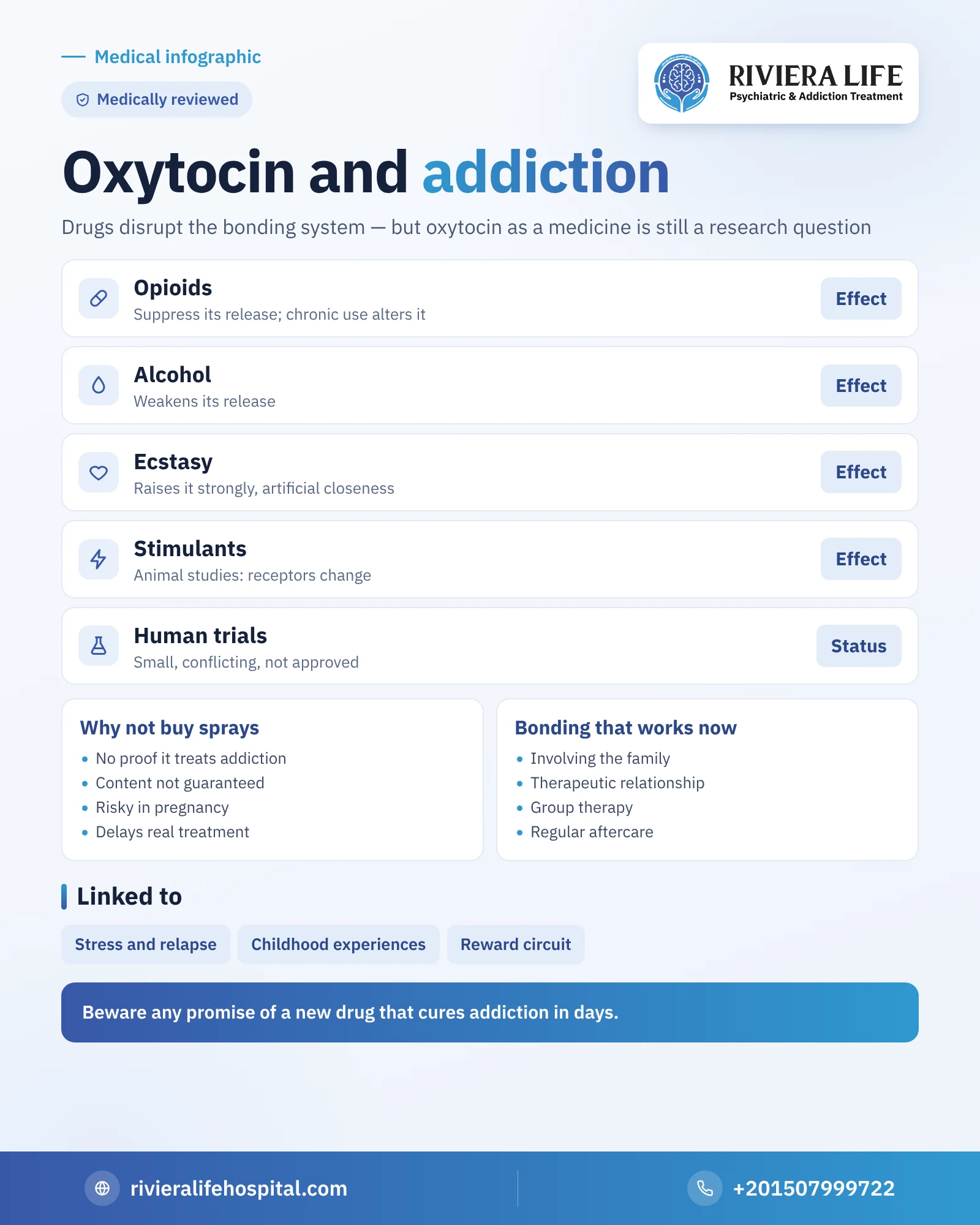
- Opioids: such as heroin and morphine, suppress the release of oxytocin from the pituitary gland, and animal research suggests chronic use changes its system inside the brain.
- Alcohol: weakens its release, which is one reason breastfeeding mothers are advised to avoid it, as milk let-down decreases.
- Ecstasy: raises it strongly, and this is thought to be part of the artificial feeling of warmth and closeness to strangers that makes it attractive.
- Stimulants: such as cocaine and methamphetamine; animal studies suggest repeated exposure changes oxytocin receptors and release.
The possible result is a vicious circle: the drug weakens the bonding system, so relationships become less satisfying, so reliance on the drug increases. In the opposite direction, emotional attachment itself may turn into a compulsive pattern resembling use, which is known as love addiction.
Oxytocin and the reward circuit
Drugs work mainly through the reward circuit led by dopamine. And oxytocin connects to this same circuit; its receptors are present in its centers, and it affects dopamine release there. In rodent experiments, giving oxytocin reduced the animals’ seeking of alcohol, stimulants and opioids, and eased some signs of withdrawal. Researchers propose explanations including that it makes the drug less attractive, eases the stress that drives use, or restores the value of natural rewards. These are logical explanations, but the human brain is more complex, and what succeeds in the laboratory often stumbles in the clinic.
Stress and relapse: where does oxytocin come in?
Stress is one of the strongest relapse triggers. A person in recovery who goes through a family dispute or pressure at work may suddenly find themselves thinking about the drug after months of abstinence. Stress is linked to a hormonal axis that ends with the release of cortisol, and oxytocin is known for its ability to calm this axis under certain conditions. That is why it has been studied in humans from the angle: does it ease the recovering person’s response to stress and to situations that remind them of the drug? Some small studies noted a reduction in stress or craving after a single dose in the laboratory, and other studies noted nothing.
What do human trials say?
Researchers have tried nasal oxytocin spray in small groups of patients addicted to alcohol, cocaine, opioids and hash. The overall picture so far:
- A small early study on alcohol withdrawal suggested patients needed fewer sedatives, but later studies didn’t consistently repeat the results.
- Some trials noted improvement in stress or craving under laboratory conditions, without a clear effect on actual long-term abstinence.
- Most studies are short, with few participants, and differ in doses and measurement methods, which makes comparing them difficult.
- An open question remains: how much of the nasal spray actually reaches the brain?
The honest conclusion: oxytocin isn’t an approved treatment for addiction in any country, there are no medical guidelines recommending it for this purpose, and larger trials are still under way.
A warning about sprays in circulation
Adverts are spreading online for oxytocin sprays that promise to ease anxiety, “treat addiction” or improve relationships. Don’t use them, for the following reasons:
- There is no evidence they treat addiction, and scientific trials themselves use controlled preparations under supervision.
- The content and concentration of these products aren’t guaranteed, and they may not contain the substance at all.
- Oxytocin is a potent drug that causes uterine contractions and affects the body’s water and salt balance, and it is a real danger to pregnant women.
- Relying on them delays real treatment, which is the most dangerous thing of all.
Social isolation and childhood: shared roots
Research indicates that early experiences shape the oxytocin system; a child who grows up in safe, warm care has a brain that learns closeness to people is a source of calm. Neglect or early trauma, on the other hand, is linked to changes in this system and difficulty regulating stress later. This is one of the threads linking childhood trauma to a higher risk of addiction, alongside other genetic, psychological and social factors. This doesn’t mean that someone who had a difficult childhood will inevitably become addicted, but that good treatment needs attention to relationships and trauma, not only the substance, as seen in treating post-traumatic stress disorder that accompanies addiction.
What “bonding treatment” is available today?
If the idea behind oxytocin is that human connection protects against addiction, that connection itself is available without a medicine, and it has stronger evidence than the spray:
- Involving the family: family therapy programs raise the chances of staying in treatment and reduce relapse.
- The therapeutic relationship: the patient’s trust in their treatment team is among the most important predictors of treatment success.
- Group therapy and support groups: restore to the recovering person the sense of belonging they lost.
- Rebuilding social life: work, hobbies and friendships away from using circles.
- Regular aftercare: protects the recovering person when the enthusiasm of the beginning fades.
Does it differ between types of addiction?
Probably yes, but information is limited. Most research has studied alcohol, opioids and stimulants, while work on hash or new synthetic substances is rare. There is also research interest in behavioral addictions such as pornography addiction and compulsive eating, because oxytocin takes part in the feeling of fullness and in sexual response, but all of this is still in its early stages and no treatment is built on it.
Where do you start treatment?
Start with an integrated medical and psychological assessment that determines the type of substance, the severity of dependence and whether there is accompanying depression, anxiety or trauma, then medically supervised detox when needed, followed by psychological rehabilitation that treats the reasons for use and rebuilds relationships. Choose a place that involves the family and follows up the patient after discharge, and beware of any party that promises a new drug that cures addiction in days, or a guaranteed cure rate.
How Riviera Life meets these standards
Riviera Life combines the medical, psychological and family sides in one program:
- A licensed provider: Riviera Life operates under a Ministry of Health license in psychiatry and addiction treatment.
- Specialist consultants: in psychiatry and addiction treatment, who treat addiction and accompanying disorders together.
- Round-the-clock medical supervision: during detox and the first days.
- A family program and aftercare: that rebuild the support network the recovering person needs.
- A long treatment history: fourteen years, thousands of recovered patients, and complete confidentiality of every patient’s data.
Contact us at any hour on +201507999722 to get your first consultation free of charge; we welcome you in Sheikh Zayed, Giza Governorate.
More from the oxytocin guide
- Oxytocin: the complete guide
- Dopamine and addiction
- Endorphins and addiction
- GABA and addiction
- Natural ways to increase oxytocin: touch, closeness, company, and what isn’t proven
Questions many people ask
No, it is still at the research stage. Animal experiments are encouraging, but human trials are small with conflicting results, and no medical guidelines recommend it for this purpose.
Yes, opioids and alcohol weaken its release, ecstasy raises it temporarily, and animal research suggests chronic use changes its system in the brain.
Family support and safe relationships are proven factors that raise the chances of staying in treatment and reduce relapse, regardless of the exact chemical mechanism.
No, the products in circulation have no guaranteed content and there is no evidence of their benefit; a medical assessment and a treatment program that involves the family is more useful.
Look for medically supervised detox, psychotherapy, a family program and aftercare under a Ministry of Health license. Riviera Life in Sheikh Zayed meets these criteria, with fourteen years of experience.