The natural ways to increase oxytocin all revolve around closeness to others: a warm hug, a reassuring touch, a long look at a dear face, holding an infant against the skin, sitting with friends you trust, and even playing with a pet dog. These actions are linked in studies to raised oxytocin or improved bonding, but the evidence varies. As for the oxytocin sprays and capsules sold online, the evidence doesn’t support them. This article ranks the methods by their strength, shows what can’t be expected, and when a weak feeling of closeness is a sign that deserves attention.
Oxytocin in brief: what do we know about it?
Oxytocin is a small peptide made by the hypothalamus in the brain, released by the posterior pituitary gland into the blood as a hormone, and released by the cells themselves inside the brain as a neurotransmitter. In the body it stimulates the contractions of the uterus during labor and pushes milk during breastfeeding. In the brain it is linked to bonding, trust and easing social stress. You will find the general picture in our oxytocin guide. But the name “love hormone” is a simplification, as research has found that oxytocin sometimes strengthens in-group bias, jealousy or the memory of negative situations; it amplifies the social importance of a situation more than it creates warmth by itself.
What can actually be measured?
Measuring oxytocin in the blood or saliva doesn’t accurately reflect what goes on in the brain, and the available tests aren’t standardized, which explains the differing results of studies. So when you read “oxytocin rose after a hug”, know that this may be a slight rise in a small sample. What we know more confidently is that warm social experiences are linked to improved mood and lower blood pressure and cortisol. These are proven benefits regardless of the exact role of oxytocin in them.
A quick summary by strength of evidence
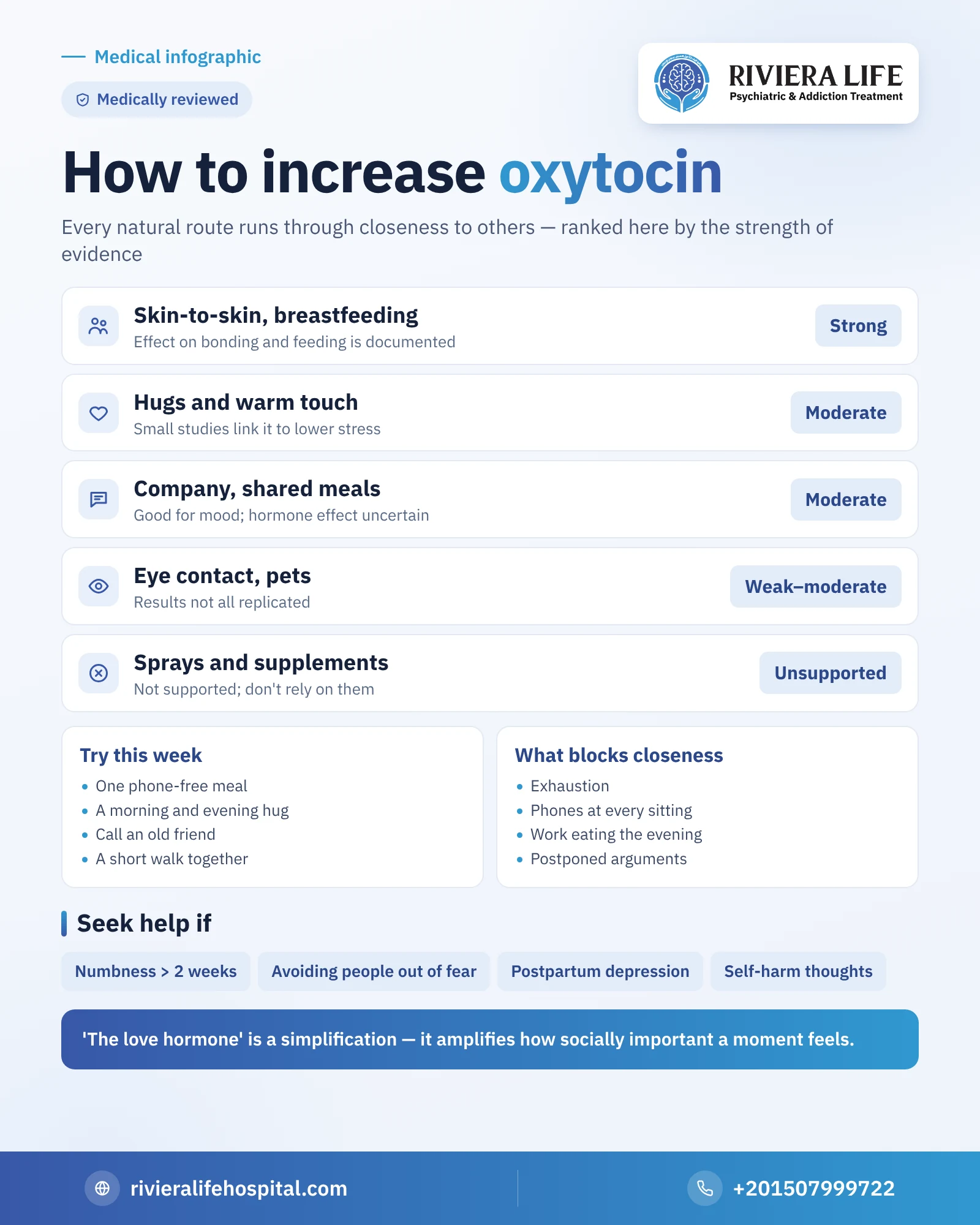
| Method | Strength of evidence | Note |
|---|---|---|
| Breastfeeding and skin-to-skin contact with the newborn | Strong in mothers | Its effect on bonding and breastfeeding is documented |
| Hugging and warm touch between partners | Moderate | Small studies link it to lower stress |
| Company and shared meals | Moderate for mood | The effect on oxytocin is uncertain |
| Eye contact and pets | Weak to moderate | Results not all replicated |
| Group singing and massage | Weak | Small samples |
| Sprays and supplements sold | Not supported | Don’t rely on them |
Touch and hugging
Gentle, slow touch activates nerve fibers in the skin dedicated to sensing warmth and affection, which are linked to calming stress. Studies have indicated that regular hugging between spouses is linked to lower blood pressure and a smaller stress response, in women especially, though the studies were small. The application is simple: a hug that lasts twenty seconds, a hand on the shoulder, and holding hands while talking. In marriage, where coldness creeps in gradually, this may be harder than it seems; if what prevents closeness is depression or anxiety in one of the spouses, you will find this explained in the effect of mental health on the marital relationship.
Skin-to-skin contact and breastfeeding
Here the evidence is clearer. Breastfeeding releases oxytocin and lets the milk down, and skin-to-skin contact between mother and newborn after birth is linked to improved stability and easier breastfeeding, and the World Health Organization recommends it for medically stable newborns. It doesn’t protect the mother from postpartum depression with certainty, so if severe sadness, anxiety, frightening thoughts or inability to care for the infant appear, this calls for an assessment, not more effort.
Eye contact and pets
Long gazes between a dog owner and his dog raised oxytocin in both in a well-known Japanese study, and not all its results were replicated to the same degree. Warm eye contact with someone you love is linked to a feeling of closeness. This doesn’t mean you must get an animal to feel better; but if you love animals, they are a source of attachment and company without judgment, and many feel they ease loneliness. Make sure of hygiene and vaccinations and that the animal suits your living conditions.
Company, group activity and giving
- Eating with others: a family meal or one with friends benefits mood more than eating alone in front of a screen.
- Singing or group activity: small studies have shown group singing linked to improved bonding, and perhaps to a change in oxytocin.
- Helping others: volunteering and giving are linked to meaning and belonging, which matters more than tracking a hormone.
- Expressing gratitude: a sincere message or a short call to someone who has influenced you.
- Massage: it brings relaxation, and the evidence that it raises oxytocin is limited.
This doesn’t mean measuring your activities by hormones, as a good relationship is an end in itself. In happiness hormones there is a comparison between this hormone and others, and for natural ways to raise another messenger read how to increase serotonin.
Oxytocin sprays and supplements: what is the truth?
Products are sold that claim to raise oxytocin or “give trust and attraction”. The honest information is:
- Nasal oxytocin has been tried in research on autism, social anxiety and schizophrenia, and the results were mixed and often disappointing, and it hasn’t been approved for these purposes.
- The quality and ingredients of many products sold online aren’t proven, and they may contain undeclared substances.
- Medicinal oxytocin in hospital, such as that used during labor, is given intravenously under monitoring, and isn’t for home use.
- Dietary “oxytocin boosters” have no good evidence behind them.
If anyone offers you a product that promises love, trust or attraction, ignore it.
Intimacy between spouses
Oxytocin rises in the blood during sexual activity and at orgasm according to small studies, and is thought to contribute to the feeling of closeness afterwards. But the relationship isn’t a means of raising a hormone; if the body becomes a source of pressure or performance, the opposite will happen. Conversation, unconditional affection and a hug after intimacy all strengthen the feeling of safety. And if desire has decreased because of a medicine or depression, mention it to your doctor without embarrassment, as there is no need to bear it in silence.
What blocks closeness in daily life?
The practical reasons are simpler than we think: exhaustion, the phone that is present at every sitting, the work schedule that eats the evening, and postponed disagreements that pile up unresolved. Each of these reduces the chances for touch, talk and looking. It may help to try this week: one meal without phones, a hug in the morning and another on meeting in the evening, a call to an old friend, and a short walk with someone you love. These steps are small, and their effect shows on mood and relationships before it shows on any test.
If closeness is hard for you
Some people don’t feel warmth or closeness despite good circumstances. The cause may be depression or social anxiety, painful childhood experiences, trauma, anxious attachment in relationships, or the effect of substances. Research indicates that early abuse affects bonding systems, but this doesn’t mean the matter is final: psychotherapy and safe relationships change the picture. Read about psychological trauma and social anxiety. And if you notice you are attaching to a substance instead of people, the relationship between oxytocin and addiction is explained in oxytocin and addiction.
When should you seek a specialist’s help?
- If emotional numbness or isolation lasts more than two weeks and affects your life.
- If it is accompanied by severe sadness, anxiety or thoughts of self-harm; call an ambulance on 123 or the mental health line on 16328.
- If you avoid people out of fear, not choice.
- If symptoms of depression appear after childbirth.
How can Riviera Life help you?
At Riviera Life we listen to what lies behind isolation and emotional dryness: is it depression, anxiety, the effect of a substance or old trauma? There is a special program for the family and follow-up after treatment, and the first consultation is free and completely confidential on +201507999722.
More from our oxytocin guide
- Oxytocin: the complete guide
- Oxytocin and addiction
- Happiness hormones
- How to increase endorphins naturally
Questions many people ask
Small studies point to this along with lower stress, but measuring the hormone in the blood doesn't accurately reflect what happens in the brain. The benefit to mood and the relationship is more clearly proven.
Research results are mixed and often disappointing, and it hasn't been approved as a medicine for these purposes. Don't buy online products that promise this.
Not with certainty. If severe sadness, anxiety or inability to care for the baby appears, seek a psychiatric assessment and don't rely on breastfeeding alone.
That is a simplification; it may sometimes increase in-group bias or jealousy, as it is linked to the importance of social situations more than to warmth alone.
The cause may be depression, anxiety, trauma, or the effect of a substance or medicine. If it lasts more than two weeks, seek an assessment from a specialist.