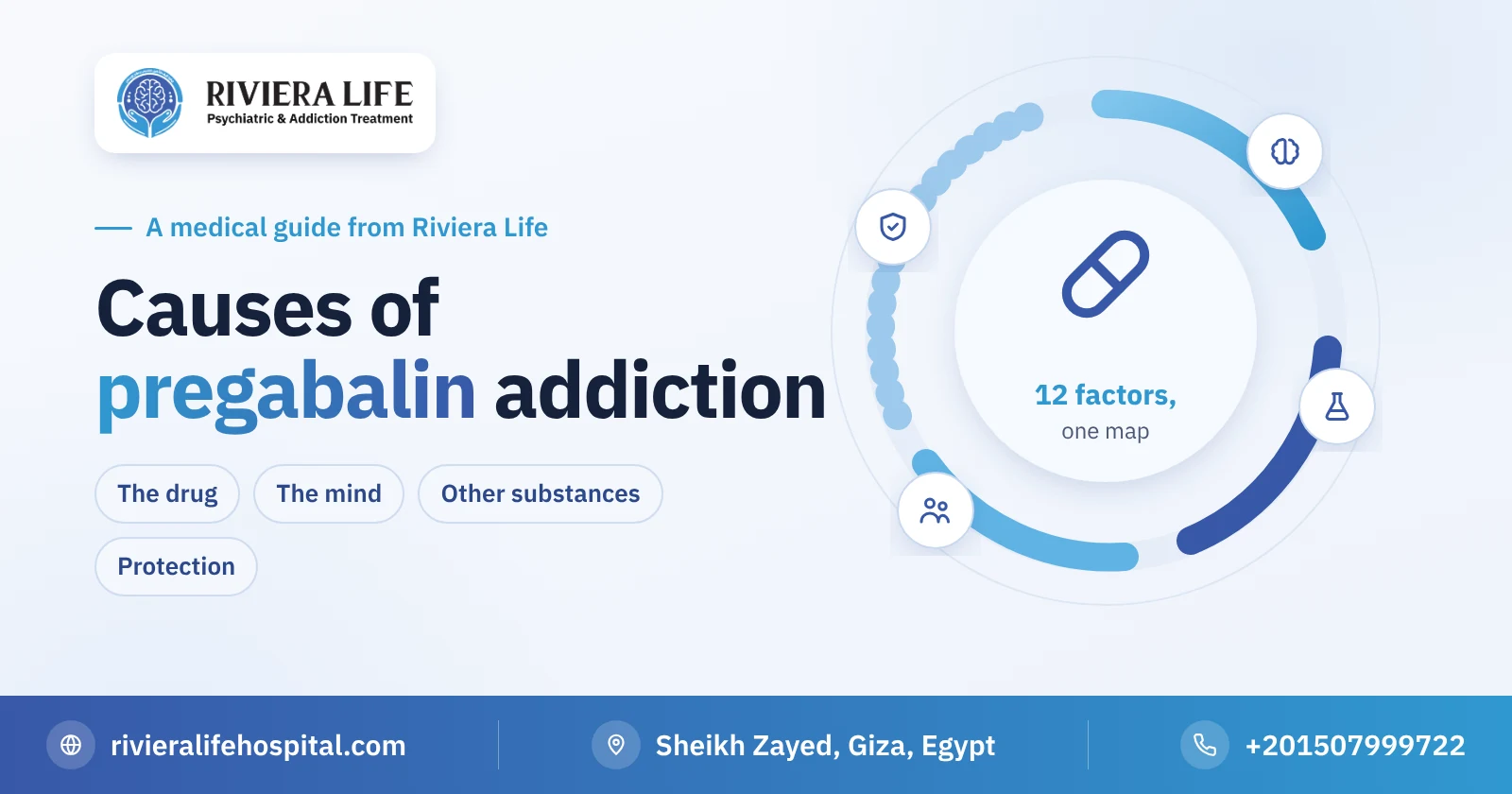
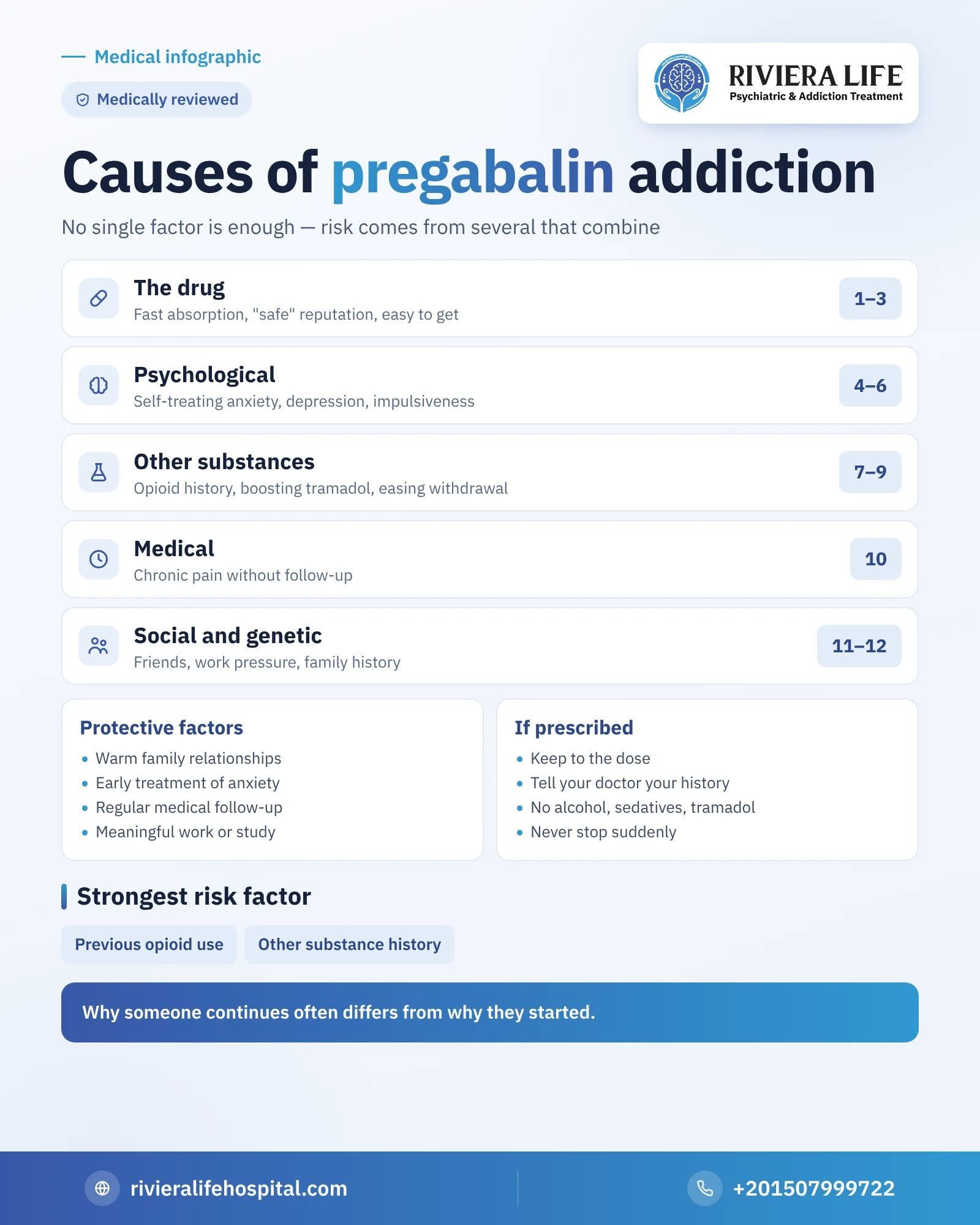
Not everyone who takes pregabalin becomes addicted to it, and the causes of pregabalin addiction aren’t limited to a single factor. Most patients to whom a doctor prescribes it use it and then stop without a problem, while for others it turns into a daily need within weeks. The difference is made by a set of factors that come together: the characteristics of the medicine itself, the person’s psychological state, their history with other substances, and the environment they live in. The strongest of these factors by far is a history with opioids or other substances. This article sets out twelve factors that increase the risk of pregabalin addiction, why some people fall into it and not others, and what protects against it.
These causes apply to anyone who misuses pregabalin under the name “Lyrica”, “Lyrolin” or any other brand name, as the substance is the same.
How does a prescribed medicine turn into addiction?
The usual story doesn’t begin with a decision to use. It begins with a prescription for back pain, anxiety or insomnia, or a capsule offered by a friend “to help you sleep”. The person notices that the medicine doesn’t just ease the symptom, but gives them a calm and lightness they had never known. So they take an extra capsule on a difficult day, then the difficult day becomes a permanent reason. Over time the effect lessens so the amount increases, and insomnia and tension appear if the dose is late, so the medicine turns from a means of relief into a means of avoiding distress. At this point the question is no longer “why did they start?” but “why can’t they stop?”, and the answers to the two questions differ.
Factors related to the medicine itself
1. Rapid absorption and a clear effect
Pregabalin is absorbed quickly and almost completely, so its effect appears within a short time and in a predictable way. This property is useful medically, but it makes the link between the capsule and the feeling of relief strong and direct, which reinforces repetition.
2. The reputation of a “safe medicine”
Because it is dispensed from the pharmacy and prescribed by doctors, many don’t feel they are doing something dangerous when they increase the amount. This false reassurance delays noticing the problem for months.
3. Ease of getting it
Despite the restrictions on dispensing it in Egypt, it remains available through old prescriptions, more than one doctor, or from others. The easier access to a substance is, the higher the risk of overuse.
Psychological factors
4. Self-treating anxiety and insomnia
Someone with chronic anxiety or insomnia who hasn’t received structured treatment may find pregabalin a quick solution. The problem is that the amount they set for themselves rises over time, and that anxiety returns more strongly when the medicine is absent, so the loop closes. You will find this relationship detailed in our article on pregabalin and anxiety.
5. Depression and trauma
People who have been through trauma or have undiagnosed depression are more prone to using any substance that eases psychological pain, including pregabalin. Here the medicine becomes a cover for an untreated wound.
6. Impulsiveness and thrill-seeking
Some personality traits, such as impulsiveness, difficulty tolerating boredom and a tendency to experiment, raise the likelihood of moving from experimenting to repeated use, especially in adolescence and youth. Their effect is increased by weak alternative skills for dealing with distress; someone who hasn’t learned to calm themselves by talking, movement or regular sleep tends towards the quickest solution, and the capsule is always the quickest solution.
Factors linked to other substances
7. A previous history with opioids or other substances
This is the strongest factor in most studies. Someone who has previously been dependent on tramadol, heroin, methadone or others is clearly more prone to misusing pregabalin, because their brain has already learned to look for relief in a substance.
8. Boosting the effect of tramadol and hashish
Using pregabalin to boost the effect of tramadol, hashish or alcohol is widespread in Egypt. This mixing starts as an “add-on” then becomes a fixed part of the routine, and it is also the most dangerous pattern of use, as our article on pregabalin vs tramadol explains.
9. Easing withdrawal from another substance
Some of those trying to quit opioids turn to pregabalin to ease withdrawal pains without supervision. So they leave one addiction to enter another, and sometimes combine the two.
Medical factors
10. Chronic pain without follow-up
A nerve pain patient who takes the medicine for years without regular review may raise the amount gradually whenever the pain intensifies. The pain is real, but the absence of a doctor turns treatment into invisible dependence. Kidney patients are more prone to the medicine and its effects accumulating. The same sometimes happens with a prescription written for a short period that then continued to be dispensed for months without anyone asking whether it was still needed.
Social and genetic factors
11. Friends and work pressure
The medicine being present in a circle of friends, or in an exhausting work environment with long hours, makes trying it easier and gives it a false legitimacy. Often the first capsule is a “gift” from a colleague. In some occupations that depend on night shifts or long physical effort, workers pass medicines among themselves as a way to endure or to sleep after the shift.
12. Family history
Addiction in the family raises susceptibility to addiction in general, through genetic factors that affect the reward system and stress tolerance, and through the environment in which the child grows up. Genetics doesn’t decide addiction, but it makes caution more necessary.
Why do some become addicted and not others?
No single one of these factors is enough to create addiction. What usually happens is that a personal predisposition, such as untreated anxiety or a history with another substance, combines with a circumstance that makes the medicine easy to get, then the medicine’s characteristics complete the circle. That is why two people may take the same amount, and one stops easily while the other can’t. Understanding this map isn’t meant to assign blame, but to know where treatment begins. The signs that use has gone beyond the limit are in our article on pregabalin addiction symptoms.
The reasons for continuing aren’t the reasons for starting
Many families look for “the cause” in the past: a bad friend or pressure at work. But what keeps a person on pregabalin after months usually differs from what pushed them to it the first time. After the nervous system has adapted, the insomnia and anxiety that appear when a dose is late become a sufficient reason on their own to continue, even if the original problem has ended. Added to this are fear of withdrawal, shame at admitting it, and the daily habit linked to particular times and places. That is why solving the problem the story started with isn’t enough; the dependence itself must be dealt with through a medical plan, and the shame through a conversation that carries no accusation.
Factors that protect against addiction
- A warm family relationship in which the person can talk about their distress.
- Diagnosing and treating anxiety, depression and insomnia early with structured methods.
- Regular medical follow-up for everyone who takes pregabalin on prescription.
- Work or study that gives the day meaning and routine.
- Accurate knowledge that a prescribed medicine can be addictive like any other.
Advice for those taking it on prescription
If you take pregabalin for a medical reason, these are simple steps that reduce the risk: keep to the amount the doctor set and don’t raise it yourself even if the effect lessens, tell your doctor about any previous history with other substances, don’t combine it with alcohol, sedatives or tramadol, don’t give your capsules to anyone, and review with the doctor regularly to assess the need to continue. And if you decide to stop, let it be gradual with a plan from them, because stopping suddenly has risks explained in our article on pregabalin withdrawal symptoms.
From understanding the cause to the treatment step
Knowing the factor that led to addiction is half the treatment plan. Someone who started because of anxiety needs treatment for anxiety, someone who started with tramadol needs a plan covering both substances, and someone who started with chronic pain needs an alternative for the pain. At Riviera Life the assessment begins with exactly this question, then the plan is built around it, and its details are in our article on pregabalin addiction treatment.
More from our pregabalin guide
- Pregabalin: the complete guide
- Pregabalin addiction symptoms
- Pregabalin and anxiety
- The harms of pregabalin
Questions many people ask
The strongest risk factor is a previous history with opioids or other substances, followed by using it to self-treat anxiety or insomnia without medical supervision.
No, most patients who stick to the prescription and follow-up don't become addicted to it. The risk rises when the amount is increased without a doctor or there is a history with other substances.
Because it strengthens the feeling tramadol causes. This mixing speeds up dependence on both substances and raises the risk of breathing depression and seizures.
A family history of addiction raises susceptibility in general, but doesn't decide addiction. A supportive environment and early treatment of psychological problems change the course.
Keep to the prescribed amount, don't mix it with alcohol, sedatives or opioids, tell your doctor about any history with other substances, review it regularly, and don't stop it suddenly.