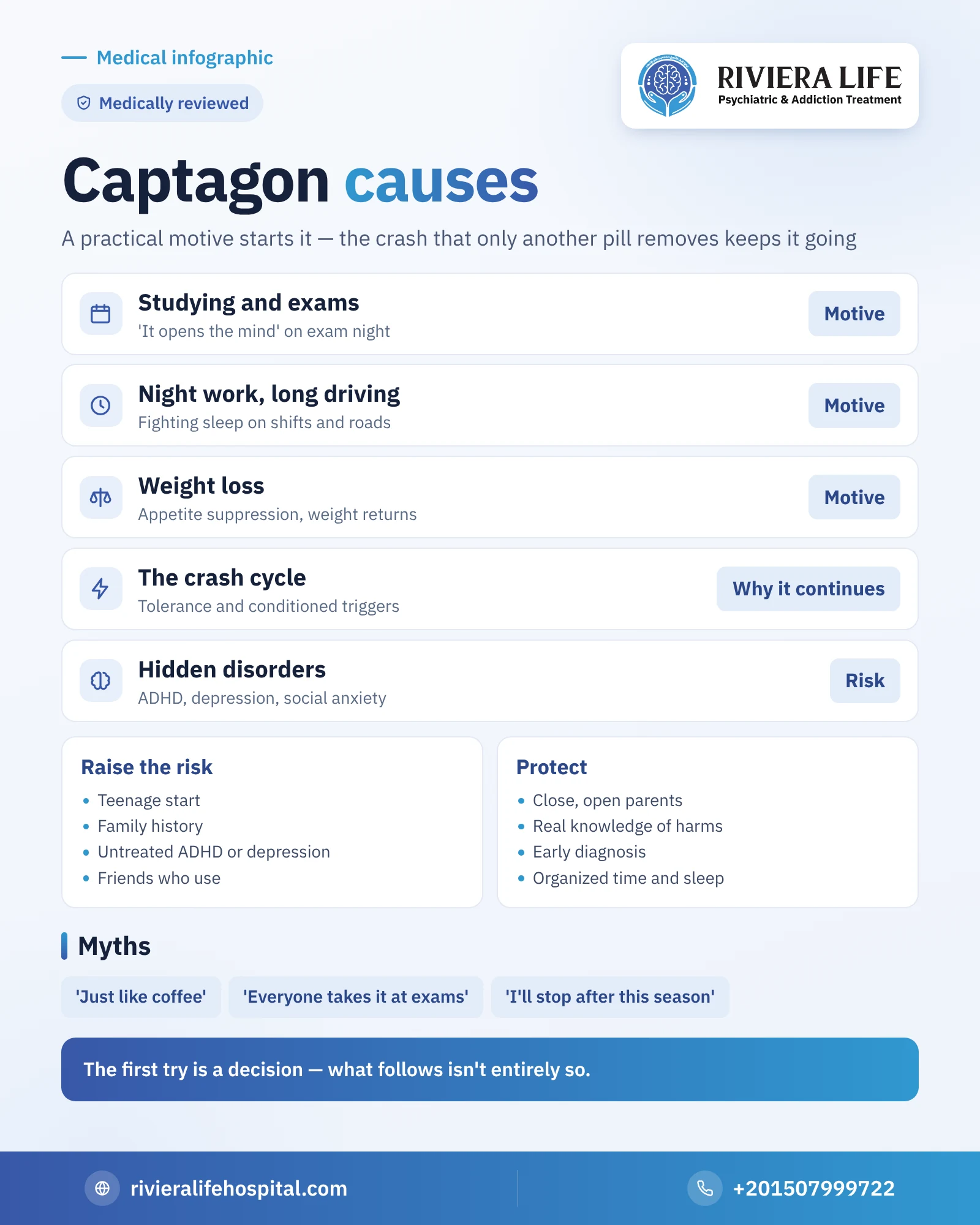
For most users, the causes of captagon addiction start with a practical motive, not a search for a “mood”: a student who wants to stay up studying, a driver who wants to finish the road, a worker on a night shift, or a young man who wants to lose weight quickly.
Then use continues because the pill creates its own problem, as the crash that follows the effect wearing off can only be removed by another pill. Between the start and continuation, factors step in that make some people more prone than others, such as genetic predisposition, disorders like ADHD and depression, friends, and the ease of getting the pills. This article explains these factors, and clarifies what the family can do for prevention.
What does captagon offer the beginner?
To understand why someone tries captagon, we must admit what it offers at first: long hours without sleepiness, a feeling of focus and control, confidence in talking with people, and a suppressed appetite. These “benefits” are real in the first days, and they are what make the pill convincing to someone facing pressure. The problem is that they are temporary and costly, as the brain quickly gets used to it, and the price is paid in the form of exhaustion, depression and a decline in the very performance the pill came to improve.
From trying to addiction: how does it develop?
The road usually passes through successive stages. It starts with trying in a specific situation, such as an exam night or a long trip. Then it turns into seasonal use linked to the same situations. After that it widens to include ordinary days, because the person can no longer bear the crash that follows each time. With tolerance they need larger amounts, and may add other substances to sleep or calm down. At this stage the pill is no longer a means to perform a task; it has become the task.
The most common motives for starting
Studying and exams
Among the most repeated stories: a secondary school or university student hears that the pill “opens the mind”. He tries it on an exam night, studies until morning, and believes it is the reason for his success. It repeats in the next exam, then at every study pressure. He overlooks that repeated staying up weakens memory, and that the tension the pill causes may spoil performance in the exam itself. The same story repeats with prescribed wakefulness medicines, as we explain in the article on treating dependence on Bravamax.
Night work and long driving
Long-distance transport drivers, and those working night shifts or exhausting physical jobs, find in the pill a way to resist sleepiness. Here personal risk mixes with risk to others, because driving after long hours of use and staying awake weakens judgment and increases the likelihood of accidents when the effect suddenly wears off.
Losing weight
Because captagon suppresses appetite, some girls and young men turn to it to lose weight quickly, sometimes on the advice of a friend or online content. They do lose kilograms, but at the expense of sleep, mood and the heart, and the weight often comes back on stopping, bringing the motive to use back with it.
Late nights and parties
For some young people captagon is linked to staying up in groups and the desire to continue until morning. Here mixing with alcohol, hash or others is common, and the risks multiply.
Why does use continue despite the harms?
Three mechanisms explain the difficulty of stopping:
- The crash cycle: after the effect wears off comes exhaustion and depression, and the fastest way to get rid of them is a new pill.
- Tolerance: the brain gets used to high dopamine, so its response decreases and it needs a larger amount for the same effect.
- Conditioned association: books, the road, the shift or particular friends become signals that call up craving automatically, even after weeks of stopping.
All this makes stopping suddenly without help difficult, and the page on captagon withdrawal symptoms explains the details of what happens after it.
Genetic and biological factors
Not everyone who tried captagon became addicted to it. Research indicates that genes explain an important part of vulnerability to addiction in general, so having a first-degree relative who suffered addiction raises the risk. Some people also respond to stimulants with a stronger high, so their attraction to them is greater. Added to this is the age of starting, as in adolescence the brain’s areas for controlling impulsivity haven’t fully matured, which makes an early start more dangerous.
Psychiatric disorders: when the pill is a wrong treatment
Some users use captagon, without realizing, to treat an undiagnosed problem:
- Attention-deficit/hyperactivity disorder: someone suffering chronic distraction may feel the pill “set them right” for the first time, but uncalculated doses and unknown content turn this into addiction.
- Depression: the depressed person looks for missing energy and pleasure, and the pill gives them for hours then deepens the depression afterwards.
- Social anxiety: the pill gives temporary boldness in social situations.
Doctors call this overlap dual diagnosis, and its treatment requires dealing with the psychiatric disorder and the addiction together, as the article on captagon addiction treatment explains.
Environment, friends and ease of access
Captagon is widespread across the Arab region and the Gulf, and is passed around among young people as “a pill”, not “a drug”, which alone lowers the psychological barrier to trying. The risk increases with friends who use, a work environment in which staying up on pills is considered normal, or a lack of oversight over pocket money and time. And in societies where the pill is seen as a means to success or to hold out at work, everyone is late in seeing it as a problem.
Family pressures and expectations
Some homes put grades above everything, and some live with constant disagreements or the absence of a parent. In both cases the son finds himself under pressure he doesn’t know how to deal with. The pill here seems a solution that pleases the parents or escapes from them. This doesn’t mean blaming the family, but it means that changing some patterns at home is part of prevention and treatment.
Is addiction a choice?
The first try is a decision, but what comes after it isn’t entirely so. With repetition, the reward and control circuits in the brain change, so stopping becomes much harder than someone watching from outside thinks. This doesn’t release the person from responsibility, but it explains why advice and scolding aren’t enough, and why the matter needs real treatment.
Who is most at risk of captagon addiction?
| Factors that raise the risk | Factors that protect |
|---|---|
| Starting in adolescence | A close, open relationship with the parents |
| A family history of addiction | Realistic knowledge of the harms of stimulants |
| Untreated attention deficit or depression | Early diagnosis and treatment of psychological problems |
| Continuous study pressure or night work | Realistic organization of time and sleep |
| Friends who use | Activities, sport and a healthy circle of friends |
Wrong ideas that pave the way
“It’s just a stimulant pill like coffee”, “everyone at college takes it at exam time”, “I’ll stop after this season”. These sentences repeat on the lips of those who have started, and all of them lessen the danger of the pill in the mind. The truth is that its content is unknown, and that its harm to the heart may appear from the first time in someone predisposed, as the article on the harms of captagon explains.
How do you protect your son from the start?
Talk with him about captagon before the exam season, not after it, and calmly, not with scaring. Help him organize his studying throughout the year instead of last-minute late nights. Ease the pressure of grades, and make your message that his health is more important than the result. Watch for signs of attention deficit or depression and ask for an assessment for them. And follow his friends and pocket money without turning into a watchman. If signs appear that worry you, compare them with the list of captagon addiction symptoms and ask for early advice.
At Riviera Life the assessment starts with a simple question: why did you start? Because the answer to it determines half the plan, whether the motive was study, work or a psychiatric disorder that needs treatment.
More from the captagon guide
- Captagon: the complete guide
- Captagon addiction symptoms
- The harms of captagon
- The causes of amphetamine addiction
Questions many people ask
Among the best-known motives are staying up to study or work, suppressing appetite to lose weight, and staying up at gatherings. Many start with a practical goal and don't see themselves as users.
No, but repetition raises the risk a lot, especially with an early start, a family history of addiction, or untreated depression or attention deficit.
Someone with undiagnosed attention deficit may find that the pill improves their concentration temporarily so they repeat its use. Correct diagnosis and treatment of the disorder reduce this risk.
Because the crash after the effect wears off pushes towards a new pill, because the brain gets used to the substance so it needs larger amounts, and because situations such as studying or the road become triggers for craving.
Talk with him early and calmly, help him organize his studying throughout the year, ease the pressure of grades, and pay attention to any attention deficit or depression that needs assessment.