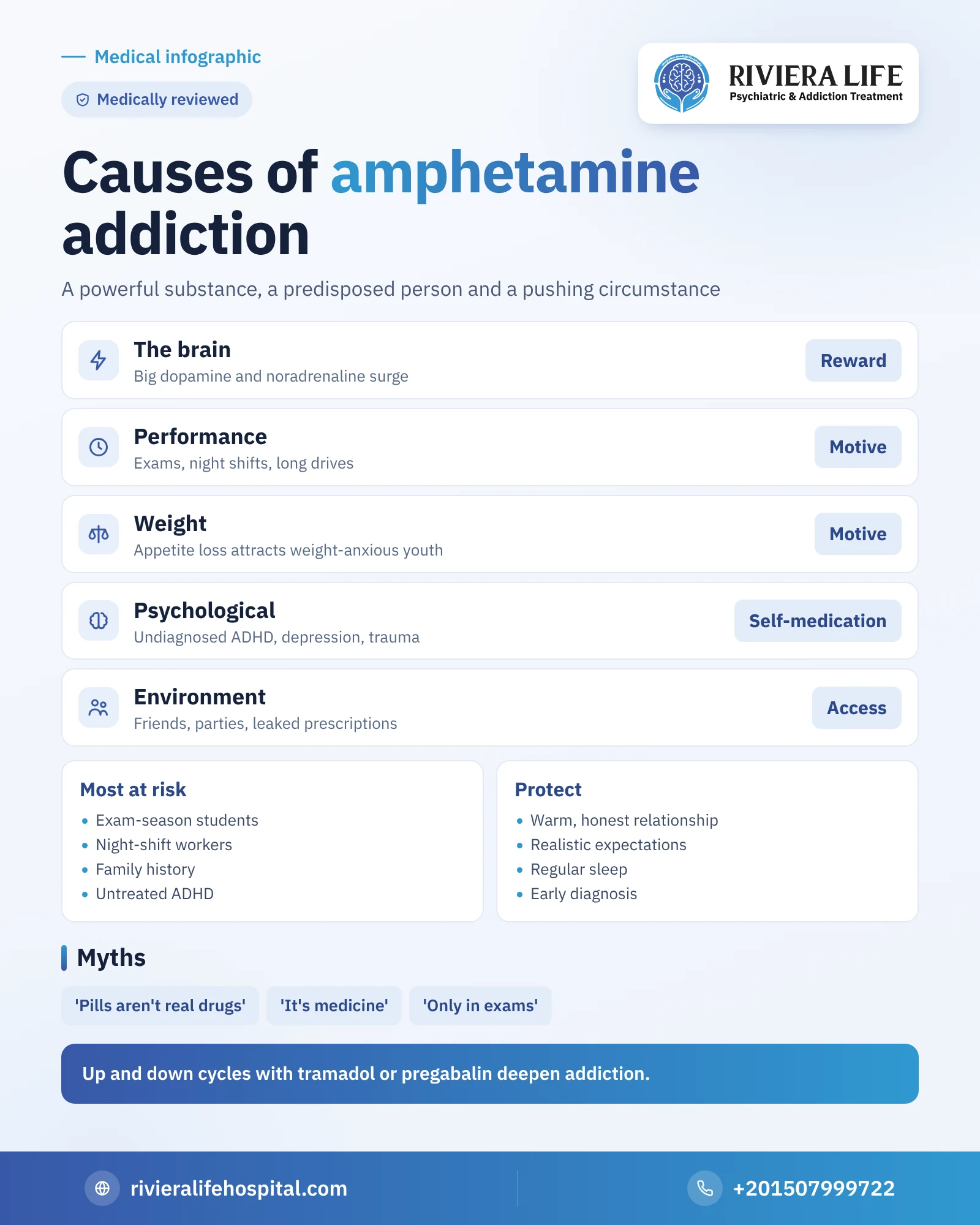
The causes of amphetamine addiction aren’t limited to one cause, as addiction is the result of a substance that strongly affects the brain’s reward system meeting a person with a particular predisposition, in a circumstance that pushes them toward it: a decisive exam, exhausting night work, a desire to lose weight, or company that uses. Genetics, undiagnosed mental disorders and trauma play a large role in determining who stops after an experiment and who continues. This article explains these factors, why this type of use spreads among particular groups, and what protects children.
Why does amphetamine cause addiction?
Everything that gives us natural pleasure, from food to success, raises the level of dopamine in the brain’s reward areas to a limited degree. Amphetamine raises it to a much greater degree, and adds a surge of noradrenaline that gives a feeling of energy and capability. The brain quickly learns that this pill is “important”, so it links it to the places, people and feelings that accompanied it. With repetition the natural secretion of dopamine decreases, so ordinary pleasures fade and the pill remains the easiest way to feel alive. This is what turns the experiment into a habit, and the habit into dependence.
The performance motive: study and work pills
One of the most distinctive things about amphetamine addiction is that it often starts with a goal that is “useful” in its owner’s view. A student in secondary school or university hears from a classmate that a pill makes him study all night. A transport driver wants to cover the distance without stopping. A worker on night shifts wants to hold out. At first the pill seems to do the job, so it repeats in every season of pressure, then becomes a condition for any achievement. The problem is that the crash after it eats up what was achieved, so the person returns to it to make up for what was lost, and so the circle closes.
Weight loss and body image
Amphetamines were used in the past in slimming tablets before they were restricted because of their risks. The loss of appetite they cause still attracts some young men and women anxious about their weight. The risk rises in those with a disturbed relationship with food, because the pill gives them a quick result, so it is hard for them to give it up despite the insomnia and palpitations.
Genetic and biological factors
Family and twin research indicates that the predisposition to addiction in general is inherited to a considerable degree, estimated at roughly half, with estimates differing according to the substance and the study. This doesn’t mean that an addict’s son will inevitably become addicted, but that his brain may respond to the substance more strongly, or recover from its effects more slowly. Age at first experiment is also linked to predisposition; the brain in adolescence hasn’t yet matured its control areas, which is why early use is more dangerous.
Undiagnosed attention deficit hyperactivity disorder
Some of those who use stimulants on the street originally have undiagnosed ADHD. They feel with the pill that they can “finally” concentrate, so they think it is the solution. And there is a big difference between a treatment a doctor prescribes at a calculated dose with follow-up, and random use of pills of unknown content. The paradox is that diagnosing and treating the disorder correctly from childhood is linked in many studies to a lower risk of addiction later, not a higher one.
Depression, anxiety and trauma
Some people turn to the stimulant to escape the sluggishness of depression or an inner emptiness they can’t name. Others turn to it after difficult experiences, so it gives them a temporary feeling of strength and control. In both cases addiction and the mental disorder become intertwined, each feeding the other, which doctors call dual diagnosis. And treatment only succeeds if it treats both together.
Environment, company and availability
- Friends: most first experiments happen with a friend who offers the pill as something ordinary.
- Night outs and parties: where the stimulant is used to stay awake and dance for hours.
- Availability of medicines: leakage of prescribed medicines from a home, a pharmacy or a friend who has a prescription.
- Family and academic pressure: high expectations without space for failure or rest.
- The absence of calm supervision: whether excessive harshness that pushes toward hiding, or complete leniency.
Mixing with other substances
In the Egyptian reality use rarely stops at amphetamine alone. Many use tramadol, pregabalin or hash to come down from the effect of the stimulant and sleep, then need the stimulant again to wake up. This cycle between “up” and “down” deepens addiction and makes it more complex. Some may progress from pills to the stronger methamphetamine in search of a more intense effect; you will find the causes of this type in the article on the causes of ice addiction.
False ideas that pave the way for the first experiment
Before trying the first pill the young person has usually been convinced of one or more ideas that make the matter seem simple. Among the best known is that “pills aren’t real drugs” because they aren’t smoked or injected, or that they are “medicine” since there are children who take them on prescription. Others hear that the pill “doesn’t cause addiction if taken only in exams”. These ideas lower the psychological barrier to the experiment, and delay seeking help later, because the person doesn’t see themselves as an “addict” even after months of regular use. Correcting these ideas calmly and with accurate information is an essential part of prevention.
Who is most at risk of amphetamine addiction?
- Secondary school and university students in exam seasons.
- Workers on long night shifts and long-distance drivers.
- Those with a family history of addiction.
- Those suffering from ADHD, depression or anxiety without treatment.
- Those who started use at an early age.
- Those already using other substances, including those who drink alcohol or smoke hash regularly.
- Those going through a big sudden change, such as moving to live alone in a new city or losing a job.
Protective factors
On the other hand there is what clearly reduces the risk: a warm relationship with the parents in which the son can admit his weakness without fear, realistic expectations from study and work, regular sleep, sporting activity, friends who don’t use, and early diagnosis of any mental disorder. Knowing the truth about these pills, not exaggerated frightening, makes the young person more able to refuse. You will find a comprehensive picture of the substance itself on the amphetamines page.
Is addiction a choice?
The first experiment is usually a decision, but what happens after it isn’t entirely so. Addiction changes the way the brain areas responsible for judgment and self-control work, so stopping becomes much harder than someone who hasn’t gone through it imagines. Understanding this doesn’t exempt the person from responsibility, but it explains why blame and preaching aren’t enough, and why treatment needs a medical and psychological plan. And if you notice that the experiment has turned into a pattern, the signs are explained in the article on amphetamine addiction symptoms.
How do you protect your son from study pills?
Talk with him about the pills before the exam season, not after it, and ask him about what he hears from his classmates. Explain to him that staying up on a stimulant harms memory instead of improving it, and that the pills in circulation are of unknown content. Ease the pressure around grades, and help him organize his time and sleep. If you notice real difficulty concentrating, take him to a psychiatrist instead of him looking for a solution on the street. And if he has already started, the next steps are in the article on amphetamine addiction treatment.
How does Riviera Life help you?
Understanding the cause is half the treatment. That is why the Riviera Life team doesn’t settle for stopping use, but looks with the patient and family for what drove them to the pill in the first place: academic pressure, silent depression, undiagnosed hyperactivity, or company that is hard to move away from. Then the plan is built on this understanding, in complete confidentiality, with family sessions that help it change what can be changed inside the home.
More from the amphetamines guide
- Amphetamines: the complete guide
- Amphetamine addiction symptoms
- The harms of amphetamine on the heart, brain and body
- The difference between methamphetamine and amphetamine
Questions many people ask
Because they start with a goal that seems useful, such as staying up to study, then a crash follows that pushes toward a new pill, so they gradually turn into a condition for any achievement.
Genetics increases the predisposition to addiction considerably, but it isn't a final verdict. Environment, age at first experiment and mental health play important roles.
Untreated ADHD may push toward using stimulants in search of concentration, while correct early diagnosis and treatment are linked to a lower risk in many studies.
They use them to calm themselves and sleep after the stimulant, so a cycle forms between up and down that deepens addiction and adds new risks.
With early dialogue and correct information, easing the pressure around grades, organizing sleep, and taking him to a doctor if he has real difficulty concentrating.