Bravamax is a medicine containing modafinil, a brain stimulant prescribed to treat excessive daytime sleepiness in specific conditions such as narcolepsy. The medicine has spread among students and night-shift workers as “focus pills”, and some of them can no longer start their day without it. Its addiction risk is lower than that of strong stimulants such as amphetamine, but it isn’t zero, and psychological dependence on it is documented, which is where the need for Bravamax addiction treatment with a clear plan comes from. In this article we explain when Bravamax use becomes a problem, what happens on stopping, and how treatment works step by step without falling into another substitute.
If you are looking for the medicine itself — its uses, when it starts working and how long it lasts — you’ll find that in our guide to Bravamax.
What is Bravamax and why is it prescribed?
Modafinil activates the brain’s wakefulness centers and raises dopamine levels more gently than traditional stimulants. That is why it doesn’t usually cause the intense high caused by substances such as Captagon, but it gives a feeling of alertness and attention for long hours.
This article is about stopping Bravamax and treating dependence on it. Information about the medicine itself, from its uses to when its effect starts and ends, whether it is a scheduled drug, and whether it shows in a test, is in our guide to Bravamax (modafinil).
Its known medical uses are limited: narcolepsy, residual sleepiness in people with sleep apnea despite treatment, and shift work sleep disorder. Using it for studying or to boost productivity isn’t an approved medical use, and it is the best-known route into misuse.
Like any medicine, it has known side effects: headache, nausea, nervousness and a dry mouth, and difficulty sleeping if taken late in the day. Rarely it causes serious skin reactions or psychological symptoms such as severe anxiety and hallucinations, symptoms that call for stopping it and seeing a doctor immediately.
Is Bravamax addictive?
International regulators classify it among controlled medicines because it has a potential for misuse, though lower than other stimulants. Cases of dependence on it have been recorded in medical reports, most in people who raised the dose themselves or had a history with other substances.
The most common picture isn’t strong physical dependence, but psychological dependence: the person becomes convinced they can’t study, work or fight tiredness without the pill, so they keep taking it despite insomnia, anxiety and lost sleep. And if other stimulants are mixed in, the picture is closer to what is explained in our article on amphetamine addiction treatment.
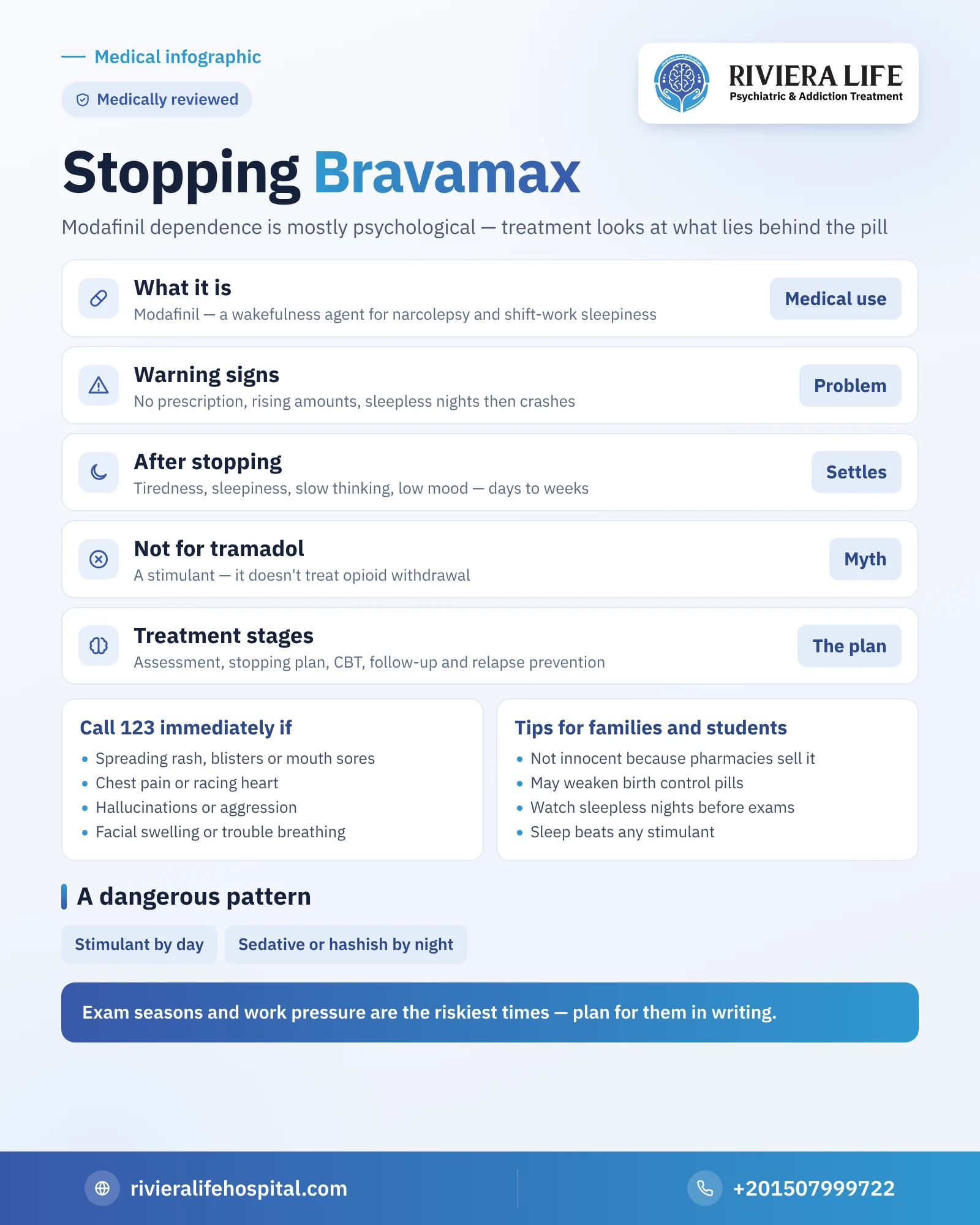
Signs that Bravamax use has become a problem
- Taking it without a prescription, or buying it from sources other than a pharmacy.
- Gradually raising the amount because “the effect isn’t what it was”.
- Staying up two or more nights in a row, then collapsing into a long sleep.
- Relying on it every day, even on rest days.
- Using a sleeping pill, sedative or hashish to be able to sleep afterwards.
- Showing anxiety, irritability, loss of appetite and weight loss.
The last cycle in particular — a stimulant by day and a sedative by night — is one of the most dangerous patterns, because it combines two problems in one body.
Is Bravamax a substitute for tramadol?
This question comes up repeatedly in Egypt, and the answer is no. Tramadol is an opioid painkiller, while modafinil is a stimulant that neither treats opioid withdrawal nor eases the craving for them. Anyone who uses it to make up for tramadol’s “energy” or to get through withdrawal alone is shifting the problem from one substance to another. The right path is tramadol addiction treatment with a clear medical plan.
What happens when you stop Bravamax?
There is no specific, agreed picture of a modafinil withdrawal syndrome as there is with other substances, but many people who used it regularly notice after stopping:
- Severe tiredness, daytime sleepiness and a desire to sleep for long hours.
- Slowed thinking and difficulty concentrating.
- Low mood and a loss of enthusiasm.
- A strong urge to go back to it at the first pressure or exam.
These symptoms usually ease within days to a few weeks. But if severe, persistent sleepiness appears, there may be a real sleep disorder that was hidden behind the medicine and needs diagnosis.
Symptoms that call for the emergency department during use
Modafinil rarely poses a direct threat to life, but there are signs that can’t wait, especially with large doses or when it is mixed with other stimulants.
Call an ambulance on 123 immediately if you see
During Bravamax use or after a large amount of it, seek urgent medical help if you see:
- A spreading skin rash, blisters, peeling skin or mouth sores
- Chest pain or a fast heartbeat that doesn’t settle
- Hallucinations, severe suspicion or unusual aggressive behavior
- Thoughts of self-harm
- Swelling of the face or lips, or difficulty swallowing and breathing
The stages of Bravamax addiction treatment
Assessment
The doctor asks about the actual amount, the source of the medicine, other substances used with it, the sleep pattern, and any undiagnosed depression, anxiety or attention deficit disorder. Sometimes they discover that the person is self-treating a problem that needs completely different treatment.
The stopping plan
The doctor decides whether stopping is direct or in stages depending on the amount and duration, and monitors sleep and mood in the first weeks. The medicine isn’t replaced with another stimulant or with large amounts of energy drinks.
Treating the motive behind the use
Cognitive behavioral therapy helps dismantle the idea “I can’t succeed without it” and builds practical alternatives: organizing study, managing pressure, and sleeping at fixed times. Anyone who has had poor concentration since childhood deserves an assessment for attention deficit disorder rather than self-treatment.
Follow-up and relapse prevention
Exam seasons and work pressure are the riskiest periods. A written plan for these times, follow-up sessions, and the family knowing the early signs reduce the chance of going back.
How long does treatment take?
There is no fixed duration. Someone who used it for a short time without other substances may need weeks of outpatient follow-up. Someone who mixed it with sleeping pills or drugs, or has clear depression, may need a longer program, and sometimes a short inpatient stay to regulate sleep and mood.
Tips for the family and the student
- Don’t treat the pill as an innocent booster just because pharmacies sell it.
- Talk to a doctor before any use, especially anyone with a heart problem or a psychiatric history.
- Be aware that modafinil may reduce the effectiveness of birth control pills.
- If you notice your son staying up night after night before exams with unusual energy and then collapsing, calmly ask him what he is taking before assuming it is just pressure.
- Enough sleep improves achievement more than any stimulant in the long run.
Bravamax and sex: what is actually known?
Some young people say that Bravamax increases desire or prolongs intercourse, and the medical evidence doesn’t support this. Modafinil hasn’t been studied or approved for any sexual purpose, and it isn’t a sexual stimulant like erection medicines. The alertness and enthusiasm the user feels may suggest an improvement in performance that isn’t there, and psychological dependence on the pill before sex may create new performance anxiety instead of solving an existing problem.
The indirect effects, however, are mostly well known:
- Repeated late nights and exhaustion are linked to lower desire and weaker erections.
- The anxiety and palpitations the stimulant causes can get in the way of enjoyment.
- The crash and lethargy on days off it temporarily weaken desire.
- Combining it with stimulants or erection medicines strains the heart with no benefit.
If a sexual problem persists, it is better to see a doctor to find the cause rather than adding a new substance. For comparison with substances promoted with the same claim, read tramadol and sex and amphetamine and sex.
The right hospital for Bravamax addiction treatment: how to choose
The right hospital for treating Bravamax addiction is one that sees what lies behind the pill — insomnia, pressure, sleep and concentration disorders — and doesn’t stop at banning the medicine. Put these questions in front of you:
- Does it assess sleep disorders and attention deficit before setting the plan?
- Does it uncover other stimulants and sedatives used with the medicine?
- Does it offer behavioral therapy that rebuilds study and work habits?
- Does it treat accompanying depression and anxiety?
- Does it have a clear plan for exam seasons and work pressure after stopping?
And be wary of any provider that promises a guaranteed cure or to end the problem in days.
Why Riviera Life for Bravamax addiction treatment?
Here is how these standards are met at Riviera Life:
- A licensed hospital: licensed by the Ministry of Health for psychiatry and addiction treatment.
- Specialist consultants: in psychiatry and addiction, who assess sleep, concentration and mood together.
- Fourteen years of experience: with thousands of recovered cases, including stimulant and medication cases.
- Round-the-clock supervision: for those who need an inpatient stay to regulate sleep after mixing with sedatives.
- Complete confidentiality: protecting the future of the student and the employee.
- The family as a partner: a family program and aftercare for pressure seasons.
To stop Bravamax safely, the first consultation is free on +201507999722, day and night, and we are based in Sheikh Zayed, Giza.
Read also
- Amphetamine: the complete guide to stimulants
- Melatonin and sleep in recovery
- Tryptizol addiction treatment
- Zolpidem addiction treatment
Questions many people ask
That isn't its approved medical use; it is prescribed for specific cases of pathological sleepiness. Using it for studying without a doctor can cause insomnia, anxiety and psychological dependence, and it doesn't make up for good sleep.
Many people stop without major physical danger, but tiredness, sleepiness and low mood may appear for days or weeks. Anyone who used large amounts or combined it with other substances needs a doctor's plan.
In most cases yes, with regular outpatient follow-up with a psychiatrist and behavioral therapy. An inpatient stay is better if it was mixed with sedatives or other drugs, or if severe depression or psychosis appears.
No. It is a stimulant that doesn't act on opioid receptors, and using it for this purpose shifts dependence from one substance to another. Tramadol withdrawal needs its own treatment plan.
A hospital that assesses sleep, concentration and mood alongside the addiction, offers behavioral therapy, a family program and full confidentiality. Riviera Life in Sheikh Zayed meets these standards, and the first consultation is free.