Two people try heroin in the same circumstances; one stops and doesn’t return, and the other finds himself months later unable to spend a single day without it. This difference isn’t explained by willpower alone, but by the intertwined causes of heroin addiction; addiction results from an interaction between a substance with a very strong effect on the brain, a person with a particular genetic and psychological predisposition, and an environment that eases use or protects from it. This article explains these causes and how they intertwine, who is most at risk, and what protects children.
Why does heroin cause addiction so quickly?
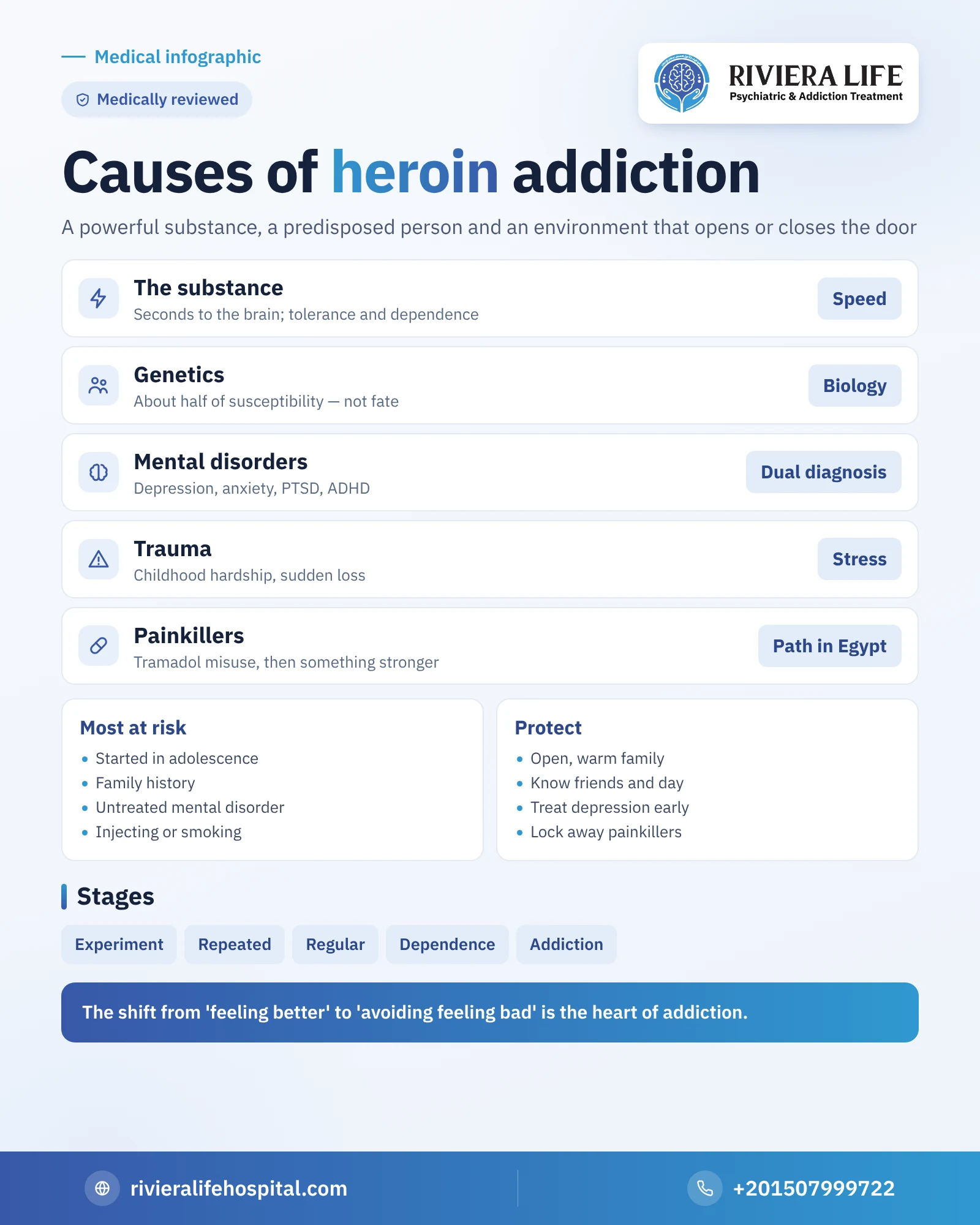
A large part of the answer is in the substance itself. Heroin reaches the brain within seconds when injected or smoked, and the faster the arrival, the stronger the brain’s link between the act and the reward. The brain learns by repetition: each dose releases a wave of a feeling of relief in the reward system, so it records it as something important worth repeating, exactly as it records food and water.
Then come tolerance and physical dependence. After weeks of regular use the effect of the same amount decreases, and troublesome symptoms appear in its absence. Here the motive for use gradually changes: it is no longer a search for euphoria, but an escape from the pain of withdrawal. This shift from “the desire to feel better” to “the need to avoid feeling bad” is the heart of addiction. And this mechanism is shared by all opioid substances, as the article on why opioid addiction starts and why it is hard to stop explains.
From experiment to addiction: how does it develop?
No one decides to become an addict. Usually the matter passes through overlapping stages:
- Experiment: out of curiosity, peer pressure or an attempt to escape a particular distress.
- Repeated use: on particular occasions or circumstances, with a strong belief in the ability to control.
- Regular use: it becomes part of the routine, and tolerance begins to appear.
- Dependence: withdrawal symptoms appear, and use becomes a necessity to get through the day.
- Addiction: loss of control and continuing despite clear harms.
The speed of moving between these stages differs a lot from person to person, and with heroin in particular it may be surprisingly short.
Why does the craving continue even after stopping?
The brain links heroin to everything around it: places, people, times, and even smells and tools. After stopping these links remain stored, so if the person passes the same street, meets the old using friend or feels a similar distress, the craving wakes strongly as if it were an automatic reaction. That is why relapse sometimes happens months after abstinence, and that is why treatment focuses on learning to recognize these triggers and deal with them, not on abstinence alone.
Genetic and biological factors
Family and twin studies indicate that genetic factors explain a large part of susceptibility to addiction, possibly reaching about half according to many estimates. This doesn’t mean there is an “addiction gene” that condemns its owner, but a group of genes that affect matters such as the brain’s sensitivity to reward, the speed of metabolizing substances, and the tendency toward impulsivity. Having a father or brother suffering from addiction raises the risk, but doesn’t make it inevitable; environment, upbringing and support change the outcome a lot.
Mental disorders and dual diagnosis
A large proportion of those addicted to heroin suffer from a previous or accompanying mental disorder, such as depression, anxiety, post-traumatic stress disorder, ADHD or personality disorders. The person finds in heroin rapid calming of a suffering that wasn’t diagnosed or treated, so use turns into destructive self-treatment. When addiction comes together with a mental disorder this is called dual diagnosis, and it needs treatment that deals with both together, otherwise one returns to ignite the other.
Trauma and difficult experiences
Harsh childhood experiences, such as neglect, violence, losing a parent or living with someone who uses, are linked to a clear rise in the risk of addiction later. These experiences affect the development of the brain systems responsible for stress and regulating emotions, so the person becomes more sensitive to pressures and more in search of what relieves them quickly. Trauma in adulthood, such as wars, accidents or sudden loss, may play the same role.
From painkillers to heroin
In many cases the road doesn’t start with heroin, but with an opioid painkiller. In Egypt tramadol usually occupies this position: the person starts with it to relieve pain, to improve performance in hard work, or for social reasons, then increases the dose with tolerance, and when getting it becomes difficult or costly, or it loses its effect, some turn to heroin because it is stronger and sometimes easily available. That is why using opioid painkillers outside medical supervision is among the most important risk factors. You can learn about this family on the tramadol page and the opioids page.
Environment and social factors
Environment may open the door or close it. Among the most prominent environmental factors: easy access to the substance in the neighborhood or surroundings, friends who use, weak family supervision or its excessive harshness, unemployment and emptiness, financial pressures, and living in a place where use is regarded as normal. On the other hand, warm family relationships and being occupied with work, study or a meaningful activity protect.
Who is most at risk of heroin addiction?
There is no single shape of an addict, but the risk rises when several factors come together, such as:
- Starting use in adolescence, when the brain is still developing.
- A family history of addiction.
- An untreated mental disorder.
- A history of trauma or abuse.
- Using opioid painkillers or sedatives without supervision.
- Using by injection or smoking for the speed of effect.
- Social isolation or the absence of support.
Risk factors and protective factors
For every risk factor there is a protective factor that can be strengthened. The family that talks openly with its children about drugs, knows their friends and the details of their day without spying, notices mood changes early and seeks psychological help without shame, reduces the risk in a real way. Academic success, involvement in sport or activities, the presence of a positive role model, and personal skills such as the ability to say “no” and deal with pressures also protect.
Is addiction a choice?
The first use is usually a decision, but addiction isn’t. With continuation, areas in the brain responsible for decision-making, controlling impulsivity and evaluating consequences change, so stopping becomes much harder than simply “deciding”. This understanding doesn’t exempt the person from the responsibility of treatment, but it changes the family’s way of dealing with them: from blame and punishment to support and insistence on treatment. And when the family approaches the problem in this way, asking for help becomes easier for the patient.
How do you protect yourself and your children?
Prevention doesn’t start with frightening, but with knowledge and relationship. Talk with your children about drugs early and with correct information, and listen to their questions without anger. Watch the painkillers in the house and get rid of what remains after treatment ends. Don’t ignore signs of depression, anxiety or withdrawal in a teenager, as treating them early cuts off a possible road toward use. And if you notice worrying signs, referring to the article on heroin addiction symptoms helps you read them correctly.
Understanding the causes isn’t a goal in itself, but a tool for treatment. Each of these factors is dealt with directly in the treatment plan, which is what the article on heroin addiction treatment explains. And for the general picture of the substance itself you can return to the heroin page.
Questions many people ask
Addiction in its medical sense needs repetition, but the first time may be a fast start because of the strength of heroin's effect on the reward system, and it may be dangerous in itself because of overdose.
Genetics plays a large role in susceptibility, estimated by many studies at about half, but it doesn't settle the outcome. Environment, upbringing, support and early treatment change the path a lot.
Not necessarily, but misuse of tramadol and opioid painkillers is one of the best-known roads that end in heroin, especially with tolerance, rising cost or difficulty getting the painkiller.
Because the brain keeps the links between heroin and places, people and feelings, so the craving wakes up on exposure to them. Treatment teaches the patient to recognize these triggers and deal with them.
A warm and open family relationship, the parents knowing his friends and his day, treating depression and anxiety early, being occupied with study, sport or a meaningful activity, and keeping painkillers out of reach.