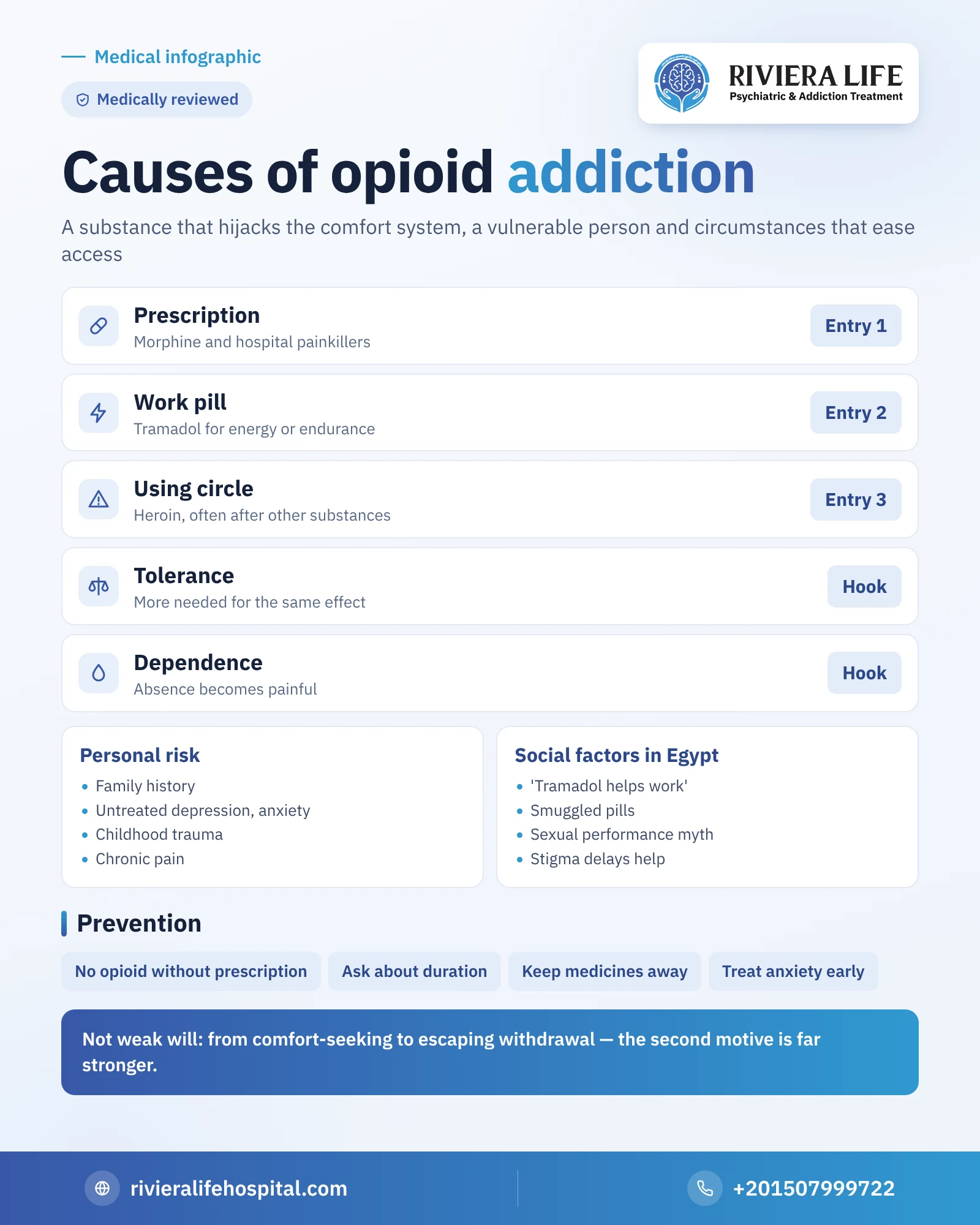
The causes of opioid addiction can’t be reduced to a single cause; addiction is the result of three things meeting: a substance that hijacks the brain’s comfort and reward system with rare strength, a person carrying a genetic or psychological predisposition that makes them more vulnerable, and circumstances that make access to the substance and its repetition easy. With repetition a fourth cause is added that explains why stopping is hard even for those who sincerely want it: physical dependence that makes the absence of the substance painful. This article explains these causes at the level of the whole opioid family, from tramadol to heroin, and refers you to separate articles explaining the particulars of each substance, including opium and the cause of its addiction for the raw substance extracted from the poppy.
What makes opioids different from others?
The body has a natural system for easing pain and stress, relying on substances the brain releases such as endorphins, which bind to special receptors. Opioids, whether natural or synthetic, bind to the same receptors but with much greater strength and stability than the body does. The result isn’t only the relief of physical pain, but also the calming of psychological pain: anxiety, sadness and tension fade for hours.
This double effect is what makes opioids tempting to those who are suffering, not only to those seeking pleasure. The article on endorphins and addiction explains how these substances replace the body’s natural painkiller, then weaken it over time.
Where does the road start? Three common entry points
The starting point differs with the substance, and this is what makes prevention different too:
| Entry point | Substance most linked to it | What usually happens |
|---|---|---|
| A medical prescription for real pain | Morphine and hospital painkillers | Long pain treatment turns into dependence then use outside the prescription |
| A pill passed around at work or among friends | Tramadol | Seeking energy, delayed ejaculation or endurance for work, then daily repetition |
| An experiment in a using circle | Heroin | Curiosity or peer pressure, often after other substances |
From these entry points branch details specific to each substance: the article on the causes of tramadol addiction explains the pill culture in hard work, the article on the causes of morphine addiction covers the road from the prescription, and the article on the causes of heroin addiction focuses on how quickly it turns into addiction.
How does repetition turn into difficulty stopping?
The path repeats in a similar way across all members of the family, though its speed differs:
- Tolerance: the brain adapts to the presence of the substance, so its response to it decreases, and the person needs a larger amount to feel the same effect.
- Physical dependence: the body’s production of its natural painkillers decreases, so the absence of the substance becomes physically and psychologically painful.
- Learning: the brain links the substance to specific places, people and feelings, so these triggers provoke strong craving even months after stopping.
- Declining control: the ability of the brain’s planning and control areas to restrain craving weakens, so the person continues despite knowing the harm.
The article on dopamine and addiction covers the neural side of this learning in greater detail.
Why does the person continue after the “pleasure” disappears?
This is among the things that most puzzle families. At first the substance gave comfort or euphoria, but after months the person uses just to feel “normal”, that is, to avoid the pain and anxiety of withdrawal. The motive changes from seeking something pleasant to escaping something painful, and this second motive is far stronger. The article on opioid withdrawal symptoms details what the body goes through when the substance is absent.
Genetic factors and family history
Twin and family studies indicate that genetics explains a considerable part of susceptibility to addiction in general, and opioids are no exception. Someone whose father or brother suffered from addiction, whatever the substance, carries a higher risk than others. But genetics is a predisposition, not inevitable fate, and many who carry this predisposition never become addicted when protective factors are available to them. What matters practically is that the doctor knows this history before prescribing any opioid painkiller.
Psychological causes and dual diagnosis
A large proportion of those who become addicted to opioids were suffering beforehand from depression, anxiety, post-traumatic stress disorder or a personality disorder, and many of them were never diagnosed. The opioid here works as a mistaken self-medication: it calms psychological pain temporarily then deepens it. That is why addiction treatment doesn’t succeed if it ignores the original disorder, which is what the dual diagnosis program is based on.
Chronic pain: a cause and a risk factor at the same time
Real long-term pain, such as back or nerve pain or old injuries, is among the most common doors through which people enter opioids. The problem is that long use may increase sensitivity to pain itself in some patients, so they think the pain is getting worse and increase the amount. This doesn’t mean that every pain patient will become addicted, but that pain treatment needs a clear plan and follow-up, and non-opioid alternatives when possible.
Social and environmental factors in Egypt
- The spread of the idea that tramadol “helps with work” among laborers, drivers and those with long shifts.
- The ease of obtaining smuggled pills without a prescription, and exchanging them among friends and colleagues.
- Linking some opioids to sexual performance, a belief that pushes many to start.
- Unemployment, financial pressures and isolation, which make temporary escape more tempting.
- Stigma that makes the person delay asking for help until the case becomes complicated.
Who is most at risk?
The risk rises in those who started in adolescence, those with a family history of addiction, those suffering from an untreated psychological disorder, those exposed to trauma in childhood, those using other substances such as hashish, pregabalin or alcohol, and those taking an opioid painkiller for a long period without follow-up. The combination of more than one factor doesn’t only add the risk but multiplies it. A young man of twenty who started hashish at school, suffers untreated anxiety, then was offered a tramadol pill “for tiredness” by a work colleague, gathers at least three factors in his story, and it is a story that repeats often in Egyptian clinics.
Is it a weakness of will?
Many families say: “if he wanted to stop, he would stop”. The truth is that the first decision to try was mostly a choice, but what happens after months of repetition can’t be explained by will alone. The changes in the brain’s craving and control areas, and the withdrawal pains that await the person at every attempt, make stopping without help similar to trying to suppress a cough by willpower. This understanding doesn’t exempt the person from responsibility for treatment, but it changes the family’s approach from blame to pushing towards help, a change linked with better chances of recovery.
How does understanding the causes help in treatment and prevention?
Knowing the entry point through which the person came determines a large part of their plan: someone who started with pain needs pain treatment along with withdrawal, someone who started escaping depression needs depression treatment, and someone who started in a work environment needs a plan for after returning to it. The page on opioid addiction treatment presents how this plan is built. And prevention has simple steps: don’t take an opioid painkiller without a prescription, ask the doctor about the duration of use and how to stop, keep medicines away from others, and don’t postpone treating anxiety or depression.
How does Riviera Life help you?
At Riviera Life treatment doesn’t begin by asking about the substance only, but about the whole story: when it began, why, and what was happening in the person’s life at the time. This is what the consultants in psychiatry and addiction treatment assess in a free and confidential first consultation, before setting a plan that includes the family from the start.
Read also
- Opioids: the comprehensive guide
- Opioid addiction symptoms
- The harms of opioids on the body and mind
- Types of opioid painkillers
Questions many people ask
Yes, long use of an opioid painkiller may cause tolerance and dependence, and in some patients it turns into use outside the prescription. Medical follow-up and a defined stopping plan reduce this risk.
Genetics plays a considerable role in susceptibility, so someone with an addicted relative carries a higher risk. But it is a predisposition that doesn't decide the outcome, and environment and early treatment change the course.
Because over time the motive changes from seeking comfort to escaping the pain and anxiety of withdrawal, so the person uses just to feel normal.
No, most who use them for a short period under medical supervision don't become addicted. The risk rises with long duration, family history, psychological disorders and use without a prescription.
Understanding the causes guides the plan but doesn't replace treatment. Recovery usually needs safe withdrawal, psychotherapy, treatment of accompanying disorders and follow-up to prevent relapse.