The difference between heroin and hash is that heroin is an opioid that suppresses breathing, kills by overdose and creates strong physical dependence, while hash is a cannabis derivative that alters perception, mood and memory, and its direct danger to breathing is much lower. But this doesn’t make it harmless: hash is linked to anxiety, psychosis, disturbed concentration and driving accidents, and causes real addiction in a considerable proportion of its users. This article compares them on a fair scale, neither exaggerating hash nor downplaying it, and deals with the common phrase “hash is just a gateway to heroin”.
The difference between heroin and hash in a table
| Comparison | Heroin | Hash |
|---|---|---|
| Family | An opioid depressant | Derived from the cannabis plant |
| Receptors affected | Opioid receptors | Cannabinoid receptors in the brain |
| Feeling | Euphoria and warmth then drowsiness | Relaxation and altered perception and time |
| Direct death risk | High through stopped breathing | Rare from poisoning alone, but accidents and illnesses are possible |
| Physical dependence | Strong and fast | Milder, with troublesome withdrawal symptoms |
| Most prominent psychological effect | Depression, numbness and isolation | Anxiety and suspicion, which may reach psychosis |
| Withdrawal | Physical pains, diarrhea and vomiting | Irritability, insomnia and loss of appetite |
| Approved treatment medicine | Exists | No approved medicine for the addiction |
What is heroin and what is hash?
Heroin is a substance manufactured from morphine, used by snorting, smoking or injection, and it is among the strongest substances causing dependence. It is the subject of the heroin page.
Hash is a compressed resin extracted from the cannabis plant, containing compounds, the most important being tetrahydrocannabinol (THC), responsible for the psychological effect. It is usually smoked, and in Egypt it is known by many popular names. You will find the background on the hash page, and if you want the difference between it and marijuana read the difference between hash and marijuana.
Two different keys in the brain
The brain has a natural opioid system, the endorphins, and another cannabinoid system that controls memory, appetite, mood and the estimation of time. Heroin presses on the first, so it suppresses pain and breathing together. Hash presses on the second, so it disrupts short-term memory, attention and motor coordination. The decisive difference is that the breathing centers in the brainstem are rich in opioid receptors and poor in cannabinoid receptors, which is why a heroin overdose kills by suffocation, while hash poisoning alone doesn’t usually cause that.
Is hash a “gateway” to heroin?
Most who tried hash didn’t move on to heroin, so the common phrase confuses sequence with causation. But there is an element of truth: someone who starts early, continues for a long time and combines multiple substances is more likely later to explore stronger substances, because of shared factors such as environment, impulsivity, untreated psychological problems and availability of substances. So hash isn’t an inevitable key, but it may be one of the signs of a greater readiness for risk. The causes articles cover this aspect, such as the causes of hash addiction.
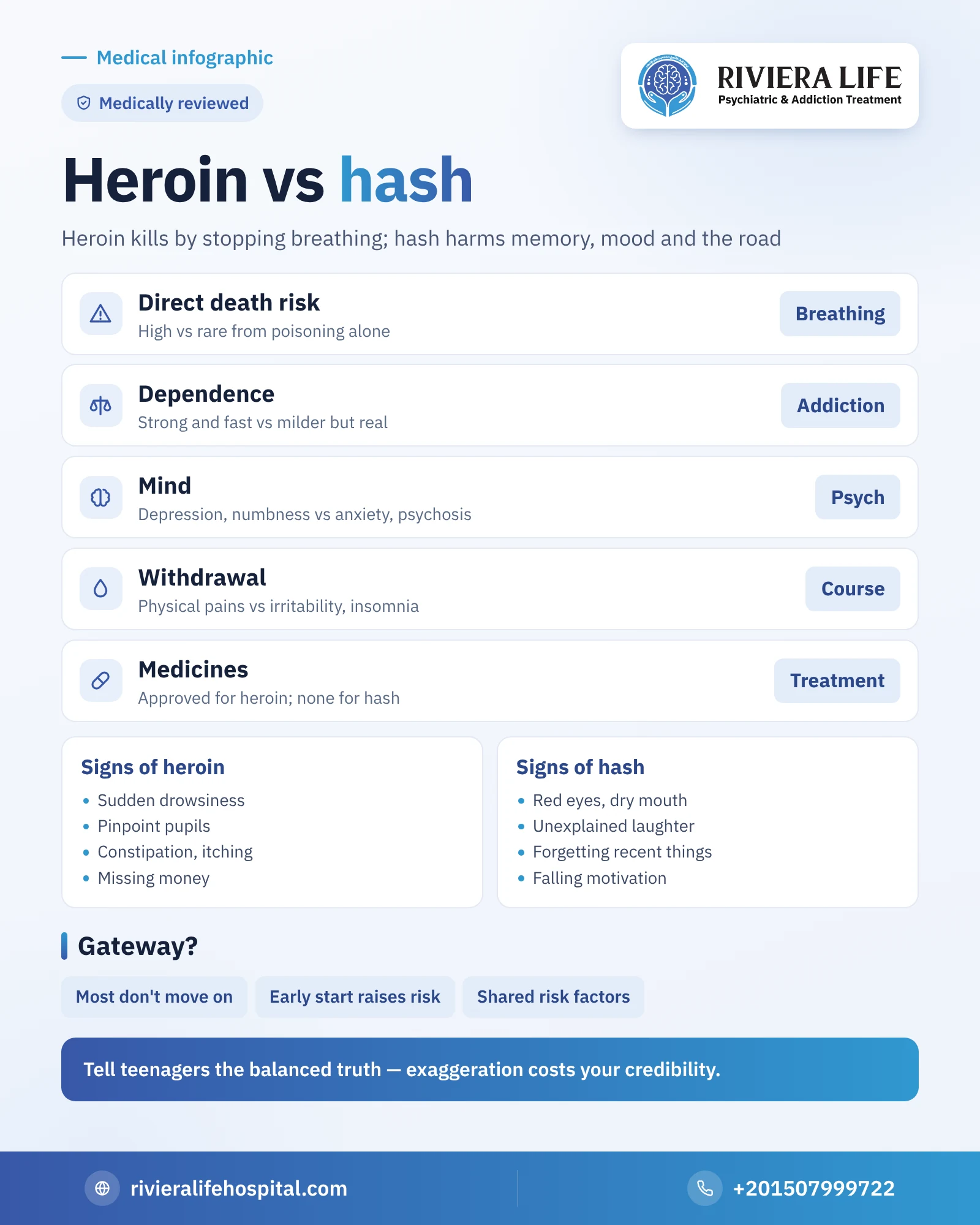
Signs the family sees
With heroin
- Sudden drowsiness and very narrow pupils.
- Constipation, itching and slowness in speech and movement.
- Money and things disappearing, and dropping out of work or study.
With hash
- Red eyes, dry mouth and increased appetite.
- Unjustified laughter or absent-mindedness and forgetting recent things.
- Declining motivation and performance, and anxiety or suspicion with heavy use.
For more see heroin addiction symptoms and hash addiction symptoms.
Which is more dangerous?
If we mean the immediate danger to life, heroin is much more dangerous, as one wrong dose may end a life within an hour. If we mean the long-term effect, the matter may come closer in some people: hash may trap a teenager in years of weak achievement and memory, raises the risk of psychosis in those predisposed to it, and increases road accidents. The risks are linked more to high potency, early starting and daily use. The details of the harms are in the harms of heroin and the harms of hash.
Driving, work and study
Here another face of the comparison appears. Heroin quickly takes its user out of working life: absence, drowsiness and job loss. Hash, however, may keep its user doing their work at half concentration for years, so no one notices. It slows reaction and weakens judgment of distances, which is why driving under its influence is linked to repeated accidents. In a teenager concentration and achievement weaken silently, so it is put down to laziness. This is what makes hash more dangerous than it seems for families reassured because their son “doesn’t use the heavy substances”.
When the two come together
Some users use hash to ease tension or insomnia during heroin withdrawal, or to prolong the feeling of relaxation. This combination adds sedation on top of sedation, weakens awareness and judgment, raises the risk of accidents and overdose, and complicates reading the symptoms for the family and the doctor. Hash may also mask withdrawal signs and so delay seeking treatment. The article on the dangers of mixing drugs offers a wider picture of this.
How do you talk with a teenager about the difference?
Don’t use exaggerated frightening, as if you tell a teenager that hash is “like heroin” and reality shows otherwise, you may lose your credibility in everything after. Tell the balanced truth: hash is lighter than heroin in the danger of direct death, but it affects memory, mood and driving and may push some toward psychosis and addiction. This honesty makes them listen, and opens the door to talk instead of denial.
The mind and suspicion
Hash in some cases awakens suspicion, anxiety and persecutory ideas, and may develop into psychosis in someone with a genetic predisposition or who started early. Heroin rarely causes psychosis directly, but it causes depression, numbness and isolation, and leads to a psychologically exhausting lifestyle. The article on the hash addict and suspicion explains this aspect.
Withdrawal: physical pain or psychological distress?
Heroin withdrawal strikes the body: pains, diarrhea, vomiting and chills, accompanied by a strong urgent craving. Hash withdrawal is milder physically but troublesome: irritability, anxiety, insomnia, vivid dreams and loss of appetite, peaking in the first week then easing gradually. The mildness of hash here makes many think it is “not addictive”, while the truth is that the difficulty of stopping it may lie in the psychological side and the daily habit. The details are in heroin withdrawal symptoms and hash withdrawal symptoms.
Treatment: a medicine in one case and behavioral therapy in the other
Heroin addiction has approved medicines from which the doctor determines the most suitable, which ease withdrawal, reduce craving and prevent relapse, and are combined with psychotherapy. Hash addiction, however, has no approved medicine so far, and its treatment rests on cognitive behavioral and motivational therapy, and treating anxiety, insomnia and depression if present. Neither treatment can do without a program for the family and follow-up after discharge. Read heroin addiction treatment and hash addiction treatment.
Call an ambulance on 123 immediately if there appear
Signs differ by substance, and may come together if they are mixed or other substances are added to them.
- Very slow or intermittent breathing or blue lips
- No response to calling with very narrow pupils
- Hallucinations, severe agitation or thoughts of harming self or others
- Chest pain or severe palpitations
- Seizures or loss of consciousness
When do you ask for help?
Don’t compare to decide whether the problem is “big enough”. If your relative has lost control over use or their study, work and relationships have been affected, it is time for an assessment, whether the substance is heroin or hash. Your first consultation at Riviera Life is free and completely confidential, contact is available around the clock on +201507999722, and the hospital is licensed by the Ministry of Health and located in Sheikh Zayed, Giza.
More from the heroin guide
- Heroin: the complete guide
- Hash: the complete guide
- The difference between tramadol and hash
- The difference between heroin and shabu
Questions many people ask
No. Most who tried hash didn't move on to heroin, but early starting, long use, multiple substances and environmental factors raise the likelihood of trying stronger substances.
Because the breathing centers in the brain are rich in opioid receptors and poor in cannabinoid receptors, so hash doesn't usually stop breathing, but it may cause accidents and psychosis.
Yes, some users develop cannabis use disorder, and health bodies estimate that a considerable proportion of them, roughly three in ten, may reach it.
Heroin withdrawal is more severe physically, and hash withdrawal is milder physically and closer to irritability and insomnia, but both may push toward relapse without support.
There is so far no approved medicine for hash addiction, and treatment relies on behavioral therapy and treating accompanying symptoms, while heroin has approved medicines.