Cleanliness OCD is the common name for contamination OCD, one of the most widespread forms of obsessive-compulsive disorder: a pressing fear of germs, infection, impurity or chemicals that drives the person to wash their hands and body and clean their home with repeated rituals that consume hours of their day. It has nothing to do with an ordinary liking for cleanliness; the person washes to escape anxiety, not to enjoy being clean, and their hands may crack and bleed while they carry on. And often the whole family becomes caught up in the rituals without realizing. In this article we explain the signs, the damage to skin and life, how exposure and response prevention treats this type, and how the family can help without feeding the OCD.
What is cleanliness OCD?
Cleanliness OCD is one of the well-known types of OCD. The cycle begins with an intrusive thought: “I touched the door handle, and now my hands are contaminated, and I’ll pass the illness to my children.” Anxiety or disgust rises, so the person washes their hands until they feel “clean enough”, an inner sensation unrelated to actual cleanliness. They calm a little, then touch something else and the cycle starts again. Their fears may include infectious diseases, bodily fluids, cleaning products themselves, or impurity in its religious sense, which we cover in our article on religious OCD.
Liking cleanliness or OCD?
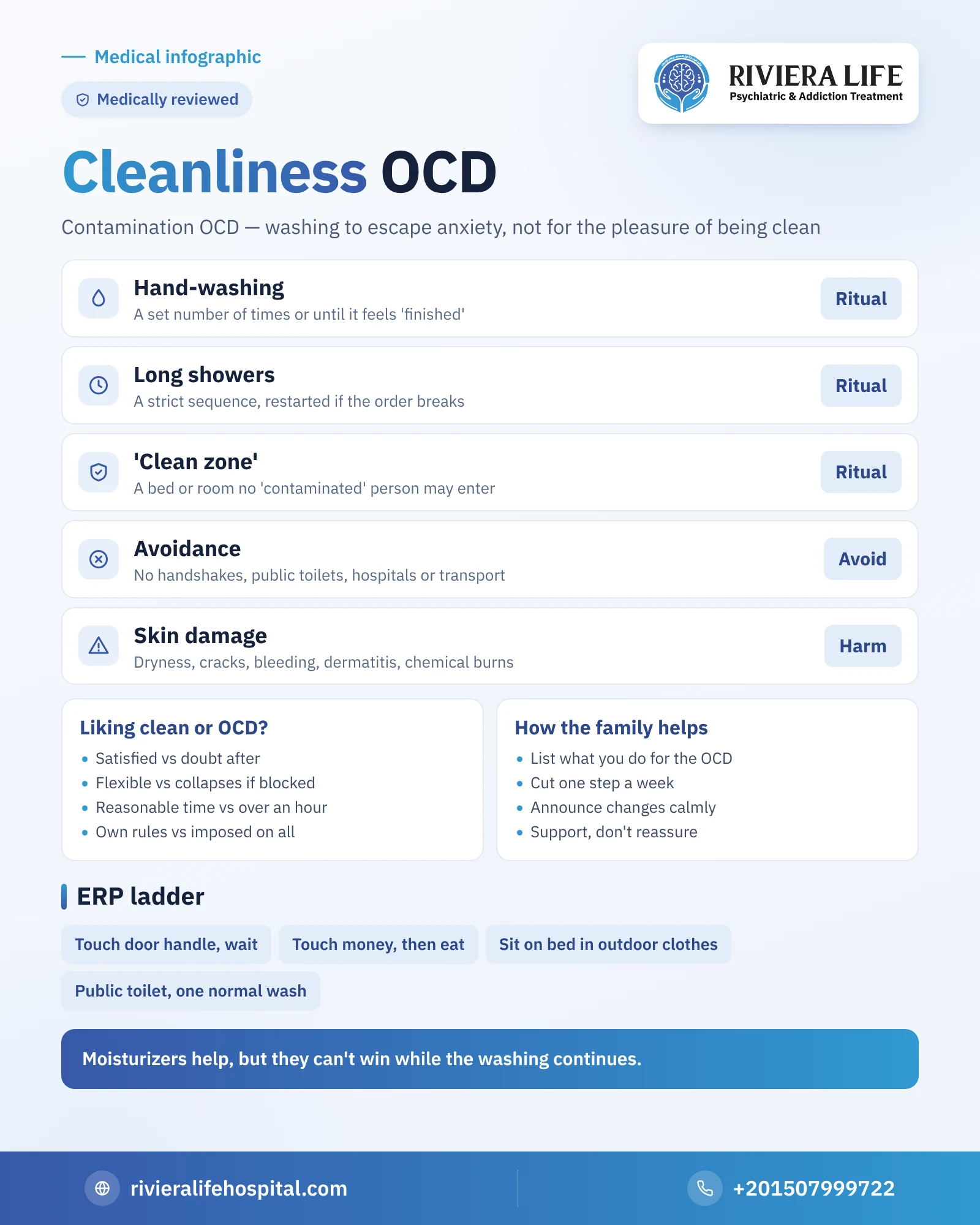
| Liking cleanliness | Cleanliness OCD |
|---|---|
| Feels satisfied after cleaning | Feels temporary relief followed by doubt and anxiety |
| Washes hands when needed | Washes a set number of times or until it feels “finished” |
| Flexible when necessary, such as when traveling or with guests | Falls apart if the rituals are disrupted |
| Takes a reasonable amount of time | May take more than an hour a day |
| Doesn’t impose their rules on others | Asks the family to change clothes and wash |
Common washing and cleaning rituals
- Washing the hands a set number of times or for a long time, with a fixed order for the fingers.
- A long shower following a strict sequence, restarted from the beginning if the order breaks.
- Changing clothes immediately on entering the home, and washing what was worn outside even if it isn’t dirty.
- Washing shopping and bags before bringing them in, and overusing disinfectants and alcohol.
- A “clean zone” in the home, such as the bed or a particular room, that anyone “contaminated” is forbidden to enter.
- Avoiding handshakes, public toilets, hospitals and public transport.
- Using tissues or the elbow to open doors and press lift buttons.
Many of these actions spread among everyone during the coronavirus pandemic, but the difference is that the person with OCD didn’t return to normal life after the danger ended, or their OCD actually began in that period.
Disgust, not only fear
Not all patients fear illness. Some feel a deep disgust and a sense of dirtiness they can’t explain, and may feel contaminated just by remembering a certain person or place without touching anything, which specialists call “mental contamination”. Water and soap don’t remove this type, so the person washes more and more to no avail. Treatment here needs to target the feeling of disgust itself, because it settles more slowly than anxiety.
Damage to the skin and body
The hands are the first victim. Repeated washing and disinfectants strip the oily layer that protects the skin, so dryness, redness, cracking and bleeding appear, and it may develop into chronic dermatitis or infection in the cracks; in other words, the OCD creates the very danger it is fleeing. And some patients use bleach or strong substances directly on the skin and suffer burns.
Less well-known harms include holding urine or becoming constipated to avoid toilets outside the home, arriving at work hours late, and high water and disinfectant bills. You will find details of the psychological and social effects of OCD in general in our article on the harms of OCD. Skin treatment from a dermatologist helps, but it isn’t enough if compulsive washing continues.
Family accommodation: when the whole home joins the rituals
Out of love or to avoid arguments, the family begins to adapt to the OCD: the husband takes off his clothes at the door, the mother washes her son’s clothes twice, the children are kept out of certain rooms, and everyone answers the question “did you wash your hands?” dozens of times. Specialists call this “family accommodation”, and research indicates it is linked to more severe symptoms and a weaker response to treatment, because it deprives the patient of the chance to discover that anxiety settles on its own. Over time the family tires, and accommodation turns into anger and shouting, which also doesn’t help.
Exposure and response prevention for cleanliness OCD
This is the first and most effective treatment. The patient gradually faces what they fear and refrains from washing or cleaning afterward, until the brain learns that anxiety falls without rituals. A ladder is built together with the therapist, for example:
| Level | The exercise |
|---|---|
| Easy | Touching the home’s door handle, then waiting ten minutes before washing |
| Medium | Touching money, then eating a snack without washing |
| Hard | Sitting on the bed in outdoor clothes |
| Hardest | Using a public toilet, then washing the hands once in the ordinary way |
In parallel, the patient agrees “normal washing rules” with their therapist: before eating, after the toilet, and when the hands are actually dirty, once and for a normal length of time. No one is asked to become dirty, but to return to what most people do. Cognitive behavioral therapy helps review the patient’s exaggerated estimate of the chance of infection and their responsibility for it.
Medicines in general
In moderate and severe cases, or when OCD comes with depression, the doctor may prescribe a medicine from the serotonin reuptake inhibitor class or clomipramine, alongside psychotherapy, not instead of it. Their effect takes several weeks, and they must not be changed or stopped except by the doctor’s decision, as our article on OCD treatment explains. And in very severe cases that completely disrupt life, an intensive inpatient treatment program may help.
How can the family help without feeding the OCD?
- Understand before you change: write a list of everything you do because of the OCD; this is the starting point.
- Reduce accommodation gradually and by agreement: don’t stop everything suddenly; choose one step each week in coordination with the therapist.
- Announce the step in advance, calmly: “From next week I won’t wash my clothes at the door, because I trust that you can bear the anxiety.”
- Supportive phrases, not reassurance: instead of “your hands are clean”, say “I know this is hard, and you can wait”.
- No mockery and no punishment: OCD isn’t stubbornness, and shouting raises anxiety and increases the rituals.
- Look after yourselves: an exhausted family can’t keep going, and family sessions are part of the treatment.
Cleanliness OCD in children
OCD may begin at school age. A mother notices her son spending a long time in the bathroom, refusing to touch his things after a classmate touched them, asking her to wash her hands before she hugs him, or his hands reddening in winter for no clear reason. Many children hide their rituals at school and then “explode” at home.
Because a child sometimes can’t explain what they feel, they are asked in simple language about the “worry voice” that tells them to wash. Exposure and response prevention is effective with children too once adapted to their age, and there are programs in which parents are trained to reduce accommodation in an organized way, which help even if the child at first refuses to attend sessions.
When should you seek help?
If washing and cleaning rituals go beyond an hour a day, if your hands have cracked and bled and you still wash, or if the whole home revolves around cleanliness rules, this is the time for an assessment. The good news is that cleanliness OCD is one of the types of OCD that responds best to exposure and response prevention. At Riviera Life, consultant psychiatrists set a plan that includes the patient and their family, in complete confidentiality, and the first consultation is free on +201507999722.
More from our OCD guide
- OCD: the complete guide
- Types of OCD: the most common themes
- The psychological and physical harms of OCD
- OCD treatment: the main options
Questions many people ask
It rarely goes away without treatment, and usually worsens with stress. But it is one of the types of OCD that responds best to exposure and response prevention.
Moisturizers and a dermatologist's treatment ease the cracking, but the lasting solution is reducing compulsive washing through psychotherapy. Continued washing cancels out the effect of any cream.
Don't refuse everything suddenly; reduce taking part in the rituals gradually and in agreement with the therapist, and announce each step in advance calmly and supportively.
Yes, and it may begin at school age. It shows as staying a long time in the bathroom, refusing to touch things or red hands, and is treated with exposure adapted to the child's age alongside parent training.
Healthy caution is flexible and changes with the actual risk. OCD continues despite the absence of risk, takes up a lot of time, causes distress and disrupts life.