The harms of OCD don’t stop at the anxiety it causes. It drains hours of the day, leaves effects on the skin, sleep and nutrition, raises the likelihood of depression, presses on study, work and marriage, and drags the whole family into its circle. The longer it is left untreated, the wider and more tangled these harms become. This article sets out the psychological, physical and social harms in detail, the harms of the wrong solutions some turn to, and then what improves after treatment, which is a lot.
Is OCD dangerous?
OCD doesn’t threaten life directly in most cases, but its danger comes from its persistence and the build-up of its effects. It is a disorder that often begins at an early age and may continue for many years if untreated, so it coincides with the most important stages of building a life: study, choosing work, marriage and raising children. It is considered one of the psychiatric disorders that most affect quality of life, and in severe cases its effect may reach the patient being unable to leave the house or work.
Psychological harms
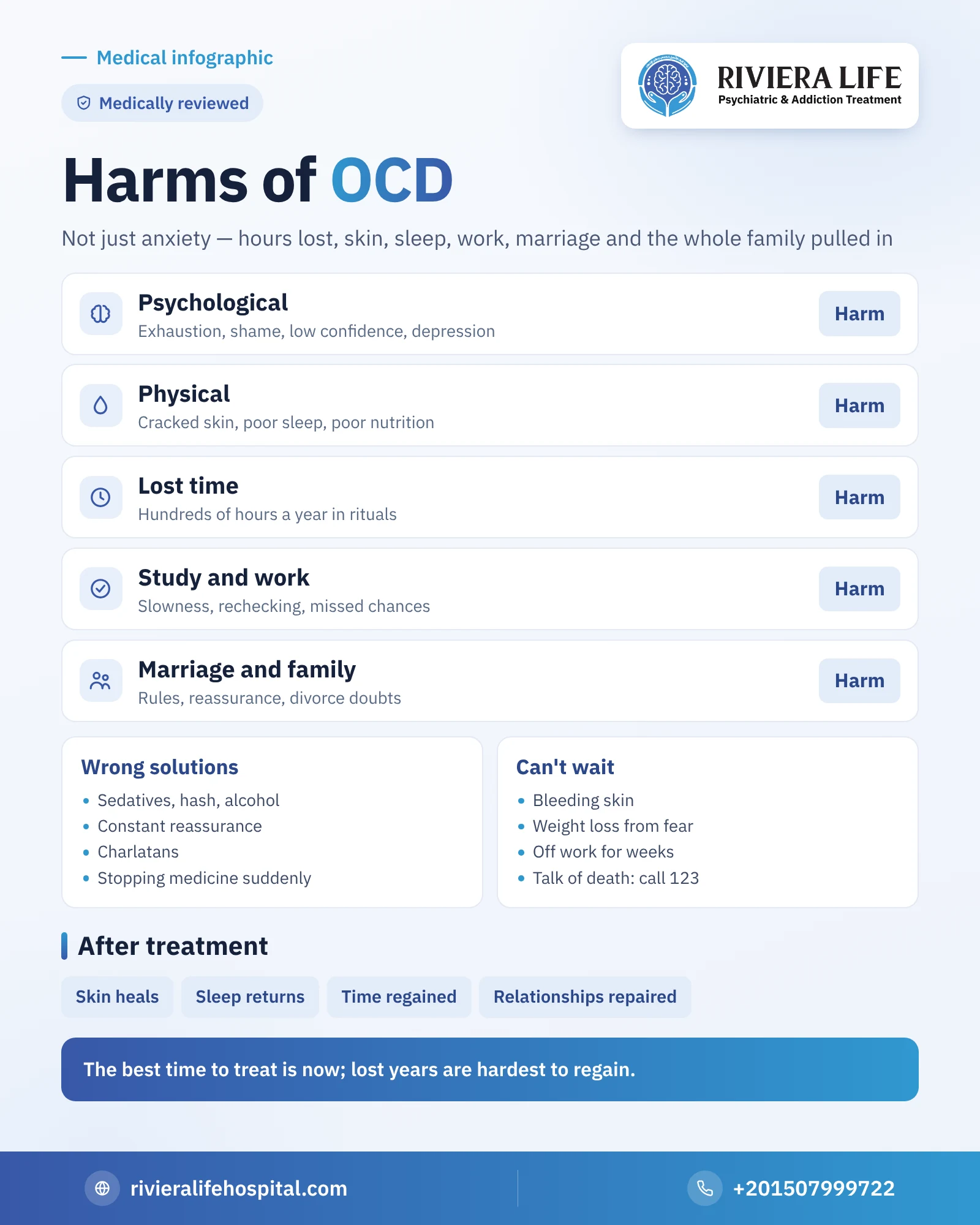
The patient lives in an almost constant state of alarm: every door, every handle and every passing thought may set off a new cycle of anxiety. Over time there appears:
- Mental exhaustion resembling tiredness after a long working day, even if the person hasn’t left home.
- A deep sense of shame about the content of the thoughts, especially aggressive, religious or sexual thoughts, which pushes towards isolation and secrecy.
- Declining self-confidence, because the patient sees themselves as unable to control acts they know are excessive.
- Scattered concentration and slow achievement because the mind is occupied with checking.
- Depression, which accompanies many cases, and sometimes brings despair and thoughts of death with it.
Because depression is what most often accompanies OCD, we have dedicated the article on OCD and depression to it, and the article on OCD and suicide covers the warning signs and how the family should act.
Physical harms
Some may be surprised that a psychiatric disorder has clear physical effects, but they are common:
- Skin inflammation: dryness, cracking and bleeding in the hands, and sometimes chronic dermatitis from long washing and strong disinfectants.
- Injuries from repeated acts: skin abrasion from rubbing, or joint pain from repeated movements.
- Sleep disturbances: staying up checking or reviewing, then waking exhausted.
- Nutrition problems: avoiding foods feared to be contaminated, or drinking less water to avoid using the bathroom, which may cause weight loss or dehydration.
- Neglecting medical care: avoiding hospitals and clinics for fear of infection, or on the contrary having repeated unnecessary tests.
- The dangers of hoarding: piled-up things may cause falls, fires or health problems in the home.
Lost time: the harm no one sees
An hour or two of rituals a day may seem a small figure, but counting it over a year reveals hundreds of lost hours. And OCD’s time isn’t taken from free time, but from sleep, work and sitting with the family. An employee late every morning because he went back to check the gas, a student spending three hours on a single page because she rereads every line until she is sure she understood it, and a mother who can’t find time to play with her children because cleaning the kitchen never ends. This slow erosion is what makes OCD exhausting even in moderate cases.
The effect of OCD on study and work
In study the harm shows in extreme slowness, rewriting and erasing, not finishing an exam in time because of repeated checking, and sometimes being absent from school to avoid situations that trigger the OCD. At work an employee may lose productivity despite their competence, because they check every email several times before sending it, refuse certain tasks, or are constantly late. Some patients are forced to leave jobs that suit their abilities, or turn down opportunities because they require travel or dealing with places they fear.
Its effect on marriage and relationships
OCD brings particular tension to married life. One spouse may impose strict cleanliness rules on the other, ask for reassurance all the time, or avoid intimacy because of contamination fears or intrusive thoughts. In our societies divorce OCD appears, in which one spouse lives in constant doubt about whether they have pronounced divorce, so they ask and seek religious rulings repeatedly. The OCD may also revolve around the relationship itself: do I really love my partner? Are they the right person? The article on OCD and doubt explains how this question turns into an endless circle.
Its effect on the family
OCD rarely stays an individual matter. The family finds itself washing, disinfecting, answering and waiting, and changing its habits to avoid the patient’s anger or distress. This participation drains everyone: a mother spending her day carrying out her son’s requests, siblings barred from certain rooms, and a wife who feels the home is no longer hers. Financial burdens are added, such as high water bills, quantities of detergents and disinfectants, and repeatedly buying things feared to be contaminated. Over time sharp disputes may arise between family members over how to deal with the patient.
The harms of OCD in children and teenagers
An affected child may fall behind at school despite their intelligence, move away from their friends, and be mocked because of their rituals, so they grow up feeling “strange”. Outbursts of anger when their rituals are interrupted may turn into a daily conflict at home. Most dangerous is that the years lost in childhood and adolescence are hard to make up, which is why early treatment is more important at this stage.
The harms of wrong solutions
Much of the harm doesn’t come from OCD itself, but from attempts to get rid of it in unsuitable ways:
- Sedatives and drugs: some turn to sedatives without a prescription or to hash or alcohol to silence anxiety, adding a problem of dependence to the OCD.
- Constant reassurance: repeated searching online or asking others gives relief for minutes and then strengthens the OCD.
- Charlatans and unqualified healers: they waste time and money, and may convince the patient that what they have is possession or envy, so real treatment is delayed.
- Stopping medicine suddenly: after initial improvement, so the symptoms return and the patient loses confidence in treatment.
Signs that the harms have reached a point that can’t be postponed
Some harms creep in slowly until the family gets used to them and thinks they are part of the patient’s personality. But there are signs that mean the time has come for an urgent assessment:
- Wounds or bleeding in the skin from washing or rubbing that the patient doesn’t stop despite the pain.
- Clear weight loss or refusing to eat and drink for fear of contamination.
- Absence from study or work for weeks, or inability to leave the house.
- Persistent sadness and despair or talk of death; here you need to call the ambulance on 123 or go to the emergency department.
Do the harms of OCD go away after treatment?
Most improve clearly. The skin heals when excessive washing stops, sleep returns to regularity, and the recovered time goes back to study, work and family. Strained relationships can be repaired, especially when the family takes part in the treatment plan. What is hard to recover is the years lost before asking for help, which is why the best time for treatment is now. Learn about the available options in the article on OCD treatment. At Riviera Life the road starts with a free, confidential assessment with a consultant psychiatrist who determines the severity of the condition and what it needs.
More from the OCD guide
- OCD: the complete guide
- OCD symptoms
- OCD treatment and the steps of recovery
- OCD and panic attacks
- OCD and marriage: when OCD enters the home and how treatment protects it
- OCD in children: signs by age and the family’s role
Questions many people ask
Yes, indirectly: excessive washing causes skin inflammation and cracked hands, long rituals weaken sleep, and nutrition may decline in those who fear contamination.
It may cause great tension because of cleanliness rules, reassurance-seeking and doubt, but many couples regain stability when the OCD is treated and the partner takes part in family sessions.
No, OCD doesn't turn into madness, and most patients realize their thoughts are exaggerated. But leaving it untreated raises the likelihood of depression and life being disrupted.
Sedatives taken without supervision don't treat OCD, and may lead to dependence and withdrawal symptoms that increase anxiety. Proper treatment is a plan set by a psychiatrist.
Most improve clearly, such as skin inflammation, sleep disturbance and family tension. The earlier treatment starts, the more is regained.