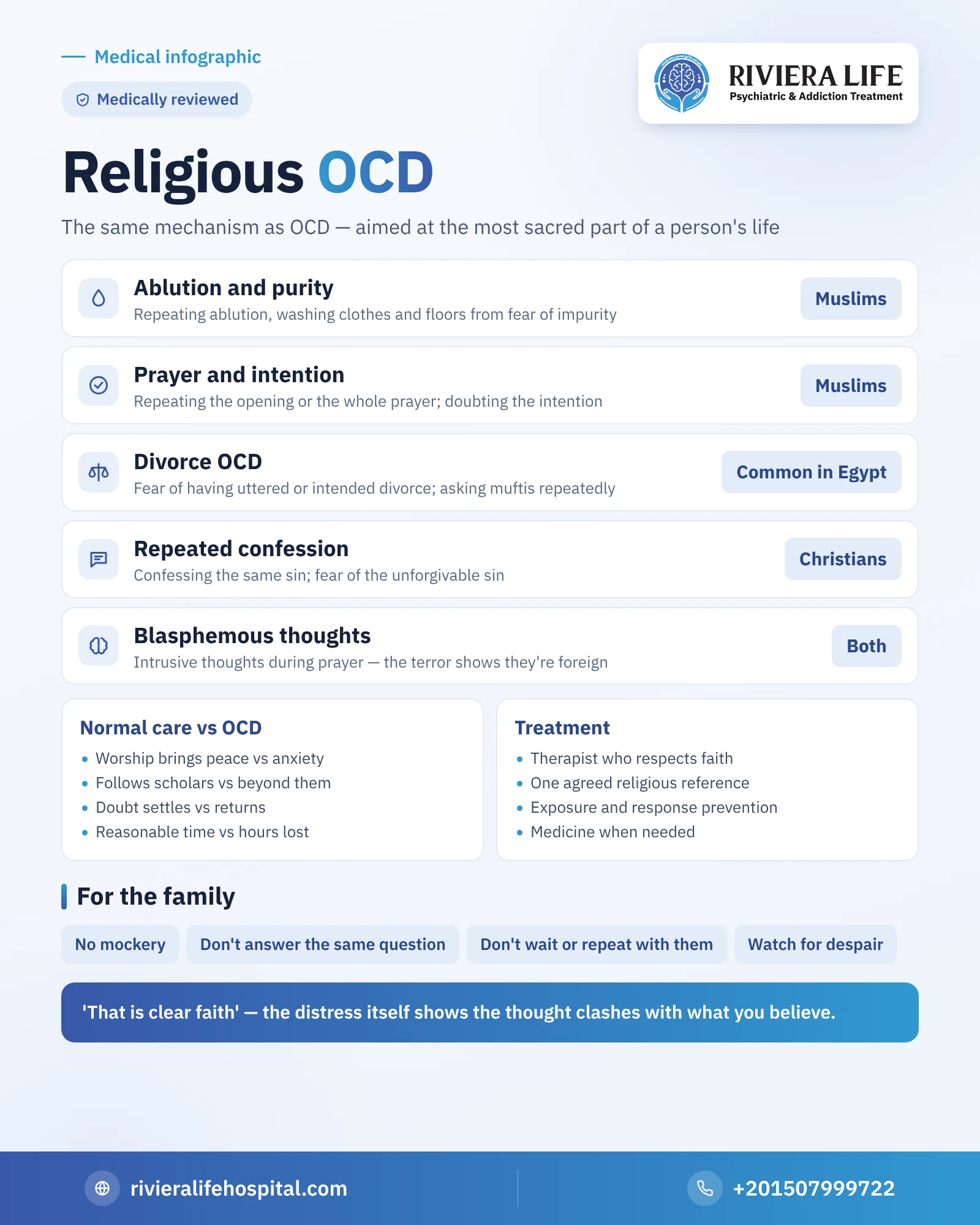
Religious OCD is a type of OCD in which intrusive thoughts revolve around worship, purity and the fear of sin: repeating ablution and prayer many times, endless doubt about intention, and blasphemous thoughts that intrude on the mind against the person’s will and fill them with terror. It isn’t evidence of weak faith; on the contrary, it usually affects the people most devoted to their religion. It is treated successfully when a therapist who respects the patient’s beliefs works together with a trusted religious scholar or spiritual father. In this article we address it respectfully in the context of Muslims and Christians, and go deeper into what the brief mention in our article on OCD treatment had no room for.
What is religious OCD?
Specialists call it religious or moral “scrupulosity”. Its mechanism is the same as that of OCD: an intrusive thought that triggers anxiety and guilt, followed by an act that tries to cancel it, such as repeating worship, seeking forgiveness in a particular way, or asking a sheikh or priest, so the anxiety eases a little and then returns stronger. The difference is that the theme of the obsession here is the most sacred thing in a person’s life, so the pain is doubled, and seeking treatment is delayed because the patient is ashamed or thinks their problem is purely spiritual.
Common forms among Muslims
- Ablution: repeating it several times because the water “didn’t reach” a certain spot, or doubting whether wind was passed after finishing, until ablution takes half an hour or more.
- Purity and impurity: washing clothes and the floor of the house for fear of a drop of urine or spray, and avoiding praying in certain places.
- Prayer: repeating the opening takbir or Al-Fatiha because the pronunciation “wasn’t correct”, or repeating the whole prayer for fear it was invalid, and sometimes stopping praying out of despair.
- Intention: doubting that the intention was properly made, so starting again and again.
- Fasting: anxiety about swallowing saliva or water entering while rinsing the mouth.
- Divorce OCD: common in Egypt; fear of having uttered the word of divorce or intended it in the mind, so the husband lives in terror and repeatedly asks muftis.
- Fear of unbelief: terror of having said or believed something that takes them out of the religion.
Common forms among Christians
- Repeated confession: returning to the father confessor with the same sin many times, or feeling that the confession wasn’t complete.
- Fear of the unforgivable sin: terror that a passing thought was blasphemy against the Holy Spirit.
- “Perfect” prayer: repeating prayers because the mind wandered during them or an improper thought entered it.
- Communion: intense anxiety about being unworthy, so the person abstains from communion or repeats the preparation for it.
- Improper thoughts during worship: sexual or insulting images intruding on the mind, specifically in church.
The church has known this condition for centuries, and many spiritual fathers deal with it by advising the penitent not to confess the same matter again and to trust in forgiveness.
Blasphemous thoughts: why do they come to the most devoted?
Every person sometimes has strange, meaningless thoughts pass through their mind, and most people ignore them and they pass. But a person deeply devoted to their religion stops at the thought in alarm: “How can I think this? What does it say about me?” This alarm gives the thought importance, so the brain watches for it and tries to drive it out by force, and it returns more often. That is why blasphemous thoughts intrude specifically during prayer or reading the Quran or the Bible: because this is the time the person fears their appearance more than any other. This may overlap with sexual OCD when the intrusive thoughts have a sexual character touching sacred things.
Why don’t these thoughts reflect the truth of your faith?
The clearest evidence is the pain itself. Someone indifferent to their religion isn’t tormented by a passing thought about it; the terror you feel means the thought conflicts with what you believe. In the Islamic tradition, Sahih Muslim reports that some of the Companions complained to the Prophet, peace be upon him, that they found in themselves things too grave to speak of, and he said: “That is clear faith.”
Many jurists hold that a person whose doubts are excessive shouldn’t pay attention to them. In the Christian tradition, rejected thoughts that a person resists are seen as a temptation, not a sin. We mention this not to give a religious ruling, but to say that religion itself distinguishes between what a person chooses and what intrudes on their mind against their will; the details are clarified by the scholar you trust.
Normal religious care or OCD?
| Normal care | Religious OCD |
|---|---|
| Worship brings peace of mind | Worship brings anxiety and fear of mistakes |
| Follows what scholars approve | Goes beyond what religion asks, and rulings don’t convince |
| A passing doubt is settled and forgotten | Doubt returns after every answer |
| A reasonable time for ablution and prayer | Hours lost in repetition |
| Doesn’t avoid worship | May avoid it to escape the torment |
Treatment: a therapist and a trusted scholar together
The most successful plans bring two parties together. The therapist explains the mechanism of OCD and leads the exercises, and never asks the patient to give up or belittle their religion. The religious scholar or spiritual father sets out the religious ruling on which treatment is built, such as that ablution once is enough, and that doubt after worship isn’t to be heeded.
It is important that there be one reference agreed on in advance, because moving between sheikhs or priests in search of a reassuring answer is itself a compulsion. Many patients feel relief when they hear from their reference that following the treatment plan is what pleases God, not obsessive strictness.
Exposure and response prevention with religious sensitivity
Exposure and response prevention is the main treatment for OCD, and here it is adapted so that the patient is never asked to do anything against their religion. With their therapist, the patient builds a ladder of situations from easiest to hardest, such as:
- Performing ablution once in a set time, then praying straight away despite the feeling that it “wasn’t complete”.
- Performing the prayer without repeating any part, and tolerating the doubt until it settles on its own.
- Refraining from asking the sheikh or priest about the same question that has already been answered.
- Sitting on a floor they doubt is pure, after the religious reference has confirmed it is religiously pure.
- Writing a sentence that accepts uncertainty, such as “Maybe I made a mistake and maybe not, and I leave the matter to God”, instead of searching for complete certainty.
The goal isn’t for the patient to stop worshipping, but to return to it with a peaceful heart. Cognitive behavioral therapy is added to address beliefs such as “merely thinking about something is like doing it”.
Medicines in general
In moderate and severe cases the doctor usually prescribes a medicine from the SSRI class, and sometimes clomipramine, alongside psychotherapy. These medicines need weeks for their effect to appear, and OCD may need doses different from those for depression, set by the doctor. They are not changed or stopped except on the doctor’s decision. If severe depression accompanies the OCD, both are treated together.
How can the family help?
- Don’t mock the repeated worship, and don’t accuse them of extremism or weak faith.
- Don’t answer the same religious question many times; gently remind them of what was agreed with their reference and therapist.
- Don’t wait with them for the ablution to finish or repeat the prayer with them.
- Encourage them that seeking psychological treatment doesn’t conflict with religion.
- Watch for despair; if they say they are “doomed for certain” or thoughts of ending their life appear, seek urgent help by calling an ambulance on 123 or the mental health hotline on 16328, and read our article on OCD and suicide.
When should you seek help?
If ablution and prayer have come to take time that disrupts your day, or you have started avoiding worship for fear of the torment that comes with it, or no religious ruling reassures you any more, it is time for a psychological assessment. At Riviera Life, consultant psychiatrists work with full respect for each patient’s beliefs, and your religious reference can take part in the plan if you wish, in complete confidentiality. The first consultation is free on +201507999722.
More from our OCD guide
- OCD: the complete guide
- Types of OCD: the most common themes
- Sexual OCD: intrusive thoughts that don’t reflect who you are
- OCD treatment: the options
Questions many people ask
From a psychiatric point of view it is a type of OCD with a known mechanism that responds to treatment. The religious side is clarified by a trusted scholar, and there is no conflict between the two in the treatment plan.
Many scholars state that rejected thoughts the person hates aren't held against them, and that hating them is a sign of faith. For the details of the ruling, refer to a scholar you trust.
No. Treatment doesn't ask for any act that goes against the patient's religion. The goal is to perform worship once, with peace of mind, instead of repetition and torment.
Because repeated asking has become a compulsion that eases anxiety for moments and then strengthens it. So in treatment one religious reference is agreed on, and repeating the same question is avoided.
Yes. In moderate and severe cases the doctor may prescribe medicines from the SSRI class alongside psychotherapy. The doctor decides the medicine and its duration, and it is only stopped with them.