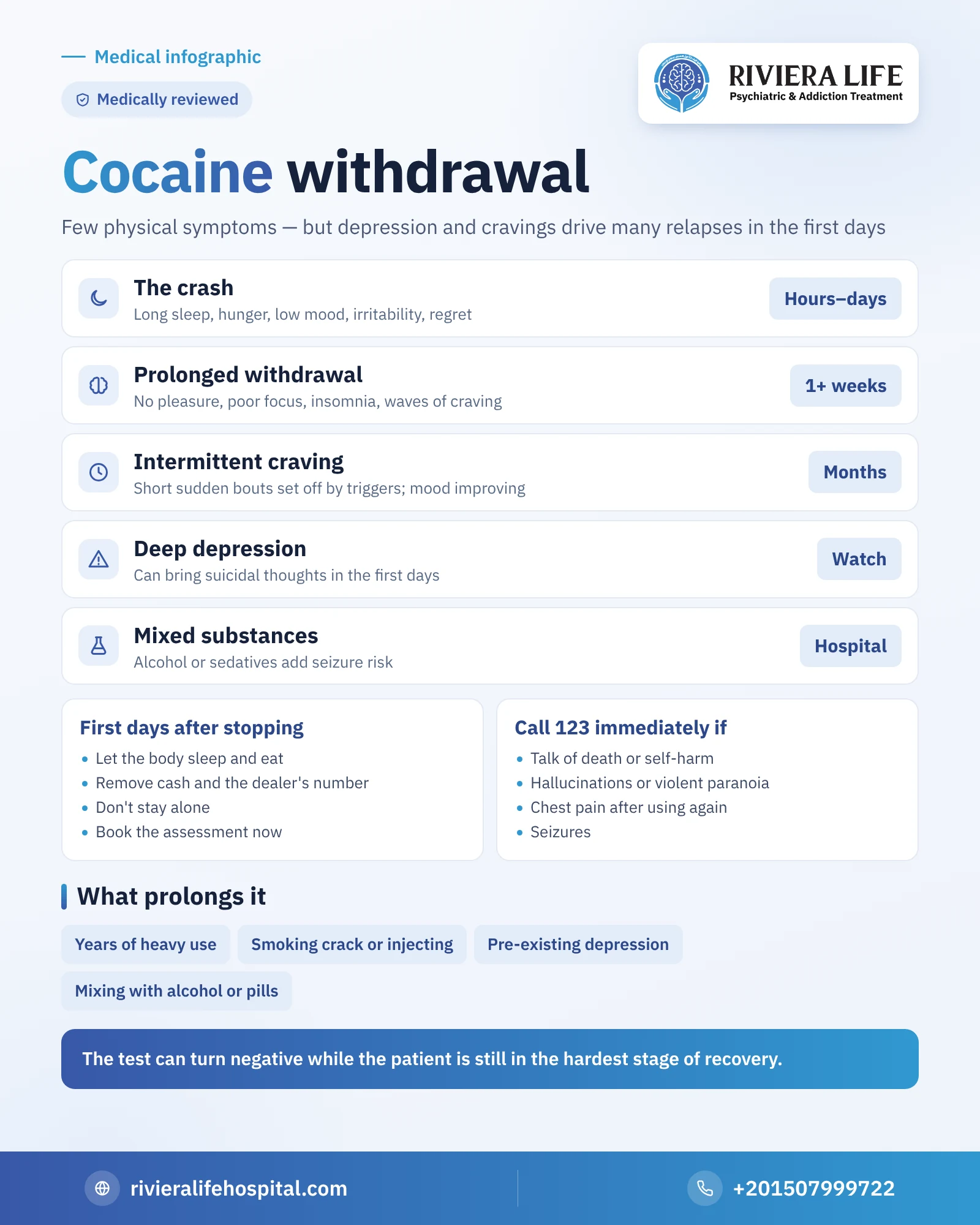
Cocaine withdrawal symptoms usually begin within hours of the last dose, with a crash dominated by exhaustion, long sleep, hunger and low mood. Then comes a longer stage that may last weeks, with flatness, loss of pleasure, anxiety and a craving to use that rises and falls. Unlike withdrawal from alcohol or opioids, cocaine withdrawal isn’t usually accompanied by sweating, tremor and vomiting, but its real danger is psychological: depression that can be deep, and a pressing craving that leads many people to relapse in the first days. Here we explain the stages and their approximate timing, what prolongs them, and when you need a doctor or the emergency department.
Why do cocaine withdrawal symptoms appear?
Cocaine raises dopamine in the brain to a level ordinary life never reaches. With repetition, the brain tries to protect itself by reducing the number and sensitivity of its receptors, while increasing the activity of its stress circuits. When the substance is gone, the brain is left with this new setting: unresponsive to pleasure, highly responsive to distress. This temporary imbalance is what the patient experiences as low mood, exhaustion and craving, and it needs time to return to balance.
When do withdrawal symptoms start?
Because cocaine’s effect is short, the comedown may begin minutes to a few hours after the last dose, especially after a night of closely spaced doses. That is why it differs from other substances whose symptoms are delayed by a day or more. It is important for families to know that the person may seem “normal” in the first hour and then collapse suddenly, so don’t take the initial calm as proof the problem is over.
Stage one: the crash
This lasts from hours to a few days, and its severity is linked to the length of the binge before it. The most prominent features include:
- Severe exhaustion and long sleep that may exceed half a day.
- Clear hunger after days of lost appetite.
- Low mood, irritability and annoyance at any sound or request.
- Anxiety mixed with regret, and sometimes guilt or hopelessness.
- A craving to use that may be weak at first because of exhaustion, then rises as energy returns.
Stage two: prolonged withdrawal
Once the patient has regained their sleep and appetite, a stage begins that is calmer on the outside and harder on the inside. It may last from a week to several weeks, and sometimes two months or more in people who used heavily for years. In this stage:
- The person loses the sense of pleasure in food, company and work, and feels the days are gray.
- Concentration and short-term memory weaken, so they seem slow and scattered.
- Sleep swings between insomnia and vivid, disturbing dreams.
- Craving comes in waves, set off by memories, places and people.
This is the stage in which many people go back to using, because the patient compares their dull day with the memory of the high, and their mind tells them that one dose will bring their life back.
Stage three: intermittent craving
Over time, mood and energy clearly improve, but the craving doesn’t disappear suddenly. It remains for months in the form of short, sudden bouts, triggered by a salary that has just come in, an evening with old friends, or even a scene in a film. The difference is that the patient becomes better able to recognize and get past it, especially if they learned how in treatment.
An approximate timeline of cocaine withdrawal symptoms
| Stage | Approximate timing | Main symptoms |
|---|---|---|
| The crash | From hours to several days | Long sleep, hunger, low mood, irritability |
| Prolonged withdrawal | From a week to several weeks | Loss of pleasure, poor concentration, insomnia, repeated craving |
| Intermittent craving | Months | Bouts of craving linked to triggers, with general improvement |
The figures here are approximate; there is no fixed hour at which every case moves from one stage to the next. Some patients get through the crash in a day and struggle for weeks in the second stage, while others go through the reverse. That is why doctors measure progress by improvements in sleep, mood and the ability to resist craving, not by the number of days alone.
What prolongs withdrawal or makes it more severe?
- A long period of use and intense binges.
- Smoking crack or injecting, because the swings are more violent.
- Depression, anxiety or a mental disorder that existed before the addiction.
- Mixing cocaine with alcohol, sedatives, tramadol or pregabalin.
- A lack of regular sleep and good nutrition, and staying in the same environment.
Is cocaine withdrawal dangerous?
Physically, cocaine withdrawal alone doesn’t usually cause life-threatening complications like those of alcohol withdrawal. But that doesn’t mean it is safe. Depression in the first days can be severe enough to bring suicidal thoughts, and suspicion or hallucinations may persist in someone who developed psychosis while using. And a patient going back to a large dose after a break, trying to recapture an old feeling, puts their heart at risk.
Call an ambulance immediately (123 in Egypt) if you see
Or go to the nearest emergency department — these signs can't be managed at home.
- Talk of death or self-harm, or planning it
- Hallucinations or severe paranoia pushing them to violence or flight
- Chest pain or severe palpitations after going back to using
- Seizures, especially when alcohol or sedatives are stopped suddenly
Withdrawal when cocaine is mixed with other substances
A cocaine patient rarely comes to hospital using it alone. Many use alcohol, sedatives or hashish to “come down” after a night out. This changes the whole calculation, because withdrawal from alcohol and sedatives can cause seizures and delirium, and withdrawal from opioids such as tramadol has its own physical symptoms. That is why the doctor starts by finding out everything the patient uses, not just cocaine, before deciding where and how detox will happen.
How is cocaine withdrawal managed medically?
There is still no medicine approved specifically for treating cocaine withdrawal, so treatment relies on supportive care and close monitoring of mental state. The team follows sleep, nutrition and fluids, treats insomnia and severe anxiety as suits each patient, and assesses suicide risk regularly. If depression persists after the first weeks, they look at whether it is an independent disorder that needs its own treatment. Most importantly, this stage is used as the start of psychotherapy, not just a wait for the symptoms to end, as we explain in our article on cocaine addiction treatment.
Tips for the first days after stopping
- Let the body sleep and eat — long sleep in the first days is a normal part of recovery.
- Put away cash, the dealer’s number and the apps linked to late nights.
- Don’t stay alone in the first days; ask someone you trust to stay close.
- Avoid alcohol and unprescribed sedatives, which open the door to another addiction.
- Move a little every day — walking gradually improves mood and sleep.
- Write down what triggers your craving; this list will help you and your therapist later.
- Book the medical assessment in the first days themselves, and don’t wait for the first wave of craving.
Withdrawal doesn’t mean the body still holds the substance
Some people confuse how long withdrawal lasts with how long cocaine stays in a test. The substance itself leaves the blood within hours, and its metabolites usually stay in the urine for a few days, while withdrawal symptoms may last for weeks. In other words, the test may turn negative while the patient is still in the hardest stage of recovery; the details are in our article on how long cocaine stays in your system. To understand why the craving is so strong, see our article on the causes of cocaine addiction.
How can Riviera Life help you?
In the first weeks after stopping, the patient needs a place that watches their mood, sleep and safety, and turns withdrawal into the start of real treatment. The Riviera Life team provides this with round-the-clock medical supervision and complete confidentiality, together with a family program that helps relatives understand what the patient is going through.
More from our cocaine guide
- Cocaine: the complete guide
- Cocaine addiction symptoms
- The harmful effects of cocaine
- How to deal with someone addicted to cocaine
Questions many people ask
The crash lasts from hours to days, then the calmer withdrawal stretches from a week to several weeks. Intermittent bouts of craving may appear for months, but they weaken with treatment.
Withdrawal alone doesn't usually cause fatal physical complications, but severe depression may be linked to suicidal thoughts, and going back to a large dose can harm the heart. That is why the patient needs close follow-up.
Because the body is making up for days of sleeplessness and strain, and the brain is in a temporary state of low dopamine activity. Long sleep in the first days is a normal part of the crash.
No medicine is approved specifically for this. The doctor treats symptoms such as insomnia and severe anxiety, follows mood closely, and starts psychotherapy early to prevent relapse.
This may happen in simple cases not mixed with other substances and with medical follow-up, but severe depression, psychosis or mixing with alcohol or sedatives makes hospital the safe option.