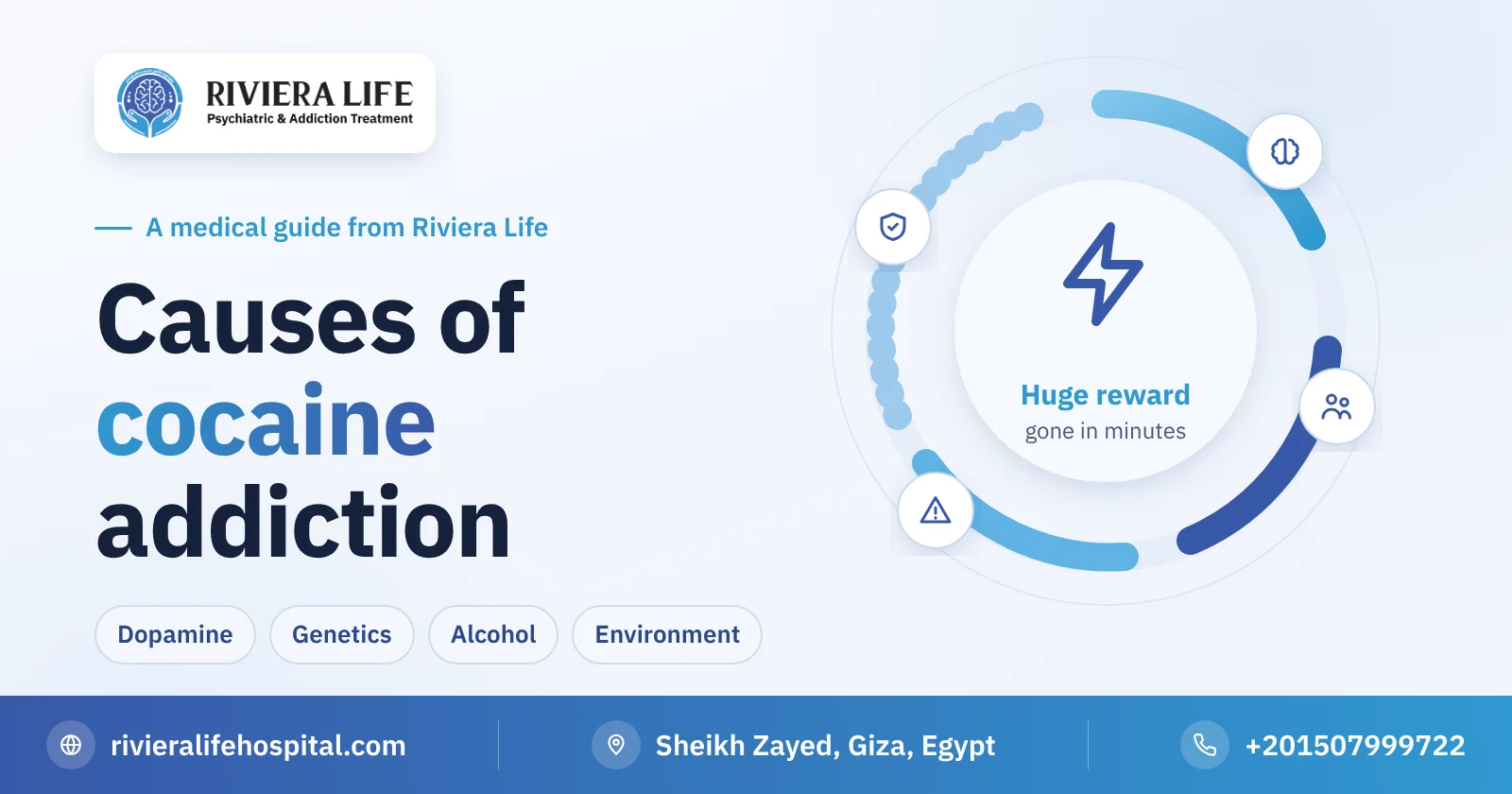
The causes of cocaine addiction come down to the meeting of three things: a substance that gives the brain a huge reward then withdraws it within minutes, a person who has a higher genetic or psychological susceptibility than others, and an environment that makes the substance available and acceptable. The short action of cocaine is the key to the story, as it quickly trains the brain to link relief with a new dose. Not everyone who tries it becomes addicted, but it is hard for anyone to predict in advance that they will be among the survivors. Here we present the biological, psychological and social causes, how the matter develops from a party night to addiction, who is most at risk, and what protects.
Why does cocaine cause addiction so strongly?
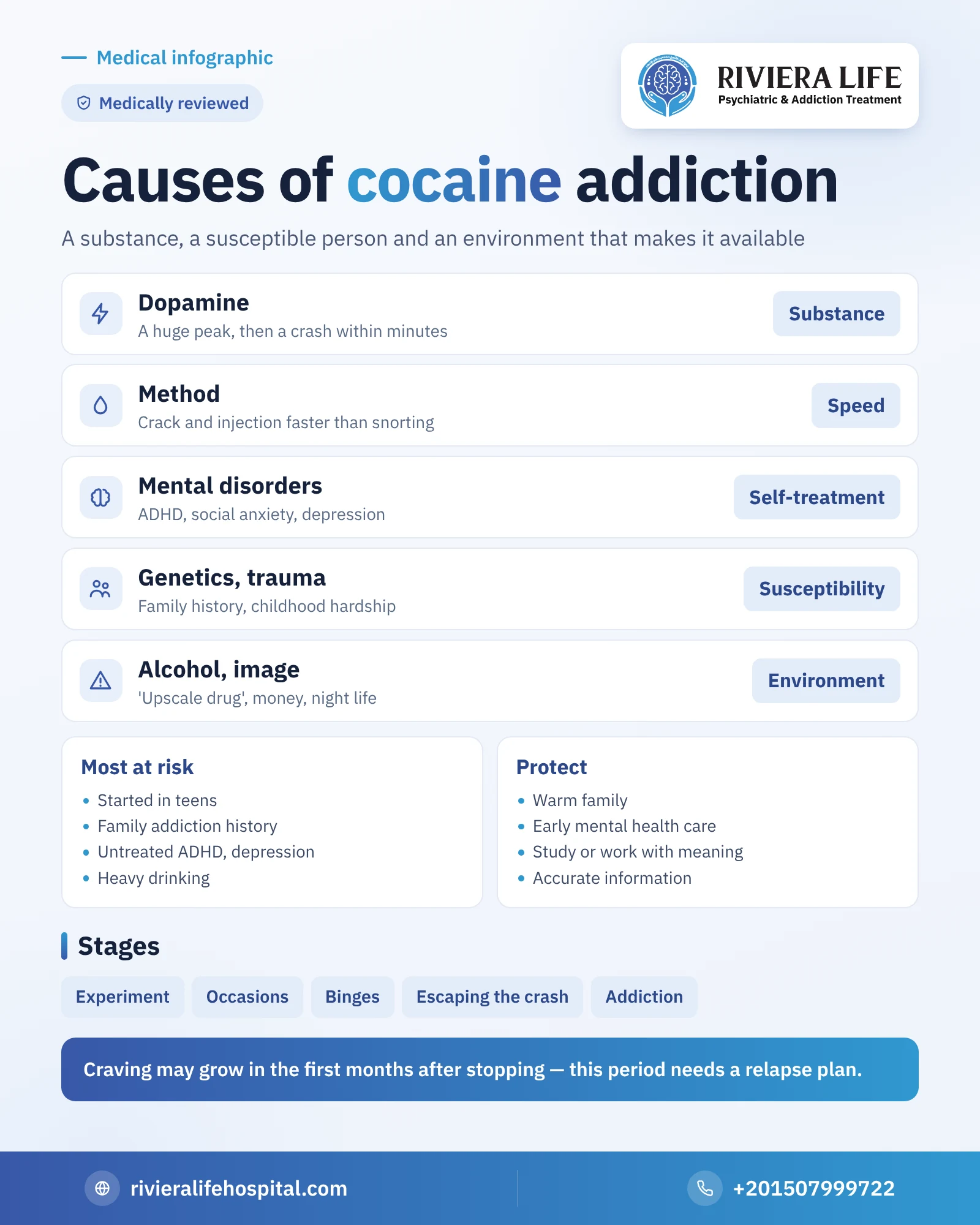
Dopamine in the brain isn’t “the happiness substance” as is commonly said, but a signal telling the brain: “This is important, remember it and seek it again”. Cocaine raises this signal to a level far beyond what food, success or relationships produce, so the brain records the experience as the most important thing that has happened to it. Then dopamine drops quickly within minutes, so the brain receives an opposite signal: something important has disappeared.
This rapid succession between peak and bottom repeats dozens of times in one night, and each repetition entrenches the link further. That is why some patients describe that they never decided to become addicted, but found themselves asking for the dose before they thought.
From the first party to addiction: how does it develop?
Addiction doesn’t happen in a night, but it may happen faster than the person expects. The usual path passes roughly through these stages:
- Experiment: at a party, on a trip or with a friend, out of curiosity or a desire to belong.
- Occasion-linked use: cocaine becomes part of the weekend or occasions, with a feeling of control.
- Binges: nights get longer and doses closer together, and the crash appears the next day.
- Use to escape the crash: the goal is no longer pleasure but getting rid of gloom and exhaustion.
- Addiction: promises to stop that aren’t kept, and continuing despite debts and problems.
The method of use changes the speed
The faster cocaine reaches the brain, the more violent the high, the harsher the crash, and the closer addiction is. That is why smoking crack and injection are linked to faster addiction than snorting. Many crack patients talk about losing control within a few weeks, which we cover in the article on crack addiction. But snorting isn’t as safe as people think, as it is the road from which most addicts started. Even moving from one method to another has significance; someone who starts with snorting then tries smoking or injection in search of a stronger effect has usually entered an advanced stage of dependence.
Genetic and biological factors
Family and twin studies show that genetics explains a large part of susceptibility to stimulant addiction. There is no single “addiction gene”, but a group of small differences that affect the brain’s response to dopamine, impulsivity, and the ability to bear pressure. Someone who has a father or brother suffering from addiction, whatever the substance, carries a higher risk. Added to this is the age factor: in adolescence and the early twenties the brain’s self-control areas haven’t fully matured, so it is more affected.
Mental disorders: an attempt at self-treatment
Many cocaine patients weren’t looking for euphoria so much as for a feeling they were missing. Someone with ADHD may feel concentration for the first time. Someone with social anxiety suddenly finds themselves a confident speaker. Someone living with undiagnosed depression feels the energy they lost. This relief is temporary and costly, but it explains why some cling to the substance. That is why medical assessment always looks for these disorders, because treating them is an essential part of cocaine addiction treatment.
Trauma and continuous pressures
Harsh experiences in childhood, such as domestic violence, neglect or losing a parent, are linked to a higher risk of addiction in general. In adulthood continuous pressures may play a similar role: long work shifts, financial pressure, or a work environment that rewards staying up and constant performance. Here cocaine seems a quick solution to tiredness, then it becomes the source of tiredness.
Money, night life and social image
In Egypt cocaine has been linked to the image of the “upscale drug” associated with private parties, travel and summer resorts, and this image is a cause in itself. It gives the substance acceptance in certain circles, and makes the user see themselves as far from the traditional image of an addict. Also, high income or liquid money eases access to an expensive substance, and delays the moment of colliding with the consequences. Even so, the matter isn’t limited to a particular class, as the spread of cheaper, less pure mixtures has widened the circle of users.
Alcohol: a companion on the road
Cocaine and alcohol almost go together in many cases. Alcohol weakens decision-making so it makes the first dose easier, and cocaine hides the effect of drunkenness so it pushes toward drinking more. Over time each needs the other, so quitting one alone becomes difficult. That is why excessive drinking is among the most important risk factors for cocaine addiction, and vice versa.
Who is most at risk of cocaine addiction?
- Those who started use in adolescence or the early twenties.
- Those with a family history of addiction to any substance.
- Those suffering from ADHD or untreated depression or anxiety.
- Those exposed to trauma in childhood or living under continuous pressures.
- Those who drink excessively or use other substances.
- Working or living in a setting where cocaine is easily available.
The presence of one or more factors doesn’t mean addiction is inevitable, but it means the experiment itself is more dangerous for this person than for others.
Factors that protect against cocaine addiction
Against the risk factors there are factors that reduce the likelihood of the experiment turning into addiction, or help with early stopping if it happens:
- A warm family relationship in which the son can talk about his problems without fear.
- Early diagnosis and suitable treatment of anxiety, depression and ADHD.
- Study or work that gives the person meaning and a regular routine.
- Friends whose nights don’t revolve around alcohol and drugs.
- Accurate information about cocaine that breaks its glamorous image.
These factors don’t guarantee protection, but they give the person wider space to retreat before the substance tightens its grip.
Why does the craving remain after stopping?
Many expect the craving to fade the longer the abstinence, but research indicates that the response to cocaine-linked triggers may intensify in the first weeks and months after stopping before it calms. The brain has kept a strong memory linking the substance to places, people and situations, and one of them is enough to ignite the craving. This is what makes the period after cocaine withdrawal symptoms end very important in the relapse prevention plan.
Is addiction a matter of willpower?
The first decision to try is a choice, but what happens after that isn’t merely weak willpower. Cocaine changes the functions of the areas responsible for judgment and controlling impulsivity, the same ones the person needs to decide to stop. Understanding this fact doesn’t exempt the patient from responsibility, but it changes the question from “why don’t you stop?” to “what do you need in order to stop?”.
How do you protect yourself and your children?
Protection doesn’t start with frightening but with knowledge and relationship. Talk with your children about cocaine with accurate information, not exaggerated stories they later discover are untrue. Pay attention to disorders of mood and concentration and treat them early. Watch the family’s relationship with alcohol and money. And if worrying signs appear, see the article on how to recognize a cocaine addict and ask for a consultation before things get complicated. At Riviera Life the family can start with a free and confidential assessment session with a specialist consultant.
More from the cocaine guide
- Cocaine: the complete guide
- Cocaine addiction symptoms
- The harms of cocaine
- How to deal with a cocaine addict
Questions many people ask
Addiction in its medical sense needs repetition, but the first experience may leave a strong desire to repeat it, especially with crack or in someone with a genetic or psychological susceptibility. And no one can know in advance which group they belong to.
Several factors overlap: genetics, the age at starting, the presence of mental disorders, the method of use, and the surrounding environment. The more factors come together, the higher the risk.
Some people with ADHD feel a temporary improvement in concentration with cocaine, so they cling to it as self-treatment. That is why this disorder is assessed within the treatment plan and treated in safe ways.
Yes, alcohol weakens decision-making and makes the first dose easier, and cocaine hides the effect of drunkenness so it pushes toward drinking more, and over time each reinforces the other.
Not always; the response to triggers may intensify in the first months before gradually calming. That is why this period needs follow-up and a clear relapse prevention plan.