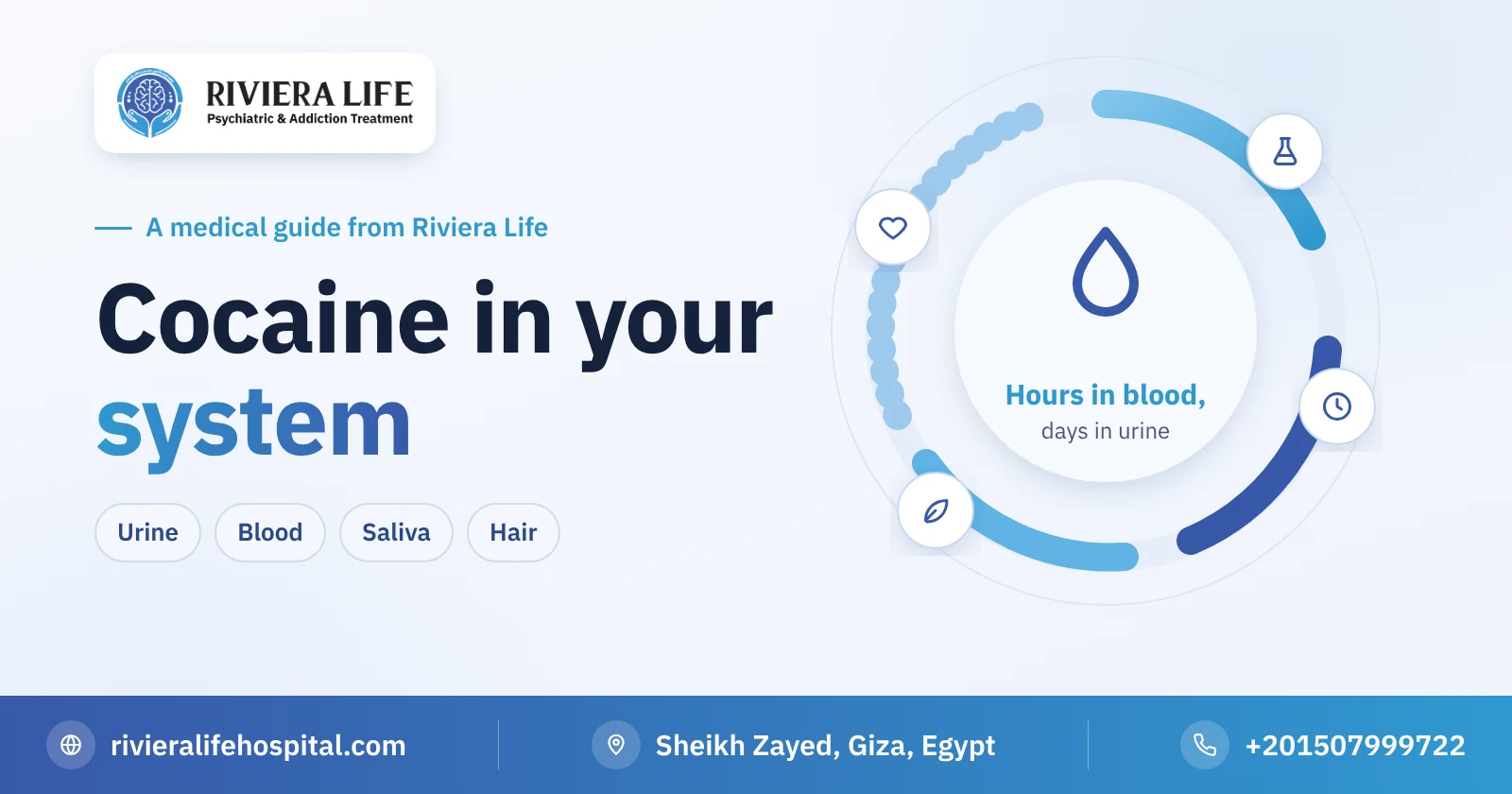
How long cocaine stays in the body depends on what the test is looking for. Cocaine itself leaves the blood quickly, within a few hours, but what the test usually looks for is a substance produced as it breaks down, called benzoylecgonine, which stays longer.
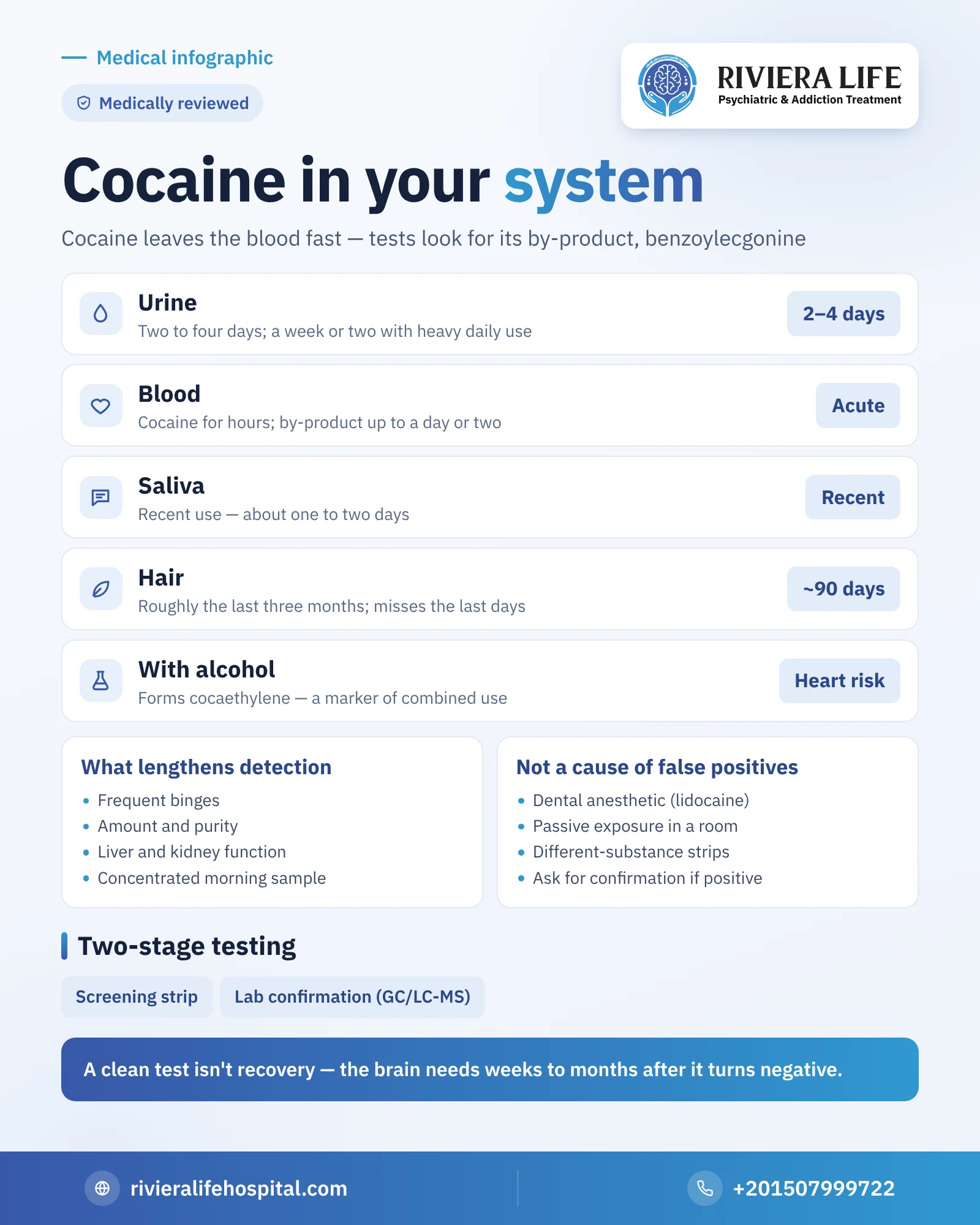
In a urine test it usually shows for two to four days after the last use, and this may extend to a week or more in someone who has used heavily for a long time. In saliva it shows for a day or two, in blood for hours to about two days, and hair may keep its trace for about three months. This article explains what lies behind these figures, why they differ from person to person, and when a result needs confirmation.
What happens to cocaine inside the body?
As soon as it enters the blood, the liver and enzymes in the blood itself start breaking cocaine down, so it loses roughly half its amount within an hour or less. Most of what remains is converted into two main substances, the most important being benzoylecgonine, which stays in the body several times longer than the original cocaine and then leaves in the urine. That is why most tests base their result on this by-product, not on cocaine itself.
This explains something that puzzles some people: how can the effect have completely worn off two days ago while the test is still positive? The answer is that what remains in the body is no longer an active substance, but a chemical trace of earlier use.
How long cocaine shows in each type of test
The urine test
The most widespread in laboratories and workplaces. It usually detects use that happened within two to four days. With heavy daily use over a long period, the by-product can build up, remaining detectable for about a week or two, and longer times have been recorded in a few cases.
The blood test
Detects cocaine itself for a few hours, and its by-product for up to about a day or two. It is usually requested in emergencies to assess someone who is poisoned or after an accident, not to look for old use.
The saliva test
Detects recent use, within about a day or two. Its sample is easily taken under the specialist’s eye, which is why it is sometimes used in field testing.
The hair test
Keeps a longer record, as the substance is deposited in hair as it grows. The part close to the scalp usually reflects roughly the last three months. But it doesn’t detect the last few days, because hair needs time to emerge above the skin.
Why does the time differ from person to person?
The figures above are approximate averages, and the following factors may lengthen or shorten them:
- Pattern of use: a single dose on one occasion differs greatly from repeated binges every week.
- Amount and purity: the cocaine in circulation varies in purity, so the user themselves doesn’t know how much actually entered their body.
- Liver and kidney health: reduced efficiency of these organs delays the removal of cocaine’s by-products.
- Urine concentration when the sample is taken: the first morning sample is usually more concentrated.
- The test’s cutoff: each device has a minimum threshold, so what exceeds it in one laboratory may not show on another, less sensitive strip.
Cocaine with alcohol: an extra fingerprint in the test
When cocaine and alcohol are together in the body, the liver forms a third substance called cocaethylene. This substance only forms when both are present, which is why specialists in confirmatory testing consider it evidence that the two were combined. And it isn’t just a laboratory marker: it stays in the body longer than cocaine and does greater harm to the heart, as we explain in our article on the harmful effects of cocaine.
The screening test and the confirmatory test
Rapid strips and the first laboratory screen rely on an immune reaction that recognizes cocaine’s by-product. This test is relatively accurate for cocaine compared with other substances, but it remains “preliminary”. If the result is positive in a context with consequences, such as work or a legal case, the right step is a confirmatory test using chromatography and mass spectrometry, which identifies the substance by name and measures its concentration.
It is important to know that each substance has its own strip. A cocaine strip doesn’t detect amphetamines, hashish or opioids, and vice versa. So a negative result on one strip doesn’t mean the person hasn’t used anything.
Can a positive result appear without use?
This is rare with cocaine, but possible in specific cases:
- A medical procedure in the nose or throat that used topical cocaine solution, in countries that still use it.
- Drinking coca leaf tea, common in some South American countries, because it contains some of the same substance.
The local anesthetic a dentist uses, such as lidocaine, doesn’t cause a positive cocaine result despite the similar names. Likewise, simply sitting in a place where others used cocaine isn’t usually enough to exceed the cutoff in an accredited test.
Is a crack test different from a cocaine test?
Crack is cocaine itself in a smokable form, so it is converted in the body into the same by-product and shows on the same strips. But its intense pattern of use may lengthen the time it shows, and smoking it sometimes leaves an extra substance specific to heating that a confirmatory test can detect. The details are in our article on how long crack stays in your system.
Recipes for “cleansing the body” of cocaine
Recipes and drinks promising to flush cocaine out of the body within hours are widespread online. There is no evidence that any of them speeds up the liver’s clearance of the by-product, and drinking too much water can be harmful. Serious laboratories check the concentration and properties of the sample, detect a diluted sample, and ask for it to be repeated. Most importantly, a “clean” test isn’t a goal in itself: the brain needs weeks and months to regain its balance after the test becomes negative.
Cocaine testing at work and in official situations
Government and private employers in Egypt request drug tests on hiring or periodically, and testing may be required in other official situations. In these cases a urine test is usually used, with the possibility of confirmation in an accredited laboratory. If you take medicines regularly, mention them before the sample is taken, and if the result is positive without use, ask for the confirmatory test. But if there is actual use, the next test isn’t the real problem, and the right time to ask for help is now, before the losses widen.
What can’t the test tell you?
The test says that the substance or its by-product is present above a certain threshold, but it doesn’t precisely determine when the last dose was, how much it was, whether the person is addicted or tried it once, or whether they were under the influence when the sample was taken. These questions are answered by a medical assessment that brings together the history, symptoms and behavior; you will find the signs the doctor looks for in our article on cocaine addiction symptoms.
How are tests used during treatment?
In stimulant treatment programs, urine tests are done regularly, and they play a bigger role than monitoring. Some of the most effective treatments for cocaine are built on rewarding negative results in a tangible way, so every clean sample becomes a step counted in the patient’s favor. Tests also help the team detect relapse early and adjust the plan. You can learn about these approaches in our article on cocaine addiction treatment.
Before you use a test strip at home
If you are a parent thinking of buying a test strip, first ask yourself: what will I do with the result? A positive result needs confirmation, then a calm conversation and a consultation, and a negative result doesn’t cancel other signs that worry you, especially with a substance that disappears from urine within days. The strip is a means of reaching treatment, not a tool for proving an accusation. At Riviera Life, the family can begin with a free, confidential consultation before any confrontation.
More from our cocaine guide
- Cocaine: the complete guide
- Cocaine withdrawal symptoms
- How to recognize someone addicted to cocaine
- How long crack stays in your system
Questions many people ask
Usually two to four days after the last use. With heavy daily use over a long period, it may remain detectable for about a week or two.
Cocaine itself disappears from the blood within hours, while its by-product may be detected for up to about a day or two. That is why a blood test is mostly used to assess acute cases.
No. The local anesthetic used by dentists, such as lidocaine, is a different substance and doesn't cause a positive cocaine result despite the similar name.
A hair test usually reflects roughly the last three months, but it doesn't detect use in the last few days.
Not necessarily: cocaine usually disappears from urine within a few days, and use may happen in spaced-out binges. A medical assessment of symptoms and behavior is more accurate than a single test.