Gabapentin is a relatively old medicine that neurologists prescribe for epileptic seizures and nerve pain, and many patients know it by its trade name “Neurontin”. In an Egyptian home its strip may look completely innocent; it is prescribed for a grandfather suffering shingles pain or for a son with epilepsy.
But the same medicine has found another path among those who use tramadol and opioids, as it is used to strengthen their effect or as a cheaper alternative to pregabalin, and here it turns from a treatment into a real danger to breathing. This page explains what gabapentin is, how it works, why it is misused, and when the matter becomes a case that calls for treatment, then leads you to detailed articles about its withdrawal and treatment.
What is gabapentin?
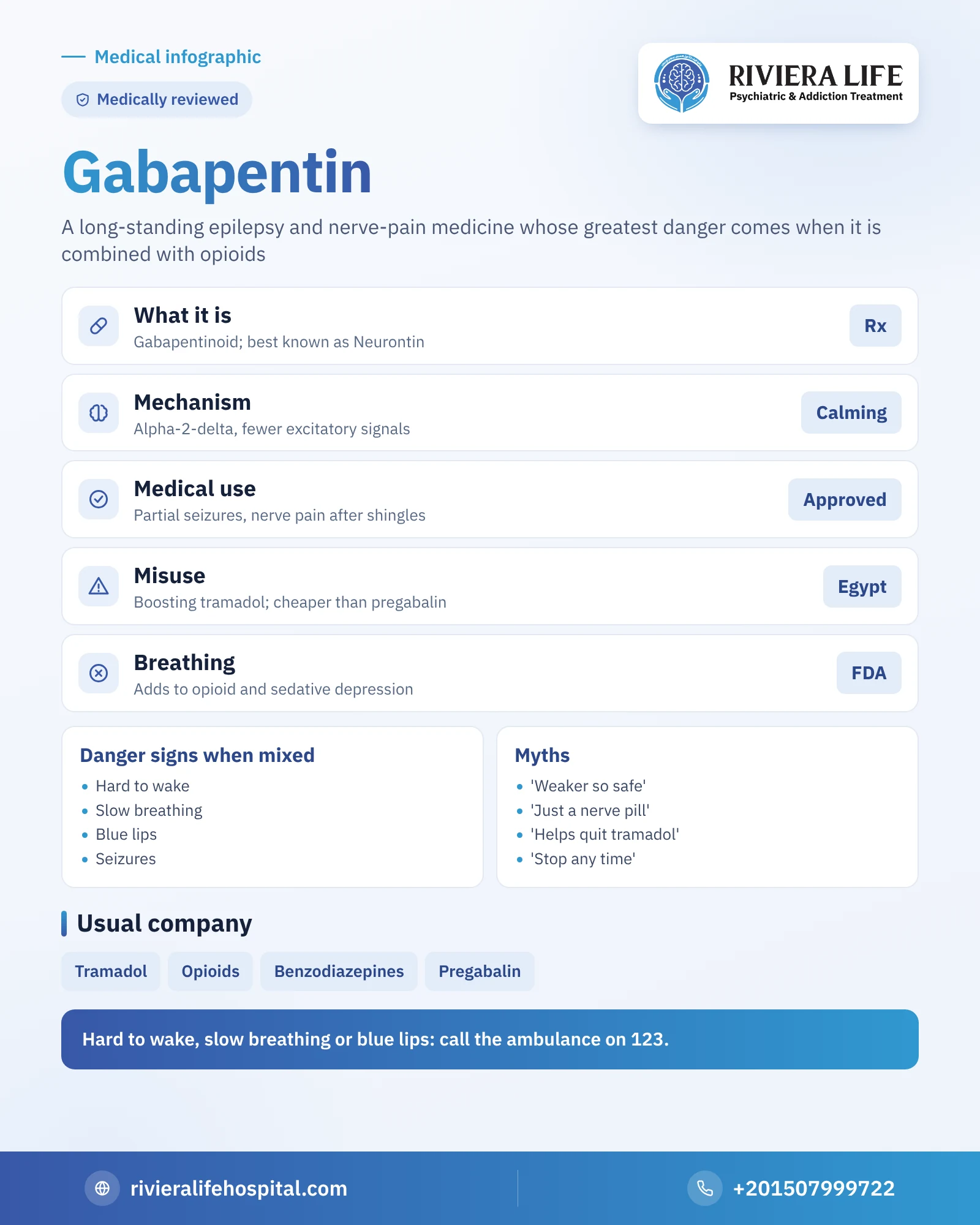
Gabapentin, sometimes written “gabantin”, is a medicinal substance launched in the early 1990s as an add-on treatment for epilepsy, and its use then widened to include nerve pain. It belongs to the “gabapentinoid” group, which it shares with pregabalin, and it is the older of the two. The shape of its molecule is close to the calming neurotransmitter “GABA”, hence its name, though it doesn’t act on the receptors of this transmitter as the name suggests.
It is usually dispensed as capsules or tablets, and in some countries there is a syrup for children and extended-release formulations. The medicine hardly passes through the liver, but leaves the body in the urine as it entered, which is why kidney patients and older adults need special caution in setting its amount.
Neurontin and gabapentin’s other names
The original and best-known trade name is “Neurontin”, and many still apply it to any medicine containing the substance. Alongside it, many local preparations carrying the same active substance under different names are widespread in Egyptian pharmacies, the best known being “Gaptin”, “Conventin” and “Gabimash”, and abroad there are other formulations such as the extended-release “Gralise”, and “Horizant”, which contains a modified form of the substance.
Unlike pregabalin, which became known on the street as “Lyrica”, gabapentin doesn’t carry a widespread popular nickname, and is often known by the name on the strip or by a shortening of the substance’s name. What matters for the family is to know that a different trade name doesn’t mean a different medicine; taking two preparations with different names may mean doubling the same substance without noticing.
How does gabapentin work in the brain and body?
Gabapentin binds to a small subunit in the calcium channels of nerve cells called “alpha-2-delta” (alpha2delta), the same subunit pregabalin binds to. This binding reduces the entry of calcium into the endings of excited nerves, so the amount of excitatory transmitters such as glutamate that they release decreases. The result at therapeutic doses is calmer nerves: milder nerve pain and less likely epileptic seizures.
Gabapentin differs from its relative in the way it is absorbed; the intestines absorb it through a transporter of limited capacity, so the larger the amount, the smaller the proportion that reaches the blood. This property makes its effect slower and less regular, but it doesn’t protect someone who misuses it as some think, because the real danger comes from mixing, not from the amount alone. At large amounts a different picture appears: elation and relaxation, dizziness and unsteadiness, drowsiness and slow speech, blurred vision, and weak concentration.
The medical uses of gabapentin
Gabapentin has a firm place in medicine, and describing it as a “drug” is unfair to the millions of patients who take it regularly. Its most prominent uses:
- An add-on treatment for partial epileptic seizures, added to another medicine, with the neurologist deciding whether to continue it.
- Nerve pain, the best known being the pain that remains after shingles, and in several countries peripheral nerve pain in general, such as that caused by diabetes.
- Other uses the doctor decides on in specific cases, such as restless legs syndrome in some formulations, and sometimes off-label for types of chronic pain or sleep disorders.
A patient who sticks to the prescription and follow-up rarely turns to addiction, but may become physically dependent on the medicine over time, which is why it isn’t stopped and its amount isn’t changed except by the decision of the doctor who prescribed it.
Why is gabapentin misused in Egypt?
Gabapentin is rarely the first substance in an addiction story. The usual picture in Egyptian clinics is a person who uses tramadol or another opioid, then adds gabapentin for reasons that are heard repeatedly:
- To strengthen the effect of the opioid, or what users call “boosting” tramadol, so they get a stronger feeling with a smaller amount of opioid.
- As a cheaper or easier alternative to pregabalin after the restrictions on its dispensing were tightened, thinking “the two are the same”.
- To ease withdrawal symptoms when the opioid runs out, so the “helper” turns into a second dependence.
- Because it was originally prescribed for a member of the household, so getting hold of it seems easy and unsuspicious.
Studies generally indicate that its misuse is clearly higher among those who use opioids compared with the general public, which makes any appearance of its strips alongside tramadol an alarm bell that deserves attention.
Why does gabapentin become dangerous?
The most dangerous thing about gabapentin isn’t its effect alone, but what it does when it comes together with others. It adds depression to the depression of opioids, benzodiazepines and alcohol, so breathing slows and may stop. The US Food and Drug Administration has warned of serious breathing problems when medicines of this family are used with opioids or sedatives, or in older adults and lung patients. Several studies have linked combining gabapentin and opioids with a raised risk of death from opioid overdose.
Besides mixing, dizziness and drowsiness raise the risk of falls and road accidents, and antiepileptic medicines in general have been linked to a rare increase in suicidal thoughts that calls for monitoring any sudden change in mood. Stopping suddenly after long use may cause troublesome symptoms and sometimes seizures.
Gabapentin within its medicine family
Its closest relative is pregabalin, which acts on the same target but is absorbed quickly and in a regular proportion, so its effect appears faster and seems more attractive to those who misuse it. You will find the full comparison between the two medicines in the article on pregabalin and gabapentin, and everything about pregabalin itself in the pregabalin guide. In terms of effect, gabapentin stands close to sedatives, but isn’t one of them, and its best-known company in Egyptian reality is opioids, headed by tramadol.
Dependence and withdrawal in brief
With daily use of large amounts, the nervous system adapts to the presence of the medicine, so the person needs a higher amount and is disturbed when it is absent. Withdrawal symptoms usually begin within a day or two of the last dose: anxiety, insomnia, sweating, aches and irritability, and confusion or a seizure may occur, especially in epilepsy patients. That is why the medicine isn’t stopped suddenly, and is withdrawn gradually under medical supervision.
Gabapentin and the law
Gabapentin is a licensed medicine dispensed only by medical prescription, and dispensing, selling or possessing it in amounts outside the medical framework is a violation that may expose a person to accountability. Several countries have moved to tighten control over it after its misuse widened; the United Kingdom listed it among controlled substances, and several US states added it to their schedules. In Egypt the dispensing controls for medicines of this family change from time to time, so the reference is the pharmacist and the treating doctor. Voluntarily seeking treatment remains a safe path, and for inquiries you can contact the hotline of the Fund for Drug Control and Treatment of Addiction on 16023.
The gabapentin guide: each aspect in a separate article
We have gathered the details of gabapentin in articles, each answering a single question:
Gabapentin withdrawal symptoms
When the symptoms begin after the last dose, why stopping suddenly threatens epilepsy patients with seizures, and which symptoms may extend for weeks.
Gabapentin addiction treatment
From the assessment that uncovers accompanying substances to gradual tapering, treating the original pain or epilepsy, and relapse prevention.
Pregabalin and gabapentin
The difference between the two medicines in absorption, speed of effect, uses and the likelihood of misuse.
Common myths about gabapentin
The myth: gabapentin is weaker than pregabalin, so there is no danger from it. The truth is that its weak absorption doesn’t prevent dependence on it, and that its greatest danger comes from combining it with opioids, a combination that may depress breathing to the point of death.
The myth: it’s an ordinary nerve medicine, so it can’t be part of an addiction. The truth is that its spread among users of tramadol and opioids is documented, and that its appearance without a prescription alongside other substances is a sign that deserves assessment.
The myth: it helps you quit tramadol, so there’s no harm in taking it without a doctor. The truth is that its random use to ease withdrawal adds a second dependence and raises the risk of overdose on returning to the opioid.
The myth: an epilepsy patient can stop it whenever they like if they feel better. The truth is that stopping it suddenly may bring the seizures back more severely, and any change is made with the neurologist alone.
Where does the family start?
The first question: for whom was this medicine dispensed? If it is prescribed for the person taking it, talk with the treating doctor about what you have noticed, such as drowsiness, stammering or asking early to renew the prescription. If it isn’t prescribed, pay attention to what surrounds it: are there strips of tramadol or sedatives? Have sleep, walking and speech changed? Write down your observations calmly, and don’t confiscate all the medicines suddenly, because sudden discontinuation may be dangerous, especially if the person has epilepsy. Choose a time when they are clear-headed, talk about your fear for them, not about shame, then ask for a specialized assessment that covers all substances, not gabapentin alone.
Danger signs when gabapentin is mixed
Call the ambulance on 123 immediately if any of these appear
The greatest danger comes when gabapentin is combined with tramadol, opioids, sedatives or alcohol.
- Deep drowsiness that makes it hard to wake the person
- Slow, shallow or irregular breathing
- Bluish lips or fingertips
- Severe confusion or incomprehensible speech
- Seizures or loss of consciousness
Don’t leave the person alone until the ambulance arrives, and if they are unconscious and breathing, put them on their side. Tell the paramedics everything you know they took, and take the empty strips with you, as they save the doctor precious time.
When should you ask for help?
Ask for a specialized assessment if gabapentin has come to be taken without a prescription, in a larger amount than prescribed, or with tramadol or any opioid or sedative, or if attempts to stop have failed because of insomnia and anxiety. At Riviera Life, the consultants in psychiatry and addiction treatment carry out this assessment in complete confidentiality, and decide whether the case needs admission under round-the-clock supervision or outpatient follow-up, coordinating with the neurologist or pain doctor if the medicine is prescribed for a real reason, and involving the family from day one.
Medical sources and referencesThe information in this article is based on reliable scientific sources
1MedlinePlus — Gabapentin drug informationmedlineplus.gov2NHS — Gabapentin: uses and side effectsnhs.uk3StatPearls — Gabapentin: mechanism, uses and toxicityncbi.nlm.nih.gov4FDA — Warning about serious breathing problems with gabapentin and pregabalinfda.gov5NIDA — Misuse of prescription drugsnida.nih.gov