Gabapentin withdrawal symptoms appear in many people within about twelve to forty-eight hours of the last dose, and may be delayed by days in some. The most common are anxiety, insomnia, sweating, aches and irritability, and in more severe cases confusion and disturbed perception. The danger that makes sudden stopping an unsafe decision is seizures, and it rises clearly in those who take the medicine in the first place to treat epilepsy. This article explains the timing and sequence of the symptoms, who is most at risk, the symptoms that may extend for weeks, and why reducing the medicine is left to the doctor.
Why does stopping gabapentin cause symptoms?
Gabapentin reduces the release of excitatory messengers in the nervous system. With daily use over a long period, or in large amounts, the brain compensates for this constant braking by raising its level of excitability. As long as the medicine is present the balance holds, but if it suddenly disappears the extra excitability is exposed with nothing to balance it. That is where tension, insomnia and sweating come from, and where the possibility of seizures comes from too. This may happen even to someone who took the medicine on a proper prescription; physical dependence isn’t proof of misuse, but it is reason enough not to stop suddenly.
When do gabapentin withdrawal symptoms start?
The concentration of gabapentin in the blood falls by half within about five to seven hours, and it leaves the body through the kidneys unchanged. That is why the first symptoms usually begin within a day or two, and published case reports describe a wider range from a few hours to several days. Their appearance is usually delayed in older people and kidney patients because the medicine stays longer in their bodies, while they may begin earlier in those used to large amounts spread over the day.
How do the symptoms develop day by day?
Withdrawal doesn’t follow the same schedule for everyone, but doctors notice a recurring sequence:
The first hours and days
An inner tension for which the person finds no reason, difficulty sleeping, sweating at night and mild nausea. The patient may tell his family he is “upset for no reason”, or move between the bed and the chair without settling.
The peak days
Insomnia and irritability increase, widespread body aches, palpitations and tremor appear, and anxiety may intensify into panic attacks. In this period the likelihood of confusion and seizures is higher, and the urge to return to the medicine is at its height.
The settling stage
The physical symptoms recede gradually in most cases within days to about two weeks, and some are left with broken sleep and mild anxiety that need longer.
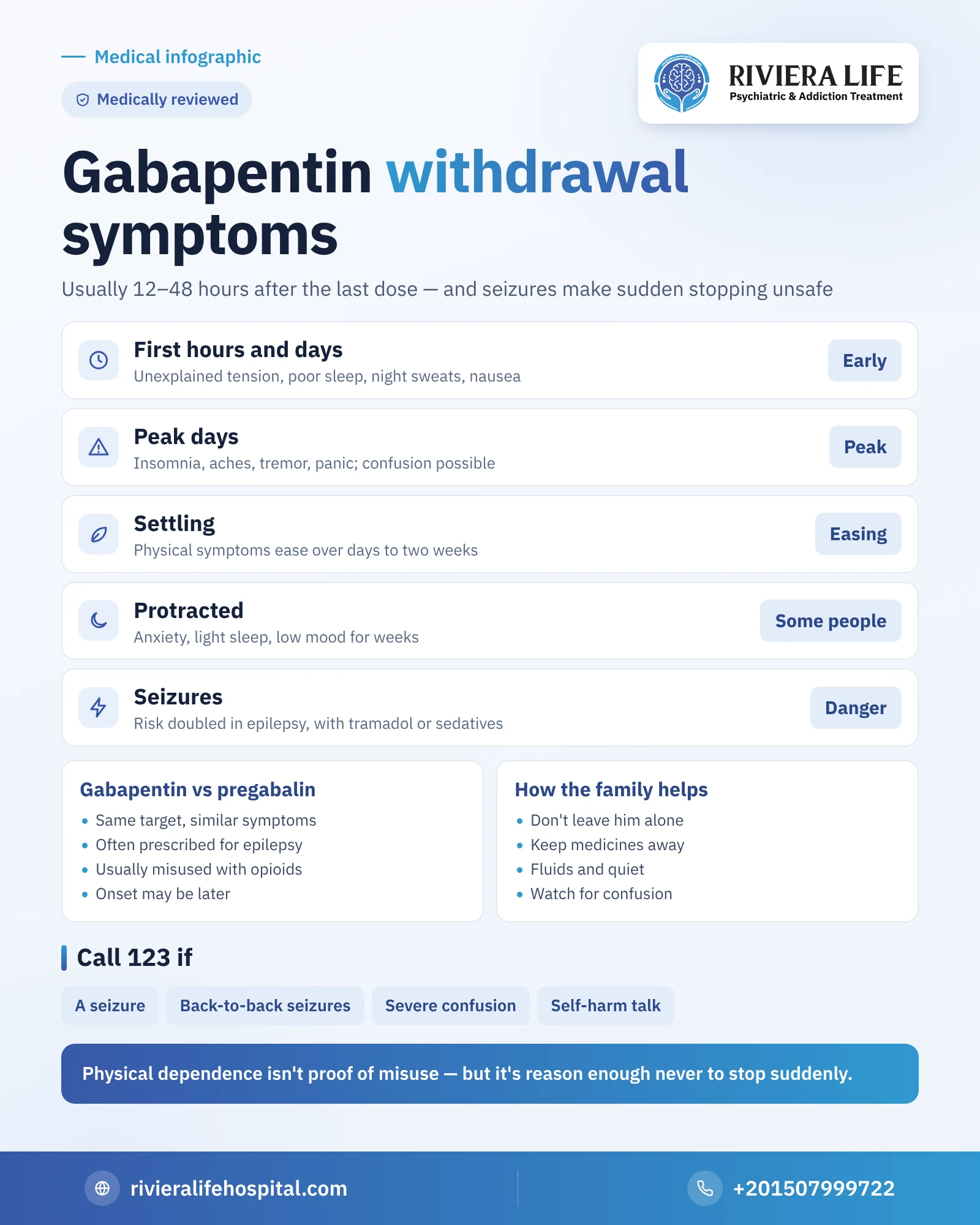
Physical and psychological gabapentin withdrawal symptoms
The physical and psychological symptoms overlap, and the most common are:
- Anxiety: constant tension, and sometimes panic attacks with chest tightness and palpitations.
- Insomnia: difficulty falling or staying asleep, one of the things that most drives relapse.
- Sweating: heavy, especially at night, and may be accompanied by chills.
- Pain: widespread muscle aches, increased sensitivity to pain, and the return of nerve pain if it was present.
- Irritability and nervousness: sharp reactions, restlessness and inability to sit still.
- Confusion: muddled thinking and difficulty concentrating, and less often disturbed perception and orientation to time and place.
- Nausea, headache, dizziness and hand tremor.
If severe confusion, hallucinations or incoherent speech appear, these aren’t symptoms to wait out, but signs that call for immediate medical assessment.
Seizures: why is the risk different in epilepsy patients?
Gabapentin is an anti-seizure medicine, and withdrawing it suddenly raises the brain’s excitability. In a healthy person this may be enough to cause a rare seizure, especially after large amounts. In an epilepsy patient the risk is double: stopping removes part of the protection that prevents his seizures, so they may return more frequently, and consecutive seizures may occur without the patient regaining consciousness between them, which is a medical emergency. That is why the neurologist arranges any change in epilepsy medicine himself, even if the aim is to reduce a medicine being misused.
The risk also rises in those withdrawing from other substances at the same time, such as sedatives or alcohol, or who use tramadol, because tramadol itself lowers the seizure threshold.
Call an ambulance on 123 immediately if you see
These signs during stopping gabapentin aren't managed at home.
- A seizure or involuntary jerking movements
- Consecutive seizures without the person regaining consciousness between them
- Severe confusion, hallucinations or loss of orientation to place and time
- Loss of consciousness or difficulty waking the person
- Talk of self-harm or ending life
During a seizure move hard objects away, don’t put anything in the person’s mouth or restrain his movement, and afterwards put him on his side and stay with him until the ambulance arrives.
Protracted symptoms after the peak ends
In a group of patients, especially those who used the medicine for years or in large amounts, not everything ends as the physical symptoms recede. Anxiety may remain intermittently, sleep light and mood low, with a craving that returns at moments of stress. Medical reports speak of symptoms that lasted weeks and sometimes longer. This stage doesn’t mean treatment has failed, but it explains why many relapses happen after everyone thinks withdrawal is over, and why follow-up remains necessary after discharge.
What sets gabapentin withdrawal apart from pregabalin withdrawal?
The two medicines act on the same target, so their withdrawal symptoms are similar in general. But there are practical differences that matter to the family:
- Many prescription users of gabapentin take it for epilepsy, so the risk of seizures returning becomes the first axis of the plan.
- Its misuse usually comes with opioids, so withdrawal from it alone is rare.
- Because of its weak absorption, those who misuse it sometimes resort to very large amounts, so it is hard for the family to estimate the extent of dependence from the number of strips alone.
- The range of symptom onset described in reports is slightly wider, so it may be delayed in some.
You will find details of its relative’s withdrawal in our article on pregabalin withdrawal symptoms, and the pharmacological differences between them in pregabalin and gabapentin.
When withdrawal comes together with opioids
The most common picture in Egypt is someone stopping gabapentin and tramadol together, or gabapentin and another opioid. Then the symptoms overlap: runny nose, yawning, bone aches and diarrhea from the opioid, and anxiety, insomnia and sweating from gabapentin. Knowing the source of each symptom becomes hard for the family, and the risk of seizures and relapse rises. These cases need a medical decision on the order of withdrawal, and our article on opioid withdrawal symptoms explains the opioid side of the picture.
Why is reducing gabapentin done under medical supervision?
Because the decision depends on questions the patient can’t answer alone: why was the medicine prescribed in the first place? Is there epilepsy needing alternative protection? What other substances does he take? How do his kidneys work? The doctor sets an individual reduction plan, follows sleep, pulse and mental state, treats insomnia and anxiety by means that don’t create a new dependence, and intervenes early at any sign suggesting a seizure. We don’t publish schedules or amounts here, because a safe schedule for one person may be dangerous for another. What comes after withdrawal in psychotherapy and relapse prevention is explained in our article on gabapentin addiction treatment.
Withdrawal or the return of the original illness?
Someone who was taking gabapentin for nerve pain may feel the pain return after stopping, and someone taking it for epilepsy may have his seizures return. Here one must distinguish between withdrawal symptoms that will recede with the days, and an original illness that needs alternative treatment. The treating doctor is the one who settles this through follow-up, because confusing the two pushes the patient to return to the medicine the old way.
How does the family support during the withdrawal days?
Treat irritability and insomnia as part of withdrawal, not a challenge to you. Provide a quiet place and enough fluids, and don’t leave the person alone on the peak days, especially if he has epilepsy. Keep the stock of medicines out of his reach, keep the doctor’s and ambulance numbers in a visible place, and watch for any sudden confusion or talk of self-harm. At Riviera Life the team follows these days around the clock, and coordinates with the neurologist when the medicine is part of real epilepsy treatment; for the full picture of the medicine see our gabapentin guide.
More from our gabapentin guide
- Gabapentin: the complete guide
- Gabapentin addiction treatment and its stages
- Pregabalin withdrawal symptoms
- Pregabalin and gabapentin: the difference between them
- How long gabapentin stays in the body: half-life, kidneys and testing
- Gabapentin harms: the brain, breathing, kidneys and when to call an ambulance
- Gabapentin addiction symptoms: signs the family sees and how to tell them apart
- Gabapentin and sex: reported effects, other causes and when to see the doctor
Questions many people ask
The physical symptoms settle in most cases within days to about two weeks, while anxiety and sleep disturbance may continue for weeks in those who used it long-term or in large amounts.
It can be, because stopping suddenly may cause confusion or seizures, and the risk is higher in people with epilepsy and those withdrawing from other substances with it, such as sedatives or tramadol.
Yes, they may happen after regular use even on prescription, because the body gets used to the medicine. That is why it is reduced gradually with a plan set by the prescribing doctor and isn't stopped suddenly.
He doesn't stop on his own, but sees the neurologist and the addiction treatment team together, so the medicine is adjusted safely with alternative seizure protection if needed.
The symptoms are similar because the two medicines act on the same target, but gabapentin withdrawal usually comes with opioid withdrawal, and the risk of seizures returning in epilepsy patients is at the forefront.