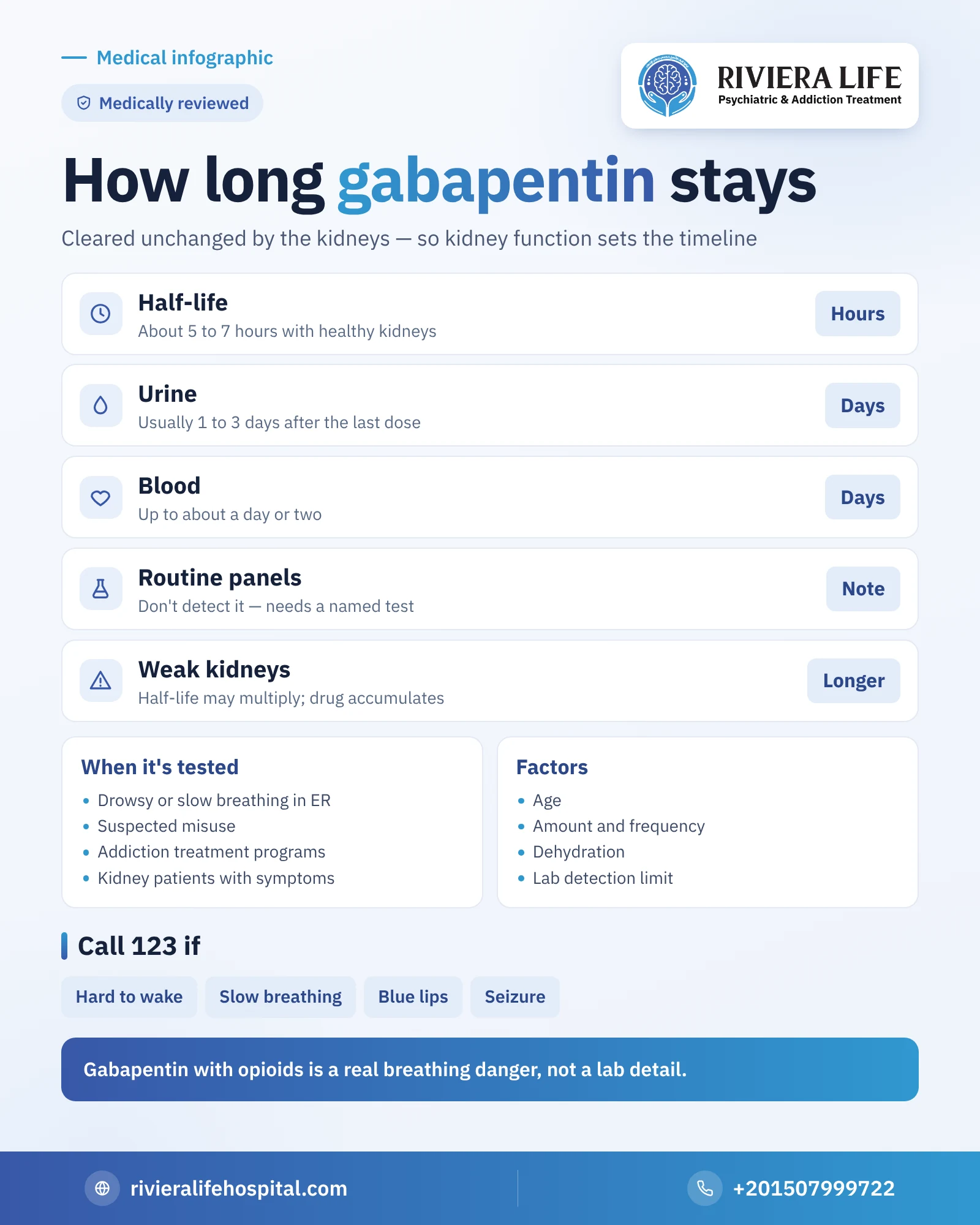
How long gabapentin stays in the body is relatively short in someone whose kidneys work normally: its concentration in the blood halves within about five to seven hours, the body clears most of it within two days, and it can usually be detected in urine for one to three days after the last dose.
But these figures change a lot with weak kidneys, as the period may double in older people and kidney patients. And most importantly, gabapentin doesn’t show in a routine drug test, and is only detected by a test ordered for it by name. This article explains the medicine’s journey through the body, how long it shows in each sample, why the kidneys are the deciding factor, and when the doctor orders this test.
How does the body handle gabapentin?
Gabapentin is one of the few medicines the liver barely changes at all. It is absorbed from the intestines, circulates in the blood, then the kidneys excrete it in urine almost as it entered, without turning into other products. This simplicity has two practical consequences: first, kidney efficiency determines how fast it leaves more than any other factor, and second, what the test looks for is gabapentin itself, not a substance derived from it.
It has another distinguishing property: its absorption from the intestines happens through a transporter of limited capacity. So the larger the amount swallowed at once, the smaller the proportion the body absorbs. That is why its blood levels don’t rise in proportion to the amount, a fact that explains why it is hard to estimate what a person took from the test result alone.
Does gabapentin show up in an ordinary drug test?
No. Routine panels, whether home strips or the usual initial screening in labs, look for specific groups such as opioids, cannabis, amphetamines, benzodiazepines and cocaine, and gabapentin isn’t among them, nor does its structure resemble any of them closely enough to react with them. So these tests come back negative however much the person takes.
To detect it, a specific gabapentin test is ordered by name, usually carried out by chromatography linked to mass spectrometry. Some labs have added it to expanded panels after its misuse spread alongside opioids, but this isn’t the rule, and you must ask about it specifically.
How long gabapentin shows by sample type
The following figures are approximate for a person with healthy kidneys, and all of them lengthen with weak kidney function:
Urine
It can usually be detected for one to three days after the last dose, and may extend further in someone taking large amounts daily. Because the medicine leaves in urine unchanged, its concentrations there are relatively high and easy to detect with the specialized test.
Blood
Reflects the last few hours, and can usually be detected for up to about a day or two. It is used in emergencies to explain unexplained drowsiness or confusion, or to monitor the medicine level in a kidney patient.
Saliva
Its data is limited, and it is expected to detect recent use within hours to about a day; it is rarely ordered.
Hair
It may reflect recent months in a few specialized labs, but it isn’t a widely available test for this medicine, and it doesn’t detect the last few days.
The kidneys: why do they change the period so much?
Since the kidneys are almost the only route out for gabapentin, any weakness in them slows its exit to roughly the same degree. In a patient with advanced kidney failure the half-life may be many times longer, so the medicine stays in the blood for days instead of hours, and may accumulate even with prescribed doses if they aren’t adjusted. That is why doctors set the gabapentin dose according to kidney function, and recalculate it as age advances.
For dialysis patients the picture is different: a dialysis session removes a large part of the medicine from the blood, so its level drops clearly afterwards and then rises again. These details make interpreting a gabapentin test result in a kidney patient the doctor’s job alone.
Accumulation of the medicine may appear in an older person before anyone orders a test: dizziness and daytime drowsiness, an unsteady walk, repeated falls at home, and sometimes confusion or slowed speech that the family thinks is a sign of aging. If these signs appear after starting gabapentin or increasing its dose, or after an illness affecting the kidneys such as severe dehydration, the right step is to see the doctor quickly, not to stop the medicine on your own or to double it.
Other factors that lengthen or shorten the period
- Age: kidney function declines naturally with age, so the medicine stays longer in older people.
- Amount and frequency: continuous daily use lengthens the detection window compared with a single dose.
- Dehydration: too little fluid slows kidney function and concentrates the urine.
- Accompanying medicines: some medicines may affect the kidneys or the absorption of gabapentin, and the doctor is the one to assess that.
- The lab’s detection limit: every machine has a minimum concentration it can detect, so the result differs between labs.
When does the doctor order a gabapentin test?
This test isn’t ordered at random, but in specific situations:
- In emergencies, faced with a patient who is drowsy, confused or breathing slowly, especially if they take opioids.
- When misuse of a prescribed medicine, or taking it without a prescription, is suspected.
- During addiction treatment programs, to confirm adherence and detect relapse early.
- In a kidney patient who shows symptoms that may come from accumulation of the medicine.
Anyone taking gabapentin on prescription for epilepsy or nerve pain should preferably tell the lab and the doctor before any test, so the result is read in its correct context.
Gabapentin with opioids in a single result
In Egypt, gabapentin misuse rarely comes alone; it is often combined with tramadol or other opioids. In this case the routine test may come back positive for the opioid only, and gabapentin remains hidden unless ordered by name. This combination isn’t a detail of testing but a real danger, because gabapentin multiplies the effect of opioids on breathing. Our article on gabapentin withdrawal symptoms explains how discontinuation symptoms from the two overlap.
Gabapentin and pregabalin in testing
Although the two medicines are similar in how they work, they are different molecules, each with its own test, and neither detects the other. They also differ in speed of absorption, as pregabalin’s absorption is faster and more consistent. You will find the details of pregabalin’s detection windows in our article on how long pregabalin stays in the body, and the pharmacological differences between them in pregabalin and gabapentin.
About recipes to speed up the medicine’s exit
Recipes claiming to “cleanse the body” of medicines within hours spread online. These recipes have no scientific basis, and some harm the very kidneys the medicine’s exit depends on. More dangerous still, stopping gabapentin suddenly after regular use may cause withdrawal symptoms and seizures, especially in epilepsy patients. That is why any change in the dose or stopping it remains a decision taken by the doctor who prescribed the medicine.
The medicine leaving doesn’t mean the end of dependence
Urine may be free of gabapentin after days, but the nervous system that got used to it needs longer to regain its balance, and anxiety, insomnia and craving may persist for weeks. That is why the goal of treatment isn’t a negative test, but stable recovery, which our article on gabapentin addiction treatment explains.
Signs that call for an ambulance
Call an ambulance on 123 immediately if you see
Especially if gabapentin was combined with tramadol, other opioids, sedatives or alcohol.
- Severe drowsiness or difficulty waking the person
- Slow, shallow or interrupted breathing
- Blue lips or fingertips
- A seizure or severe confusion
More from our gabapentin guide
- Gabapentin: the complete guide
- Gabapentin withdrawal symptoms
- Gabapentin addiction treatment
- How long pregabalin stays in the body
- Gabapentin and sex: reported effects, other causes and when to see the doctor
Questions many people ask
Usually one to three days after the last dose in someone with healthy kidneys, and the period may be much longer with weak kidneys or daily use of large amounts.
It doesn't show in routine panels or home strips, and needs a specific test ordered by name, usually carried out with mass spectrometry.
Because it leaves the body almost entirely through the kidneys, and kidney function declines with age, so its exit slows and it may accumulate if the dose isn't adjusted.
No, they are different molecules and each has its own test, despite their similar way of working.
Don't stop it on your own, as sudden stopping may cause withdrawal symptoms or seizures. Tell the lab and the doctor about the prescription, and leave any adjustment to the treating doctor.