Gabapentin addiction treatment starts with a question wider than the medicine itself: what does the patient take with it? In most cases gabapentin comes as a companion to tramadol or another opioid, and whoever treats it alone leaves half the problem in place. After a comprehensive assessment, the medicine is reduced gradually under medical supervision that protects against seizures, in coordination with the neurologist or pain doctor if the medicine was prescribed for epilepsy or real pain, then come psychotherapy and a relapse prevention program with the family taking part. This article explains each stage, when residence is necessary, and how to choose the right place for treatment.
Why does gabapentin need a special treatment plan?
Three things make a gabapentin case different from others. The first is that the medicine is rarely the only substance, as its misuse is clearly linked to opioid use, and this changes the whole order of treatment. The second is that many patients started it with a proper prescription for epilepsy or nerve pain, so it can’t be withdrawn without that illness finding another treatment. And the third is that stopping suddenly may cause confusion and seizures, so there is no place here for the advice “cut it off all at once”. As for the steps in dealing with addiction to the closely related pregabalin, you will find them in the article on pregabalin addiction treatment.
Stages of gabapentin addiction treatment
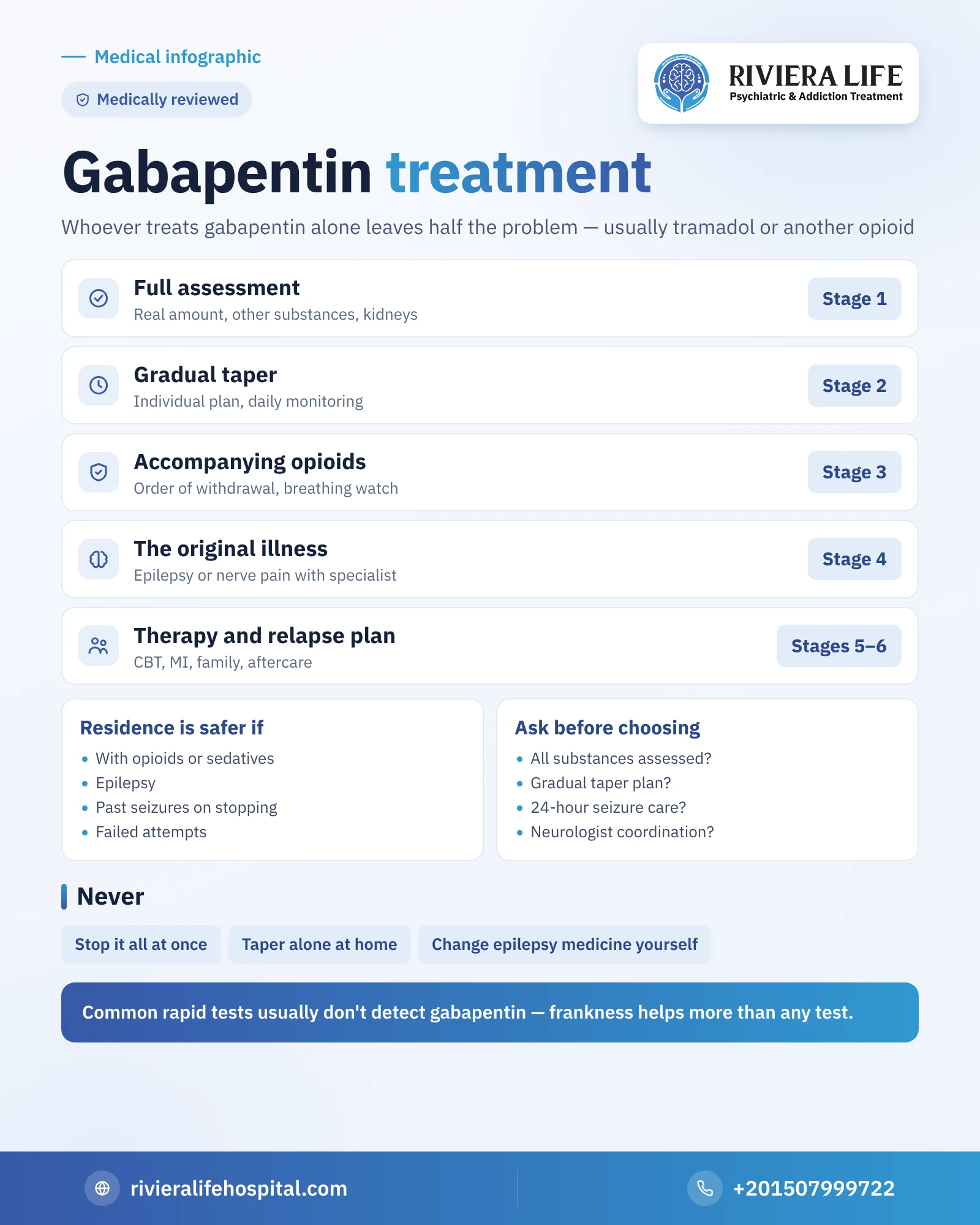
- Comprehensive assessment: the medicine, accompanying substances, the neurological and psychological state, and the kidneys.
- Gradual tapering: an individual plan set by the doctor with daily follow-up.
- Treating accompanying substances: the most common being opioids and tramadol.
- Treating the original illness: epilepsy or nerve pain, in coordination with the specialist doctor.
- Psychotherapy: understanding the motives and building alternative skills.
- Relapse prevention and aftercare: a written plan and follow-up that includes the family.
Assessment: looking for what lies behind gabapentin
In the first session the doctor needs a complete and honest picture: the amount the patient actually takes, not the prescribed amount, since when, and where they get it. Then they ask about every other substance, even if it is “a tramadol pill when tired”, a sedative before sleep or alcohol on occasions, because combining gabapentin with opioids or sedatives raises the risk of breathing depression, and because the order of withdrawal depends on these answers. They also ask about any previous seizure, and about the doctor who first prescribed the medicine and why.
They may ask for blood tests and kidney function, as the kidneys are the only way for the medicine to leave, and a substance test that detects opioids and others. It is useful for the family to know that the common rapid tests don’t usually detect gabapentin, so frankness here is more useful than any test. In the same session the psychiatrist assesses anxiety, depression, insomnia and thoughts of self-harm if present.
Gradual tapering under supervision
Gabapentin is reduced in stages according to a plan the doctor sets depending on the amount, the duration, the presence of epilepsy, the other substances and kidney function. During this period the team follows sleep, pulse, blood pressure and mental state, treats insomnia, anxiety and nausea with means that don’t create a new dependence, and intervenes immediately at any confusion or early signs of a seizure. We don’t publish schedules or amounts here, as the schedule that suits a young man who takes it with tramadol doesn’t suit an epilepsy patient who has taken it for years. The expected symptoms and their timing are explained in the article on gabapentin withdrawal symptoms.
Treating accompanying opioids
When gabapentin comes together with tramadol, heroin or any opioid, the doctor determines which of the two substances is treated first and how fast, because withdrawing them together without order raises the risk of seizures and doubles the suffering that pushes towards relapse. Opioid dependence may need approved medicines to treat it, such as buprenorphine or others, and the doctor decides this taking into account that combining these medicines with gabapentin needs breathing monitoring. You will find the full picture of this part in the article on opioid addiction treatment.
And it is important for the family to know that the risk rises after the period of abstinence; someone who goes back to the opioid and gabapentin together after days of stopping has lost part of their tolerance, so the same old amount becomes enough to stop breathing.
Treating epilepsy or the original pain with the specialist
Someone who takes gabapentin for epileptic seizures must not leave treatment without protection. That is why the addiction team contacts the neurologist who follows the patient, to decide whether the medicine is replaced by another less prone to misuse, or continued at a therapeutic amount with strict follow-up and controlled dispensing. The same goes for nerve pain, coordinating with the pain doctor to set an alternative that may include other medicines, physiotherapy or psychological methods of dealing with chronic pain. And the fixed rule is that any adjustment to epilepsy or pain medicine is made by the specialist doctor’s decision, not at home and not through personal experimentation.
Is there a medicine dedicated to treating gabapentin addiction?
There is still no approved medicine dedicated to treating gabapentin addiction itself. The doctor relies on gradual tapering, and on treating the insomnia, anxiety and mood swings that appear during and after it, while avoiding medicines that may create a new dependence. And if there is clear depression or an anxiety disorder, treating it with the suitable medicine is an integral part of addiction treatment, because leaving it keeps the reason that pushed towards the medicine in place.
Psychotherapy and skills after the medicine
The medicine stays present in the patient’s mind as long as the need it used to meet remains. That is why psychotherapy covers:
- Cognitive behavioral therapy to spot the moments that precede taking the extra amount or going back to tramadol, and to change the way of thinking about them.
- Motivational interviewing to strengthen the decision in someone who sees gabapentin as “a nerve medicine, not addiction”.
- Practical training in dealing with chronic pain, insomnia and tension without relying on a capsule.
- Group sessions with people recovered from addiction to medicines and opioids that break the feeling of isolation.
Residence in the hospital or outpatient follow-up?
Residence is the safest option for someone who combines gabapentin with opioids, sedatives or alcohol, suffers from epilepsy, has previously had a seizure or confusion while stopping, whose previous attempts failed, or who lives in an environment where substances are easy to get. Outpatient follow-up suits someone who started with a prescription then increased the amount gradually, doesn’t use other substances, and has a family able to support. Often the plan starts with a short residence then moves to regular follow-up.
Relapse prevention and the family’s role
The first months after withdrawal are the most delicate. The patient leaves with a written plan: what to do when the pain intensifies, whom to call when craving comes, and how to refuse an offer from a friend carrying a strip of tramadol. The family needs a defined role, not suffocating control: to know the prescribed medicines in the house and keep them away, to attend the sessions of the family program, and to deal with relapse if it happens as a signal to adjust the plan, not the end of the road. And if the medicine is prescribed for the patient themselves, having one doctor who dispenses and follows up reduces the chances of getting it from more than one source. To understand the medicine and the reasons for its spread see the gabapentin guide.
The right hospital for gabapentin addiction treatment: how to choose
The right hospital for gabapentin addiction treatment is the one that provides what a patient on this medicine specifically needs: an assessment that uncovers accompanying opioids and treats them, a gradual taper that is safe from seizures, and coordination with the neurologist or pain doctor so that the original illness doesn’t return. Before you decide, ask:
- Does the assessment include all accompanying substances, especially tramadol and opioids?
- Is the medicine reduced gradually with an individual plan instead of being stopped all at once?
- Is there round-the-clock medical supervision able to deal with a seizure or breathing depression?
- Does the team contact the neurologist or pain doctor to set a safe alternative for the original illness?
- Does the team include consultants in psychiatry and addiction treatment?
- Does the program include the family and aftercare after discharge?
And beware of any place that promises you a guaranteed cure or ending the addiction in a few days.
How Riviera Life meets these standards in gabapentin addiction treatment
Riviera Life applies these criteria as follows:
- Official license: a hospital licensed by the Ministry of Health for psychiatry and addiction treatment.
- An assessment covering all substances: the consultants in psychiatry and addiction treatment uncover accompanying opioids and sedatives and arrange their treatment.
- A safe gradual taper: an individual plan that takes into account epilepsy, kidney function and other substances.
- Round-the-clock supervision: 24-hour medical care to detect confusion, seizures or slowed breathing early.
- Fourteen years of experience: and thousands of cases recovered from addiction to medicines and opioids.
- Complete confidentiality: the data of the patient and their family are kept at every stage.
- A family program and aftercare: follow-up after discharge that protects against relapse.
The first consultation is free, and you can contact us around the clock via +201507999722; we are based in Sheikh Zayed, Giza.
More from the gabapentin guide
- Gabapentin: the complete guide
- Gabapentin withdrawal symptoms and the risk of seizures
- Opioid addiction treatment
- Pregabalin addiction treatment
Questions many people ask
Yes, many patients recover when treatment combines a safe gradual taper, treatment of accompanying substances and psychotherapy, with a suitable alternative for the pain or epilepsy with which use started.
Because gabapentin misuse is often linked to tramadol and opioid use, and combining them increases the risk of breathing depression, and it changes the order of withdrawal and the whole treatment plan.
The neurologist decides this in coordination with the addiction team; it may be replaced by another medicine or continued at a therapeutic amount with strict follow-up, and it is never stopped without protection from seizures.
The gradual taper usually takes from days to several weeks depending on the amount and accompanying substances, then psychotherapy and follow-up continue for months to reduce the risk of relapse.
Look for an assessment of all accompanying substances, an individual gradual taper with round-the-clock supervision, coordination with the neurologist and a family program. Riviera Life in Sheikh Zayed, Giza, meets these criteria.