
The 7-day detox program is the first medical stage in addiction treatment: a week’s stay under medical supervision in which the patient stops the substance, gets through the hardest days of withdrawal safely, and their body stabilizes enough to begin real treatment. Frankness is a duty here from the start: seven days are enough in many cases to get through acute withdrawal, but they aren’t enough to treat the addiction itself. This page explains what happens day by day inside the program at Riviera Life, who it suits, when the patient needs longer, and where they move on to after the seventh day.
What is meant by the 7-day detox program?
The word “detox” suggests the task is cleaning the blood, but the truth is different. The body gets rid of most substances on its own within days; what needs a doctor is the nervous system’s reaction when the substance it is used to disappears: insomnia, pain and anxiety, and with some substances raised blood pressure or seizures.
That is why medical references divide detox into three tasks: a careful assessment of the case, then medical stabilization that eases symptoms and prevents their complications, then preparing the patient to move on to treatment. A program that neglects the third task discharges a patient who is physically comfortable but not ready for what comes next.
Are seven days really enough?
They are usually enough for the specific goal: getting past the acute peak of withdrawal with many short-acting substances. But the number is an organizing framework, not a promise, and the actual duration changes according to:
- The type of substance and the length of its effect, as long-acting substances’ symptoms come later and last longer.
- The amount and duration of use, and whether the patient mixes more than one substance.
- Age, general health, and the presence of liver or heart disease.
- Co-occurring psychological disorders such as depression or severe anxiety.
At the end of the week the doctor decides whether stabilization is complete or the patient needs extra days before moving on.
What happens before admission?
The program starts before day one with an assessment that answers one question: what is the expected risk in withdrawal for this specific patient? It usually includes an interview about the substances, their amounts and the last dose, measuring vital signs, blood tests and a drug test to know everything in the body, and a psychological assessment looking for any thoughts of self-harm or psychotic symptoms. Frankness in this interview, even about “a little” sedative or alcohol, changes the whole plan.
The seven days step by step
The rhythm differs from substance to substance, but the week usually runs like this:
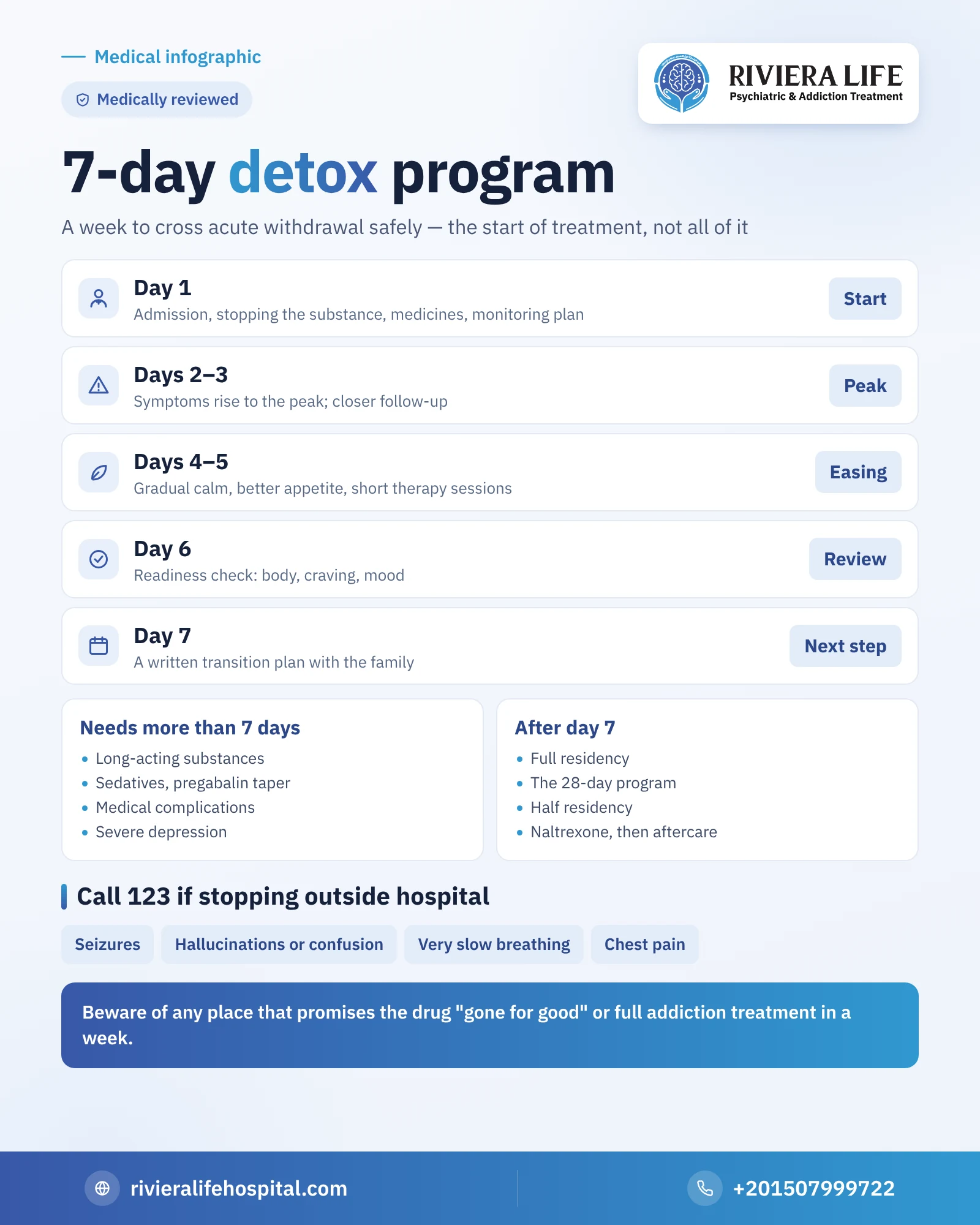
| Day | What the team focuses on |
|---|---|
| One | Admission, stopping the substance, starting suitable medicines, and setting a plan for monitoring vital signs. |
| Two and three | Symptoms rising towards the peak with many substances; closer follow-up, adjusting medicines, and attention to fluids and sleep. |
| Four and five | The start of gradual calm, improved appetite, and starting short psychological sessions. |
| Six | Assessing readiness: has the body stabilized? What is the level of craving and the mood? |
| Seven | A written transition plan that the doctor discusses with the patient and family. |
The details of each substance’s symptoms and their timing are in our article on drug withdrawal symptoms; what matters here is that each day has a goal the team measures, not just waiting for time to pass.
Does withdrawal pass without pain?
No one can promise withdrawal without any discomfort, and anyone who promises that is exaggerating. What is medically possible is easing symptoms to a bearable degree, preventing dangerous complications, and helping the patient sleep. There is no single “prescription” for all patients; the doctor chooses medicines according to the substance, the symptoms and the health condition, and adjusts them daily. That is why one patient’s medicines shouldn’t be passed on to another, nor should something called “withdrawal treatment” be bought from the pharmacy.
Substances where medical supervision is a necessity, not a luxury
Withdrawal from opioids is painful but rarely directly threatens life in a healthy person. But suddenly stopping alcohol after heavy regular drinking, sedatives from the benzodiazepine family, or pregabalin at high doses may cause seizures or delirium. In these cases stopping is managed gradually inside the hospital, and it may take longer than a week.
Call an ambulance on 123 immediately if you see
If someone stops alcohol, sedatives or a mix of substances outside hospital, these signs are an emergency:
- Seizures or an epileptic fit
- Severe confusion, hallucinations or not knowing the place and time
- Very slow breathing or difficulty waking them
- A very high temperature with shaking and heavy sweating
- Chest pain or a fast heartbeat that doesn’t settle
Nutrition and sleep during the week
Many patients come in with an exhausted body: low weight, dehydration, vitamin deficiency and sleep disturbed for months. That is why regular meals and fluids are part of treatment, not a hotel service. Sleep is what patients complain about most in the first nights; the team improves it gradually with a fixed routine and suitable medicines when needed, while explaining that insomnia may continue to a lesser degree after leaving the program.
Is detox at home suitable?
Some mild, stable cases may be managed outside hospital with a strict medical plan, which is what the home addiction treatment program offers after an assessment. The safe limits of home treatment in general and when it becomes dangerous are detailed in our article on addiction treatment at home: the medical truth.
When does the patient need more than seven days?
- If the substance is long-acting, so the peak is delayed until after mid-week.
- If stopping needs gradual reduction, as with sedatives and pregabalin.
- If medical complications appear, or the patient has a chronic illness that needs controlling.
- If severe psychological symptoms appear, such as acute depression or suicidal thoughts.
Extending the days here isn’t a failure or “exploitation”, but a medical decision that prevents discharging an unstable patient.
Rapid detox: does it replace medical detox?
Some advertisements promote rapid detox as a shortcut: the patient is put to sleep or anesthetized while given medicines that hasten opioid withdrawal, and wakes up with it over in hours. The idea is attractive, but the medical evidence doesn’t support it.
- Comparative studies haven’t shown it to outperform conventional detox in sustained abstinence after weeks and months.
- Serious complications linked to anesthesia and withdrawal-hastening medicines, affecting the heart and breathing, have been recorded with it, and deaths have been reported.
- Withdrawal doesn’t disappear; the feeling of it is just absent during sleep, and craving, habits and triggers remain as they are.
- Tolerance falls after stopping, so the risk of overdose increases if the patient returns to their old amount.
It is offered for opioids only, and doesn’t apply to alcohol and sedatives, which need gradual reduction under monitoring. What is closer to right is an organized program that eases symptoms with medicines chosen by the doctor, and links the first week to a complete treatment plan. Learn what happens in the body in opioid withdrawal symptoms, and about the stages of treatment in opioid addiction treatment. The details of the procedure itself, research results on it and its complications are in our article on rapid detox under anesthesia.
Why isn’t detox alone enough?
After a week withdrawal disappears, but the brain hasn’t yet learned anything new. The craving, the friends, the places and the pressures that led to use are all still waiting. Most dangerous, tolerance falls during the days of stopping, so if the patient returns to their old amount, especially with opioids, the risk of overdose rises. That is why international guidelines consider detox the beginning of treatment, not the whole of it.
What after the seventh day?
The transition plan is built on the patient’s condition and circumstances, and the most common paths after detox are:
- Completing treatment in the full residency program for those who need a longer protected environment.
- Entering a structured, fixed-length program such as the 28-day program when it suits the case.
- Moving to the half residency program for those who have stabilized and have a safe home.
- Starting a medicine that protects against relapse when appropriate, such as the naltrexone program after completely stopping opioids or alcohol.
In all cases the journey ends in extended follow-up within the aftercare program.
For the real role of IV drips during withdrawal, and what they can’t do, read addiction treatment with IV drips.
The right hospital for a 7-day detox: how to choose
The right hospital for detox is one that has what a patient needs in the most dangerous days of stopping: a doctor close by day and night, medicines chosen according to the substance, and a clear plan for after the week. Ask before you choose:
- Does the place carry out a medical and psychological assessment and tests before withdrawal starts?
- Is there a doctor and nursing around the clock throughout the seven days?
- Can the team handle withdrawal from alcohol, sedatives and mixed substances safely?
- Is the stay extended medically if the patient hasn’t stabilized on time?
- Does the place hand you a written transition plan instead of just discharging?
- Does it respect the confidentiality of the patient and their family?
And beware of any place that promises the drug will leave “for good” or complete addiction treatment in a week.
How Riviera Life meets these standards for a 7-day detox
This is what the patient and their family find at Riviera Life in practice:
- Official license: a hospital licensed by the Ministry of Health.
- Continuous supervision: round-the-clock medical care on every day of withdrawal.
- Consultant doctors: consultants in psychiatry and addiction treatment determine the suitable withdrawal medicines for each patient individually.
- Long experience: fourteen years and thousands of recovered cases.
- Uninterrupted transition: full residency, half residency and aftercare within the same place.
- Family support: a family program that starts from the detox week.
- Complete confidentiality: for the data of the patient and their family.
If you are considering a detox program, start with a free first consultation; our number +201507999722 works day and night, and the hospital is based in Sheikh Zayed, Giza.
Detox is only a first step; that is why it is preferable to do it at an accredited addiction treatment center that can continue rehabilitation and follow-up with you.
Read also
- The 28-day addiction treatment program: is it enough for recovery?
- The residential addiction treatment program
- The dual diagnosis program for addiction and mental illness
- Drug withdrawal symptoms and how to deal with them