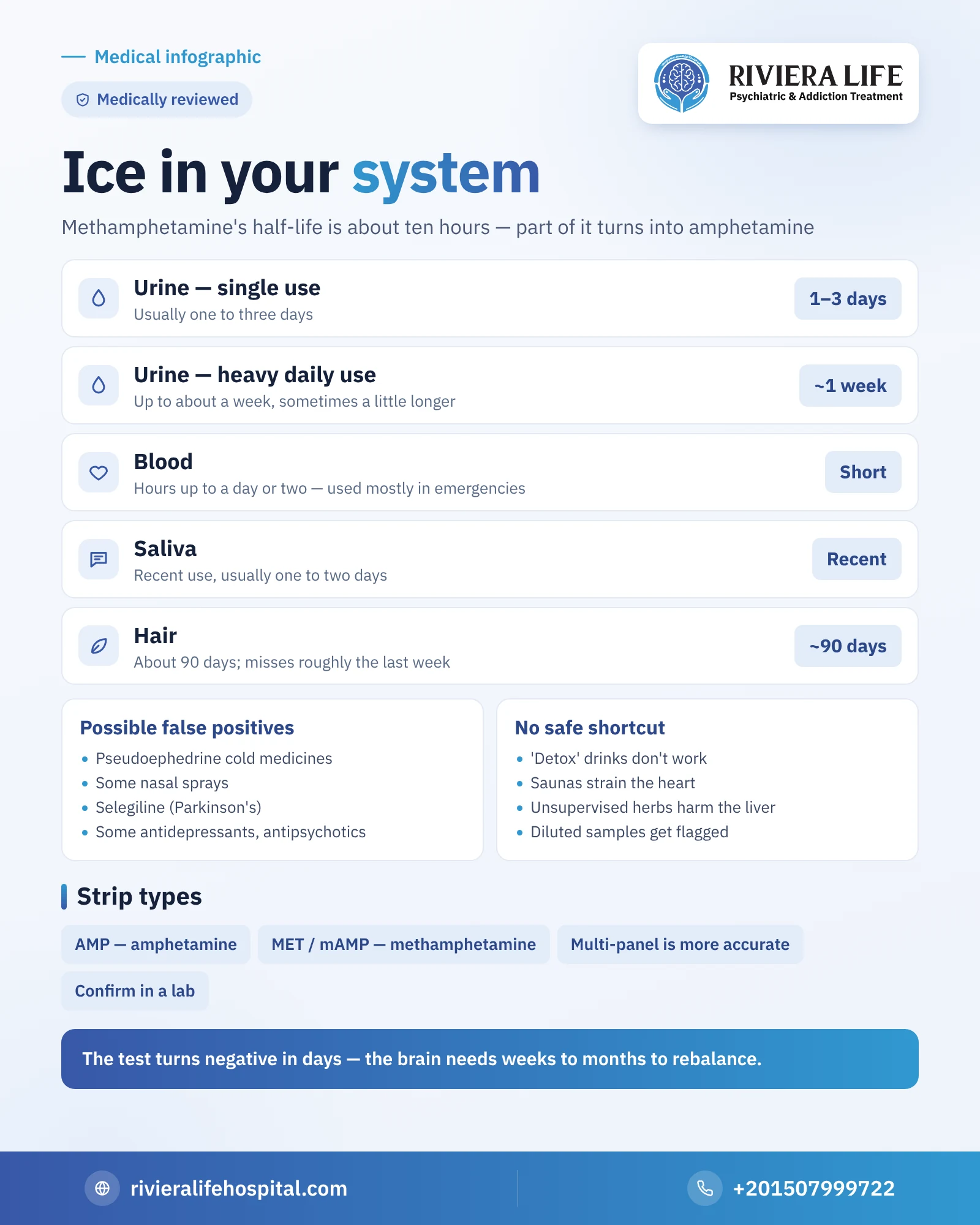
How long ice stays in the body differs by type of test: it usually shows in a urine test for about one to four days after the last use, and the time may extend to about a week in someone who uses shabu or crystal daily in large amounts. In blood it stays for hours up to a day or two, and in hair it may be detected for up to about ninety days.
This is the short answer to how long ice stays in the body, but the figures alone aren’t enough to read a result: methamphetamine is partly converted into amphetamine, and some cold medicines can give a positive screening result. This article explains the detection windows for each sample, what lengthens them, the difference between a strip and a confirmatory test, and what a test can’t tell you.
What happens to methamphetamine inside the body?
Methamphetamine stays in the blood longer than many stimulants. Its half-life — the time in which the body clears half the amount — is estimated at about ten hours on average, ranging roughly from six to fifteen hours depending on the person. The liver processes part of it and converts it into amphetamine, and a large part of the substance leaves unchanged in the urine. That is why the test usually detects methamphetamine and amphetamine together. The presence of amphetamine alone without methamphetamine points thinking towards another source, such as Captagon tablets or prescribed amphetamine medicines — differences explained in our article on the difference between methamphetamine and amphetamine.
How long shabu stays in urine
The urine test is the most widely used in hospitals, workplaces and pre-marriage testing. The commonly accepted approximate times are:
- A single or occasional use: shabu usually shows for one to three days.
- Repeated use: the time may extend to four or five days.
- Heavy daily use over a long period: methamphetamine may be detected in urine for up to about a week, and sometimes a little longer.
These are approximate figures, not fixed dates, and they are governed by the detection threshold of the device used and the concentration of the sample at the moment it is taken.
Crystal in blood and saliva tests
The blood test
Crystal appears in the blood minutes after smoking or injecting, and remains detectable for hours that may reach about a day or two. A blood test is mostly used in emergencies to assess someone who is agitated or poisoned, or in criminal cases, more than to detect old use.
The saliva test
Detects recent use, usually within one to two days, and may extend a little with heavy use. Its advantage is that the sample is easily taken in front of the person responsible for the test, but it is less common in Egypt than the urine test.
The hair test: the longest detection window
The substance is deposited in hair as it grows, so the part close to the scalp, about four centimeters long, reflects roughly three months of earlier history. But it doesn’t detect use that happened during roughly the last week, because hair needs time to emerge above the surface of the skin. The hair test is affected by factors such as hair color and treatment with dyes or chemicals, and body hair may be used if scalp hair isn’t available. It is sometimes used in long-term assessments or when the aim is to know the pattern of use over months, not a particular moment.
How long crystal takes to leave the body: why does it differ from person to person?
- Pattern of use: long binges lasting days leave a larger amount that takes longer to leave.
- Amount and purity: the purity of crystal in circulation is unknown, so the dose may be larger than the person thinks.
- Liver and kidney efficiency: if either is weak, ice takes longer to leave the body.
- Age, body mass and general health: these affect the speed of metabolism.
- Route of use: affects how quickly it reaches the blood more than how long it stays.
- Test sensitivity: a laboratory using a low detection threshold may detect the substance for longer than a home strip.
It is important to point out that drinking large amounts of water or taking the “cleansing” recipes spread online doesn’t change the fact of use, and may make the sample diluted in a way the laboratory notices, asking for it to be repeated.
AMP strip or MET strip?
Many families buy a strip from the pharmacy without knowing there are two types. The AMP strip is designed mainly to detect amphetamine, and may pick up methamphetamine at certain concentrations. The MET or mAMP strip is designed specifically for methamphetamine. So an amphetamine strip may come out negative despite ice use if the concentration is low, and the reverse is also possible. Multi-panel strips combining both types are more accurate in this case.
The screening test and the confirmatory test
The home strip and the first laboratory screen rely on an immune reaction that looks for a group of substances with similar structures, which is why their result is considered preliminary. The right step after any positive result is a confirmatory test using chromatography coupled with mass spectrometry, which identifies the substance by name and measures its concentration. Some laboratories can also distinguish between the two chemical forms of methamphetamine, telling the form found in ice apart from the form found in some nasal sprays.
When is a positive result inaccurate?
A screening strip can give a positive result for amphetamines without ice use in known situations, including:
- Cold and flu medicines containing pseudoephedrine or ephedrine.
- Some nasal sprays containing a non-stimulant form of methamphetamine.
- Selegiline, used to treat Parkinson’s disease.
- Some antidepressants, antipsychotics and other medicines that interfere with the strip.
- Prescribed ADHD medicines containing amphetamine, which do genuinely show up but aren’t ice.
That is why you should tell the laboratory about all the medicines the person takes before the test, and not judge a strip result before confirmation.
What can’t the test tell you?
All the test says is that the substance is present in the sample at a concentration above a certain threshold, or isn’t. It doesn’t precisely determine the timing or amount of use, doesn’t distinguish between someone addicted and someone who tried ice once, and doesn’t reveal whether the person was under its influence when the sample was taken. Diagnosis relies on an interview and an assessment of behavior, mood and personal history, and the test remains just one piece of the picture. The picture is completed by the signs explained in our article on the signs and symptoms of ice addiction.
Advice for the family before home testing
Before you buy the strip, ask yourself: what will I do with the result? A positive result deserves confirmation in a laboratory, then a calm conversation and a specialist consultation, and a negative result doesn’t cancel other worrying signs if they are present. Avoid using the test as a trap in front of others: your goal is to use it to reach treatment, not to prove an accusation. You will find practical ways to manage this conversation in our guide to how to deal with someone addicted to ice.
Can the body be cleansed of crystal meth quickly?
The frank answer: there is no safe shortcut. The body clears methamphetamine through the liver and kidneys at the speed its own function sets, not with a drink, a supplement or a sweating session. Every promise to the contrary exploits a family’s anxiety before a test or a job appointment.
These are the best-known illusions:
- “Cleansing” drinks and lots of fluids: they don’t reliably speed elimination, and can strain the body if overdone.
- Saunas and intense exercise: they raise body temperature and strain the heart, a real danger to a heart already exhausted by stimulants.
- Herbs and medicines without supervision: they may interact with other medicines and add a burden on the liver.
What the person needs after stopping isn’t “cleansing” but medical supervision of the crash period: disturbed sleep, depression that may come with dark thoughts, and sometimes psychosis. This is what detox under medical supervision provides, within an ice and shabu addiction treatment plan, and you will find what someone stopping goes through in our article on ice withdrawal symptoms. Most importantly, the body may clear the substance within days, but the brain needs weeks to months to regain its balance.
Ice leaving the body doesn’t mean the end of addiction
After a few days the test becomes negative, while the changes methamphetamine made to the reward and craving system remain for weeks and months. In the same period that the substance disappears from urine, the person goes through the crash, depression and pressing craving, as our article on ice withdrawal symptoms explains. In treatment programs, regular tests are used as a tool to follow stability and build trust; some behavioral programs even reward the patient for successive negative results, one of the most successful approaches with stimulants, as our article on ice addiction treatment explains.
More from our ice and shabu guide
- Ice, shabu and crystal meth: the complete guide
- Ice withdrawal symptoms and how long they last
- The harmful effects of ice
- The difference between methamphetamine and amphetamine
Questions many people ask
Shabu usually shows in urine for about one to four days after the last use, and the time may reach about a week with heavy daily use.
After a single use, methamphetamine is usually detected in urine for one to three days, depending on the amount, the sensitivity of the test, and liver and kidney function.
Yes, but for a relatively short time, from hours up to about a day or two, which is why a blood test is mostly used in emergencies, not to detect old use.
Crystal can be detected in hair for up to about ninety days, but hair doesn't reveal very recent use during roughly the last week.
Yes. Cold medicines containing pseudoephedrine, some nasal sprays and other medicines can give a positive screening result for amphetamines, so any result must be confirmed with a laboratory test.