EMDR therapy, meaning eye movement desensitization and reprocessing, is a psychotherapy used mainly with painful memories that have stayed alive in the body as if they are happening now. The therapist asks the patient to recall the memory to a tolerable degree, while directing his attention to an alternating side-to-side movement, such as eye movement or light taps. The therapist doesn’t hypnotize anyone, and doesn’t erase the memory; the aim is for the memory to lose its painful charge and become an event from the past. This article explains how sessions run, the eight phases of treatment, what the scientific evidence says, and when treatment is suitable or postponed.
What is EMDR therapy?
It was devised by the American researcher Francine Shapiro in the late 1980s, after she noticed while reflecting on disturbing memories that the rapid movement of her eyes eased the intensity of the thoughts. She turned the observation into an organized protocol that was tested in many trials. Today it is one of the treatments recommended by bodies such as the World Health Organization and the UK’s National Institute for Health and Care Excellence for post-traumatic stress disorder, alongside trauma-focused cognitive behavioral therapy.
Its idea is that a traumatic memory isn’t stored as a complete story with a beginning and an end, but as fragments of images, sounds and bodily sensations that explode at any trigger. The treatment helps the brain rearrange these fragments and integrate them into ordinary memory.
How is it supposed to work?
Scientific honesty requires saying that the precise mechanism hasn’t been settled. The best-known explanation is that dual attention, recalling the event while following an external movement, uses up part of working memory, so the painful image becomes less vivid and emotionally weaker each time. Other explanations suggest a calming effect on the nervous system during recall. Reviews indicate that part of the benefit may come from elements it shares with other trauma treatments, such as graded exposure to the memory in a safe environment. So the patient can genuinely benefit without our knowing exactly why.
The eight phases of treatment
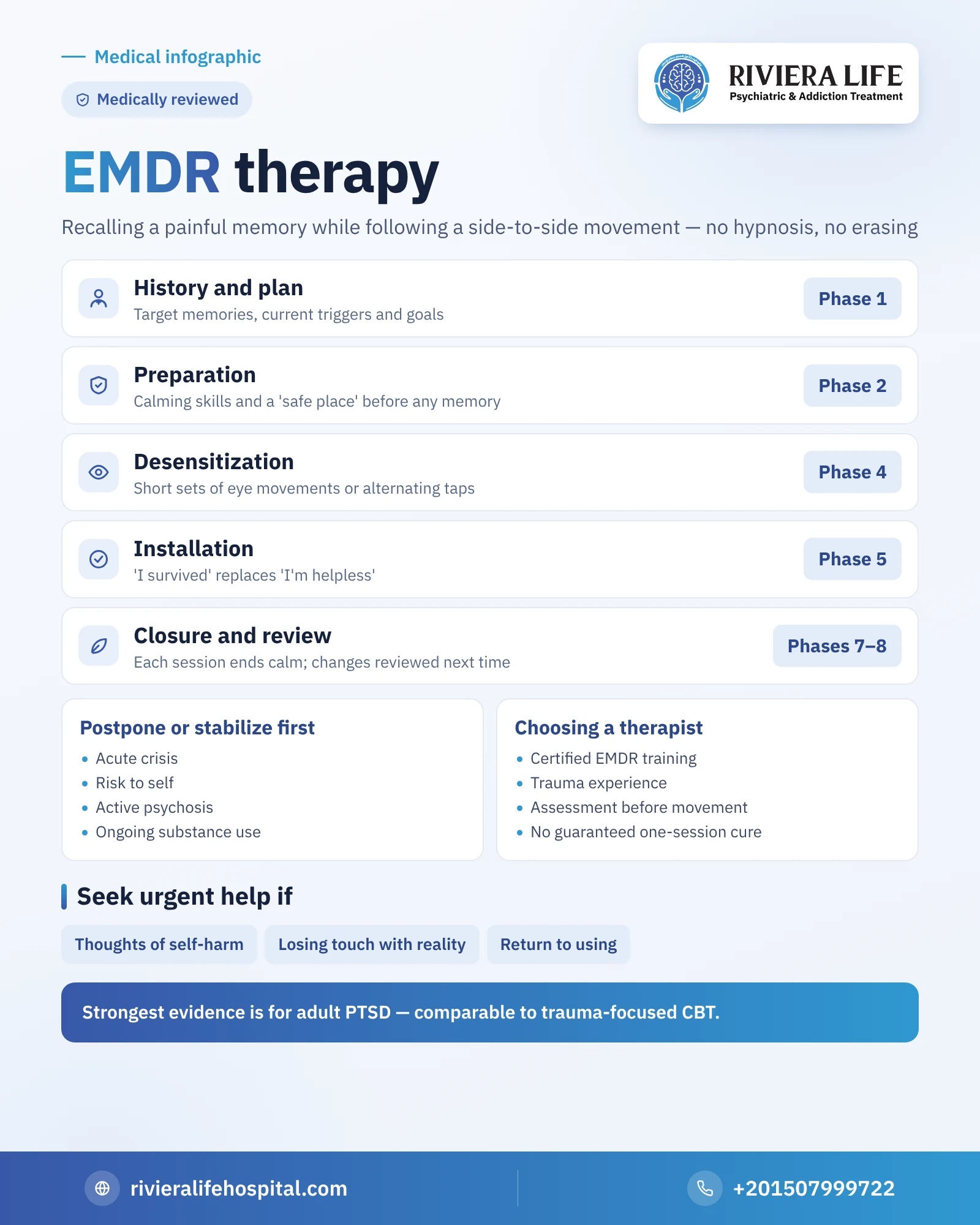
The treatment isn’t just eye movement; the movement comes only in the fourth phase. The phases are:
- First — history and treatment plan: the therapist identifies the target memories, current triggers and the patient’s goals.
- Second — preparation: he explains the method and teaches the patient calming skills, including imagining a “safe place”, before touching any painful memory.
- Third — assessment: the patient chooses a scene from the memory, the worst part of it, and the negative belief about himself linked to it, and rates the level of distress.
- Fourth — desensitization: short sets of side-to-side movement are carried out, between which the patient stops to describe what he noticed without analyzing.
- Fifth — installation: a truer belief is strengthened in place of the old one, such as “I survived” instead of “I am helpless”.
- Sixth — body scan: the patient checks for any remaining bodily tension, which is then treated.
- Seventh — closure: each session ends with calming, even if the memory hasn’t been completed.
- Eighth — reevaluation: at the start of the next session, what has changed is reviewed.
What does a session look like from inside?
A session usually lasts between sixty and ninety minutes. The patient sits fully awake and in control of himself, and can ask to stop at any moment. He may follow the therapist’s finger with his eyes, hold two small devices that vibrate alternately in his hands, or hear tones moving between the ears.
What passes through the mind meanwhile varies: images, unexpected old memories, or an emotion that rises then falls. Many describe the feeling as watching the film from a safe distance instead of being inside it. The number of sessions varies with the case; one specific memory may need a few sessions, while a long history of accumulated traumas needs more time and a longer preparation phase.
What does the scientific evidence say?
The strongest evidence concerns post-traumatic stress disorder in adults, the field for which it gained official recommendations. Many trials have compared it with waiting lists and other treatments, and found that it eases symptoms of intrusive memories, nightmares and avoidance to a degree close to trauma-focused cognitive therapy. In other conditions, such as anxiety, phobias, complicated grief and phantom limb pain, the evidence is less, more recent and needs larger studies. And no psychotherapy works for everyone; some patients prefer more talking and some prefer homework, and a good therapist presents the options and doesn’t impose one.
Who does it suit, and when do we postpone it?
- Usually suits: those with clear trauma symptoms after an accident, assault, sudden loss, disaster or harsh medical experience, and also those whose suffering is linked to specific memories that can be named.
- Postponed or preceded by stabilization: when there is an acute crisis, danger to oneself, active psychosis, ongoing substance use that prevents stability, or a life still threatened by danger.
- Needs an experienced therapist: with repeated dissociation from reality or a long history of repeated trauma since childhood, where long preparation is needed.
Many think the treatment means opening the wound immediately, while in reality a serious therapist spends significant time building safety before starting.
EMDR and addiction
A considerable proportion of those who enter addiction treatment have a history of trauma, and use often began as an attempt to silence images and sensations that won’t calm down. When trauma remains untreated, it may remain a strong trigger for craving after stopping the substance. That is why EMDR is being studied as a complementary treatment for those with trauma and addiction together. But the order matters: first safe withdrawal and stabilization of the physical and psychological condition, then work on the trauma alongside a relapse prevention plan. Our article on PTSD treatment explains the wider picture of the options for this disorder.
Side effects and risks
The treatment is generally safe when led by a trained therapist, but it isn’t without effect. The patient may feel exhaustion or a headache after the session, vivid dreams or additional memories may appear in the following days, and distress may rise temporarily before it falls. That is why each session ends with calming, and the patient is told what may happen. If insomnia, impulsivity or dark thoughts increase instead of easing, this is a reason to contact the therapist immediately, not to be patient.
The difference between EMDR and cognitive behavioral therapy
| Comparison | EMDR | Trauma-focused cognitive behavioral therapy |
|---|---|---|
| Main approach | Recalling the memory with bilateral attention | Graded exposure and reappraising thoughts |
| Detailed talking | Less; telling the whole event isn’t required | More, with a detailed description of the event |
| Homework | Usually little | Essential |
| Official standing | Recommended for adults with trauma | Also recommended |
Neither decisively outperforms the other, and the choice depends on the patient’s preference and the availability of a trained therapist. Learn the basics in our article on cognitive behavioral therapy.
How do you choose a therapist?
- Ask about his certified EMDR training and his experience with trauma, not only with general anxiety.
- Make sure he starts with assessment and preparation and doesn’t jump straight to the movement.
- Beware of anyone who promises a guaranteed result in one session or uses it as a treatment for everything.
- Ask for treatment to be coordinated with the psychiatrist if you are taking medication or have an addiction.
The family’s role
Parents don’t need to know the details of the memory, as some patients prefer to keep them private. What helps is a calm home environment in the days following the session, and meeting tiredness or crying with understanding, not with persistent questions about what happened. Tears don’t mean the treatment is failing. Reading psychological trauma: natural reactions and what helps helps you understand what your relative is going through.
Seek urgent help immediately if you see
Call an ambulance on 123, the mental health hotline on 16328, or go to the nearest emergency department.
- Thoughts of ending one’s life or self-harm
- Losing touch with reality, hearing voices or seeing what others don’t
- Severe impulsivity or a return to using after recalling memories
How can Riviera Life help you?
The first step in any trauma treatment is a careful assessment that isn’t based on the name of a particular method. Riviera Life’s psychiatry and addiction consultants examine the symptoms, history and substance use if present, then set a plan suited to the case, with the family program and follow-up after discharge taking part. The first consultation is free and completely confidential on +201507999722.
More from our psychotherapy guide
Questions many people ask
No. The patient stays fully awake and in control of himself, and can ask to stop at any moment. The treatment isn't hypnosis.
It doesn't erase it. The memory stays in the mind, but loses most of its painful charge, so it is recalled as an event from the past.
It varies with the case; a specific memory may need a few sessions, while accumulated traumas need longer and a longer preparation phase.
It is being studied as a complementary treatment for those with trauma and addiction together, after the condition is stabilized and withdrawal is safe, alongside a relapse prevention plan.
The patient may feel tiredness, headache, vivid dreams or a temporary rise in distress after the session, and if symptoms become severe he contacts his therapist.