The short answer
Psychotherapy is treatment through talking and training led by a qualified specialist; it helps you understand the thoughts, feelings and behaviors that keep your suffering going, then trains you in other ways of dealing with them. It has scientifically studied schools, the best known being cognitive behavioral therapy, dialectical behavior therapy and acceptance and commitment therapy. It is used alone in many cases of anxiety and milder depression, combined with medicine in more severe cases, and is a fixed pillar of any serious plan to recover from addiction.
- Usually a weekly sessionAbout an hour in outpatient clinics
- Measurable goalsReviewed every few sessions with the therapist
- A partner to medicineIn severe cases and addiction there is no substitute for it
Psychotherapy is a question many people in Egypt ask in a low voice, as if going to a therapist were an admission of weakness. The truth is that it is closer to physiotherapy after a broken leg: organized exercises supervised by a specialist that give you back an ability you temporarily lost. On this page we explain how it works, when you need it, which method suits which problem, how sessions go, its relationship with medicine, the difference between the doctor and the therapist, and its role in recovering from addiction; then we help you choose the right place, and put before you an organized guide to the section's articles.
What is psychotherapy and how does it bring about change?
The idea psychotherapy rests on is simple: what we learn we can relearn. The employee who panics before every meeting wasn't born with this fear; her brain learned it through repeated situations. In the sessions she discovers the automatic thoughts that come before the panic, such as "They will see that I'm incompetent", then tests them in reality step by step, so the response gradually changes.
That is why psychotherapy differs from venting to a friend. The friend comforts you, while the therapist sets a plan with you that has a goal, gives you exercises between sessions, and monitors progress with clear measures. And the therapeutic relationship itself, meaning trust and safety with the therapist, is one of the strongest predictors of treatment success in research.
When do you need psychotherapy?
You don't need to reach a breakdown to start psychotherapy. Among the reasonable indicators are sadness or anxiety lasting weeks and affecting your sleep, work or relationships, thoughts or rituals you can't stop repeating, a painful memory returning to intrude on your day, or turning to a substance or behavior to calm what is inside you.
Psychotherapy also helps in situations that aren't considered illness, such as grief after a loss, a marital crisis, or accumulated work pressures. And if you are unsure between ordinary symptoms and what calls for a visit to a doctor, the article When to go to a psychiatrist helps you judge, and the section Mental illness symptoms explains the signs in detail.
Types of psychotherapy and what suits each problem
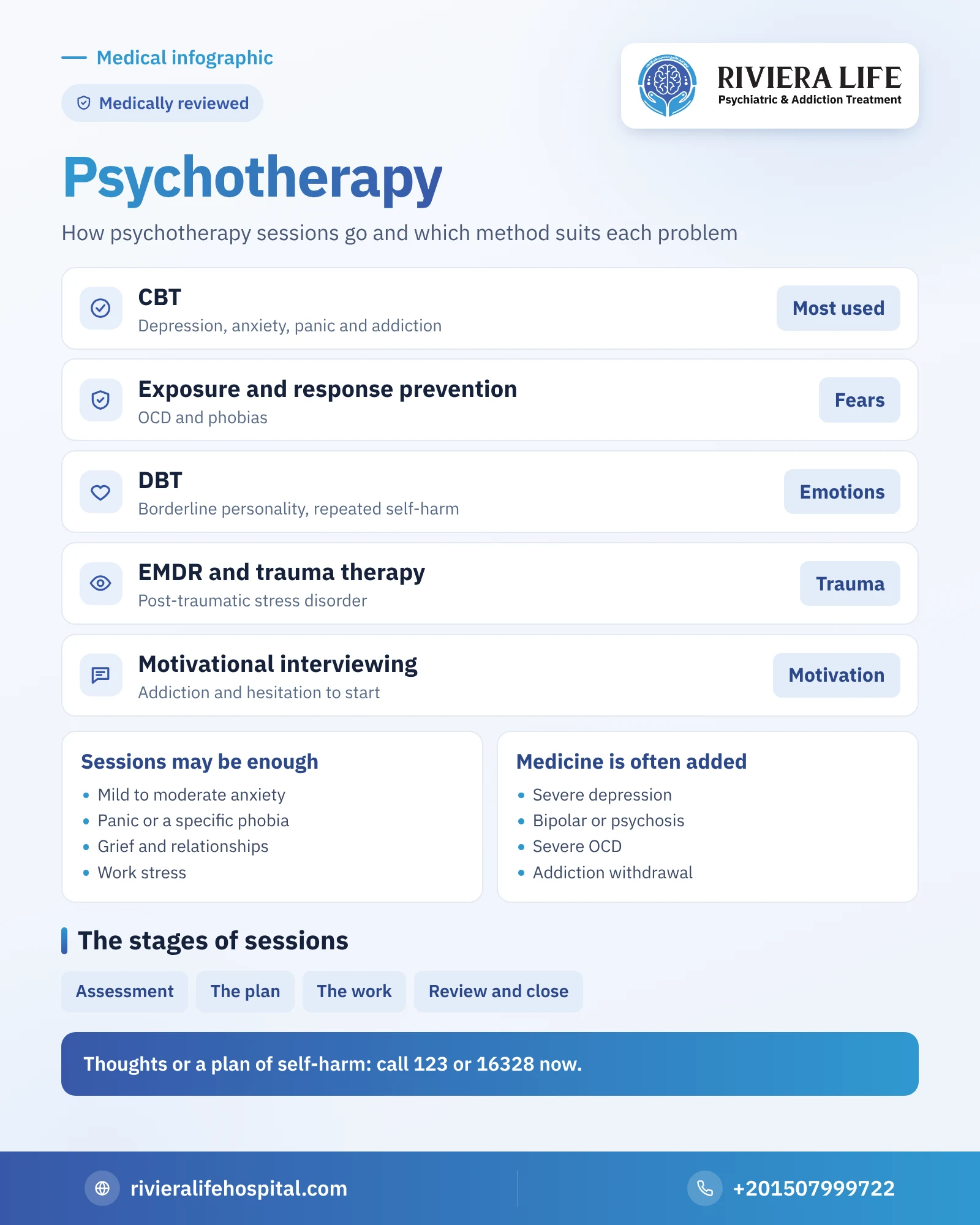
In psychotherapy there is no method that suits everyone. The therapist chooses the approach according to the diagnosis, the available evidence and what suits your personality and circumstances. The following table summarizes the best-known schools and their common uses.
| The method | Its idea | Mostly used in |
|---|---|---|
| Cognitive behavioral CBT | Tracking distorted thoughts, testing them and changing the behavior linked to them | Depression, anxiety, panic attacks and addiction |
| Exposure and response prevention | Facing fears gradually without performing rituals | Obsessive-compulsive disorder and phobias |
| Dialectical behavioral DBT | Skills of emotion regulation, distress tolerance and relationships | Borderline personality and repeated self-harm |
| Acceptance and commitment ACT | Accepting disturbing thoughts and moving toward values | Chronic anxiety and chronic pain |
| EMDR and cognitive therapy for trauma | Processing traumatic memories in an organized way | Post-traumatic stress disorder |
| Interpersonal therapy | Improving relationships, roles and periods of transition | Depression linked to loss or conflicts |
| Motivational interviewing | Strengthening the person's own motivation for change | Addiction and hesitation to start treatment |
You will find a detailed explanation of the most widespread of these schools in the article The techniques and sessions of cognitive behavioral therapy, and for those who suffer sharp emotional swings, the article The four skills of dialectical behavior therapy helps.
How do sessions go? Duration, number and frequency
- 1AssessmentOne or two sessions
The therapist asks you about the symptoms and their history, your life and your family, and may use written scales; then you agree on a preliminary diagnosis and specific goals.
- 2Building the planChoosing the method
They explain the proposed approach and why they chose it, the expected number of sessions, and what is required of you between appointments.
- 3The actual workRegular sessions
You practice new skills and try them in your life, then come back to discuss what worked and what stumbled.
- 4Review and closingGradual tapering
The symptoms are measured again, the sessions are spaced out, and a plan for after the end is set to protect the improvement.
An individual psychotherapy session usually lasts about an hour. The British National Health Service (NHS) states that a cognitive behavioral therapy program usually consists of five to twenty sessions, weekly or every two weeks. Personality disorders and complex trauma, however, often need longer months.
Individual, group or family?
The individual session gives you a completely private space, and suits beginnings and sensitive topics. Group sessions, however, bring together roughly six to ten people going through similar experiences, in which the patient discovers that they are not alone and learns from others' experiences, and they are an essential part of addiction programs. The article Group therapy and its therapeutic factors explains when it suits you.
Family psychotherapy doesn't mean the family is accused, but that it is part of the solution. When the father learns how to talk with his recovering son without interrogation, and the wife learns when to help and when to leave the responsibility to its owner, tension at home drops and with it the likelihood of relapse.
Sessions, medicine or both together?
The British NICE guidelines recommend talking therapy as a first option in many less severe cases of depression, while the doctor combines psychotherapy and medicine in more severe cases. Medicine doesn't replace learning, and learning alone may not be enough when the symptoms are so harsh that they prevent the person from attending sessions at all.
Sessions alone may be enough
- Mild to moderate anxiety or depression
- A specific phobia or panic attacks
- Relationship difficulties or grief after a loss
- Work pressures and exhaustion without severe symptoms
Medicine is usually added
- Severe depression or suicidal thoughts
- Bipolar disorder, psychosis or schizophrenia
- Severe obsessive-compulsive disorder that disrupts life
- Substance withdrawal and disorders accompanying addiction
Any psychiatric medicine is started, adjusted and stopped under a doctor's supervision. The article Do psychiatric medicines cause addiction? answers families' most common fears, and the article The families of psychiatric medicines presents the general picture.
The psychiatrist and the psychotherapist: who does what?
A psychiatrist is a medical school graduate who specialized in psychiatry; they diagnose, order tests, prescribe medicine and follow its effects, and many of them also offer sessions. A therapist or psychologist, however, studied psychology and trained in talking-therapy methods, and carries out psychological tests, but doesn't prescribe medicines.
In simple cases you may start with either of them. In complex cases, however, such as addiction with depression or a personality disorder, it is best to have a team in which both work together and exchange information with your consent.
The role of psychotherapy in recovering from addiction
Detox cleans the body in days, but the brain needs months to learn to live without the substance. This is where psychotherapy comes in: understanding the triggers that ignite the craving, building skills for dealing with pressures without using, and repairing what has been destroyed in relationships. Motivational interviewing in particular helps the hesitant patient find their own reasons for change instead of hearing sermons.
Other important tools include training in dealing with the urgent craving to use, treating the accompanying anxiety or depression within the dual diagnosis program, and continuing after discharge through the aftercare program. The complete stages of treatment belong in the addiction treatment guide, the details of the programs in the treatment programs section, and the helping medicines in the addiction treatment medicines section.
Myths that stop people from seeking help
What people repeat
- Sessions are only for the insane
- The therapist will tell me what I already know
- Whoever goes to therapy will stay in it for life
- Talking changes nothing in a real illness
The reality in the clinic
- Most visitors are ordinary people going through distress
- The therapist trains you in skills, not general advice
- Many programs are time-limited with clear goals
- Research proves its effect in anxiety, depression and addiction
For more correction of common notions, read the article Myths about mental illness.
How do you know the sessions are helping you?
Improvement in psychotherapy is rarely a straight line, and you may feel some distress at the start when you come close to painful topics. But after several sessions you should notice signs such as better sleep, a greater ability to face situations you used to avoid, or a shrinking of the time disturbing thoughts take up. A good therapist measures this with you regularly and adjusts the plan if no progress is made. And if you aren't comfortable after a sincere attempt, you have the right to ask for another therapist.
What determines the cost of sessions?
The cost of psychotherapy varies according to the type of session, individual or group, the therapist's experience, the number of sessions the case needs, and whether the plan includes an inpatient stay or medicines and medical follow-up. Because figures change, we have gathered the factors that affect them and how to compare places in the article The cost of psychiatric hospitals in Egypt.
How do you choose the right therapist and place?
1
Check the license
A place licensed by the Ministry of Health and a therapist with an accredited qualification and training.
2
Ask about the method
A therapist who explains their approach and why they chose it for your case.
3
Ask for clear goals
A written plan and periodic review of progress.
4
Make sure of the team
A psychiatrist available when medicine or a deeper assessment is needed.
5
Protect your privacy
A clear confidentiality policy before the first session.
And remember that good psychotherapy isn't built on promises; beware of anyone who promises you a cure in a fixed number of sessions whatever the case, or who refuses to cooperate with your doctor.
Thoughts of self-harm: when is it an emergency?
Weekly psychotherapy sessions don't suit moments of danger. If serious thoughts of ending life appear, the priority is immediate safety, and the treatment plan resumes after that. The article Suicidal thoughts and how to deal with them explains the danger signs for the family.
Seek help immediately
Don't wait for the next session in these cases:
- Thoughts or a plan to harm oneself or end life: the ambulance 123
- Severe agitation or hallucinations that threaten the safety of the person or those around them
- Poisoning or loss of consciousness after taking medicines or substances
- The hotline of the General Secretariat of Mental Health and Addiction Treatment: 16328
The psychotherapy article guide: methods, treatment plans and medicines
We have chosen from the section's articles those that cover all its themes, starting with session methods, through treatment plans for each disorder, to psychiatric medicines and the family.
Talking and skills therapy methods
7 articlesThe therapeutic schools and how they go
- Cognitive behavioral therapy step by step: its techniques, types and the shape of sessions.
- DBT skills: who it suits and how the program goes.
- Acceptance and commitment: its six processes and who benefits from it.
- Treating trauma with eye movement: its eight phases and what the scientific evidence says.
- Group sessions: their types and when they suit you.
- Art and music as a therapeutic tool: how they work and their limits.
- Mindful meditation and relapse prevention: the MBRP program and when to postpone it.
Anxiety, depression and OCD
6 articlesTreatment plans for the most common disorders
- An anxiety treatment plan: sessions, medicines and steps to get life back.
- Comprehensive depression treatment: when the clinic is enough and when you need the hospital.
- Depression without medicines: when that is enough and what really helps.
- Overcoming social phobia: the steps to improvement and what can be done at home.
- OCD treatment options: exposure and response prevention and medicine.
- Controlling excessive irritability: the hidden causes and practical steps.
Trauma and personality disorders
4 articlesLong treatment that needs patience and realistic goals
- Recovering from post-traumatic stress disorder: the latest effective methods.
- A borderline personality treatment plan: the steps to recovery and the limits of home treatment.
- The therapeutic approach to narcissism: methods and realistic goals.
- Treating masochism: the treatment steps, the role of medicines and the time to improve.
Psychosis, mood and hyperactivity
7 articlesConditions where medicine and rehabilitation come together
- Early intervention in psychosis: medicine, support and preventing relapse.
- A schizophrenia treatment plan: medicine, rehabilitation and family support.
- Bipolar disorder and mood stabilizers: with sessions and a relapse prevention plan.
- Treating hallucinations: assessment, treating the cause and psychological support.
- Treating attention deficit hyperactivity disorder: the treatment plan by age.
- Electroconvulsive therapy (ECT): what it really is today, its indications and effects.
- Transcranial magnetic stimulation (TMS): how it works and who it is used for.
Psychiatric medicines: concepts and comparisons
11 articlesAnswers to families' most common questions about medicine
- A map of psychiatric medicines: the families and what each treats.
- How antidepressants work: their types and when their effect appears.
- Antipsychotics in both generations: side effects and follow-up.
- Psychiatric medicine and dependence: what causes habituation and what doesn't.
- When psychiatric medicine leaves the body: the half-life of each family.
- Symptoms of stopping antidepressants: their causes, duration and safe stopping under a doctor's supervision.
- Choosing a medicine for depression and anxiety: how the doctor weighs the options.
- Antidepressants and married life: the effect of the medicine, the effect of the illness and what can be done.
- Comparing Prozac and Lustral: duration in the body, effects and interactions.
- Supranil or Anafranil?: the differences and which is more suitable.
- Adderall and modafinil for studying: the difference between them and the risks of using them.
Guides to specific medicines
17 articlesEach medicine's uses, effects and warnings
- Sertraline (Lustral): uses, effects and warnings.
- Escitalopram (Cipralex): side effects and the heart warning.
- Fluoxetine (Prozac): uses and interactions.
- Paroxetine (Seroxat): discontinuation symptoms and sexual effects.
- Mirtazapine (Remeron): drowsiness, appetite and warnings.
- Venlafaxine (Efexor): blood pressure and discontinuation symptoms.
- Duloxetine (Cymbalta): depression and nerve pain.
- Bupropion: depression, quitting smoking and the risk of seizures.
- Trazodone (Trittico): sleep, depression and warnings.
- Quetiapine (Seroquel): uses and the risks of using it for sleep.
- Olanzapine (Zyprexa): weight, blood sugar and follow-up.
- Risperidone (Risperdal): uses and follow-up.
- Aripiprazole (Abilify): restlessness and impulses.
- Lamotrigine (Lamictal): bipolar disorder and skin rash.
- Methylphenidate (Ritalin): uses and the risk of misuse.
- Buspirone (Buspar): an anti-anxiety medicine that doesn't cause dependence.
- Propranolol (Inderal): physical anxiety and performance anxiety.
The family, daily life and cost
3 articlesWhat the home needs during treatment
- Supporting the psychiatric patient at home: a practical guide for the family without burning out.
- Fasting and psychological recovery: who needs caution and how to protect their recovery.
- The costs of psychiatric hospitals in Egypt: the influencing factors and how to choose.
When should you seek help?
If your suffering has been taking from your sleep, work or relationships for weeks, or you turn to a substance or behavior to calm it, this is a good time to start psychotherapy with a specialist. At Riviera Life in Sheikh Zayed, licensed by the Egyptian Ministry of Health, consultants in psychiatry and therapists have been working as one team for fourteen years, in complete confidentiality, with a program for the family and follow-up after treatment, and the first consultation is free. Contact us on +201507999722.
Medical sources and referencesThe information in this article is based on reliable scientific sources