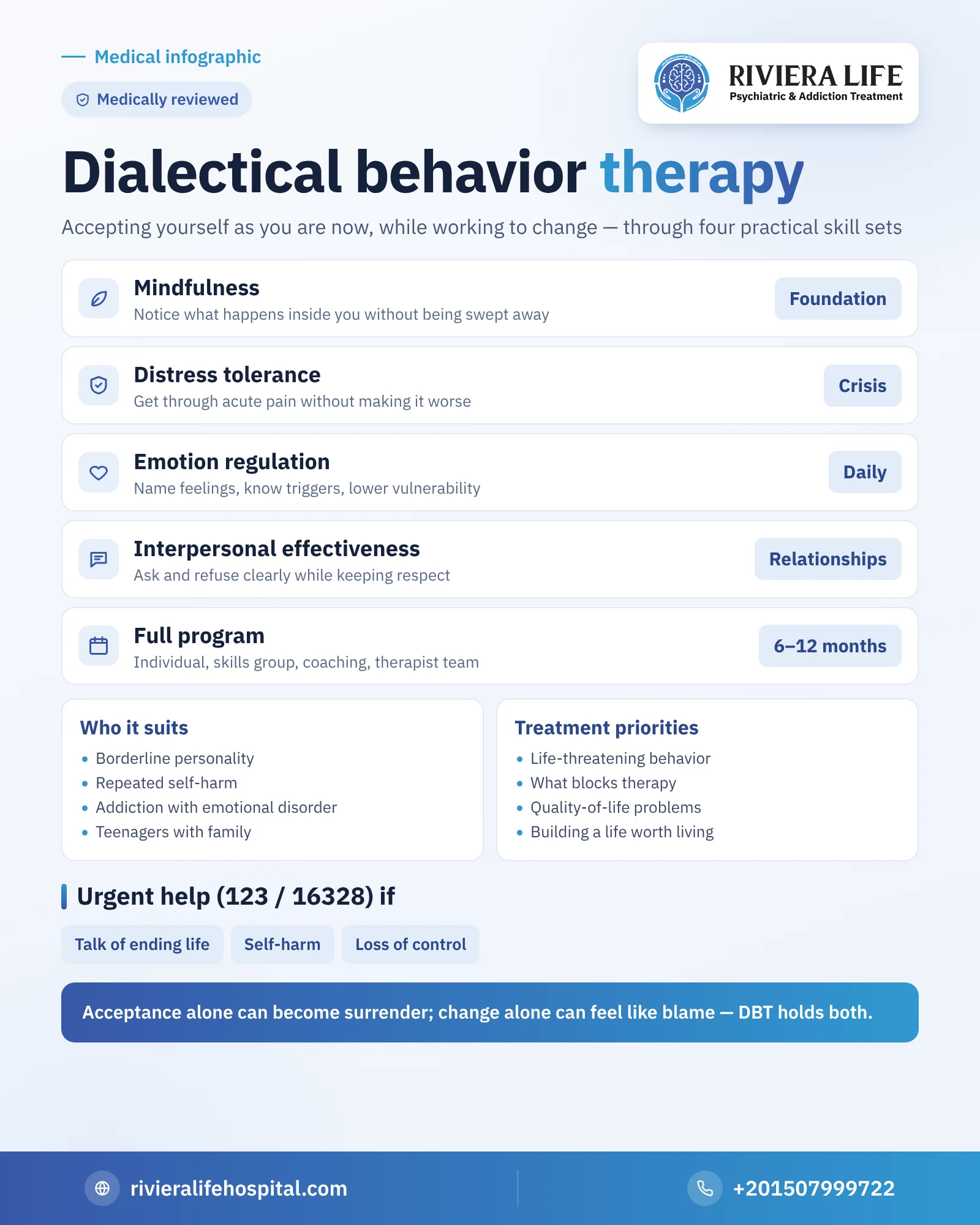
Dialectical behavior therapy is a type of psychotherapy originally designed for those overwhelmed by emotions so strongly that they act in ways that harm them, and its use then widened to include many conditions that share a difficulty regulating emotions. It is based on an idea that seems contradictory: that you accept yourself as you are now, and at the same time work on change. It teaches the patient four sets of practical skills that he trains in as he would train in any new skill. This article explains what dialectical therapy means, its four skills, who it suits, how the treatment journey goes, and the difference between it and cognitive behavioral therapy.
What is dialectical behavior therapy?
It was developed by the American therapist Marsha Linehan in the late 1980s, after she noticed that traditional cognitive behavioral therapy didn’t succeed enough with patients living through repeated emotional crises and self-harming behavior. These patients felt that the constant focus on changing their thoughts meant the therapist didn’t understand the size of their pain, so they left treatment. So she added the element of acceptance and empathy, drew on mindfulness practices, and built an integrated program known by the abbreviation DBT.
Today it is one of the most studied psychotherapies for borderline personality disorder, and is used in many clinics and hospitals around the world in versions adapted for different groups.
What does the word “dialectical” mean?
Dialectics here means bringing together two ideas that seem opposed and are both true. The therapist essentially says to the patient: you are doing the best you can right now, and you also need to learn better ways. Acceptance alone may turn into surrender, and change alone may seem like blame and harshness; combining them creates a safe therapeutic relationship that allows progress. The patient learns to apply the same logic to his life, leaving black-and-white thinking behind: “Either I’m perfect or a complete failure”.
The four skills of dialectical behavior therapy
Mindfulness
This is the foundation the other skills are built on: noticing what happens inside you and around you in the present moment without judging it or being swept away by it. When a person learns to say to himself “I notice intense anger right now” instead of becoming the anger, a small space appears in which choice is possible.
Distress tolerance
Skills for getting through moments of acute pain without making them worse with an impulsive action. They include ways to calm the body quickly, deliberate temporary distraction, weighing the pros and cons of the impulsive action, and accepting the reality that can’t be changed right now. The goal isn’t for the pain to disappear, but for the wave to pass with the least losses.
Emotion regulation
Here the patient learns to name his feelings precisely, understand what triggers them and their function, reduce his vulnerability to exploding by caring for sleep, food and activity, and build small positive experiences regularly. Among its tools is acting opposite to the emotional urge when that urge isn’t in his interest.
Interpersonal effectiveness
Skills for asking for what you need or refusing what you don’t want clearly, while keeping the relationship and self-respect at the same time. Many who have an emotional disorder swing between silence and building up and then exploding, and these skills give them a third way.
The components of the full program
Dialectical therapy in its original form isn’t just a weekly session, but a system of four elements working together:
- Individual sessions: usually once a week, in which the therapist reviews with the patient the events of the week and what led to each behavior.
- A skills training group: a weekly meeting like a classroom, in which skills are explained and homework is given for practice.
- Coaching between sessions: brief contact during crises to help the patient apply a skill in the real situation.
- A consultation team for therapists: in which therapists meet to support each other and maintain the quality of treatment.
The patient usually uses a daily card on which he records his emotions, urges and the skills he applied, which becomes the material for the individual session. In many places shortened versions are offered that focus on the skills group only, and they are also useful even though their evidence is less than the full program.
Who is dialectical behavior therapy suitable for?
- Borderline personality disorder: the group it was originally designed for. Our article on borderline personality disorder treatment explains its place among the other treatments for this disorder.
- Repeated self-harm and suicidal thoughts: among its first goals is reducing these behaviors, and many studies have shown that it reduces their recurrence and the number of hospital admissions.
- Addiction: especially when it comes together with an emotional disorder, and it has a version adapted for this purpose.
- Difficulty regulating emotions in general: severe anger outbursts, rapid mood swings and constantly tense relationships, even without a specific diagnosis.
- Teenagers: there is a version that involves parents in the skills sessions.
- Other conditions: it is used with some cases of post-traumatic stress disorder, eating disorders and treatment-resistant depression, usually within a broader plan.
Dialectical behavior therapy and addiction
Many addicts don’t use in search of a high so much as to escape feelings they can’t bear: anger, emptiness, shame or anxiety. That is why a treatment that teaches them to tolerate these feelings in another way suits them. In the version adapted for addiction, the therapist takes a dialectical position too: the goal of complete abstinence is clear from day one, and at the same time a relapse, if it happens, is treated as information to learn from, not as the end of treatment. Distress tolerance skills specifically are used to get through waves of craving without responding to them. This connects with what we know about the relationship between depression and addiction; treating emotional pain is part of preventing relapse.
How does the treatment journey go?
Treatment usually starts with a preparatory stage in which the patient and therapist agree on goals and commitment, because the program needs real regularity. Then the therapist orders priorities clearly:
- First: any behavior that threatens life or safety.
- Second: whatever obstructs the therapy itself, such as absences and not doing homework.
- Third: whatever spoils the quality of life, such as substance use and problems at work and in relationships.
- Fourth: building the skills that allow a life the patient sees as worth living.
The full skills course takes about six months in most programs, and it is often repeated a second time, so the full treatment extends to about a year. The duration varies with the case and the version used.
The difference between dialectical behavior therapy and cognitive behavioral therapy
Dialectical therapy grew out of cognitive behavioral therapy, and shares its structure, homework and focus on behavior, but differs from it in important points:
| Point of comparison | Cognitive behavioral therapy | Dialectical behavior therapy |
|---|---|---|
| Central idea | Modifying inaccurate thoughts changes feelings and behavior | Balancing self-acceptance with striving for change |
| Focus | The content of thoughts | The intensity of emotion and the ability to tolerate and regulate it |
| Format | Mostly individual sessions | Individual, group and coaching between sessions |
| Usual duration | Weeks to a few months | Usually six months to a year |
| Suits best | Depression, anxiety, panic and OCD | Borderline personality, self-harm and severe emotional disorder |
Neither is absolutely better than the other; the choice depends on the main problem, and sometimes elements of both are used together.
The role of the family
A family living with a highly emotional person gets tired too, and may swing between complete leniency and anger. Some DBT programs offer sessions for parents in which they learn the same skills, and how to validate their son’s or daughter’s feelings without approving of harmful behavior. A sentence such as “I understand you’re very angry, and I won’t accept you breaking things” sums up this balance.
Seek urgent help immediately if you see
Call an ambulance on 123, the mental health hotline on 16328, or go to the nearest emergency department.
- Talk of ending life or that everyone would be better off without him
- Self-harm or wounds he can’t explain
- Intense emotion with loss of control over actions
How can Riviera Life help you?
Riviera Life’s psychiatry consultants assess whether difficulty regulating emotions is part of a personality disorder, depression or addiction, then build a plan combining the appropriate psychotherapy, medicine when needed and the family program. All in complete confidentiality, and the first consultation is free on +201507999722.
More from our psychotherapy guide
- Cognitive behavioral therapy
- Borderline personality: the complete guide
- Borderline personality disorder treatment
- Electroconvulsive therapy
- Acceptance and commitment therapy (ACT): its six processes and who it suits
- Group therapy: its types, therapeutic factors and when it suits you
Questions many people ask
Yes, it is used for difficulty regulating emotions in general, addiction accompanying an emotional disorder, and some cases of trauma and eating disorders, according to the therapist's assessment.
The skills course takes about six months in most programs, and it may be repeated so treatment extends to about a year, and shorter versions exist.
Self-help materials may help in understanding the skills, but they don't replace a trained therapist, especially when there is self-harm or repeated crises.
The psychiatrist may prescribe a medicine for accompanying symptoms such as depression or anxiety, while DBT remains the basis for working on skills.
Some programs offer sessions for parents, especially with teenagers, in which they learn the skills and how to validate feelings while setting limits on harmful behavior.