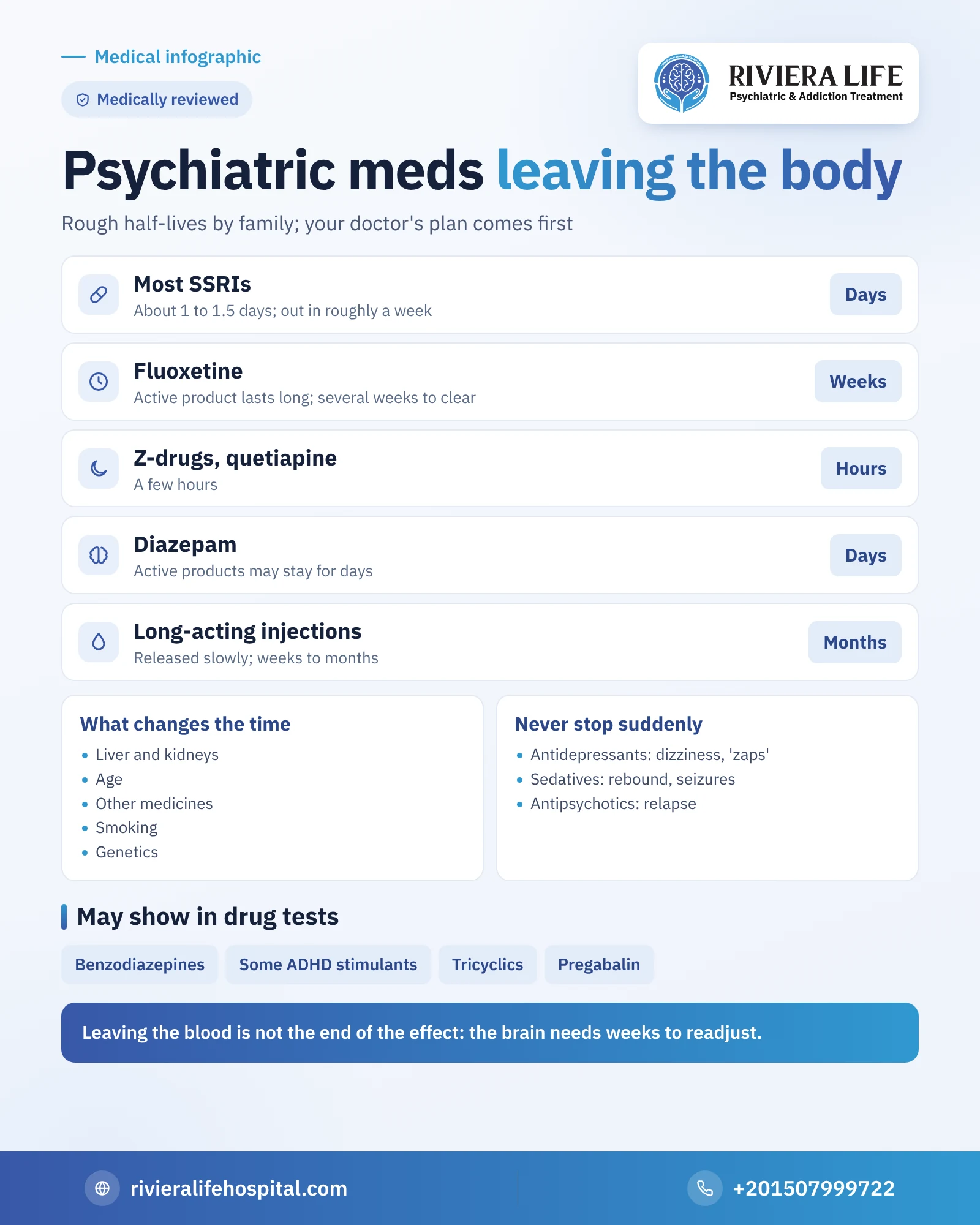
How long psychiatric medications take to leave the body differs greatly from one medicine to another: the body clears some sleeping pills in less than a day, most antidepressants in days, while fluoxetine and some long-acting sedatives stay for weeks, and long-acting injections continue for months.
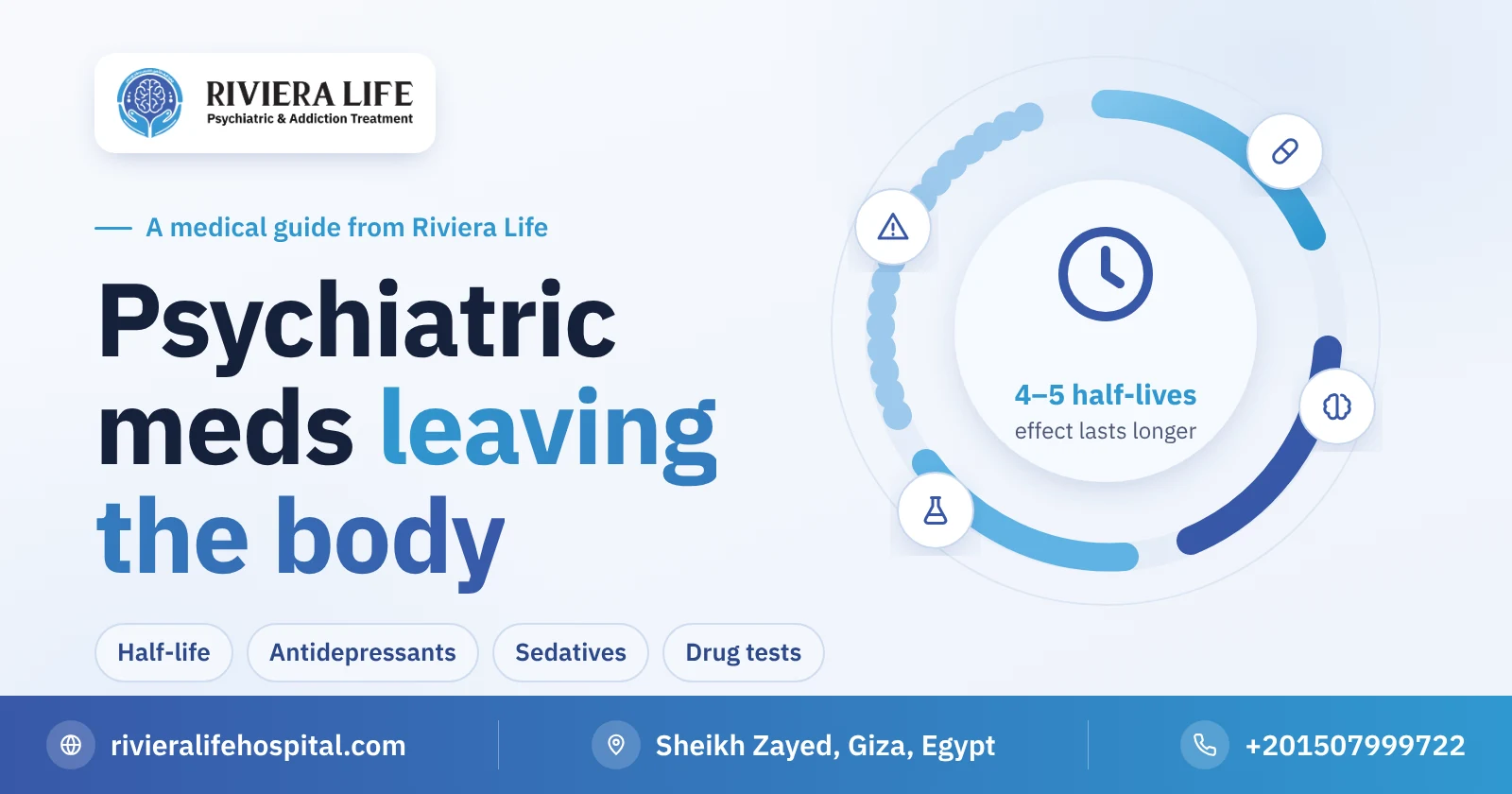
The measure doctors use is the “half-life”, and the body gets rid of most of the medicine after roughly four to five half-lives have passed. But the medicine leaving the blood does not mean its effect on the brain has ended, nor does it mean that stopping it suddenly is safe. In this article we explain these concepts with approximate ranges for each family, and clarify their relationship to drug tests and to the gradual tapering the doctor decides on.
What is half-life, and how long do psychiatric medications take to leave the body?
Half-life is the time the body needs to lower the concentration of the medicine in the blood by half. If a medicine’s half-life is a full day, then after a day half remains, after two days a quarter, and so on. And after four to five half-lives the remaining amount is so small that doctors consider it practically out of the body. The same concept also explains why a medicine needs days to reach a steady level in the blood after starting it, and why discontinuation symptoms appear faster with short-lived medicines.
Factors that make the time differ from one person to another
- The liver: it breaks down most psychiatric medicines, and weakness in it prolongs their stay.
- The kidneys: they clear medicines such as lithium, pregabalin and gabapentin, so their stay is affected by any weakness in kidney function.
- Age: older people clear many medicines more slowly.
- Other medicines: some slow the breakdown of the psychiatric medicine and some speed it up.
- Smoking: it speeds the breakdown of some antipsychotics such as olanzapine and clozapine, so their level changes if the patient starts smoking or quits suddenly.
- Genetics: some people break down certain medicines faster or slower than usual by the nature of their enzymes.
- Length of use: some fat-soluble medicines accumulate with long-term use.
Antidepressants
Most selective serotonin reuptake inhibitors, such as sertraline, escitalopram and paroxetine, have a half-life of roughly one to one and a half days, so they leave the body within about a week. The best-known exception is fluoxetine, which turns into an active substance that stays for many days, so the body may need several weeks to get rid of it. At the other end comes venlafaxine with a short half-life of no more than hours. Mirtazapine and the tricyclics usually fall in the range of a day or a little more. And this difference explains why paroxetine and venlafaxine cause clearer discontinuation symptoms than fluoxetine.
Sedatives and sleeping pills
Benzodiazepines divide into short-acting ones such as alprazolam, with a half-life of roughly half a day, and long-acting ones such as diazepam, which turns into active substances that may stay for days, with clonazepam in the middle at a half-life of about a day or more. “Z-drug” sleeping pills such as zolpidem have a half-life of a few hours. And the detection windows of sedatives in drug tests specifically we explained in the article How long benzodiazepines stay in the body.
Antipsychotics
The range here is wide. Quetiapine has a half-life of hours, olanzapine is much longer, at roughly a day and a half, risperidone is relatively short but its active breakdown product stays longer, and aripiprazole is among the longest, at days. Long-acting injections, however, are designed to release the medicine slowly, so it remains in the body for weeks and sometimes months after the last injection. The details of this family are in the article Antipsychotics.
Mood stabilizers, stimulants and other medicines
- Lithium: its half-life is roughly a day, and it is longer in older people and those with weak kidneys, which is why its level is measured by a blood test.
- Valproate and lamotrigine: in the range of hours to a day or more, and they are greatly affected by other medicines.
- Stimulants: a few hours, and extended-release forms prolong the effect within the same day, no more.
- Pregabalin and gabapentin: hours, and they leave mainly through the kidneys.
When does a psychiatric medicine wear off? And why does its leaving not mean its effect has ended?
Here lies the point many overlook. A psychiatric medicine does not work only while it is in the blood; it leaves behind an adaptation in the brain: receptors whose sensitivity has changed, and neural circuits that have grown used to a certain level of transmitters. When the medicine disappears, the brain needs weeks to readjust this balance.
That is why discontinuation symptoms may appear two or three days after the last dose and last two weeks or more even though the medicine itself has almost left the blood. Conversely, the patient may seem well for weeks after stopping and then relapse, because the therapeutic benefit was fading slowly. The article Antidepressant withdrawal symptoms details how to tell discontinuation symptoms from the return of the illness.
Why should you not stop the medicine suddenly?
- With antidepressants: dizziness, flu-like symptoms and a feeling of electric shocks in the head.
- With sedatives after long use: rebound anxiety and insomnia, and it may reach seizures.
- With antipsychotics and mood stabilizers: the risk of relapse of psychosis or the return of mania.
- With pregabalin and gabapentin: anxiety, insomnia and sweating, and a risk of seizures in some patients.
Gradual tapering is set by the doctor according to the medicine’s half-life, the length of use and your response. Short-lived medicines often need a slower taper, and the doctor may sometimes replace them with a longer-lived medicine before stopping. And we discussed the difference between these symptoms and addiction in the article Are psychiatric medications addictive?
How long medicines stay when switching from one to another
When the doctor decides to change an antidepressant or an antipsychotic, it is not enough to stop the old one and start the new one the next day. Some switches need a gradual overlap, and some need a washout period in which the first medicine leaves the body. The clearest example is switching to or from a monoamine oxidase inhibitor, which needs a mandatory washout period to avoid serotonin syndrome, and this period is much longer after fluoxetine because of how long it stays. That is why you should not start a new medicine prescribed by another doctor before they know what you were taking until recently.
Do psychiatric medications show up in a drug test?
The usual drug test at work, before marriage or for licenses looks for specific groups, the best known being: benzodiazepines, amphetamines, opioids and cannabis. This means the following:
- Prescribed sedatives from the benzodiazepine class may show a positive result.
- Some stimulant ADHD medicines may show up under amphetamines, depending on the type of medicine and test.
- Some extended tests include tricyclics or pregabalin.
- Modern antidepressants and antipsychotics are not usually targets of the routine test, but some of them may cause a false positive result in the rapid test.
A positive result in the rapid test is not final; it can be confirmed by a more precise test that identifies the substance by name. So tell the lab or the requesting party about the medicines you take on prescription, and keep the prescription or a report from your doctor. And don’t stop your medicine before a test out of fear of the result, as this may cause discontinuation symptoms or relapse. For more on the types of tests themselves see the article How long amphetamine stays in the body.
Before surgery and pregnancy
Before any operation that needs anesthesia, tell the surgeon and the anesthetist about your psychiatric medicines, as some of them interact with anesthetic drugs or affect blood pressure and bleeding, and the decision to continue or stop temporarily belongs to them and your psychiatrist together. And if you are planning a pregnancy, discuss it with your doctor early, because some medicines need changing well before pregnancy depending on how long they stay.
How can Riviera Life help you?
If you want to stop a psychiatric medicine, or need a medical report clarifying your medicines before a test, the first consultation at Riviera Life is free. A psychiatry consultant sets a tapering plan that suits your medicine and the length of your use, and if the medicine is a sedative or pregabalin and its use has been long, withdrawal inside the hospital under round-the-clock medical supervision may be the safest.
More from the psychiatric medications guide
- Benzodiazepines: the comprehensive guide
- Psychiatric medications: types and uses
- How long benzodiazepines stay in the body
- Antidepressant withdrawal symptoms
Questions many people ask
Not necessarily. The brain needs weeks to readjust its balance, and discontinuation symptoms or relapse may appear some time after the medicine has left, which is why the doctor follows the patient up after stopping.
Drinking water does not speed up the breakdown of most psychiatric medicines, because the liver is mainly responsible for them. Excessive water may do harm, especially with lithium.
That differs according to the medicine and how long it stays, and some medicines do not need to be stopped at all. Discuss it with your doctor before planning a pregnancy so they can set a safe plan.
Modern antidepressants are not usually part of the routine test, but some of them may give a false result in the rapid test. Tell the lab about your medicines and keep the prescription.
This is not advised, as sudden stopping may cause discontinuation symptoms or relapse. It is better to prove the medical prescription to the party requesting the test.