Pregabalin addiction treatment is possible and has good results when it is built on a clear plan, not a sudden decision to stop. It begins with a medical and psychological assessment, then gradual withdrawal of the medicine under supervision that protects against seizures and severe insomnia, then psychotherapy that treats the reason behind the overuse, and finally follow-up that prevents relapse. Treatment often includes another substance that accompanies pregabalin, the best known in Egypt being tramadol. This article explains the stages step by step, the role of medicines, the expected duration, when an inpatient stay is necessary, and how to choose the right hospital.
The same plan applies to anyone addicted to pregabalin under the name “Lyrica” or any other brand name for the substance.
What makes pregabalin treatment different?
Three features give pregabalin treatment its particular character. The first is that it is a medicine with a legitimate use: the patient may have started it for real nerve pain or chronic anxiety, and ignoring that origin means the pain or anxiety will return and lead them back to the medicine. The second is that stopping it suddenly can cause seizures, so there is no place here for the idea of “quitting at once and toughing it out”. The third is that it rarely comes alone: mixing with tramadol, hashish or sedatives changes the order of the whole plan.
The stages of pregabalin addiction treatment
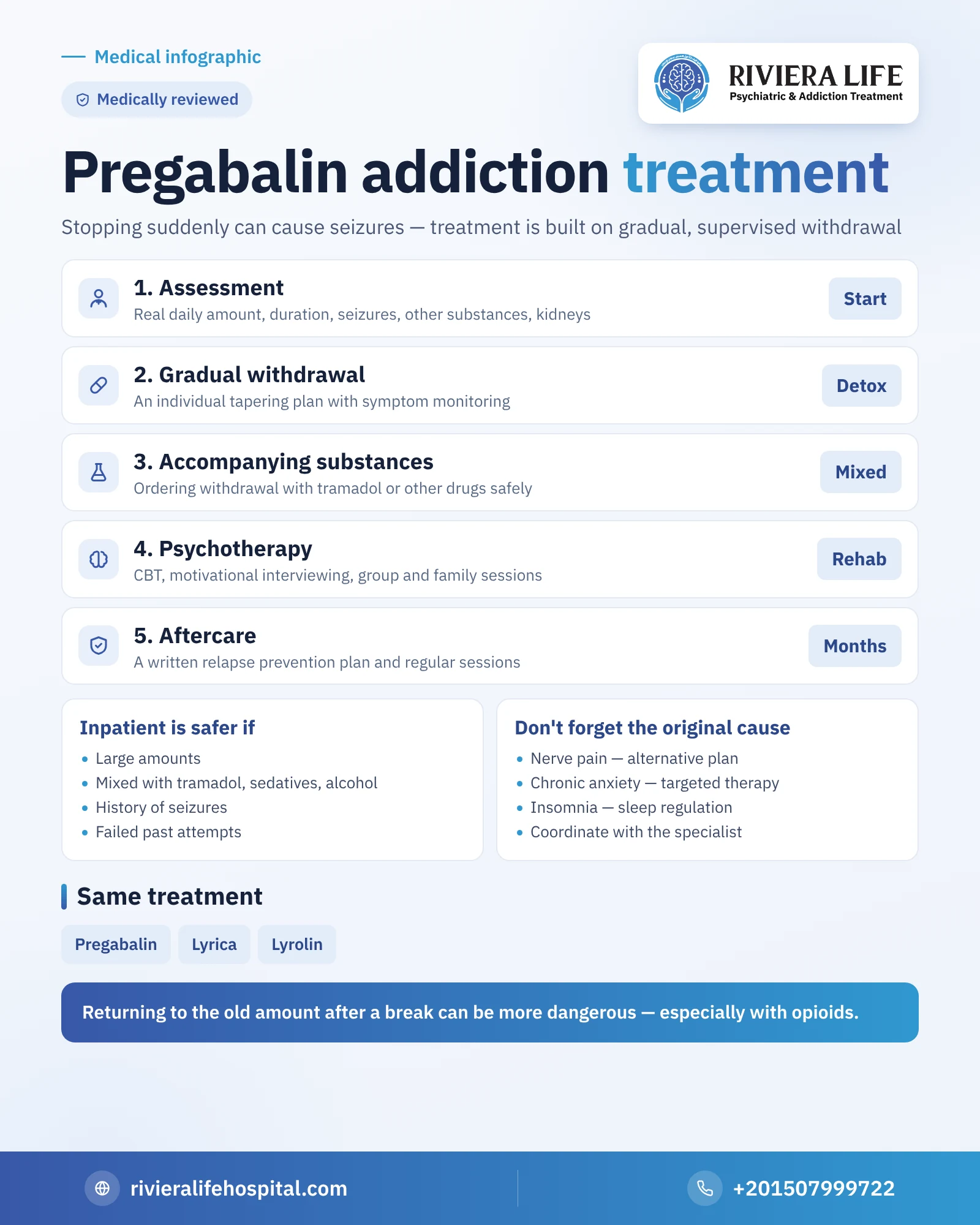
- Assessment: determining the actual amount and duration, accompanying substances, and the psychological and physical condition.
- Gradual withdrawal: reducing the medicine according to a schedule set by the doctor, while monitoring symptoms.
- Treating accompanying substances and existing mental disorders.
- Psychotherapy and rehabilitation: understanding the motives and building alternative skills.
- Follow-up and aftercare: a written relapse prevention plan and regular sessions.
The first assessment: what does the doctor need to know?
The doctor asks about the real amount the patient takes daily, not the prescribed amount, the duration of use, any previous seizure, and every other substance they take, even once a week. They ask about the pain, anxiety or insomnia that came before the medicine, and about chronic illnesses, especially kidney disease, because it changes how quickly pregabalin leaves the body.
They may request blood tests, kidney function and a drug screen. Honesty at this stage isn’t a confession the patient will be held to account for, but what makes withdrawal safe. To learn what may and may not show in tests, see our article on how long pregabalin stays in your system.
Gradual withdrawal instead of stopping suddenly
The essence of detox for pregabalin is gradualness. The doctor sets a schedule that lowers the amount in stages, and its speed differs from one patient to another depending on the amount, the duration, and whether there is epilepsy or other substances. During this period the team monitors sleep, pulse, blood pressure and mood, and intervenes early at any sign suggesting a risk of seizures. We don’t publish schedules or amounts here, because any general schedule may be safe for one person and dangerous for another. The expected symptoms and their timing are explained in our article on pregabalin withdrawal symptoms.
Are there medicines to treat pregabalin addiction?
There is still no approved medicine specifically for treating pregabalin addiction, as there is with buprenorphine for opioid addiction, for example. So the doctor relies on medicines that treat what appears during and after withdrawal: insomnia, anxiety, nausea and mood swings, taking care to choose medicines that don’t create new dependence. And if the patient has clear depression or an anxiety disorder, treating it with the right medicine is part of treating the addiction itself, because leaving it untreated is one of the strongest causes of going back.
Treating accompanying substances
When pregabalin is combined with tramadol or another opioid, the doctor decides the order of withdrawal: which substance is withdrawn first and how fast, because withdrawing both together without order raises the risk of seizures and relapse. With opioid dependence, the approved medicines for treating it may be used, bearing in mind that combining pregabalin with them needs caution because of breathing suppression. You’ll find the details of tramadol treatment in our article on tramadol addiction treatment.
Psychological and behavioral therapy
The medicine keeps its hold on the patient as long as the reason that led them to it remains. So psychotherapy focuses on:
- Cognitive behavioral therapy to identify the situations and thoughts that come before taking the extra capsule.
- Motivational interviewing to strengthen the inner drive to continue, especially in someone who sees the medicine as “not a drug”.
- Practical training in dealing with insomnia and stress without medicine, such as regulating sleep and relaxation techniques.
- Group sessions that break the feeling that the problem is theirs alone.
- Family sessions that rebuild trust and define each member’s role.
What about the original pain or anxiety?
Someone who started pregabalin for nerve pain or anxiety won’t recover if they leave treatment without an alternative. Here the addiction team coordinates with the relevant specialist to set another plan for the pain or anxiety, which may include different medicines less prone to misuse, physiotherapy, or psychotherapy targeting anxiety. In some cases the doctor may decide to continue pregabalin itself at a therapeutic amount with strict follow-up, an individual medical decision that isn’t made at home. The relationship between the medicine and anxiety is explained in our article on pregabalin and anxiety.
How long does pregabalin addiction treatment take?
Gradual withdrawal may take from a week to several weeks depending on the amount and duration. The intensive treatment program usually extends for additional weeks, while outpatient follow-up continues for months. Research generally links staying in treatment long enough with better outcomes, so the important thing is that the patient doesn’t drop out as soon as the physical symptoms end, because craving and insomnia may return after everyone thinks it’s over.
Inpatient stay or outpatient treatment?
An inpatient stay is the safest option for those taking large amounts, mixing it with tramadol, sedatives or alcohol, with a history of seizures, who tried to stop before and failed, or who live in an environment where the medicine is easy to obtain. Outpatient treatment suits someone who used it on prescription and then gradually increased the amount, has a supportive family and doesn’t use other substances. Treatment often begins with a short inpatient stay and then moves to outpatient follow-up.
Relapse prevention and the family’s role
The first months after withdrawal are the most delicate. The patient needs a written plan: what to do on a sleepless night, whom to call when craving strikes, and how to deal with a friend offering a strip. The family needs to know the medicine is available in pharmacies, so protection comes from trust and follow-up, not from prohibition alone. It is important for everyone to know that going back to the old amount after a break may be more dangerous, especially with opioids. Understanding the reasons that led to addiction helps anticipate moments of risk, as explained in our article on the causes of pregabalin addiction.
Is treating Lyrica and Lyrolin addiction different from treating pregabalin?
No. “Lyrica” and “Lyrolin” are brand names for products containing the same active substance, pregabalin, so treating Lyrica or Lyrolin addiction is the same plan we explain in this article: an initial assessment, then gradual reduction under medical supervision instead of stopping suddenly, then psychological and behavioral therapy and follow-up to prevent relapse. What differs from one patient to another is the amount, the duration of use and the substances mixed with it, not the name on the box.
Many ask about treating Lyrica addiction at home. This is possible in selected cases after assessment, provided there is a tapering plan set by a doctor, regular follow-up, a supportive family, and no mixing with other substances or history of seizures. You’ll find its conditions in our home addiction treatment program.
The recovery rate from pregabalin addiction: the truth you should know
Many families ask about the cure rate in the first call, and the honest answer is that there is no single precise rate that can be promised:
- There are no large, standardized studies measuring the recovery rate from pregabalin addiction specifically.
- The definition of “recovery” itself varies: is it stopping for a month? A year? A full return to work and life?
- The outcome depends on the duration of use, mixing, accompanying mental disorders, family support and commitment to follow-up.
What we know is that addiction is a chronic illness whose course resembles illnesses such as high blood pressure and asthma. The US National Institute on Drug Abuse estimates that relapse rates in substance use disorders range roughly between 40 and 60%, close to the rates of symptom return in those illnesses. Relapse, if it happens, means adjusting the plan, not abandoning it, and any place that promises you a guaranteed cure rate is offering a marketing figure, not a medical fact.
The right hospital for pregabalin addiction treatment: how to choose
The right hospital for treating pregabalin addiction is one that offers what a patient on this medicine specifically needs: gradual withdrawal that is safe from seizures, experience with cases mixed with tramadol, and an alternative plan for the pain or anxiety that started everything. Before you decide, ask:
- Is withdrawal managed gradually with an individual plan, or is the medicine stopped all at once?
- Is there medical staff all day who can treat the patient if they have a seizure during withdrawal?
- Does the team assess accompanying substances and order their withdrawal safely?
- Does it have consultants in psychiatry and addiction treatment?
- Does it treat the original anxiety, insomnia and pain instead of ignoring them?
- Does the program include the family and clear follow-up after discharge?
And be wary of anyone who guarantees a cure rate or promises to end pregabalin addiction in days.
Why Riviera Life for pregabalin addiction treatment?
These are the details of what Riviera Life offers in this area:
- Official authorization: a psychiatric and addiction treatment facility licensed by the Ministry of Health.
- Supervised gradual withdrawal: an individual withdrawal plan set by consultants in psychiatry and addiction treatment.
- Round-the-clock care: 24-hour medical supervision throughout withdrawal to detect any sign of seizures early.
- Experience with mixed cases: a safe order for withdrawing pregabalin together with tramadol or other substances.
- A long treatment record: over fourteen years, thousands of patients have recovered at the hospital from medication and drug addiction.
- Complete confidentiality: the data of the patient and family are protected at every stage.
- A family program and aftercare: follow-up after discharge that protects against relapse.
Your first consultation about pregabalin is free, the line +201507999722 works all day, and you’ll find us in Sheikh Zayed, Giza governorate.
More from our pregabalin guide
- Pregabalin: the complete guide
- Pregabalin withdrawal symptoms and their duration
- Pregabalin addiction symptoms
- The causes of pregabalin addiction
- Gabapentin addiction treatment: assessment, gradual tapering and accompanying opioids
Questions many people ask
Yes. Many patients recover when treatment combines safe gradual withdrawal, psychotherapy and follow-up after discharge, along with treating any pain or anxiety that started the use.
There is no approved medicine specifically for it, so treatment relies on gradual withdrawal and treating accompanying symptoms such as insomnia and anxiety with medicines that don't cause new dependence, alongside psychotherapy.
Gradual withdrawal usually takes from a week to several weeks depending on the amount, duration and accompanying substances, then the treatment program and follow-up continue for months to prevent relapse.
Not always, but an inpatient stay is safer for those taking large amounts, mixing it with tramadol or sedatives, or with a history of seizures. A medical assessment decides.
Safe gradual withdrawal with round-the-clock supervision, experience with mixed cases, and a plan for the original pain or anxiety. Riviera Life in Sheikh Zayed, Giza, is licensed by the Ministry of Health and meets these standards.