Pregabalin stays in the body for a relatively short time compared with many substances: it usually shows in a urine test for about one to three days after the last dose, and in the blood for hours that may stretch to a day, while in theory it can be detected in hair for months. But the surprise for many families is that pregabalin doesn’t show up at all on most routine drug-test strips, and needs a dedicated test requested by name. This article explains how the medicine leaves the body, how long it shows in each sample, why the kidneys affect the result more than any other factor, and how to read the result correctly.
How does the body deal with pregabalin?
Pregabalin is absorbed from the stomach quickly and almost completely, reaching its highest blood concentration within about an hour. Unlike most medicines, the liver hardly changes it at all, so it isn’t converted into other products; instead, the kidneys remove it unchanged in the urine.
Its concentration in the blood halves within about six hours in someone with healthy kidneys. A general rule in pharmacology is that most of a substance leaves the body after about five of these periods — that is, roughly a day and a half after the last dose — with small traces remaining that sensitive tests may still pick up afterwards.
Does pregabalin show up in a standard drug test?
In most cases, no. The usual rapid strips, whether they test for five substances or more, are designed for opioids, cannabis, stimulants, sedatives and others, and don’t include pregabalin unless this is stated explicitly. So someone taking large amounts of it may come out completely negative on a routine test. Detecting it requires one of two things: a rapid strip dedicated to pregabalin, available in some laboratories and markets, or a confirmatory laboratory test using chromatography combined with mass spectrometry, which is the most accurate and best able to measure the concentration.
How long pregabalin shows up, by type of test
The following figures are approximate, and vary with the amount, the frequency and kidney function:
Urine test
This is the most suitable way to detect pregabalin, because most of the medicine leaves through the urine. It usually shows for about one to three days after the last dose, and may show for longer in someone who takes large amounts daily or has weak kidneys.
Blood test
This reflects what is in the body right now, so the medicine shows in it for hours after taking it and possibly up to about a day. It is mostly used in the emergency department to assess poisoning, or to follow up a particular patient, not for routine screening.
Saliva test
There is less data on it, and it is expected to detect recent use within hours to about a day. It isn’t common in Egypt for this purpose.
Hair test
This can detect repeated use over a period of up to about three months, depending on the length of the sample, but it doesn’t detect the last few days, and it is only done in specialist laboratories.
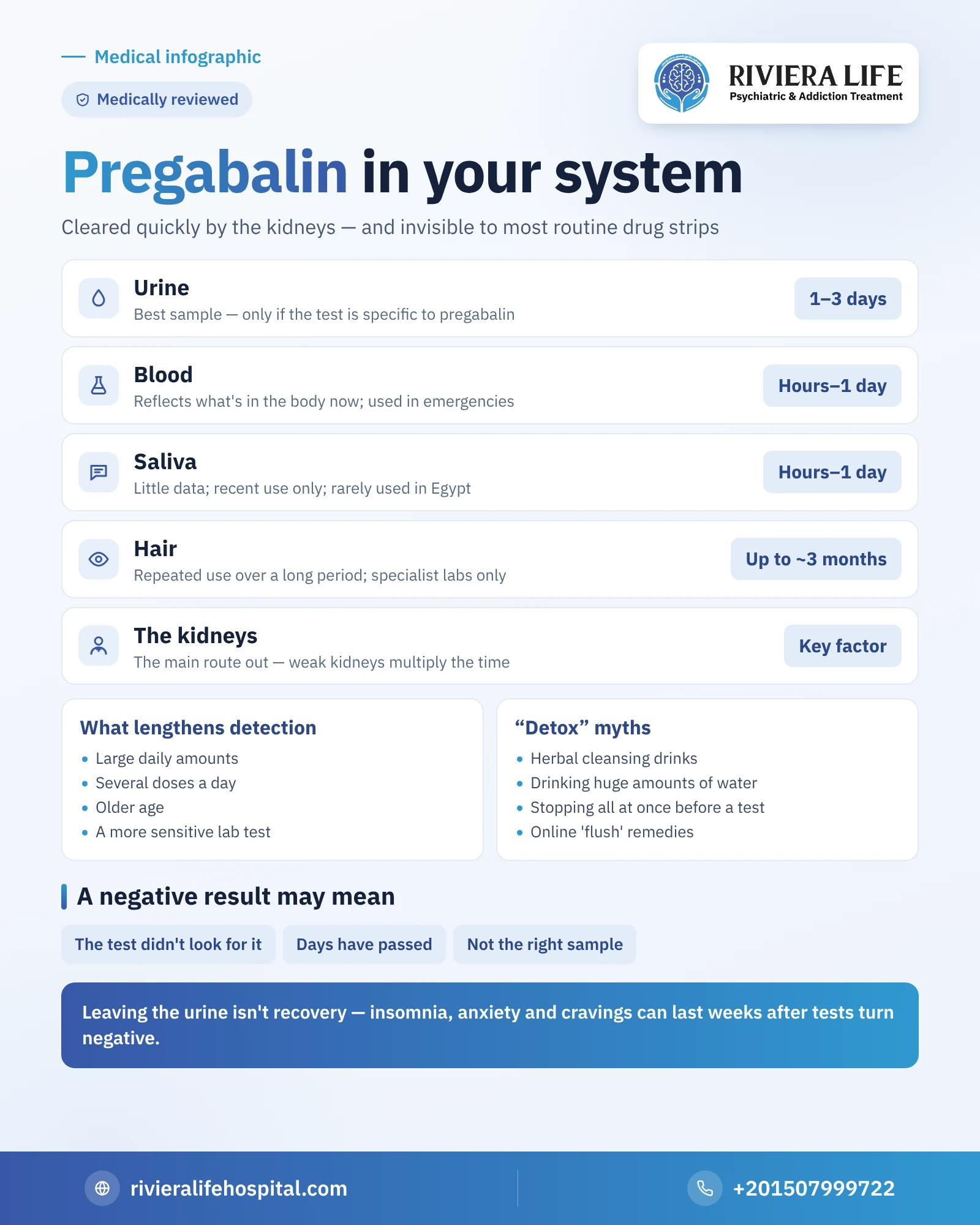
Detection times at a glance
| Type of sample | Approximate time | When it is used |
|---|---|---|
| Urine | One to three days | The most common screening, provided the test is specific to pregabalin |
| Blood | Hours to about a day | Emergencies and assessing poisoning |
| Saliva | Hours to about a day | Rarely used |
| Hair | Up to about three months | Detecting a long-term pattern of use |
Is the time different for pregabalin, Lyrica and Lyrolin?
No. Lyrica, Lyrolin and others are brand names for products containing the same substance, and the body doesn’t distinguish between one capsule and another by the company’s name. What really changes how long it stays is the total amount that entered the body, how often it was repeated, and kidney function. In the test result, only the generic name appears: pregabalin.
The same applies to the smuggled capsules known in the Gulf as Indian Lyrica: they are detected in testing like any other pregabalin, the only difference being that their actual content is unknown, so it is hard to estimate in advance how long they will stay.
Factors that lengthen or shorten the time
- The daily amount: large amounts need longer to fall below the detection limit.
- Frequency: taking it several times a day for consecutive days lengthens the time compared with a single dose.
- Age: kidney efficiency falls gradually with age.
- The sensitivity of the test: a confirmatory laboratory test detects lower concentrations than a rapid strip.
- The type of sample: hair holds the trace far longer than urine and blood.
On the other hand, liver function doesn’t greatly affect how long pregabalin stays, unlike most other substances, because the liver plays almost no part in getting rid of it. This explains why two people may differ in the time despite taking the same amount: the difference is usually in the kidneys, age and pattern of use, not in weight or physical activity.
The kidneys: the most important factor
Because the kidneys are almost the only route out for pregabalin, any weakness in their function clearly lengthens how long it stays, and its time in the body may multiply several times over in patients with kidney failure. For the same reason, doctors lower the prescribed amount for these patients. More important than the test here is that build-up of the medicine in these patients can cause drowsiness, dizziness and confusion even at amounts others tolerate, as our article on the side effects of pregabalin explains.
When is a pregabalin test requested?
The doctor usually requests it in three situations: in the emergency department when someone arrives unconscious or confused and it isn’t known what they took; when assessing addiction, to identify all the substances used before setting a withdrawal plan; and when following a patient up during and after treatment. In some workplaces or private screenings, it may be added to the test if requested by name. The role of testing in the treatment plan is explained in our article on pregabalin addiction treatment.
When it is mixed with other substances
In many of the cases that reach the hospital, the routine test is positive for tramadol or cannabis, while the pregabalin taken alongside them stays completely out of the picture, because the strip doesn’t look for it. This is a mistake with a price: a withdrawal plan that ignores pregabalin may leave the patient facing two withdrawals at once without preparation, with a higher risk of seizures.
That is why, when assessing addiction, the doctor requests an extended panel of tests and asks the patient and family directly about every strip being used, however ordinary it seems. The reverse is also true: finding pregabalin in the test doesn’t rule out other substances the screening didn’t cover. The relationship between pregabalin and tramadol in particular is explained in our article on pregabalin vs tramadol.
How is the result read?
A positive result means the person took pregabalin in the last few days, but on its own it doesn’t distinguish between a patient taking it on prescription and someone misusing it. That is why the test is read together with the prescription and medical history, and a quantitative laboratory test may help show whether the concentration is far higher than expected. A negative result has its limits: it may mean the test wasn’t specific to pregabalin at all, or that enough time has passed since the last dose. So a family shouldn’t be reassured by a negative routine strip if the other signs are clear; you will find those signs in our article on pregabalin addiction symptoms.
About “body cleanse” remedies
Many remedies circulate online claiming to flush the medicine out of the body within hours. Most have no scientific basis, and some are dangerous, such as drinking excessive amounts of water, which can disturb the salts in the blood. More dangerous still is stopping suddenly before a test in someone who takes large amounts, because it can cause severe withdrawal symptoms, including seizures, as our article on pregabalin withdrawal symptoms explains.
Can the body be cleared of pregabalin quickly?
The honest answer: there is no safe shortcut. The body removes pregabalin through the kidneys at its own pace, and most of it leaves chemically unchanged, so there is no drink, herb or supplement proven to speed up this process.
- Myth: “cleansing” drinks and herbs wash the medicine out. Truth: there is no evidence for this, and some strain the stomach and kidneys.
- Myth: drinking lots of water flushes it out. Truth: drinking too much disturbs the salts in the blood and can cause serious symptoms.
- Myth: stopping all at once settles the matter. Truth: it can trigger anxiety, insomnia and seizures in someone used to large amounts.
For anyone who means getting rid of the dependence itself by “cleansing”, the safe route is a gradual reduction under a doctor’s supervision, monitoring sleep, mood and withdrawal signs, which is what the medically supervised detox program provides. After withdrawal, the stage of dealing with the reasons for use begins, as our article on pregabalin addiction treatment explains. And anyone who doesn’t take the medicine on prescription and fears withdrawal would do best to start with a call to a doctor, not with a remedy from the internet.
The medicine leaving the body doesn’t mean recovery
The urine may be free of pregabalin within a few days, but the nervous system that got used to it doesn’t regain its balance as quickly. Insomnia, anxiety and craving for the medicine may continue for weeks after tests are completely negative. That is why the success of treatment isn’t measured by the test alone, but by the person’s ability to sleep, work and cope with stress without going back to the capsule. At Riviera Life testing is used as a follow-up tool within a wider treatment plan, in complete confidence — not as a means of holding someone to account.
More from our pregabalin guide
- Pregabalin: the complete guide
- Pregabalin addiction symptoms
- Pregabalin withdrawal symptoms and how long they last
- Pregabalin vs gabapentin: the difference between them
- Alternatives to pregabalin: medical options by the reason for the prescription, and the risks of switching
Questions many people ask
It usually shows for about one to three days after the last dose, and longer with repeated large amounts or weak kidney function — provided the test is specific to it.
Usually not, because routine strips don't look for it. Detecting it needs a dedicated strip or a confirmatory laboratory test requested by name.
Yes, but for a short time, from hours to about a day. That is why blood tests are usually used in the emergency department to assess poisoning, not for routine screening.
Because the kidneys are almost the only route for it to leave the body unchanged. Weak kidneys slow its removal, so it stays longer and the risk of side effects rises.
Not necessarily: the test may not be specific to it, or days may have passed since the last dose. The result is always read together with the signs and medical history.