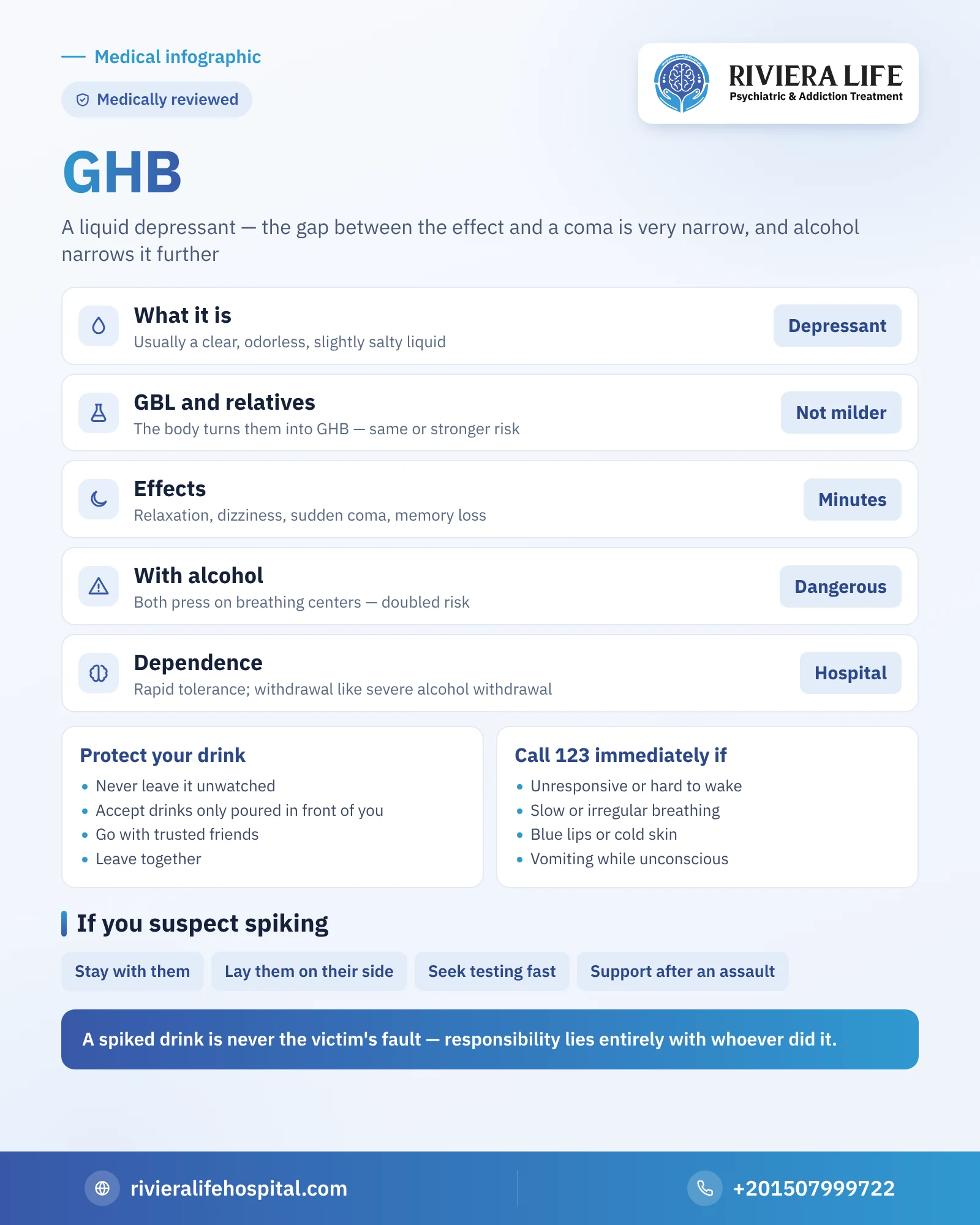
GHB is a substance that depresses the nervous system, usually coming as a colorless liquid, and it became known in nightlife and in assaults in which it is slipped into a victim’s drink. Its greatest danger is that the gap between the amount that produces an effect and the amount that puts a person into a coma or stops their breathing is very narrow, and narrows further with alcohol. And someone who uses it regularly may develop dependence followed by severe withdrawal that resembles alcohol withdrawal and needs a hospital. In this article we explain what GHB and its relative GBL are, why they are dangerous, how to protect yourself and those around you, and when to call an ambulance.
What is GHB?
The name is short for gamma-hydroxybutyrate. It is a substance the brain makes naturally in tiny amounts, but what circulates outside medicine is a manufactured substance at much higher concentrations. It usually comes as a clear, odorless liquid, sometimes as a powder or capsules, and its taste is described as slightly salty, which makes it easy to hide in drinks.
It has a limited, controlled medical use: a pharmaceutical preparation of it is dispensed in some countries to treat certain cases of narcolepsy with attacks of muscle weakness, under strict medical supervision and restricted dispensing programs. This use has nothing to do with the liquid of unknown origin that circulates at parties.
GBL and related substances: a different name, the same danger
Gamma-butyrolactone (GBL) is an industrial solvent used in cleaners and paint strippers, as is a substance called 1,4-butanediol. The body quickly converts these two substances into GHB once they are taken, so their effects and risks are the same as GHB’s — and GBL may even act faster and more strongly. That is why these substances are controlled in many countries, and doctors warn against believing they are a “legal alternative” or milder.
How does GHB affect the brain and body?
GHB acts on receptors linked to the GABA system, the brain’s braking and calming system, which is why its effect resembles that of alcohol and sedatives. With small amounts, the person feels relaxed and cheerful, loses inhibition and feels more sociable. With a slight increase, dizziness, nausea, poor balance and slurred speech appear, then deep drowsiness. After that, the person may suddenly lose consciousness, their breathing and pulse slow, their temperature falls, and they may vomit while unconscious.
One of the distinctive features of GHB poisoning is that the coma can come suddenly, and the person can also wake suddenly hours later, often confused or agitated, with no memory of what happened. This memory loss is one of the reasons it is used in assaults.
Its reputation as a party drug
GHB is widespread in some party and nightlife settings in many countries, and is known by names such as “G” or “liquid ecstasy”, even though it has no chemical connection to ecstasy: ecstasy is a stimulant and GHB is a depressant. It is sometimes used with other substances in the same place, adding risk on top of risk. To learn about the risks of the other substances common in these settings, read our page on ecstasy, and our page on ketamine, another drug linked to parties and loss of awareness.
The narrow margin between effect and overdose
This is the most dangerous fact about GHB. With most substances there is a reasonable gap between the amount that produces an effect and a dangerous amount; here the gap is very small. Several factors make it even harder to predict:
- The liquid in circulation is of unknown concentration, and differs from one bottle to another.
- The effect is slightly delayed, so the person takes more before the effect of the first dose is complete.
- People are affected to different degrees depending on weight, tolerance and other substances in the body.
The result is that the move from a “high” to a coma can happen within minutes, with no clear warning to the people around.
Why is GHB more dangerous with alcohol?
Alcohol is also a depressant, and the two substances press together on the brain’s breathing centers, doubling the risk of breathing stopping and coma. Medical sources indicate that in a large proportion of the GHB poisoning cases that reach the emergency department, alcohol is present. The same applies to sedatives such as benzodiazepines, to opioids and to pregabalin. And with vomiting during a coma comes the added risk of choking as vomit enters the lungs.
How to protect yourself and those around you from drink spiking
A victim who is drugged bears no blame; responsibility lies entirely with whoever did it. But some simple precautions reduce the risk:
Protect your drink
- Don’t leave your drink unwatched, and if you have been away from it, get a new one.
- Don’t accept a drink from someone you don’t know well unless you see it poured in front of you.
- Go out with friends you trust, and agree that each of you watches the others and that you leave together.
Signs that someone may have been drugged
- Sudden dizziness, drowsiness or confusion out of proportion to what they have drunk.
- Difficulty speaking or standing, or behavior unlike their usual self.
- Nausea and vomiting, or loss of consciousness.
- Waking up with no memory of hours of the previous night.
What to do if you suspect it
- Stay with the person and don’t leave them alone, and don’t let a stranger take them away “to drop them home”.
- Call an ambulance on 123 if their consciousness or breathing weakens.
- If they are unconscious but breathing, lay them on their side so they don’t choke on vomit.
- Seek a medical examination as soon as possible, because the substance disappears from the body within a few hours, and tell the doctor of your suspicion so the right tests are done.
- Anyone who has been assaulted has the right to medical, psychological and legal support, and it is better that they aren’t left alone in the following days.
Is GHB addictive?
Yes. Repeated use leads to rapid tolerance, so the person needs larger amounts or more frequent doses to get the same effect. Some people dependent on it end up taking it around the clock, because its effect is short, waking at night to take it so that withdrawal symptoms don’t start. It often begins with use at parties, or as an attempt to sleep or ease anxiety, then turns into a daily need.
GHB withdrawal: a medical condition that isn’t managed at home
When someone stops suddenly after regular use, withdrawal symptoms may begin within a few hours of the last dose, and they closely resemble severe alcohol withdrawal: tremor, anxiety, insomnia, sweating and a fast pulse, which may then progress to agitation, hallucinations, severe confusion and a high temperature, and sometimes seizures. These symptoms may last from days to about two weeks. That is why stopping suddenly without medical supervision isn’t acceptable, and the patient usually needs a hospital stay, sometimes in intensive care.
When should you call an ambulance?
Call an ambulance immediately on 123 if you see
GHB poisoning can stop breathing within minutes, especially with alcohol or sedatives, and there is no home antidote.
- No response, or difficulty waking the person
- Slow or irregular breathing, or abnormal snoring while unconscious
- Blue lips or fingertips, or cold skin
- Vomiting while unconscious or barely conscious
- Seizures, or severe agitation, confusion and hallucinations on stopping after regular use
Until the ambulance arrives, lay the person on their side, stay beside them and watch their breathing, don’t try to wake them with cold water or coffee, and don’t give them anything by mouth. Tell the paramedics everything you know about what they took.
Treating GHB poisoning and addiction
There is no specific antidote to GHB poisoning; treatment in the emergency department relies on supporting breathing, protecting the airway and monitoring the heart and temperature until the body clears the substance, and some patients may need a ventilator for a while.
Treatment of dependence begins with safe withdrawal in hospital, in which the doctor chooses the right medicines to control withdrawal symptoms and prevent their complications, with round-the-clock monitoring. After that comes psychological and behavioral therapy that addresses the reasons for use — such as anxiety, insomnia, stress and the party environment — and includes a relapse-prevention plan and an assessment of any accompanying alcohol or other substance use.
How can Riviera Life help you?
At Riviera Life in Sheikh Zayed, medical follow-up is available around the clock — exactly what a GHB patient needs in the first days of withdrawal — with consultants in psychiatry and addiction treatment and complete confidentiality. If you are afraid that you or a loved one has become dependent on it, the first consultation is free on +201507999722.
More from our party drugs guide
- Ecstasy: the complete guide
- Ketamine: the complete guide
- The harmful effects of ecstasy
- Alcohol withdrawal symptoms
- Rohypnol (flunitrazepam): memory loss, the danger with alcohol and how to protect yourself
Questions many people ask
GBL is an industrial solvent that the body quickly converts into GHB once it is taken, so its effect and risks are the same, and it may be faster and stronger. That is why it isn't a milder alternative, as some people think.
Because it is a colorless, odorless liquid that is easy to hide in drinks, and it causes drowsiness, loss of consciousness and forgetting what happened. Responsibility in these crimes lies entirely with the attacker, not the victim.
It disappears from the blood and urine within a few hours, which is why anyone who suspects they were drugged is advised to seek a medical examination as soon as possible and tell the doctor of their suspicion.
Yes. It can be severe and resemble acute alcohol withdrawal, with tremor, hallucinations, confusion and sometimes seizures. That is why stopping must happen under medical supervision, usually in hospital.
A pharmaceutical preparation of it is dispensed in some countries to treat certain cases of narcolepsy, under strict control. The liquid circulating outside medicine is of unknown concentration and extremely dangerous.