The short answer
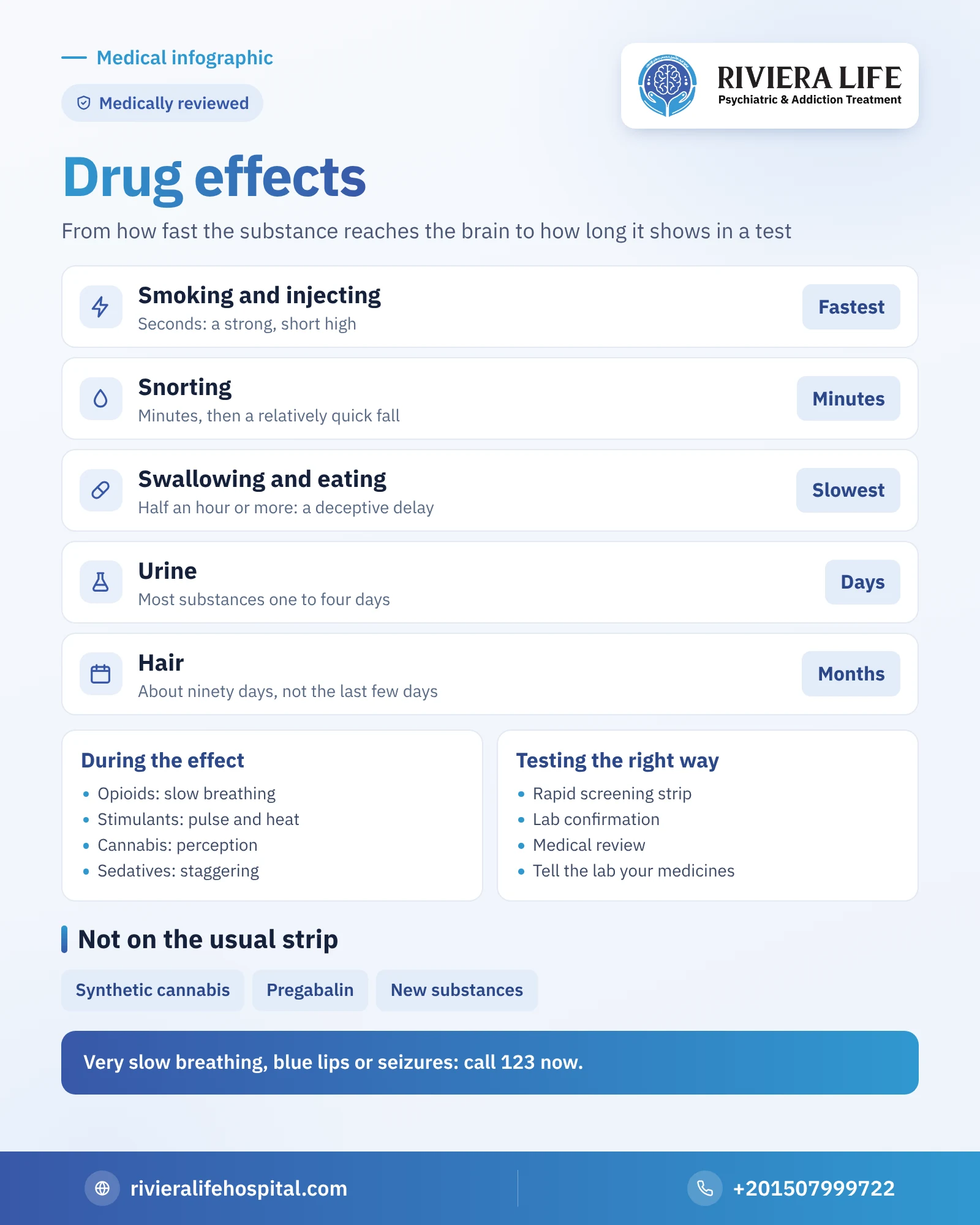
Drug effects begin the moment the substance reaches the brain: within seconds with smoking and injecting, and after half an hour or more with swallowing. There the substance imitates natural chemical messengers or amplifies their release, so dopamine rises and awareness and mood change. Opioids and sedatives slow breathing and attention, stimulants raise the pulse and temperature, and cannabis changes perception and concentration. The feeling usually fades within hours, while the substance's by-products remain detectable in urine for days and in hair for months.
- Seconds to an hourThe onset of the effect depending on the route of use
- One to four daysThe detection window of most substances in urine
- About ninety daysThe range that hair testing reflects
Drug effects are everything the substance does to the brain and body from the moment it enters until the last trace of it disappears from the blood and urine. A mother asks about them after seeing her son laugh for no reason and then sleep for hours, and so does a wife whose husband stayed up three nights in a row. On this page we explain drug effects during use itself: how the substance works in the brain, the direct effect of each family, how long the effect lasts, the detection windows in urine, blood, saliva and hair, the reasons for false results, interactions with medicines, and the signs of poisoning that call for the ambulance. The harm that accumulates on the heart, liver and brain after months and years, however, has a separate section, The long-term harms of drugs.
How do drug effects happen in the brain at the moment of use?
The brain works through small chemical messages that pass between nerve cells, and each message has a receptor that fits it as a key fits its lock. A drug interferes in this language in one of three ways: either it resembles the natural messenger and takes its place, as opioids do with endorphin receptors; or it pushes the cell to release a huge amount of it, as shabu does with dopamine; or it blocks its reuptake so the messenger keeps working longer, which is what cocaine does.
The common factor in the effect of drugs on the brain is a sudden rush in the reward circuit, which the American National Institute on Drug Abuse (NIDA) describes as faster and stronger than what natural pleasures produce, so the brain records it as an experience worth repeating. You will find the details of this circuit on the page Dopamine, and in the article How drugs hijack the reward system.
Not all substances stimulate reward in the same way. Sedatives, alcohol and pregabalin strengthen the effect of the GABA messenger that calms cells, so relaxation, drowsiness and a heavy tongue come. Ketamine blocks glutamate receptors, so the person feels detached from their body and surroundings. That is why one user looks drowsy and another tense, unable to stop talking.
The route of use determines the speed and intensity of the effect
The effect of the same substance changes according to the path it takes to the brain: the faster it arrives, the sharper the peak, the harsher the fall and the quicker the attachment.
- 1Smoking and injectingA few seconds
The substance moves from the lung or the vein to the brain almost directly, so the high comes strong and short, and use repeats at close intervals to chase it.
- 2Snorting through the noseMinutes
The mucous membrane absorbs the substance at a medium speed, so the peak appears within minutes and falls after a relatively short time.
- 3Swallowing and eatingHalf an hour or more
The substance passes through the stomach and liver before the brain, so feeling it is delayed. This delay is deceptive, because some think the pills or the food mixed with hash "didn't work" and repeat the amount, then the effect comes doubled all at once.
Drug effects on the body during the high: each family separately
Here we mean drug effects during the hours when the substance is active, that is, what the user feels and what those around them see. Substances within the same family act on roughly the same receptors, and you will find each substance separately on the page Types of drugs.
Opioids and strong painkillers
Heroin, morphine, tramadol and codeine give warmth and loosening, then broken drowsiness in which the person nods off while sitting. The pupils narrow, breathing slows, and constipation and sometimes nausea occur. Tramadol in particular may cause seizures even in those who have never had them before. More about this family on the page Opioids.
Stimulants
Captagon, shabu and cocaine raise alertness, confidence and talkativeness, and drive away sleep and hunger. The pulse speeds up, blood pressure and temperature rise and the pupils widen, and irritability or suspicion of others may appear with continuous staying up. The effect of ice (shabu) is much longer than that of cocaine, which is why staying up with it stretches over days.
Natural and synthetic cannabis
The effects of drugs from the cannabis family such as hash and bango appear as a changed sense of time, laughter, hunger, red eyes and a faster pulse, with slow reactions and weak short-term memory. Acute anxiety or a panic attack may come instead of relaxation, especially with high-potency strains. Manufactured mixtures such as strox and voodoo, however, have nothing to do with the plant except the name, and their effect is stronger and unpredictable: stiffness, agitation and sometimes seizures.
Sedatives and misused nerve medicines
Benzodiazepines such as Xanax and Rivotril, and with them pregabalin and gabapentin, give calm, heavy speech, a staggering walk and gaps in memory. Their greatest danger usually doesn't appear on their own, but when they are combined with alcohol or opioids.
Hallucinogens, party drugs and alcohol
The paper drug and magic mushrooms change perception and colors, and the experience may turn into a terrifying "bad trip". Ketamine gives detachment from the body and numbness. Ecstasy combines stimulation with a feeling of closeness to others, with a dangerous rise in temperature when dancing for hours. Alcohol, however, starts by removing inhibition, then weakens judgment and balance, and may end in vomiting and loss of consciousness.
How long do drug effects last after use?
The duration of drug effects is not the same as how long they remain in the body: the first is the time the effect is felt, and the second is the time laboratories can detect the substance. These are approximate lengths of the effect, which change according to the amount, the route and tolerance:
Snorted cocaineLess than an hour
HeroinA few hours
Smoked hashTwo to four hours
Eaten hashSix hours or more
ShabuEight hours or more
HallucinogensUp to half a day
And the end of the high doesn't mean the body has returned to normal: after stimulants comes a crash, exhaustion and long sleep, and after sedatives slowed attention may extend to the next day.
How long do drugs stay in the body? Approximate detection windows
The liver breaks down most substances into by-products that leave with the urine, and tests usually look for these by-products. The table gives an approximate range for an adult, and is for medical understanding, not for getting around a test:
| The family | Urine | Blood | Saliva |
|---|---|---|---|
| Heroin and morphine | One to three days | Hours | One to two days |
| Tramadol | One to four days with a special strip | About a day | One to two days |
| Cocaine | Two to four days, longer with heavy use | Up to two days | One to two days |
| Amphetamine, captagon and shabu | One to four days | Up to two days | One to two days |
| Hash and bango | Days for a single use, and weeks with daily use | Hours to days | One to three days |
| Benzodiazepines | Days, and may extend to weeks with long-acting types | One to several days | One to two days |
| Alcohol | Up to about three days by testing its by-products | Hours | Hours |
Hair, however, keeps the trace of most substances for about ninety days in the usual sample close to the scalp, but it doesn't detect what happened in the last few days. And there are substances that don't show on the traditional strip at all, such as synthetic cannabis, pregabalin and many new substances, and they need targeted laboratory tests.
Why does the detection period differ from one person to another?
Two men who used the same substance on the same night may get two different results three days later, because how long it stays in the body is affected by factors, the most important of which are:
- Frequency of use: whoever uses daily accumulates the substance in their body, so the window lengthens a lot compared with someone who tried it once.
- The substance dissolving in fat: the active substance in hash is stored by fatty tissue and then released slowly, which is why cannabis tops the list of long-lasting substances.
- The liver and kidneys: weakness in either slows breakdown and excretion, as does advancing age.
- Test sensitivity: each strip or device has a minimum detection level, and anything below it shows negative despite a trace being present.
- Other medicines: some slow liver enzymes and so lengthen the substance's stay, and some speed them up.
There is no home method that speeds up the drug's exit in any meaningful way. Drinking excessive amounts of water does nothing but dilute the sample, which laboratories then consider an invalid sample, and it may cause a dangerous imbalance in blood salts.
Urine, blood, saliva or hair: what does each test detect?
Choosing the sample depends on the question being asked. Urine answers about use during the last few days, and is the most common in work and license tests. Blood answers what is present now, which is why the doctor asks for it in the emergency department when poisoning is suspected. Saliva is suitable for detecting very recent use. And hair draws the pattern of past months. Whatever the sample, the right path goes through these steps:
1
An initial test
A rapid strip that gives a result within minutes; it is a screening test, not a diagnosis.
2
Laboratory confirmation
A positive result is repeated with a precise device that identifies the specific substance and its amount.
3
Medical review
The doctor reads the result in light of the prescribed medicines, the symptoms and the medical history.
And if you want to get to know the types of strips and how to read them, the article A guide to drug testing and reading the strip has a practical explanation of that.
The false result: when the strip errs in both directions
The rapid strip relies on a reaction that may be fooled by substances that resemble the drug in their structure. We have known families whose home was turned upside down because of an unconfirmed initial result, and others who were reassured by a negative result while the son was using a substance the strip doesn't detect.
Common mistaken ideas
- A positive strip is conclusive proof of use.
- A negative strip means the person isn't using anything.
- A prescribed medicine can't change the result.
What medicine says
- An initial positive needs laboratory confirmation before any judgment.
- Modern manufactured substances and pregabalin aren't detected by the usual strip.
- Some cold medicines and antidepressants may give an initial positive, so tell the lab about your medicines.
"Which is more dangerous?" How to read comparisons between substances
Many readers' questions about drug effects are comparisons: tramadol or hash? Captagon or shabu? The honest answer is that danger isn't a single number. There is the risk of poisoning on the night itself, which is highest with strong opioids and adulterated substances; there is the speed of attachment, which is highest with substances that reach the brain quickly; and there is the difficulty of withdrawal, whose details are in the section Drug withdrawal symptoms. That is why we compare on more than one axis, and one of the clearest examples is the comparison of cocaine and amphetamine: the mechanism is similar, but the difference in the length of the effect completely changes the shape of the staying up and the crash.
When the drug meets medicines and chronic diseases
Drug effects are multiplied in a patient with heart disease, diabetes or epilepsy, and what we see most in emergencies are well-known interactions:
- Alcohol, sedatives, opioids and pregabalin together multiply the suppression of breathing, and this is the most dangerous combination of all.
- Tramadol with some antidepressants may cause serotonin syndrome or seizures.
- Stimulants with high blood pressure or arterial disease raise the risk of a heart attack and stroke.
- Alcohol in a diabetic may cause a sharp drop in blood sugar that resembles drunkenness itself.
Articles such as Pregabalin with alcohol discuss these interactions in detail, while mixing more than one substance and the accumulated harm it leaves belongs in the article The danger of mixing drugs. Any medicine dispensed to you should be under the supervision of a doctor who knows everything you take.
Drugs and sexual desire: the promise versus the truth
It is widespread among young men that tramadol delays ejaculation and that captagon increases pleasure. The truth is that some substances numb sensation or remove inhibition temporarily, then performance and desire decline with repetition and hormones are disturbed. We have set out the details for each substance in the article What drugs do to intimacy.
Signs of serious poisoning during the effect
Drug effects may turn from "a night out" into an emergency within minutes, so don't wait for him to "sleep it off" if you see one of these signs:
Call the ambulance on 123 immediately
These signs during the effect mean the body is exceeding its capacity to cope:
- Very slow or broken breathing, or strange snoring with no response to being called
- Bluish lips or extremities, with very narrow pupils
- Chest pain, a very fast pulse, or a high temperature with confusion
- Seizures, violent agitation, or hallucinations that make him a danger to himself
Until the ambulance arrives, lay the person on their side and don't leave them alone, don't give them coffee, and keep any box or strip you found. In cases of opioid poisoning, the medicine naloxone may save a life in the hands of a trained paramedic. You will find the overdose signs for each substance in the article Dealing with an overdose. You can also call the hotline of the General Secretariat of Mental Health and Addiction Treatment on 16328 for advice.
The drug effects article guide: staying in the body, comparisons and interactions
We have chosen the most important articles on drug effects and arranged them by your question: how long it shows in a test, a comparison between two substances, or an interaction with a medicine or a health condition.
Tests and how long painkillers and sedatives stay
10 articlesThe strip, confirmation and how long medicines and opioids show
- Types of drug tests and reading their results: the strip, confirmation and false results.
- Opioid detection windows: urine, blood, saliva and hair.
- How long heroin shows in a test: the days and the effect of repeated use.
- How long morphine stays after a dose: the difference between medical and other use.
- Tramadol showing in a test: and why it needs a special strip.
- How long pregabalin stays: samples and targeted testing.
- Lyrolin in blood and urine: the active substance and its detection windows.
- Gabapentin leaving the body: the role of the kidneys and the half-life.
- How long benzodiazepine medicines stay: short- and long-acting.
- How long alcohol stays in the body: breath, blood and urine by-products.
How long cannabis, stimulants and manufactured substances stay
12 articlesFrom hash to shabu and ketamine
- Why hash shows for so long: fat and repeated use.
- Marijuana in a test: urine, blood, saliva and hair.
- Bango and detection tests: the expected range for each sample.
- Spice and specialized tests: what they detect and what they don't.
- Does strox show in a test? The truth behind the strip.
- Chemical and test accuracy: why detection is sometimes impossible.
- Captagon in urine and hair: approximate detection windows.
- How many days shabu shows: urine, blood and hair.
- Amphetamine and the accuracy of its results: and false positive results.
- Cocaine by-products in samples: from days to months.
- Ecstasy and drug tests: how long it stays after the party.
- Detecting ketamine in the body: blood, urine and hair.
Comparisons between substances
8 articlesMechanism, effect and which is more dangerous
- Cocaine versus amphetamine: the heart, length of effect and the crash.
- Upper or downer: cocaine and heroin: the signs and the danger.
- Captagon against shabu: psychosis and speed of attachment.
- Heroin and hash: and does one lead to the other?
- Hash and marijuana: the source and the potency.
- Tramadol and morphine: which is stronger and which is more dangerous.
- Pregabalin or tramadol: the mechanism and the risks of combining them.
- Pregabalin and gabapentin: when each is suitable.
Special substances under the microscope
6 articlesThe adulterated, the new and the less known
- Fentanyl and counterfeit pills: why a tiny amount is enough for poisoning.
- What is in the pink tusi powder: an unpredictable mixture.
- Vape liquids mixed with cannabis: what parents need to know.
- GHB and drinks: its danger with alcohol.
- Hallucinogens and the bad trip: the types and the risk of psychosis.
- Methyl alcohol poisoning: the difference between it and ethyl alcohol.
Interactions with medicines and health conditions
3 articlesPregnancy, alcohol and sexual stimulants
- Combining pregabalin and alcohol: why there is no safe amount.
- Pregabalin during pregnancy: what we know about the fetus.
- Tramadol and Viagra together: the risks to the heart.
Drugs and intimacy
5 articlesDesire, performance and fertility
- A comprehensive look at drugs and sex: performance and fertility.
- The myth of delaying ejaculation with tramadol: what really happens.
- Hash and married life: men and women.
- Captagon and desire: erection and delay.
- Alcohol and sexual performance: desire and fertility.
Brain chemistry
3 articlesThe messengers drugs target
- The natural pleasure messengers: dopamine, serotonin and endorphins.
- Drive or calm: the difference between dopamine and serotonin.
- The brain's excitatory messenger: its connection to ketamine and alcohol.
When should you seek help?
If the question about drug effects and how long they stay in a test keeps coming up in your home, or you notice that a loved one needs the substance to calm down, to work or to sleep, this is a sign that the matter has gone beyond experimenting. You can review the signs the family notices, then look at the steps of addiction treatment from assessment to follow-up. At Riviera Life, a hospital licensed by the Egyptian Ministry of Health and working for fourteen years, the first step begins with a free and confidential consultation with a consultant in psychiatry and addiction treatment; call us on +201507999722.
Medical sources and referencesThe information in this article is based on reliable scientific sources