Schizophrenia symptoms don’t usually begin with a voice the patient suddenly hears, but with quiet changes that may last months: withdrawal, a decline in study or work, disturbed sleep, and suspiciousness that wasn’t part of the person’s character. Then clear psychotic symptoms appear, such as hallucinations, delusions and disorganized speech. This article explains the signs as the family sees them at each stage, and offers a checklist that helps you decide when to ask for an assessment. It is a list for observation, not diagnosis; schizophrenia is only diagnosed by a psychiatrist after a full assessment.
How does schizophrenia begin? The early phase
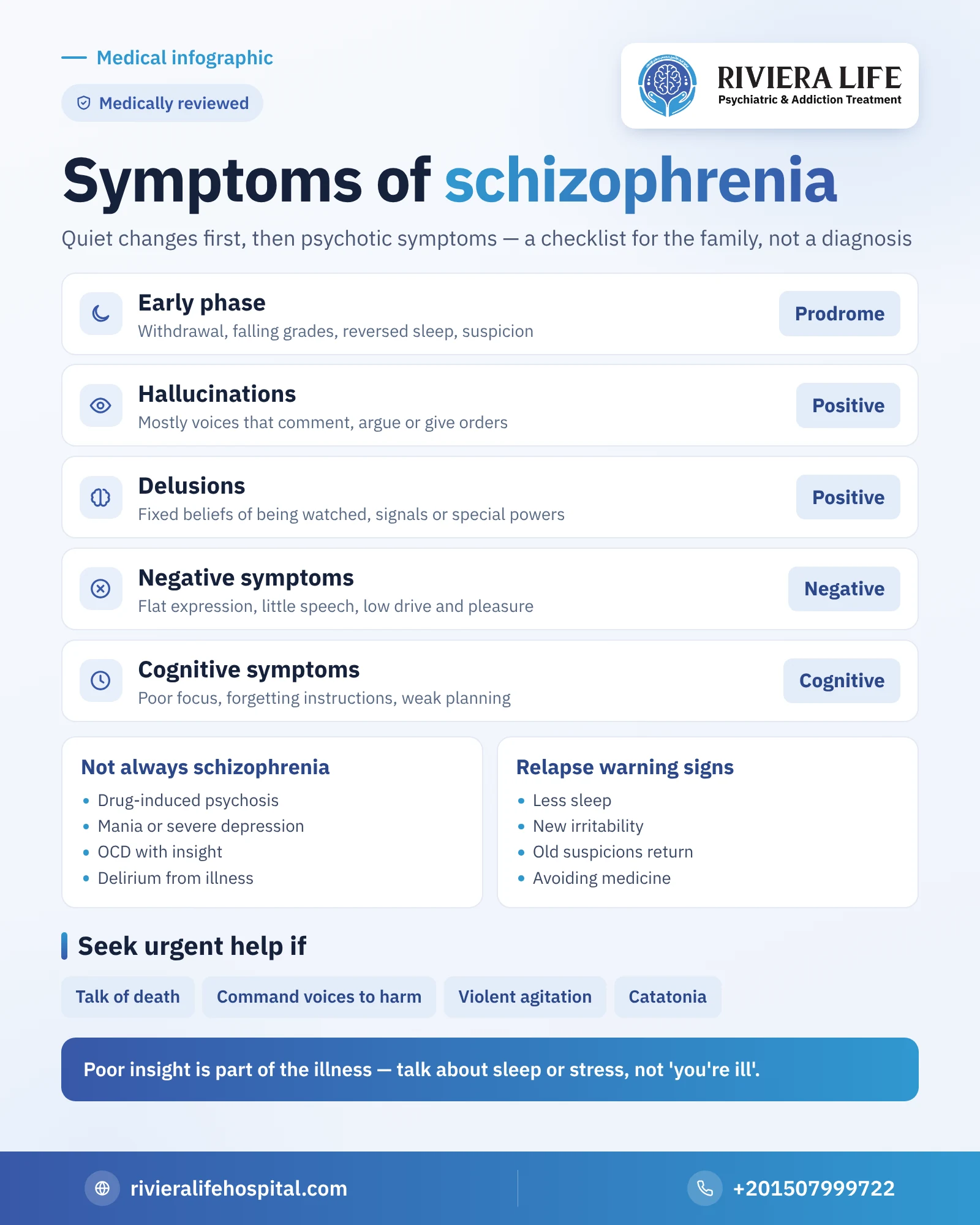
Doctors call the period that precedes the first psychotic episode the “prodromal phase”. It may last weeks or stretch to years, and in many homes it passes without anyone linking it to a psychiatric illness. A mother says her son “changed after secondary school”, and a father says his daughter “no longer goes out with her friends”. These simple observations are often the first thread.
The problem is that the signs of this phase aren’t specific; they resemble depression, the pressures of adolescence or the effects of using a substance. So they aren’t enough on their own to judge, but they deserve follow-up if they persist and accumulate.
Early signs the family may notice
- Gradual withdrawal from friends and relatives, and preferring to stay in his room for long hours.
- A clear drop in grades or work performance without an understandable reason.
- Reversed sleep times, or staying up until dawn without a specific activity.
- Neglecting bathing, changing clothes and tidying his space.
- Growing suspicion of others’ intentions, or a feeling that people are talking about him.
- A sudden preoccupation with religious, philosophical or supernatural ideas in a way unusual for him.
- Excessive sensitivity to sounds or lights, or complaining that things “look different”.
- Emotional reactions that don’t fit the situation, or clear indifference toward important events.
Positive symptoms: experiences added to reality
The word “positive” here doesn’t mean they are good, but that they are added experiences a person doesn’t usually go through. They are what attracts the most attention, and what responds most to antipsychotics.
Hallucinations
Perceiving something that isn’t there through any sense, the most common in schizophrenia being auditory hallucinations: one or more voices commenting on what the person is doing, conversing about him, criticizing him or giving him orders. The family may notice that he talks to himself or laughs for no apparent reason, turns as if someone called him, or constantly wears headphones to silence what he hears. Visual or tactile hallucinations are less common in schizophrenia, and their clear appearance prompts the doctor to look for other causes. For the wider picture, see hallucination symptoms.
Delusions
Firm beliefs the person doesn’t budge from despite clear evidence to the contrary, and which his cultural surroundings don’t share. Examples include his certainty that some party is watching him or planning to harm him, that a broadcaster is sending him signals, that his thoughts are being pulled from his head or broadcast to people, or that he carries a special message or powers. The difference between a delusion and a strange opinion is the degree of certainty and its effect on behavior.
Disorganized thinking and speech
Talk moves from one idea to another without a clear link, he answers a question with words far from it, or stops suddenly in the middle of a sentence as if the thought was cut off. In severe cases speech may become almost incomprehensible.
Disorganized behavior and catatonia
Unexpected actions that don’t fit the situation, such as wearing heavy winter clothes in summer, or agitation for no reason. In some cases catatonia appears, meaning staying fixed in one position for a long time, complete silence, or resisting any movement, a symptom that needs urgent assessment.
Negative symptoms: what fades gradually
These symptoms are less noisy, but they are often the heaviest on the life of the patient and his family, and are wrongly interpreted as laziness or bad manners:
- Blunted expression: a face with little emotion, a monotonous voice and limited eye contact.
- Poverty of speech: very short answers with little content.
- Weak will: difficulty starting or finishing any activity, even simple things.
- Loss of pleasure: he doesn’t enjoy what he used to love.
- Social isolation: he doesn’t seek out people or care for their company.
Cognitive symptoms
They affect the way information is processed: difficulty focusing on a lecture or a conversation, forgetting instructions shortly after hearing them, slowness in understanding, and inability to plan an ordinary day. The family may not notice them until the person stumbles in study or work he used to do easily. They are among the most important factors determining his ability to return to his life, which is why rehabilitation addresses them within schizophrenia treatment.
Poor insight: why doesn’t the patient see that he is ill?
One of the hardest things families face is that the patient often rejects the idea that he is ill at all. In most cases this isn’t stubbornness, but part of the disorder itself that affects the brain’s ability to assess its own state. So telling him “you’re ill” usually doesn’t help; it is more useful to talk about things he acknowledges himself: lack of sleep, tension, or his distress at the voices, and suggest a visit to the doctor to help with them.
Do the symptoms differ between men, women and teenagers?
The core symptoms are the same, but the picture differs slightly. In men the illness tends to start earlier, and negative symptoms may be more prominent. In women onset usually comes in the late twenties, and mood symptoms may be clearer. In teenagers it is hard to tell at first, because withdrawal, irritability and falling grades are common at this age for many reasons, and the most important sign here is a clear change from the usual personality, and its persistence.
Symptoms that resemble schizophrenia but aren’t
Not everyone who hears voices or holds strange ideas has schizophrenia. Among the most important things the doctor rules out:
- Drug-induced psychosis, especially from stimulants such as shabu and ice, and high-potency hashish. See the harms of methamphetamine.
- Episodes of mania or severe depression accompanied by psychotic symptoms.
- OCD, when the thoughts are distressing but the person realizes their strangeness, a difference we explain in OCD and psychosis.
- Delirium caused by a physical illness, fever or medicine, which is usually sudden with clouded consciousness.
Signs of relapse in a patient receiving treatment
If your relative is diagnosed and stable, there are signals that usually precede relapse by days or weeks: less sleep than usual, new irritability or anxiety, the return of suspicion or talk of old topics that preoccupied him in the previous episode, sudden withdrawal, and avoiding medicine or appointments. Contacting the doctor at this stage may prevent a full episode.
A checklist for the family: when should you ask for an assessment?
These questions don’t diagnose schizophrenia, but if you answer yes to more than one and it has continued for weeks, a psychiatric assessment is a step worth taking:
- Has the person changed clearly from his nature in recent months?
- Has he moved away from his friends and family for no reason anyone knows?
- Has his performance in study or work declined noticeably?
- Does he talk about voices, surveillance or a conspiracy?
- Has his speech become hard to understand or broken in its ideas?
- Has he noticeably neglected his hygiene, food and sleep?
- Has there been use of drugs coinciding with these changes?
When do the symptoms become an emergency?
Seek urgent help immediately if you see
Call an ambulance on 123 or go to the nearest emergency department, and stay close to the person until help arrives.
- Talk of death or self-harm
- Voices ordering him to harm himself or others
- Threats or violent agitation that can’t be calmed
- Refusing food and drink for days
- Catatonia or complete silence with no response
You can also ask for guidance from the General Secretariat of Mental Health hotline on 16328.
How can Riviera Life help you?
If you have observations that worry you, you can start with a free first consultation with a psychiatry consultant at Riviera Life, even before your relative is convinced to attend. We listen to what you have seen, guide you to the best way of persuading him, and explain the next step in complete confidentiality. For the full picture of the illness, go back to our schizophrenia guide.
More from our schizophrenia guide
- Schizophrenia: the complete guide
- Causes of schizophrenia and risk factors
- Types of schizophrenia between the old and new classifications
- Schizophrenia treatment and the relapse prevention plan
- Psychosis: the complete guide
- Delusions of grandeur: how they differ from confidence and narcissism, their causes and treatment
- Schizophrenia vs split personality: a common myth and a medical fact
- Dissociative identity disorder: what is it, and how does it differ from schizophrenia?
- Psychosis vs schizophrenia: symptom or illness, and how does the doctor find the cause?
- Schizophrenia vs bipolar disorder: a comparison table and how the doctor tells them apart
Questions many people ask
Hallucinations are often not the first thing to appear, but withdrawal, decline in study or work, disturbed sleep and suspiciousness. These signs aren't specific and may have other causes, but their persistence calls for an assessment.
Not necessarily. Auditory hallucinations may occur with drugs, sleep deprivation, mood disorders or physical illnesses. The psychiatrist is the one who determines the cause after an assessment.
Positive symptoms are added experiences such as hallucinations and delusions, and negative symptoms are a loss of abilities that used to exist, such as emotional expression, motivation and speech. Each group has a different effect on daily life and treatment.
Poor insight is part of the disorder itself in many patients, not stubbornness. Talking about problems he does acknowledge, such as insomnia or tension, makes it easier to persuade him to see a doctor.
Medical criteria require signs of the disorder to persist for at least six months, including an active period of psychotic symptoms, with a decline in functioning. Shorter periods are usually diagnosed as other disorders of the same spectrum.
Many patients aren't aware of their illness, especially in active episodes, because poor insight is part of the disorder, not stubbornness. Insight usually improves with regular treatment and calmer symptoms, and with a calm approach from the family that doesn't confront the patient with the words "you're ill".
Schizophrenia is a disorder of brain function with known genetic, biological and environmental causes, and it responds to medication and psychotherapy. There is no conflict between faith and treatment, but delaying the doctor in search of another explanation prolongs psychosis and makes recovery harder.