Psychosis is a state in which a person’s connection with reality weakens, so they hear or see what doesn’t exist, or hold on to ideas that no one shares with them and that evidence doesn’t shake. It isn’t a single illness, but a syndrome that may have behind it schizophrenia, bipolar disorder, severe depression, a drug, an organic illness or even childbirth.
In most cases it can be treated, and the earlier treatment begins after the first episode, the better the results. This page explains what psychosis is, how to recognize its beginnings, what its causes are, how it is treated, and when it becomes an emergency. The diagnosis in the end belongs to the psychiatrist alone, so what you read here is for understanding, not for judging yourself or others.
What is psychosis? A syndrome, not a single illness
The word psychosis describes a state, not a final diagnosis, just as the word “fever” describes a rise in temperature without telling you its cause. When the doctor says the patient is going through a psychotic episode, they mean that their thinking and perception have become detached from reality to a degree that affects their judgment and behavior, and then the most important task begins: looking for the cause. The episode may be the beginning of schizophrenia, part of a manic episode, the effect of repeated doses of shabu, or an inflammation of the brain that needs a neurologist before a psychiatrist.
This difference isn’t a linguistic detail. Someone who hears that their relative “has psychosis” may think that a verdict of a lifelong chronic illness has been handed down, while some types of psychosis disappear completely within days or weeks when their cause is treated. Others need long-term treatment, but it is successful treatment in many cases.
How common is psychosis?
The US National Institute of Mental Health states that roughly 3 in every 100 people will go through a psychotic episode at some stage of their lives. The first episode usually appears between late adolescence and the mid-twenties, the years of university and the start of work and marriage, which is why academic and working life is severely affected if treatment is delayed. Psychosis can occur at any age; in older adults it is linked more to dementia, organic illnesses and medicines, and in mothers it may appear in the first weeks after birth.
Positive and negative symptoms of psychosis
Doctors divide the symptoms of psychosis into two main groups, and each has a different impact on the family.
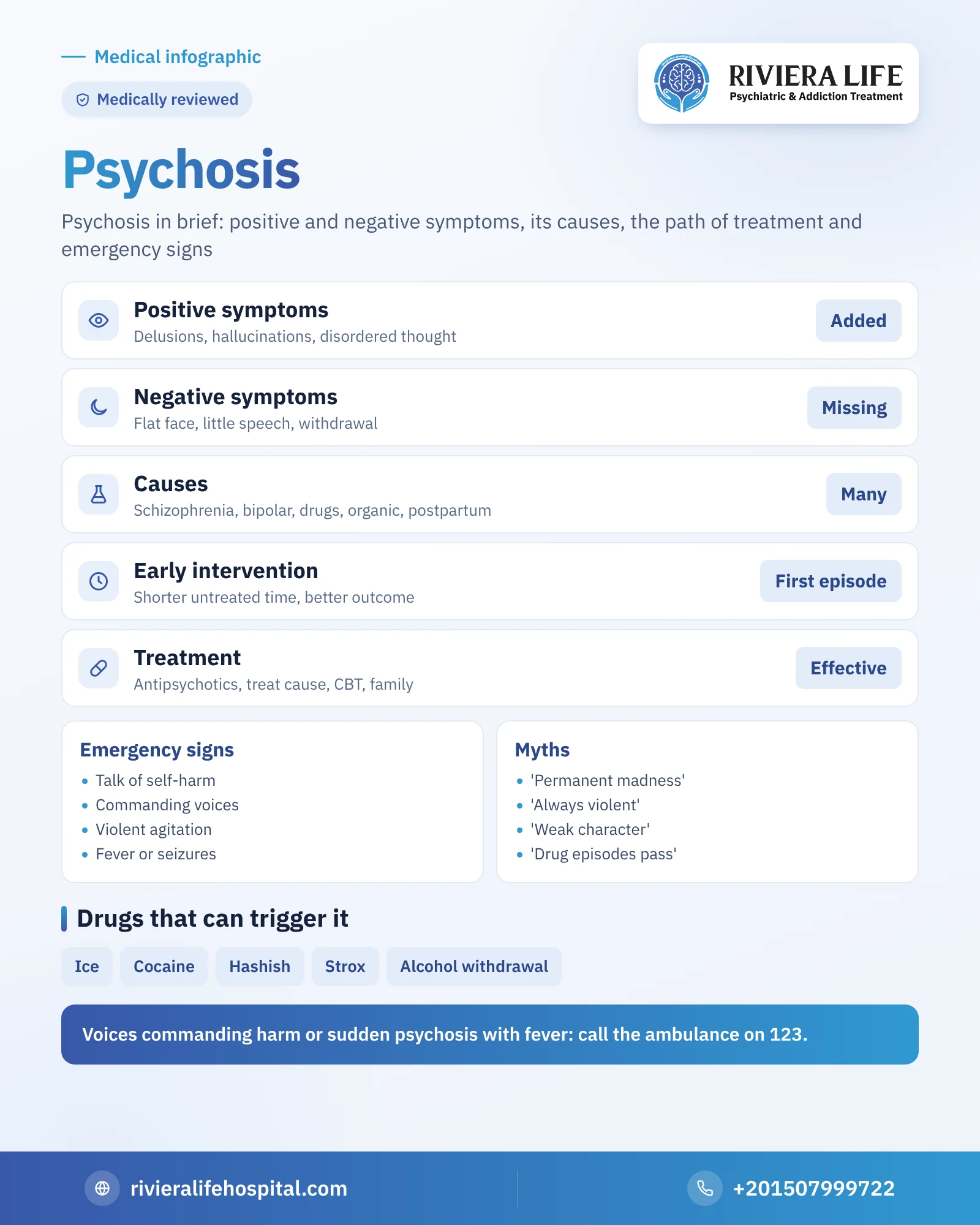
Positive symptoms: what is added to experience
- Delusions: firm convictions not supported by reality, such as certainty that the neighbors are conspiring against them, that they have been charged with a great mission, or that their body is rotting from the inside.
- Hallucinations: perception without an external source, the best known being hearing voices that comment, command or accuse.
- Disordered thinking and speech: jumping from one idea to another without a link, or answers unrelated to the question.
- Disorganized behavior: strange actions or agitation without an understandable reason, or on the contrary rigidity and ceasing to move.
Negative symptoms: what fades and disappears
These are the least eye-catching and the most misunderstood: a face with little expression, a monotonous voice, little speech, loss of the desire to start anything, withdrawal from friends, and neglect of personal hygiene. Many families read these signs as laziness or rebellion, while they are part of the illness. Both groups are sometimes accompanied by weak concentration and memory that make studying or working exhausting.
Before the clear episode, weeks or months often pass that doctors call the prodromal phase: vague anxiety, disturbed sleep, declining performance, and a feeling that the world has “changed” in a way the person can’t explain. Catching this phase opens a door to intervention before the symptoms intensify.
Psychosis and hallucination: what’s the difference?
Many confuse the two words. A hallucination is a single symptom, a sensory experience without a source, and it may occur without psychosis at all: on waking or just before sleep, with high fever, in grief for someone who has died, or with poor eyesight in the elderly, and its owner then knows that what they see isn’t real. Psychosis, however, is a wider state in which the person loses the ability to distinguish, and it may occur without any hallucination, as when it is limited to firm delusions of persecution. That is why we have dedicated a separate guide to hallucination that follows it as a symptom with its many causes on the hallucination page, while this page focuses on the complete state, its causes and how to deal with it.
Types and causes of psychosis
The first question the doctor asks in the face of any psychotic episode: what is behind it? The best-known answers:
Schizophrenia and its spectrum disorders
The best-known cause of chronic psychosis. It is characterized by symptoms continuing for at least six months with a clear decline in functioning, and negative symptoms come to dominate over time. The spectrum also includes brief psychotic disorder, which disappears within less than a month, and delusional disorder, in which a single firm idea dominates while the rest of thinking remains relatively intact. The details are in the schizophrenia guide.
Bipolar disorder
In severe manic episodes the patient may believe they have exceptional abilities, wealth or a mission, and their sleep drops to a few hours without tiredness. Psychosis may also appear in their severe depressive episodes. The psychosis usually disappears as mood stabilizes. Read more in the bipolar disorder guide.
Psychotic depression
A severe depressive episode accompanied by delusions in keeping with the dark mood, such as certainty of having committed an unforgivable sin or of having a fatal illness, and it is among the most dangerous states because of the high risk of self-harm in it.
Drug-induced psychosis
Stimulants such as shabu (ice) and cocaine, hashish especially in high concentrations, and synthetic cannabinoids such as strox can cause a psychotic episode with hallucinations and suspicion, sometimes in people who have never had any psychological problem before. Psychosis also occurs during severe withdrawal from alcohol or sedatives.
Medical and organic causes
The delirium accompanying severe infection, epilepsy, brain tumors and inflammation, thyroid disorders, lupus, vitamin B12 deficiency, dementia, and some medicines such as high doses of cortisone. These causes in particular are what make physical examination and tests an indispensable step.
Postpartum psychosis
A rare condition affecting about one mother in every thousand births according to the UK’s National Health Service, usually beginning within the first two weeks after birth: severe insomnia, sharp mood swings, confusion, and strange thoughts concerning the baby. It is a medical emergency that needs assessment the same day, and most mothers recover completely with treatment.
The first psychotic episode: why does early intervention make the difference?
Research consistently shows that the length of time the patient spends in psychosis without treatment is linked to slower recovery and weaker results in the long term. Even so, many are delayed for months, and sometimes years, because the family waits for “the phase to pass”, tries non-medical solutions first, or fears what people will say.
That is why many health systems adopt specialized first-episode programs, bringing together in a single team the psychiatrist, the psychotherapist, family support and help returning to study or work, with the lowest effective medication dose. The practical message for the family is simple: don’t wait for the picture to be complete, as an early assessment does no harm even if the matter turns out to be simpler than you feared.
How is psychosis diagnosed?
There is no test that detects psychosis directly. The doctor starts with a detailed interview with the patient and their family about the symptoms, their onset and development, the psychiatric and family history, and medicines and drugs. Then comes the role of examinations: general blood tests and thyroid function, a drug test, and they may request a brain scan or EEG if neurological signs appear or the onset was sudden and unusual. The aim of these steps is to rule out organic causes, then determine whether the psychosis is part of schizophrenia or a mood disorder, or results from a substance. The final diagnosis may only become clear after weeks or months of follow-up.
Treatment of psychosis: an overview
Treatment depends on the cause, but it has common pillars:
- Antipsychotics: they ease delusions, hallucinations and disordered thinking, and are chosen according to the case and their side effects, with the doctor alone determining their type and duration.
- Treating the cause: mood stabilizers in bipolar disorder, antidepressants with antipsychotics in psychotic depression, stopping the drug completely in substance-induced psychosis, and treating the organic illness if there is one.
- Psychotherapy: cognitive behavioral therapy adapted for psychosis helps the patient deal with voices and worrying thoughts and reduce their effect.
- Family intervention: sessions that teach the family the nature of the illness, ways of communicating and the signs of relapse.
- Hospital admission: when there is a danger to the patient or others, complete refusal of food, or when treatment at home isn’t feasible.
Psychosis and addiction: when the two problems intertwine
Drug-induced psychosis usually calms within days to weeks of stopping, but it isn’t considered a passing matter that can be ignored. A not insignificant proportion of those who go through it are later diagnosed with schizophrenia or bipolar disorder, especially with hashish at an early age and continued use. On the other hand, some people with a psychotic disorder resort to drugs to calm anxiety or voices, so their episodes increase and their response to medicine weakens.
That is why the two disorders are treated together in a single plan known as dual diagnosis treatment. And if suspicion and mistrust began with substance use, the article on the hashish addict and suspicion explains this picture in particular, and you will find the effect of shabu on the mind in the harms of ice and on the methamphetamine page.
The family’s role in the journey of recovery
The family is the one who notices the change first, and who stays by the patient’s side after they leave hospital. Among what makes a real difference:
- Talking calmly in short sentences, and avoiding arguing about whether the delusion is true, while acknowledging the fear or distress they feel.
- Reducing criticism and blame at home, as a charged atmosphere is linked to more relapse.
- Keeping up with the medicine and appointments without turning the matter into humiliating surveillance.
- Writing down the patient’s own early warning signs, such as less sleep or returning to isolation, and contacting the doctor as soon as they appear.
- Keeping drugs and alcohol out of the home as far as possible, as they are among the strongest triggers of relapse.
- Family members asking for support for themselves too, as long-term care is exhausting.
Common myths about psychosis
The myth: psychosis means permanent madness. The truth: many episodes disappear completely, and most patients stabilize with treatment and follow-up.
The myth: someone with psychosis is necessarily violent. The truth: most of them aren’t violent, and they are more likely to be harmed than to harm others, with the risk rising with untreated psychosis and substance use.
The myth: psychosis is caused by weak character or upbringing. The truth: it is a medical condition in which genetic, biological and environmental factors overlap, and it isn’t made by a moral failing of the patient or their family.
The myth: a drug episode ends when the drug’s effect ends, so there is no need for the doctor. The truth: it may last for days, and may reveal a predisposition to a longer psychotic disorder, and it needs assessment and follow-up.
The psychosis guide: each aspect in a separate article
We have dedicated separate articles to the most prominent forms of psychosis, going deep into each:
- Paranoia: the spectrum of suspicion from exaggerated caution to the delusion of persecution, the difference between paranoid personality, delusional disorder, schizophrenia and drugs, and how to talk to a suspicious relative.
- Delusions of grandeur: when self-confidence turns into a delusion, how it differs from narcissism, and its appearance in mania, schizophrenia and with stimulants.
- Psychotic depression: severe depression accompanied by delusions of guilt, illness and poverty, and why it needs urgent intervention and different treatment.
For the wider picture, also see the guides to schizophrenia and hallucination.
When is psychosis an emergency?
Some episodes can’t wait for a clinic appointment, especially if the onset was sudden or coupled with danger.
Seek urgent help immediately if any of these appear
Call the ambulance on 123 or go to the nearest emergency department, and stay with the person until help arrives.
- Talk of self-harm or ending their life
- Voices ordering them to harm themselves or others, and they seem to be responding to them
- Threats or violent agitation towards those around them
- Sudden psychosis with fever, clouded consciousness or seizures
- Psychosis after using a stimulant, with chest pain or very high temperature
- A mother in the first weeks after birth showing strange thoughts or severe confusion
Move sharp tools and medicines away from the place, and avoid cornering them or shouting at them. You can also seek guidance from the hotline of the General Secretariat of Mental Health and Addiction Treatment on 16328 or 0220816831.
When should you ask for help?
If you notice a change lasting two weeks or more in sleep, behavior and speech, or new, unexplained suspicion, or strange ideas the person holds on to, this is the time for an assessment, not for waiting. At Riviera Life in Sheikh Zayed, the consultant psychiatrists assess the psychotic episode and look for its cause in complete confidentiality, with round-the-clock medical supervision when admission is needed, and the first consultation is free. Contact us at any time via +201507999722.
Medical sources and referencesThe information in this article is based on reliable scientific sources