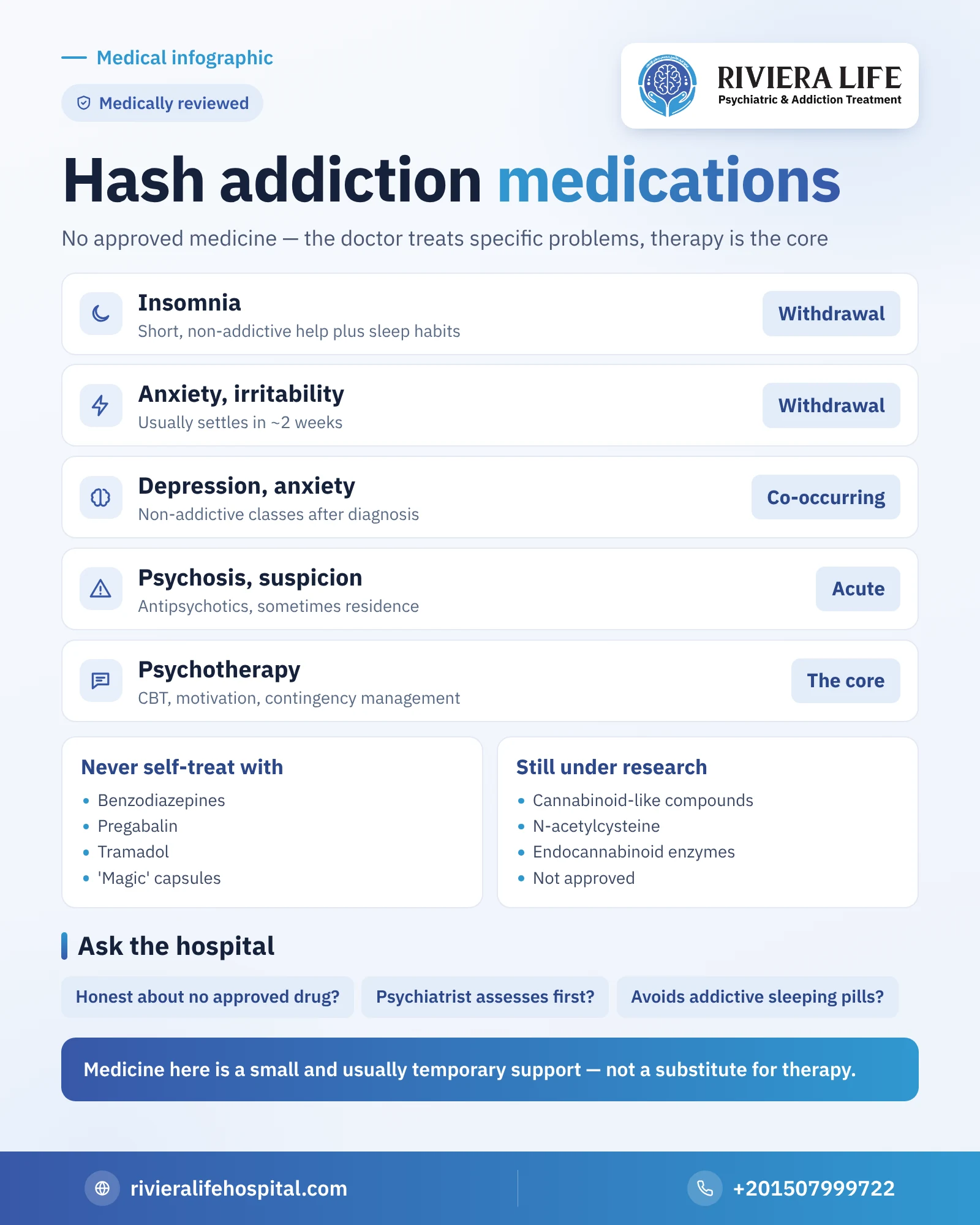
If you are looking for hash addiction medications, the honest answer is that there is to this day no medicine approved specifically to treat cannabis use disorder, neither in Egypt nor by the major drug agencies in the world. Even so, doctors do actually prescribe medicines for hash patients, but for specific goals: disturbed sleep in the first weeks, anxiety and irritability that push toward going back, or depression or psychosis that was hiding behind the smoke.
This article explains what the doctor may prescribe and why, what is still under research, and why psychotherapy remains the core, without any doses, because choosing the medicine is an individual decision the doctor makes after examination.
Why is there no approved medicine for hash addiction?
The medicines that succeed with opioid addiction work on the same receptor the substance works on, so they block the way to craving and withdrawal. Researchers tried to repeat this idea with cannabis for years, and tested dozens of compounds in controlled studies, but none of them proved a clear and consistent benefit sufficient for approval as a general treatment. Part of the reason is that the cannabinoid system in the brain takes part in many functions, including sleep, appetite, mood and pain, so intervening in it with a medicine may carry unwanted effects.
This fact doesn’t mean hash addiction has no treatment, but that treatment goes along a different road: structured psychotherapy, and helping medicines used only when needed. And any advertisement for a “capsule” or “injection” that cuts the craving for hash for good is a commercial claim not based on evidence.
What does medicine treat, then?
The doctor prescribes medicine for a hash patient to treat a problem they see in front of them, not to treat the addiction itself. Most of what they encounter falls under three groups:
- Withdrawal symptoms: insomnia, disturbing dreams, irritability, anxiety and loss of appetite in the first weeks.
- Co-occurring disorders: depression, chronic anxiety or attention deficit disorder that was present before use or worsened with it.
- Acute conditions: severe panic attacks, pathological suspicion or hallucinations that appeared with heavy use.
The details of withdrawal itself, when it starts and how long it lasts, are in the article on hash withdrawal symptoms, and here we focus only on the role of medicine in it.
Insomnia medicines in the first weeks of stopping
Insomnia is the most frequent complaint, and the most dangerous for continuing. A young man who got used to smoking before sleep for years finds himself awake until dawn, so he tells himself that “one joint” will solve the problem. That is why the doctor may see that temporary help with sleep protects recovery at this stage.
The rule among specialist doctors is to prefer what doesn’t carry a risk of dependence, and for use to be short and of a defined duration, with a plan to organize sleep without medicine: a fixed wake-up time, reducing stimulants in the evening, and movement during the day. Many of them avoid addictive sleeping pills with addiction patients, because they may replace one problem with another.
Anxiety and irritability medicines
The irritability in the first days after leaving hash is real, and families witness it in the form of outbursts of anger for simple reasons. In most cases it calms within about two weeks with support and regular sleep, and doesn’t need medicine. But if it is severe or accompanied by anxiety that disrupts life, the doctor may choose a short-term treatment to ease it, and follow its effect closely.
The important difference here is between temporary withdrawal anxiety that goes away on its own, and an old anxiety disorder that the patient was “treating” with hash. The second needs an independent treatment plan, which we cover in the next section.
Treating co-occurring depression and anxiety
Many patients started hash to calm something inside them. When the hash stops, that thing appears clearly: persistent sadness, anxiety that doesn’t leave, or difficulty concentrating since childhood. Here the psychiatrist assesses the condition, and may prescribe an antidepressant or an anxiety medicine from the classes that don’t cause addiction, alongside psychotherapy.
The timing of diagnosis matters; some symptoms of depression improve on their own after weeks of stopping, so the doctor sometimes prefers to watch a little before starting, unless the symptoms are severe or accompanied by thoughts of self-harm, in which case there is no waiting.
When psychosis or pathological suspicion appears
Heavy use of hash, especially the strong kind, may be linked to psychotic symptoms in some people: a feeling of being watched, suspicion of family and friends, or hearing voices. In this case the psychiatrist prescribes antipsychotics to calm the symptoms and protect the patient, and hospital residence may be necessary for a period. Some of these cases go away after stopping, and some reveal a disorder that needs longer follow-up. The article on the hash addict and suspicion explains how these symptoms develop.
Medicines still under research
Studies are being conducted in several directions to reduce craving or ease withdrawal, including:
- Compounds that mimic the active substance of hash but in a controlled pharmaceutical form, with an idea close to the treatment of opioids.
- N-acetylcysteine, which showed mixed results in some studies on adolescents.
- Medicines that affect the enzymes of the internal cannabinoid system, still in experimental stages.
These are research, not approved treatments, and their results so far are insufficient to recommend them generally. No one should try them on their own after reading a news item or a post.
The danger of self-treating with sedatives, pregabalin or tramadol
Here the most dangerous mistake we see in Egypt happens. A young man decides to quit hash on his own, his sleep and nerves get tight, so he takes a sedative pill from a friend, a pregabalin capsule, or even tramadol “to get through the hard days”. The recurring result:
- Sedatives from the benzodiazepine family: cause rapid dependence, and their withdrawal may be more dangerous than the withdrawal from hash itself.
- Pregabalin: turns into an independent addiction in many, and its danger increases when mixed with other sedatives, as the article on the causes of pregabalin addiction explains.
- Tramadol: an opioid that carries physical dependence and a risk of seizures, and a harder path of addiction begins with it.
In this way the patient leaves one addiction to enter two. Any medicine used in withdrawal must be chosen by the doctor who determines its duration, and stopping or adjusting it must be by their decision.
Why is psychotherapy the core?
Because what keeps hash in the patient’s life isn’t the chemistry of withdrawal alone, but habits, places, company and feelings they escape from. The methods that have proven useful in studies are:
- Cognitive behavioral therapy: in it the patient learns to detect moments of risk and the thoughts that lead them to smoking, and to build alternative responses. You will find it explained in the article on cognitive behavioral therapy.
- Motivational interviewing: a dialogue that helps the hesitant person discover their personal reasons for change, instead of having them imposed.
- Contingency management: a system of tangible rewards for negative test results, which strengthens commitment in the first weeks.
It is best for these methods to come together, and for the family to take part in them when possible. Medicine comes here as support, not as a substitute.
The difference between this article and the article on hash addiction treatment
This article answers one question: what is the role of medicines? The complete treatment program with its stages and duration, when residence is necessary, and how a relapse prevention plan is built, is the subject of the article on hash addiction treatment. And medicine in this program is a small and usually temporary part.
How do you make sure medication treatment for hash addiction is managed safely?
The right hospital for hash addiction treatment is one that deals with medicines honestly: it doesn’t promise you a magic medicine, doesn’t fill the patient with sedatives, and puts psychotherapy at the center of the plan. Ask before you decide:
- Is the team frank with you that there is no approved medicine for hash addiction, or does it sell you a treatment that “cuts the craving”?
- Does a psychiatrist assess depression, anxiety and psychosis before prescribing any medicine?
- Does it avoid addictive sleeping pills and sedatives, and set a duration for any temporary medicine?
- Does it offer structured cognitive behavioral and motivational therapy, not general advice sessions?
- Can it deal with someone who mixes hash with pregabalin or tramadol?
- Is there a program for the family and follow-up after treatment ends?
And stay away from any place that guarantees you recovery at a specific rate or in a few days.
How Riviera Life meets these standards in hash addiction treatment
Here is how these criteria are met at Riviera Life:
- Official license: a hospital licensed by the Ministry of Health for psychiatry and addiction treatment.
- Specialist consultants: consultants in psychiatry and addiction treatment assess the condition before any medicine.
- Medicine only when needed: temporary medicines for sleep and anxiety, and treatment for co-occurring disorders after accurate diagnosis.
- Psychotherapy at the center: a cognitive behavioral and motivational program targeting hash habits and triggers.
- Long experience: fourteen years in addiction treatment and thousands of recovered cases.
- Continuous supervision: 24-hour medical follow-up for those who need residence.
- Complete confidentiality: the data of the patient and their family is protected.
- Family and aftercare: a program for the family and follow-up after discharge.
The first consultation is free, and contact is available around the clock via +201507999722; we are based in Sheikh Zayed, Giza.
More from the hash guide
- Hash: the complete guide
- Hash addiction treatment: stages and the duration of recovery
- Hash withdrawal symptoms and their duration
- The difference between hash and marijuana
Questions many people ask
No. No medicine has yet been approved specifically to treat cannabis addiction, and whatever is advertised with this description is a commercial claim. The doctor may prescribe medicines that ease specific symptoms only.
Don't do that. Some sleeping pills and sedatives cause rapid dependence, and only the doctor chooses what suits the case and determines the duration of use and how to stop it.
When the psychiatrist confirms the presence of depression or a persistent anxiety disorder not linked only to temporary withdrawal, or when symptoms are severe or accompanied by thoughts of self-harm.
Yes, many patients recover with a structured psychological program without any medicine, or with a short temporary medicine for sleep. Medicine becomes essential when there is an accompanying mental disorder.
Choose one with an official license, psychiatry and addiction consultants and structured psychotherapy, which uses medicines only when needed. Riviera Life in Sheikh Zayed meets these criteria with complete confidentiality and a free first consultation.